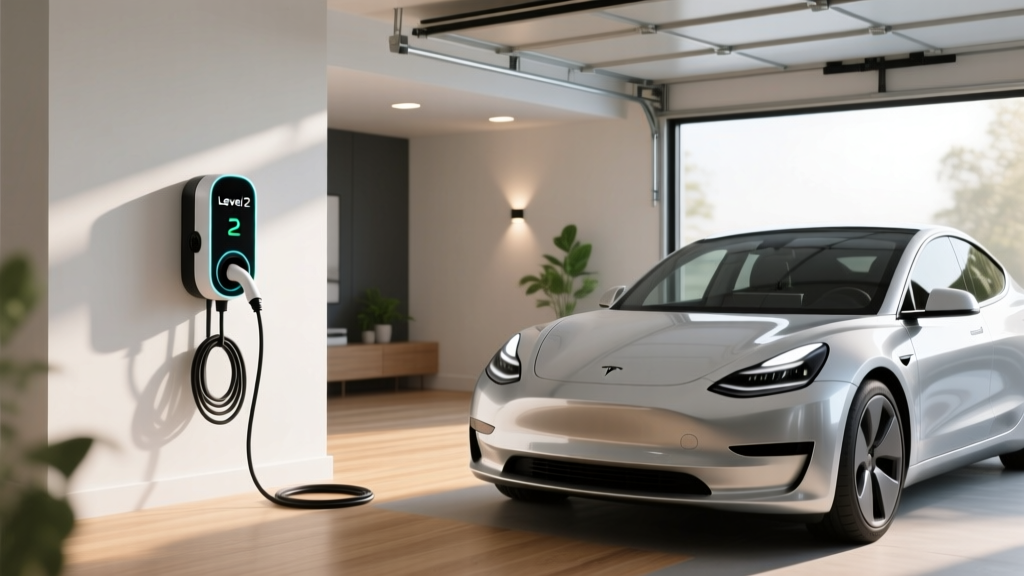
Most EV owners quickly outgrow the 120V wall outlet. A level 2 charger for home is the single highest-impact upgrade you can make for daily EV ownership — adding 25 to 44 miles of range per hour of charging, compared to the 3–5 miles per hour you get from a standard household plug. But choosing the right unit, understanding your home's electrical capacity, and budgeting for installation involves real specifics, not marketing gloss.
This guide walks through exactly what Level 2 charging requires, what it costs in 2026, which charger models deliver the best value, and how to avoid the panel-upgrade surprise that catches many older-home buyers off guard.
Charging Levels Explained: kW, Speed, and What Each Adds
Before picking hardware, clarify the three charging tiers. The critical distinction: kW (kilowatts) measures power — the rate of energy flow, like water pressure from a hose. kWh (kilowatt-hours) measures energy — the total amount stored in your battery, like gallons in a tank. A 48-amp Level 2 charger delivers up to 11.5 kW of power; your EV's 75 kWh battery holds 75 kWh of energy.
| Level | Voltage | Max Power (kW) | Miles of Range Added Per Hour | Typical Use |
|---|---|---|---|---|
| Level 1 | 120V AC | 1.4–1.9 kW | 3–5 mi/hr | Overnight trickle, PHEVs, low-mileage drivers |
| Level 2 | 240V AC | 3.3–19.2 kW | 14–64 mi/hr | Home daily charging, workplace, public AC |
| DC Fast (Level 3) | 200–800V DC | 50–350+ kW | 150–1,000+ mi/hr (peak) | Road trips, highway corridors |
The "miles per hour" figures assume roughly 3–4 miles per kWh of efficiency — typical for a midsize crossover like the Hyundai Ioniq 5 or Tesla Model Y. Heavier vehicles like the Ford F-150 Lightning will see fewer miles per hour at the same kW rate.
How Much Does It Cost to Install a Home EV Charger?
The total cost of a Level 2 home installation depends on three variables: the charger hardware, the electrical work, and your home's existing panel capacity. Here is a realistic 2026 breakdown based on national averages.
| Component | Low End | Typical | High End | Notes |
|---|---|---|---|---|
| Level 2 charger (hardware) | $300 | $500–$700 | $800–$1,200 | 32A–48A smart chargers; Wi-Fi enabled |
| Electrician labor | $400 | $800–$1,500 | $2,500+ | Depends on run length from panel to garage |
| Electrical permit | $50 | $100–$200 | $350 | Varies by municipality; required by NEC |
| Panel upgrade (if needed) | $0 | $0 | $2,000–$5,000 | Required if panel is 100A or near capacity |
| Conduit, wiring, misc. | $100 | $200–$400 | $800+ | Longer runs, underground conduit add cost |
| Total (no panel upgrade) | $850 | $1,600–$2,800 | $5,050 | |
| Total (with panel upgrade) | $2,850 | $3,600–$4,800 | $10,000+ |
The Panel-Upgrade Gotcha
Homes built before the 1990s often have 100-amp electrical panels. A 48-amp EV charger draws roughly 57 amps continuously (NEC requires circuits rated at 125% of continuous load, so a 48A charger needs a 60-amp breaker). If your panel is already running HVAC, an electric oven, a dryer, and other major loads near its limit, adding a 60A breaker may exceed capacity.
An electrician will perform a load calculation to determine whether your panel can handle the added circuit. If not, upgrading to a 200-amp panel typically costs $2,000–$5,000. Some homeowners opt for a lower-amperage charger (32A on a 40A breaker) to avoid the upgrade — this still delivers roughly 25 miles of range per hour, which covers most daily needs.
Another option gaining traction in 2026: smart load-management devices like the SPAN Drive or Emporia V2 with load sharing can dynamically throttle charger amperage based on real-time household consumption, allowing a high-power charger to coexist with a 100A panel without a full upgrade.
Electrical Requirements for a Level 2 Charger
A Level 2 charger requires a 240-volt dedicated circuit — the same voltage as your electric dryer or oven. Here are the specific electrical parameters:
- Voltage: 240V (split-phase, standard US residential)
- Amperage: 32A to 48A continuous draw (requiring a 40A to 60A breaker, per NEC 125% continuous-load rule)
- Wire gauge: 6 AWG copper for 48A (on a 60A breaker); 8 AWG for 32A (on a 40A breaker)
- Circuit type: Dedicated — no shared outlets on the same breaker
- GFCI protection: NEC 2023 and later require GFCI protection for EV charging outlets (625.54). Some chargers include built-in GFCI, which can eliminate the need for a GFCI breaker — consult your electrician.
- Outlet type: NEMA 14-50 (most common, 50A) or NEMA 6-50 (240V only, no neutral). Hardwired installations bypass the outlet entirely and allow up to 48A/60A.
Hardwired vs. Plug-In: Which Should You Choose?
Plug-in (NEMA 14-50): Portable — you can take the charger when you move. Limited to 40A continuous (48A peak breaker) because NEC caps plug-in loads at 80% of the receptacle rating. Ideal if you may relocate or want flexibility.
Hardwired: Permanently connected to your panel via a junction box. Supports up to 48A continuous (60A breaker). No outlet to degrade or overheat. Required for the highest-power residential chargers. Less portable but more robust for long-term installations.
Connector Compatibility: NACS, CCS, and CHAdeMO
The connector landscape shifted significantly between 2023 and 2026. Tesla's North American Charging Standard (NACS) is now the dominant connector for new EVs sold in North America. Here is where each brand stands:
| Connector | Brands Using It (2026) | Notes |
|---|---|---|
| NACS (Tesla standard) | Tesla, Ford, GM, Rivian, Volvo, Polestar, Mercedes-Benz, Nissan, Honda, Fisker, Lucid, BMW | Adopted by most major OEMs starting 2025. Smaller, lighter plug. |
| CCS1 | Hyundai, Kia, Genesis (some models), Volkswagen, Stellantis/Jeep, legacy models | Still common on 2023–2024 models; transitioning to NACS for 2025+. |
| CHAdeMO | Nissan Leaf (discontinued 2025), Mitsubishi Outlander PHEV (older) | Effectively legacy; no new vehicles sold with CHAdeMO in 2026. |
For home Level 2 charging, the connector on your charger must match your vehicle's inlet. If you drive a 2025+ Ford Mustang Mach-E or a 2026 Chevrolet Equinox EV, you need a NACS-connector home charger. If you own a 2024 Hyundai Ioniq 5 (which still shipped with CCS1), you need a CCS/J1772-connector charger — or you can use a NACS-to-CCS adapter for DC fast charging at Tesla Superchargers, though that adapter is not needed for Level 2 AC home charging.
Most Level 2 home chargers sold in 2026 ship with a J1772 connector (the AC standard that fits CCS1 vehicles natively and NACS vehicles via the adapter included with most new NACS EVs). Tesla's Wall Connector ships with NACS natively and includes a J1772 adapter in the box.
How Much Does Charging Cost Per Mile vs. Gas?
Home Level 2 charging is where EV ownership economics shine — but the numbers depend heavily on your local electricity rate and whether you can charge during off-peak hours.
| Scenario | Rate | Vehicle Efficiency | Cost Per Mile |
|---|---|---|---|
| Home Level 2 (off-peak, $0.09/kWh) | $0.09/kWh | 3.5 mi/kWh | $0.026/mi |
| Home Level 2 (standard, $0.16/kWh) | $0.16/kWh | 3.5 mi/kWh | $0.046/mi |
| Home Level 2 (peak/TOU, $0.30/kWh) | $0.30/kWh | 3.5 mi/kWh | $0.086/mi |
| Public Level 2 (network, $0.35/kWh) | $0.35/kWh | 3.5 mi/kWh | $0.100/mi |
| DC Fast Charging ($0.48/kWh avg) | $0.48/kWh | 3.5 mi/kWh | $0.137/mi |
| Gas vehicle (28 MPG, $3.40/gal) | $3.40/gal | 28 mi/gal | $0.121/mi |
| Gas vehicle (22 MPG, $3.40/gal) | $3.40/gal | 22 mi/gal | $0.155/mi |
At off-peak home rates, Level 2 charging costs roughly $0.03 per mile — about one-quarter the cost of fueling a 28 MPG gas car. Even at standard residential rates ($0.16/kWh national average per EIA data), home charging remains substantially cheaper than gasoline.
However, frequent DC fast-charging at public networks ($0.48/kWh average in 2026) can push EV fuel costs above those of an efficient gas car. This is why a home Level 2 charger isn't just a convenience — it's the economic foundation of EV ownership.
Time-of-Use Rates: Schedule Charging for Savings
Most utilities offer Time-of-Use (TOU) plans that discount electricity during overnight hours (typically 10 PM–6 AM). A smart Level 2 charger with scheduled charging can automatically begin charging at off-peak rates. Over a year of 12,000 miles, the difference between peak ($0.30/kWh) and off-peak ($0.09/kWh) rates amounts to roughly $720 in savings.
Charging Time Examples: 10–80% by Battery Size
Most EV owners charge between 10% and 80% State of Charge for daily use — charging above 80% slows dramatically on most battery chemistries (especially NMC) to protect long-term cell health. Here is how long a 10–80% session takes on common battery sizes with a 48A (11.5 kW) Level 2 charger:
| Vehicle Example | Usable Battery (kWh) | 70% Charge Energy (kWh) | Time at 11.5 kW |
|---|---|---|---|
| Chevrolet Equinox EV (2026) | 85 kWh | 59.5 kWh | ~5 hrs 10 min |
| Tesla Model Y Long Range | 75 kWh | 52.5 kWh | ~4 hrs 35 min |
| Hyundai Ioniq 5 (77.4 kWh pack) | 77.4 kWh | 54.2 kWh | ~4 hrs 43 min |
| Ford F-150 Lightning (extended) | 131 kWh | 91.7 kWh | ~7 hrs 59 min |
| BMW i4 eDrive40 | 81.5 kWh | 57.1 kWh | ~4 hrs 58 min |
| Toyota Prius Prime (PHEV) | 13.6 kWh | 9.5 kWh | ~50 min |
For most daily commutes (30–50 miles round trip), you'll only need to replenish 10–15 kWh overnight — roughly 1–1.5 hours on a 48A Level 2 charger. Full 10–80% sessions are typically reserved for weekends or pre-road-trip preparation.
Best Level 2 Home Chargers for 2026
These recommendations are based on power output, build quality, smart features, cable length, connector options, and real-world reliability reporting. All units support 240V installation and are UL-listed or ETL-certified for safety.
Tesla Wall Connector (Gen 4, J1772 + NACS)
- Max output: 48A / 11.5 kW (hardwired, 60A breaker)
- Connector: NACS native; J1772 adapter included
- Cable length: 24 ft
- Smart features: Wi-Fi, firmware updates, Power Sharing (link up to 6 units on one circuit), Tesla app integration, access control
- Price: ~$475
- Best for: Tesla owners and NACS-vehicle households; best value-to-performance ratio
Emporia Vue V2 EV Charger
- Max output: 48A / 11.5 kW (hardwired) or 40A / 9.6 kW (NEMA 14-50 plug-in)
- Connector: J1772 (fits CCS1 natively, NACS with adapter)
- Cable length: 24 ft
- Smart features: Wi-Fi, energy monitoring (pairs with Emporia Vue whole-home panel monitor), solar-integration scheduling, load management, TOU scheduling
- Price: ~$400 (charger only); ~$650 with Emporia Vue panel monitor
- Best for: Solar owners, budget-conscious buyers, homes needing load management
ChargePoint Home Flex (2nd Gen)
- Max output: 50A / 12 kW (hardwired, 60A breaker) — adjustable down to 16A
- Connector: J1772 (fits CCS1 natively, NACS with adapter)
- Cable length: 23 ft
- Smart features: Wi-Fi, Alexa/Google Home, ChargePoint app scheduling, flexible amperage dial
- Price: ~$550–$650
- Best for: Households wanting adjustable amperage to match panel capacity; broad ecosystem
Enel X Way JuiceBox Pro 48
- Max output: 48A / 11.5 kW (hardwired) or 40A / 9.6 kW (plug-in)
- Connector: J1772
- Cable length: 25 ft
- Smart features: Wi-Fi, JuiceNet app, energy tracking, utility demand-response programs
- Price: ~$500–$600
- Best for: Utility demand-response participants; straightforward reliable operation
For NACS-vehicle owners, the Tesla Wall Connector remains the default recommendation. For CCS1 vehicles or mixed-vehicle households, the ChargePoint Home Flex or Emporia Vue V2 offer the best combination of features and price.
Safety, Code, and Installation Best Practices
EV charging is a high-draw, long-duration electrical load — your charger may run at full power for 4–8 hours straight. Safety and code compliance are not optional.
- Dedicated circuit: NEC Article 625 requires a dedicated branch circuit for EV charging. No other outlets or appliances may share the breaker.
- GFCI protection: NEC 2023 (§625.54) mandates GFCI protection for receptacles used for EV charging. Hardwired installations may not require GFCI at the breaker if the charger has integrated ground-fault protection.
- Outdoor rating: If your charger is installed outdoors (driveway, carport), it must be rated for outdoor/wet locations (NEMA 4 or IP65). All recommended units above carry outdoor ratings.
- Permit and inspection: Most jurisdictions require an electrical permit for a new 240V circuit. The permit fee is typically $50–$350, and the work must pass inspection. Skipping the permit risks insurance claim denial in the event of an electrical fire.
- Use a licensed electrician: DIY 240V installations carry real fire and electrocution risk. A licensed electrician will perform the load calculation, pull the permit, and ensure NEC compliance. Verify they have EV charger installation experience — not all electricians are familiar with Article 625 specifics.
Federal and State Incentives for Home Charging
The federal Alternative Fuel Vehicle Refueling Property Credit (IRC §30C) covers 30% of the cost of home EV charging equipment and installation, up to $1,000, for installations in eligible census tracts. This credit was extended through 2032 under the Inflation Reduction Act. Eligibility is restricted to properties in census tracts that are either low-income or non-urban — check the IRS guidance for your address. Many state and utility programs offer additional rebates ($200–$1,000+) for Level 2 charger purchase or installation — check with your local utility.
Frequently Asked Questions
Can I install a Level 2 charger myself?
Technically, a homeowner with electrical experience can wire a NEMA 14-50 outlet. However, the NEC requires permits and inspections for new 240V circuits, and errors in wire gauge, breaker sizing, or torque specifications can create fire hazards. We strongly recommend using a licensed electrician for all EV charger installations. The labor cost ($800–$1,500 typical) is minor compared to the risk.
Will a Level 2 charger work with any EV?
Any J1772-connector Level 2 charger will charge any EV sold in North America — either natively (CCS1 vehicles) or via the J1772-to-NACS adapter that ships with most 2025+ NACS vehicles. The only exception is older CHAdeMO vehicles like the Nissan Leaf, which require a J1772-to-CHAdeMO adapter (rare and expensive). Tesla Wall Connectors with NACS plugs will charge non-Tesla NACS vehicles directly.
How fast will each charging level add range?
Level 1 (120V) adds roughly 3–5 miles per hour. Level 2 at 32A (7.7 kW) adds roughly 25 miles per hour. Level 2 at 48A (11.5 kW) adds roughly 37–44 miles per hour for a midsize EV. DC fast charging can add 150–300+ miles in 20–30 minutes, depending on the vehicle's charge acceptance rate and battery architecture.
Do I need a 200-amp electrical panel for a Level 2 charger?
Not necessarily. A 200A panel makes it easier to add a 48A charger, but many 100A panels can support a 32A charger (40A breaker) if other loads are modest. An electrician's load calculation determines your specific capacity. If an upgrade is needed, expect $2,000–$5,000 for a panel replacement.
Is it cheaper to charge at home or at public stations?
Home charging is almost always cheaper. At the national average residential rate of ~$0.16/kWh, home Level 2 charging costs about $0.046/mile. Public DC fast chargers average $0.48/kWh in 2026 — roughly $0.14/mile, comparable to or exceeding gasoline costs. Home charging is the economic advantage of EV ownership; public charging is a road-trip necessity, not a daily strategy.
What electrical upgrades might I need?
The most common upgrades are: (1) adding a new 240V circuit with appropriate breaker and wiring from your panel to the garage or driveway, (2) upgrading an older 100A panel to 200A if load capacity is insufficient, and (3) adding a GFCI breaker if your charger doesn't have integrated ground-fault protection. Homes with attached garages near the panel typically see the lowest install costs; detached garages or long conduit runs increase the price.