What You'll Actually Spend on a Level 2 Home Charger
If you've decided to stop relying on public charging and install a Level 2 charger at home, the first question is always the same: what's the real total cost? The answer depends on your home's electrical panel, the distance from that panel to where you'll park, and which charger hardware you choose. For most homeowners in 2026, a complete Level 2 installation — equipment, licensed electrician, permit, and inspection — lands between $800 and $3,500. If your electrical panel needs an upgrade to 200 amps, that ceiling can push past $5,500.
This guide breaks down every line item, compares charger hardware with exact kilowatt (kW) output, explains connector compatibility, and runs the numbers on cost-per-mile versus gasoline. The distinction between kW (power, or how fast energy flows) and kWh (energy, or how much your battery holds) matters throughout — we'll keep them strictly separate.
Typical Level 2 Home Charger Installation Cost (2026)
| Line Item | Low End | High End | Notes |
|---|---|---|---|
| Level 2 charger hardware (hardwired or plug-in, 32A–48A) | $300 | $700 | Wi-Fi/smart models cost more; basic units start ~$300 |
| Electrician labor (run 240V circuit, mount unit) | $300 | $1,500 | Depends on run length from panel; longer runs = more conduit and wire |
| Electrical permit | $50 | $250 | Varies by municipality; some bundle with inspection fee |
| Panel upgrade (100A → 200A, if needed) | $1,500 | $3,500 | Older homes with 100A service often need this for a 48A charger circuit |
| NEMA 14-50 outlet (if using plug-in charger) | $150 | $400 | Allows charger portability; hardwired avoids this but is less flexible |
| Total (no panel upgrade) | $650 | $2,450 | Most homes with 200A panels fall in this range |
| Total (with panel upgrade) | $2,150 | $5,950 | Common for homes built before 1990 with 100A service |
A few factors push costs toward the high end: running conduit through finished walls or under slabs, upgrading from aluminum to copper wire for long runs, and installing a sub-panel in a detached garage. Homes with an attached garage and a panel on the same wall as the parking spot can sometimes complete the job for under $800 total.
Charging Levels Explained: Speeds, kW, and Miles Per Hour
Before choosing hardware, understand the three charging levels available to EV owners. The critical metric is kW — the rate at which power flows into your battery. More kW means faster charging. Here's how each level performs in practice:
| Level | Voltage | Max Power (kW) | Miles of Range Added Per Hour | Best Use Case |
|---|---|---|---|---|
| Level 1 (standard outlet) | 120V | 1.2–1.9 kW | 3–5 miles | Overnight top-ups for PHEVs or low-mileage BEV drivers |
| Level 2 (home/public AC) | 240V | 3.3–19.2 kW | 12–75 miles | Daily home charging; covers most BEV overnight needs |
| DC Fast Charging | 400–800V DC | 50–350 kW | 150–1,000+ miles (peak rate) | Road trips and rapid top-ups; not for daily home use |
A typical Level 2 home installation delivers 7.7 kW (32 amps) to 11.5 kW (48 amps) of continuous power. For context, a vehicle with a 75 kWh battery charging at 11.5 kW gains roughly 40–45 miles of range per hour (depending on vehicle efficiency). That means a depleted 75 kWh pack reaches 80% in about 5.5 hours on an 11.5 kW circuit — easily handled overnight.
DC fast charging operates on a different principle: it bypasses the vehicle's onboard charger and feeds direct current straight to the battery. A 250 kW DC fast charger can take a compatible vehicle from 10% to 80% state of charge in 18–25 minutes. However, peak kW is not sustained — the charge curve tapers significantly above 80% to protect battery health, which is why fast-charge times are always quoted to 80%, not 100%.
Electrical Requirements: What Your Panel Can (and Can't) Handle
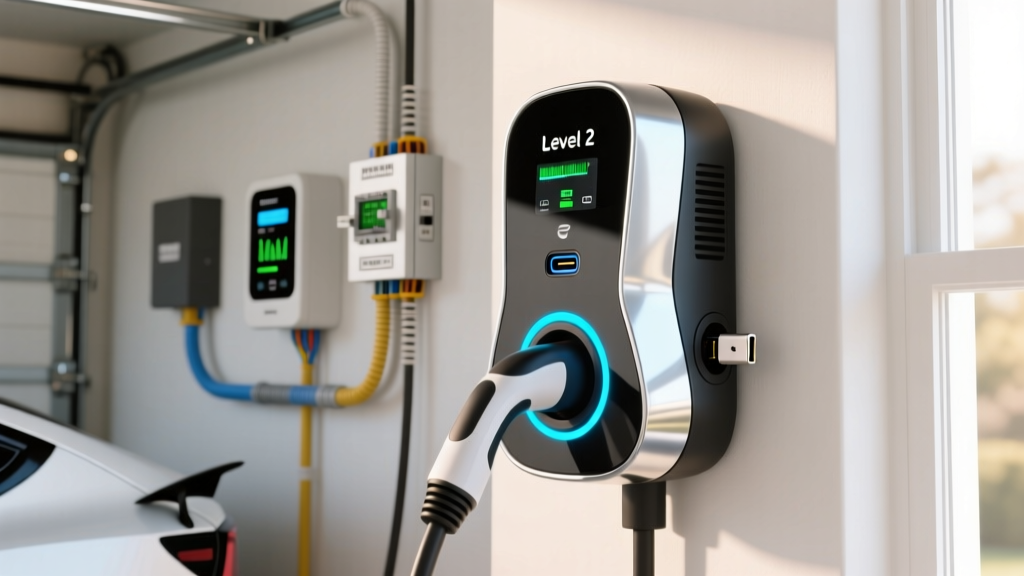
A Level 2 charger requires a dedicated 240-volt circuit — the same voltage your electric dryer or oven uses. The amperage of that circuit determines your charging speed and whether your existing electrical panel can support it.
Here's the rule electricians follow: a circuit must be rated for 125% of the continuous load. So a 48-amp charger (drawing 11.5 kW) requires a 60-amp circuit breaker. A 40-amp charger (9.6 kW) needs a 50-amp breaker. A 32-amp charger (7.7 kW) needs a 40-amp breaker.
When You'll Need a Panel Upgrade
If your home has a 100-amp electrical service — common in houses built before 1990 — adding a 60-amp EV circuit may overload the panel, especially if you're also running electric heat, a dryer, and an oven simultaneously. A licensed electrician will perform a load calculation (per NEC Article 220) to determine whether your panel has headroom. If it doesn't, you'll need to upgrade to 200-amp service, which typically costs $1,500–$3,500 including the new panel, utility coordination, and inspection.
Some homeowners opt for a lower-amperage charger (32A instead of 48A) to avoid a panel upgrade. This sacrifices some charging speed — roughly 25 miles of range per hour instead of 45 — but still covers most overnight charging needs for vehicles driven under 250 miles per day.
Safety and Code Requirements
The National Electrical Code (NEC) and local building codes govern EV charger installations. Key requirements include:
- Dedicated circuit: Your Level 2 charger must have its own breaker — no sharing with other appliances.
- GFCI protection: NEC 2020 and later require ground-fault circuit interrupter protection for EV charging outlets (hardwired units may have built-in GFCI).
- Outdoor rating: If your charger is mounted outside, it must carry a NEMA 4 or NEMA 4X weather-resistance rating. Most quality chargers meet this, but verify before purchasing for exterior installation.
- Cable management: NEC requires that charging cables not create a tripping hazard. Some jurisdictions mandate retractors or hooks.
- Permit and inspection: Nearly all US jurisdictions require an electrical permit and post-installation inspection. Skipping this can void home insurance coverage in the event of an electrical fire.
Always hire a licensed electrician familiar with EV charger installations. The US Department of Energy maintains resources on finding qualified installers and understanding local requirements.
Connector Compatibility: NACS, CCS, and CHAdeMO
The physical connector on your charger must match your vehicle's charge port. As of 2026, the North American market has largely consolidated around two standards, with a legacy third still in circulation:
| Connector | Brands Using It (2026 Models) | Notes |
|---|---|---|
| NACS (North American Charging Standard / Tesla) | Tesla (all models), Ford (F-150 Lightning, Mustang Mach-E 2025+), GM (Cadillac, Chevrolet, GMC EVs), Rivian, Volvo, Polestar, Nissan (Ariya), BMW, Mercedes-Benz, Hyundai, Kia (2025+) | Now the dominant standard; most new EVs ship with NACS. CCS vehicles can use a NACS-to-CCS adapter for Tesla Superchargers. |
| CCS1 (Combined Charging System) | Older-model EVs from VW (ID.4 pre-2025), Audi (e-tron pre-2025), BMW (i4, iX pre-2025), some Hyundai/Kia (Ioniq 5 pre-2025, EV6 pre-2025) | Being phased out in favor of NACS. CCS chargers remain widely available at Electrify America and other networks. |
| CHAdeMO | Nissan Leaf (all years), Mitsubishi Outlander PHEV (older) | Legacy standard; no new vehicles adopting it. Chargers still exist but network expansion has stopped. |
For home Level 2 charging, the connector situation is simpler. All Level 2 chargers sold in the US use a J1772 connector — which is the same physical shape as the AC portion of CCS1 and is compatible with NACS vehicles through the adapter that ships with most new NACS-equipped EVs. Tesla's Wall Connector includes a NACS plug natively and also works with non-Tesla vehicles using a J1772-to-NACS adapter.
If you drive a vehicle with a native NACS port (most 2025–2026 models), buy a charger with a NACS connector or use the adapter. If you drive a CCS1 vehicle, any standard J1772 Level 2 charger will plug in directly. CHAdeMO vehicles (mainly the Nissan Leaf) also accept J1772 for Level 2 AC charging — CHAdeMO is only relevant for DC fast charging.
Level 2 Charger Equipment Picks: Power, Features, and Price
Not all Level 2 chargers are equal. The key specs to compare are maximum power output (in kW), cable length, smart features (Wi-Fi scheduling, utility integration), connector type, and whether the unit is hardwired or plug-in. Here are five well-regarded options available in 2026:
1. Tesla Wall Connector (Gen 4)
- Power output: 11.5 kW (48A) on a 60A circuit
- Connector: NACS (native); includes J1772 adapter for non-Tesla vehicles
- Cable length: 24 feet
- Smart features: Wi-Fi, over-the-air updates, Power-Share (load balancing between two units on one circuit), Tesla app integration
- Price: ~$475
- Best for: Tesla owners or households with NACS-equipped vehicles who want maximum power without a third-party app
2. ChargePoint Home Flex
- Power output: Up to 12 kW (50A) on a 60A circuit; configurable down to 16A for smaller circuits
- Connector: J1772 (compatible with all EVs; NACS vehicles use adapter)
- Cable length: 23 feet
- Smart features: Wi-Fi, Alexa/Google Home, utility demand-response programs, detailed energy tracking in app
- Price: ~$550–$650
- Best for: Multi-EV households with mixed connector types; strong app and utility integration
3. Emporia Level 2 EV Charger
- Power output: 11.5 kW (48A) on a 60A circuit
- Connector: J1772
- Cable length: 24 feet
- Smart features: Wi-Fi, integration with Emporia Vue energy monitor, solar-aware scheduling, time-of-use optimization
- Price: ~$350–$400
- Best for: Budget-conscious buyers who want smart features and solar/home-energy integration
4. Enel X JuiceBox 48
- Power output: 11.5 kW (48A) on a 60A circuit
- Connector: J1772
- Cable length: 25 feet
- Smart features: Wi-Fi, app-based scheduling, energy usage reports, utility program compatibility
- Price: ~$450–$500
- Best for: Reliable mid-range option with long cable and robust app
5. Lectron V-BOX Pro 48A
- Power output: 11.5 kW (48A) on a 60A circuit
- Connector: J1772 (NACS version also available)
- Cable length: 20 feet
- Smart features: Basic — no Wi-Fi; LED status indicators only
- Price: ~$280–$320
- Best for: No-frills, lowest-cost 48A option for drivers who don't need app connectivity
A note on plug-in versus hardwired: plug-in chargers use a NEMA 14-50 outlet, which lets you unplug and take the charger with you if you move. Hardwired units connect directly to the circuit inside the junction box, eliminating the outlet but making the unit permanent. Hardwired installations are slightly cheaper (no outlet cost) and avoid a common failure point — loose NEMA 14-50 receptacles that can overheat under sustained 40A+ loads. If you plan to stay in your home, hardwired is generally preferred.
Cost to Charge: Home vs. Public vs. Gasoline
The ongoing cost advantage of home charging is the primary financial argument for a Level 2 installation. Electricity prices vary by state and utility, but the math consistently favors home charging over public DC fast charging — and both over gasoline for comparable vehicles.
Cost Per Mile: Home Charging vs. Public vs. Gas (2026 Averages)
| Scenario | Rate | Cost per kWh | Cost per Mile (at 3.5 mi/kWh) | Annual Cost (12,000 mi) |
|---|---|---|---|---|
| Home Level 2, off-peak (utility TOU rate) | $0.08–$0.14/kWh | $0.11 avg | $0.031 | $377 |
| Home Level 2, standard rate (no TOU) | $0.13–$0.22/kWh | $0.17 avg | $0.049 | $583 |
| Public Level 2 (ChargePoint, EVgo, etc.) | $0.25–$0.49/kWh | $0.35 avg | $0.100 | $1,200 |
| DC Fast Charging (Electrify America, Tesla Supercharger) | $0.30–$0.55/kWh | $0.40 avg | $0.114 | $1,371 |
| Gasoline vehicle (28 MPG combined, $3.40/gal) | — | — | $0.121 | $1,457 |
The numbers tell a clear story: home off-peak charging costs roughly $0.03 per mile, compared to $0.12 per mile for a 28-MPG gas vehicle at $3.40 per gallon. Over 12,000 miles per year, that's a savings of about $1,080 annually — meaning the Level 2 installation pays for itself in 1–3 years depending on your install cost.
However, if you rely entirely on public DC fast charging (common for apartment dwellers without home charging access), your per-mile cost approaches that of a fuel-efficient gas car. This is why home Level 2 access is the single biggest factor in EV ownership economics.
Many utilities offer time-of-use (TOU) rate plans that discount electricity during off-peak hours — typically 10 PM to 6 AM. Smart chargers from ChargePoint, Emporia, and Tesla can be scheduled to charge only during these windows, maximizing savings. Check with your local utility for EV-specific rate plans before installation.
Charging Time Examples: How Long Does Level 2 Really Take?
Charge times depend on two variables: your charger's kW output and your vehicle's battery capacity (in kWh). Here are real-world examples for popular 2026 EVs charging from 10% to 80% state of charge on an 11.5 kW (48A) Level 2 circuit:
| Vehicle | Battery Capacity (usable kWh) | Onboard Charger Acceptance | 10–80% Time at 11.5 kW | EPA Range |
|---|---|---|---|---|
| Tesla Model Y Long Range | 75 kWh | 11.5 kW | ~4 hours 30 min | 320 miles |
| Chevrolet Equinox EV 3RS | 85 kWh | 11.5 kW | ~5 hours 10 min | 319 miles |
| Hyundai Ioniq 5 (Long Range) | 84 kWh | 10.9 kW | ~5 hours 20 min | 303 miles |
| Ford F-150 Lightning (Extended Range) | 131 kWh | 11.5 kW | ~7 hours 55 min | 320 miles |
| BMW i4 eDrive40 | 81.5 kWh | 11 kW | ~5 hours | 307 miles |
| Toyota bZ4X | 71.4 kWh | 7.4 kW | ~6 hours 15 min | 252 miles |
A critical detail: your vehicle's onboard charger limits how much AC power it can accept, regardless of what your wall unit can deliver. The Toyota bZ4X, for example, has a 7.4 kW onboard charger — so even if you install an 11.5 kW wall unit, the bZ4X will only draw 7.4 kW. Conversely, the Tesla Model Y can accept the full 11.5 kW, making it a perfect match for a 48A circuit.
For overnight charging, even the slowest Level 2 times are rarely a problem. Most drivers plug in at 9 PM and leave by 7 AM — a 10-hour window that provides more than enough time to fully recharge any consumer EV battery on a 32A or 48A circuit.
Tax Credits and Rebates That Reduce Your Level 2 Charger Cost
The federal government and many utilities offer incentives that can significantly offset your installation expense:
- Federal Alternative Fuel Infrastructure Tax Credit (IRC §30C): Through 2026, this credit covers 30% of the cost of home EV charging equipment and installation, up to $1,000. This applies to the combined hardware and electrician cost. Eligibility depends on your census tract meeting certain income or rural criteria — check the IRS §30C page for details.
- Utility rebates: Many utilities offer $250–$1,000 rebates for installing a smart Level 2 charger, particularly if you enroll in a demand-response or time-of-use program. Pacific Gas & Electric, Southern California Edison, Con Edison, and Xcel Energy are among the utilities with active programs.
- State and local incentives: States including California, Colorado, New York, and Massachusetts offer additional rebates or tax credits for home charger installation. Amounts and eligibility vary by jurisdiction — consult your state energy office for current programs.
These incentives are separate from the federal EV purchase tax credit (§30D), which applies to the vehicle itself. You can claim both in the same tax year if eligible.
Frequently Asked Questions
How much does it cost to install a home EV charger?
A complete Level 2 home charger installation typically costs between $650 and $2,450 if your electrical panel doesn't need an upgrade. This includes the charger unit ($300–$700), electrician labor ($300–$1,500), and permit fees ($50–$250). If your home has a 100-amp panel that needs upgrading to 200 amps, add $1,500–$3,500 to the total.
How fast will each charging level add range?
Level 1 (120V) adds 3–5 miles per hour. Level 2 (240V) adds 12–75 miles per hour depending on the circuit amperage and vehicle efficiency — a typical 48A home installation adds roughly 40–45 miles per hour. DC fast charging can add 150–1,000+ miles per hour at peak rates, but is designed for road trips, not daily use.
Which connector/charger is compatible with my EV?
For Level 2 home charging, virtually all EVs use either a J1772 connector (CCS1 vehicles, CHAdeMO vehicles) or NACS connector (Tesla and most 2025+ models from Ford, GM, Hyundai, Kia, Rivian, BMW, and others). Any J1772 Level 2 charger works with CCS1 vehicles directly. NACS vehicles typically ship with a J1772-to-NACS adapter, or you can buy a charger with a native NACS plug like the Tesla Wall Connector.
How much does charging cost per mile vs gas?
Home Level 2 charging on an off-peak utility rate costs approximately $0.03 per mile. Standard-rate home charging runs about $0.05 per mile. A comparable gasoline vehicle at 28 MPG and $3.40 per gallon costs $0.12 per mile. Over 12,000 annual miles, home charging saves roughly $700–$1,100 per year versus gasoline.
What electrical upgrades might I need?
The most common upgrade is a panel replacement from 100 amps to 200 amps, needed in older homes that lack capacity for a dedicated 60-amp EV circuit alongside existing loads. You may also need a new conduit run from the panel to the garage, a NEMA 14-50 outlet installation (for plug-in chargers), or a sub-panel for a detached garage. A licensed electrician's load calculation will determine exactly what's required.
Can I install a Level 2 charger myself?
While some jurisdictions allow homeowner electrical work with a permit, a Level 2 charger installation involves a high-amperage 240V circuit that carries significant fire and shock risk if done incorrectly. Most jurisdictions require a licensed electrician for the permit to be issued, and DIY work may void your homeowner's insurance in the event of an electrical incident. Professional installation is strongly recommended.
Does a Level 2 charger increase my home's value?
Studies from Zillow and Redfin have shown that homes with EV charging infrastructure sell at a small premium — typically 1–2% above comparable homes without it. As EV adoption grows, a hardwired Level 2 charger in the garage is increasingly seen as a desirable feature, similar to a solar panel system or a upgraded electrical panel.