Why Level 2 Charger Amps Matter More Than You Think
When shopping for a home EV charger, most buyers fixate on brand or cable length — but the single most important spec is amperage. The level 2 charger amps rating determines your actual charge speed, the electrical circuit you'll need, and whether your existing panel can handle the load. Get it right, and you'll wake up to a full battery every morning. Get it wrong, and you're either wasting money on a charger your home can't support or leaving miles on the table every night.
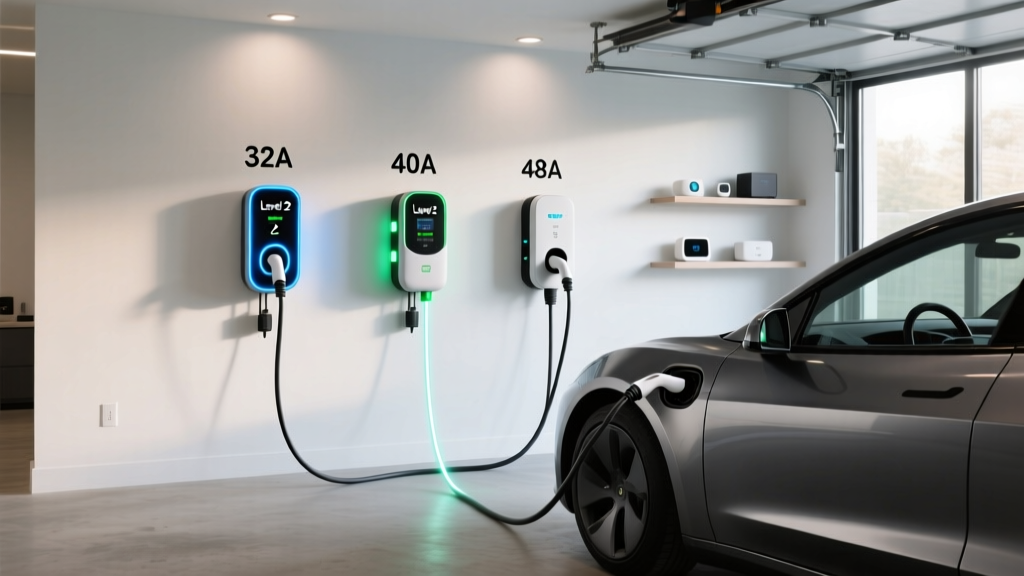
Level 2 charging operates on 240-volt AC power — the same voltage as your electric dryer or oven. But amperage varies widely across chargers, from 16A portable units up to 80A hardwired stations. Here's the critical math: kW = volts × amps ÷ 1,000. On a 240V circuit, a 40A charger delivers up to 9.6 kW, while a 48A unit pushes 11.5 kW. That difference can mean 2-4 extra hours to fully charge a large battery pack like the 131 kWh Ford F-150 Lightning Extended Range.
Before we break down the options, let's clarify the most common EV confusion: kW (kilowatts) measures power — the rate at which energy flows into your car. kWh (kilowatt-hours) measures energy — the total capacity of your battery. Think of kW as the width of a hose and kWh as the size of the bucket. A wider hose (higher kW) fills the bucket (kWh) faster.
Charging Levels Compared: Speed, Power, and Real-World Range Added
Every EV owner uses a mix of charging levels depending on the situation. Here's how they stack up in measurable terms:
| Level | Voltage | Power (kW) | Miles of Range per Hour | Typical Use Case |
|---|---|---|---|---|
| Level 1 | 120V AC | 1.2–1.9 kW | 3–5 mi/hr | Emergency / overnight trickle |
| Level 2 (32A) | 240V AC | 7.7 kW | 23–30 mi/hr | Home daily charging |
| Level 2 (40A) | 240V AC | 9.6 kW | 29–38 mi/hr | Home daily charging (most common) |
| Level 2 (48A) | 240V AC | 11.5 kW | 35–45 mi/hr | Home — large batteries, fast turnaround |
| Level 2 (80A) | 240V AC | 19.2 kW | 56–75 mi/hr | Home — F-150 Lightning, Hummer EV |
| DC Fast (Level 3) | 200–500V DC | 50–350 kW | 150–1,000+ mi/hr | Road trips, public stations |
The "miles per hour" column varies by vehicle efficiency. A Tesla Model 3 (roughly 4 mi/kWh) gains range faster than a GMC Hummer EV (roughly 1.6 mi/kWh) at the same kW input. Always check your vehicle's onboard charger rating — if your EV maxes out at 11.5 kW AC (like many Hyundai/Kia E-GMP vehicles), a 48A/11.5 kW charger is the sweet spot, and an 80A unit won't charge it any faster on AC.
Electrical Requirements: Circuit Sizing, Panel Capacity, and Upgrade Reality
National Electrical Code (NEC) requires that a continuous load — and EV charging qualifies — must not exceed 80% of the circuit breaker rating. This is the rule that dictates your level 2 charger amps and the breaker you'll need:
- 32A charger → requires a 40A breaker (32 ÷ 0.80 = 40)
- 40A charger → requires a 50A breaker
- 48A charger → requires a 60A breaker
- 80A charger → requires a 100A breaker
Most homes built after 2000 have a 200A main service panel with enough spare capacity for a 50A or 60A breaker. Older homes with 100A or 150A service may need a panel upgrade to 200A, which is the single biggest variable in your install cost. A licensed electrician will perform a load calculation per NEC Article 220 to determine if your panel can handle the additional draw alongside existing appliances (HVAC, electric range, dryer, water heater).
Home Level 2 Charger Installation: Cost Breakdown
| Component | Low Estimate | High Estimate | Notes |
|---|---|---|---|
| Level 2 Charger (equipment) | $300 | $750 | 32A–48A smart chargers; 80A units run $800–$1,200 |
| Electrician labor | $500 | $2,000 | Depends on run length from panel to garage/carport |
| Electrical materials (wire, conduit, breaker) | $150 | $500 | Longer runs and thicker gauge wire cost more |
| Permit and inspection | $50 | $300 | Varies by municipality; some jurisdictions waive |
| Panel upgrade (if needed) | $1,500 | $4,000 | 100A → 200A service upgrade; not always required |
| Total (no panel upgrade) | $1,000 | $3,550 | Typical range for most modern homes |
| Total (with panel upgrade) | $2,500 | $7,550 | Older homes or high-load scenarios |
The IRS §30D tax credit does not cover home charger equipment directly as of 2026 — the alternative fuel vehicle refueling property credit (§30C) was modified under the Inflation Reduction Act and has specific census-tract eligibility requirements. Check IRS guidance on §30C or consult a tax professional to determine if your home charger install qualifies for up to $1,000 in credit.
Which Connector Fits Your EV? NACS, CCS, and CHAdeMO Compatibility
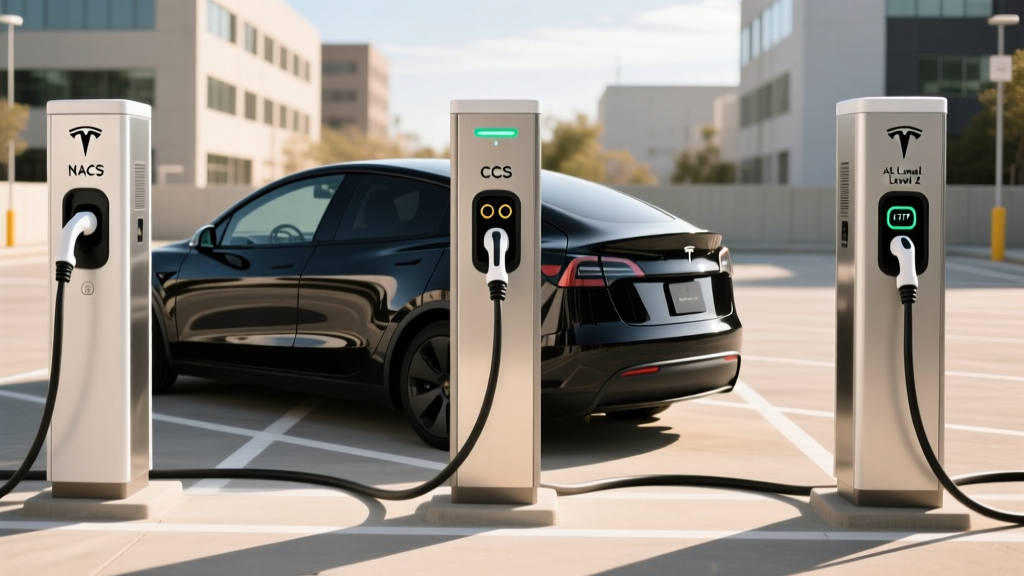
The connector landscape has shifted dramatically. As of the 2025–2026 model years, the North American Charging Standard (NACS) — originally developed by Tesla — has been adopted by Ford, GM, Rivian, Hyundai, Kia, BMW, and most major automakers. CCS1 remains on many 2022–2024 vehicles still on the road, and CHAdeMO is effectively legacy (Nissan Leaf being the primary holdout).
| Connector | Brands Using It (2026) | Home Level 2 Charging | Adapter Needed? |
|---|---|---|---|
| NACS (Tesla) | Tesla, Ford, GM, Rivian, Hyundai, Kia, BMW, Volvo, Polestar | NACS-equipped home chargers widely available | No for new vehicles; CCS→NACS adapters for older CCS cars |
| CCS1 | VW ID.4 (2024 and earlier), legacy models, some commercial fleets | CCS1 chargers still available but declining | NACS→CCS1 adapters available for use at Tesla Superchargers |
| CHAdeMO | Nissan Leaf (discontinued 2025 in US), Mitsubishi Outlander PHEV (older) | Limited new charger options | Adapters rare; plan for eventual transition |
For Level 2 home charging, the connector matters less than you might think — NACS and CCS1 both use the same J1772 communication protocol for AC charging. Most Level 2 chargers sold in 2026 ship with a NACS plug or a J1772 plug with a NACS adapter included. If you own a CCS1-equipped EV, verify the charger includes a CCS1 adapter or purchase one separately ($50–$150).
Charging Time Examples: 10–80% by Battery Size and Charger Amps
The 10–80% window is the practical charging range most EV owners use daily — charging above 80% slows dramatically on both AC and DC due to battery management system (BMS) taper curves. Here's how common battery sizes perform across different level 2 charger amps:
| Vehicle (Usable kWh) | 32A / 7.7 kW | 40A / 9.6 kW | 48A / 11.5 kW | 80A / 19.2 kW |
|---|---|---|---|---|
| Chevy Equinox EV (85 kWh) | ~7.7 hrs | ~6.2 hrs | ~5.2 hrs | ~3.1 hrs* |
| Tesla Model Y (75 kWh) | ~6.8 hrs | ~5.5 hrs | ~4.6 hrs | ~2.7 hrs* |
| Hyundai Ioniq 5 (77.4 kWh) | ~7.0 hrs | ~5.6 hrs | ~4.7 hrs | ~2.8 hrs* |
| Ford F-150 Lightning ER (131 kWh) | ~11.9 hrs | ~9.6 hrs | ~8.0 hrs | ~4.8 hrs |
| BMW iX xDrive50 (105 kWh) | ~9.6 hrs | ~7.7 hrs | ~6.4 hrs | ~3.8 hrs* |
*Vehicle's onboard AC charger may cap below 19.2 kW — check your owner's manual. Most EVs accept a maximum of 11.5 kW on AC, making 48A the practical ceiling for those models.
For most EV owners driving 30–50 miles per day, even a 32A charger replenishes daily usage in 2–3 hours overnight. The 48A or 80A options shine for drivers who regularly deplete large batteries, tow with an electric truck, or need rapid turnaround between shifts.
Cost to Charge: Home vs. Public vs. Gas — The Per-Mile Reality
The economics of EV charging depend heavily on where you charge. Home Level 2 charging on off-peak utility rates is the cheapest way to fuel any vehicle. Public DC fast charging, while convenient on road trips, can approach or exceed gasoline costs in some markets.
| Scenario | Rate | Cost per Mile (Efficient EV: 3.5 mi/kWh) | Cost per Mile (Electric Truck: 1.8 mi/kWh) |
|---|---|---|---|
| Home off-peak (national avg) | $0.09/kWh | $0.026 | $0.050 |
| Home standard rate (national avg) | $0.16/kWh | $0.046 | $0.089 |
| Public Level 2 (network avg) | $0.25/kWh | $0.071 | $0.139 |
| DC Fast Charging (network avg) | $0.40/kWh | $0.114 | $0.222 |
| Gasoline (28 MPG car, $3.40/gal) | $3.40/gal | $0.121 | — |
| Gasoline (18 MPG truck, $3.40/gal) | $3.40/gal | — | $0.189 |
Home charging at off-peak rates delivers fuel savings of 70–80% versus gasoline. Even at standard residential rates, the per-mile cost is roughly half that of a comparable gas vehicle. The breakeven math is straightforward: if you drive 12,000 miles/year in an efficient EV, home charging costs roughly $300–$550 annually versus $1,450+ for gasoline. Consult fueleconomy.gov for your specific vehicle's kWh/100mi efficiency rating to calculate personalized costs.
2026 Equipment Recommendations: Top Level 2 Chargers by Amperage
Best 32A: ChargePoint Home Flex (NACS)
Power: 7.7 kW (32A, 240V) | Connector: NACS (J1772 adapter available) | Cable: 23 ft | Smart Features: Wi-Fi, app scheduling, Alexa, energy tracking | Price: ~$499 | Install: Plug-in (NEMA 14-50) or hardwired
Ideal for: Apartments, condos, or homes with limited panel capacity. The 32A draw requires only a 40A breaker, making it compatible with most 100A panels. ChargePoint's app remains the most polished in the industry for scheduling off-peak charging and tracking utility time-of-use rates.
Best 40A: Emporia Level 2 Smart Charger
Power: 9.6 kW (40A, 240V) | Connector: J1772 (NACS adapter included) | Cable: 24 ft | Smart Features: Wi-Fi, solar integration, load management, app control | Price: ~$399 | Install: Hardwired or NEMA 14-50
Ideal for: Budget-conscious buyers who want smart features without the premium price. Emporia's integration with home solar panels and the Emporia energy monitor makes it easy to charge exclusively on surplus solar production. The 40A/9.6 kW output hits the sweet spot for most EVs with 11.5 kW or lower onboard chargers.
Best 48A: Tesla Wall Connector (NACS)
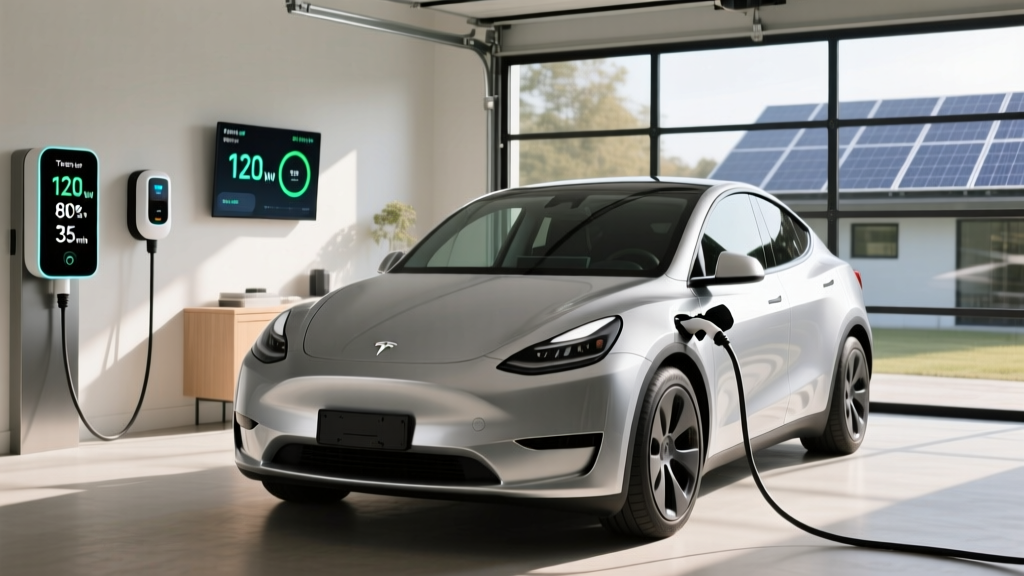
Power: 11.5 kW (48A, 240V) | Connector: NACS (J1772 adapter sold separately) | Cable: 24 ft | Smart Features: Wi-Fi, OTA updates, power sharing between two units, Tesla app | Price: ~$420 | Install: Hardwired (60A breaker required)
Ideal for: Tesla owners and the growing NACS-adopted fleet. The Wall Connector's 48A output maxes out the AC charging capability of most current EVs. Power sharing lets you install two units on a single 60A circuit — useful for two-EV households where both cars rarely charge simultaneously at full power.
Best 80A: Ford Charge Station Pro
Power: 19.2 kW (80A, 240V) | Connector: NACS | Cable: 25 ft | Smart Features: FordPass integration, V2H (vehicle-to-home) backup power capable, Wi-Fi | Price: ~$1,100 | Install: Hardwired (100A breaker required)
Ideal for: F-150 Lightning owners who need the truck ready for heavy towing days or who want home backup power via Ford Intelligent Backup Power. The 100A breaker requirement means most homes will need a dedicated sub-panel or a 200A+ main service panel. This is serious infrastructure for serious use cases.
Safety, Code Compliance, and Installation Best Practices
EV charging is a continuous high-draw electrical load — often running 6–10 hours straight. Proper installation is non-negotiable for safety and insurance compliance:
- Dedicated circuit: Your Level 2 charger must be on its own dedicated breaker — never shared with other appliances. This prevents overloads and nuisance tripping.
- GFCI protection: NEC 2020 and later requires GFCI (Ground Fault Circuit Interrupter) protection for outlets used for EV charging in garages. Hardwired installations may be exempt in some jurisdictions, and many EVSE manufacturers recommend against GFCI breakers for hardwired units because the charger has built-in ground fault protection — double-GFCI can cause nuisance trips. Your electrician will advise based on local code.
- Outdoor rating: If your charger is mounted outside (carport, driveway), it must carry a NEMA 4 or NEMA 4X weather rating. All chargers recommended above meet this standard.
- Wire gauge: A 48A/60A circuit typically requires 4 AWG copper wire (or 3 AWG aluminum). Your electrician will size wire based on run length to minimize voltage drop — runs over 100 feet may need thicker wire.
- Permit and inspection: Most jurisdictions require an electrical permit for EV charger installation. The inspection ensures code compliance and protects your homeowner's insurance coverage. Skipping the permit risks claim denial in the event of an electrical fire.
- Load management: If your panel is near capacity but you want to avoid a costly upgrade, smart chargers with load management (like Emporia or Wallbox Pulsar Plus) can dynamically reduce charge rate when other appliances are drawing power, keeping total draw within your panel's limit.
Frequently Asked Questions
How much does it cost to install a home EV charger?
A typical Level 2 home charger installation costs $1,000–$3,550 including equipment ($300–$750), electrician labor ($500–$2,000), materials ($150–$500), and permits ($50–$300). If your home needs a panel upgrade from 100A to 200A service, add $1,500–$4,000. Most homes built after 2000 with 200A service can accommodate a 48A charger without a panel upgrade.
How fast will each charging level add range?
Level 1 (120V) adds 3–5 miles of range per hour. Level 2 at 32A adds roughly 23–30 mi/hr; at 40A, roughly 29–38 mi/hr; at 48A, roughly 35–45 mi/hr. DC fast charging adds 150–1,000+ mi/hr depending on peak kW. Exact numbers depend on your vehicle's efficiency (mi/kWh).
Which connector/charger is compatible with my EV?
For 2025–2026 models, most new EVs use NACS (Tesla's standard). Older CCS1 vehicles (2022–2024 VW ID.4, etc.) need a CCS1-compatible charger or adapter. Nissan Leaf uses CHAdeMO. For Level 2 home charging, the J1772 AC protocol underpins all connectors — adapters handle the physical plug difference. Check your vehicle's charge port or owner's manual to confirm.
How much does charging cost per mile vs. gas?
Home Level 2 charging at off-peak rates ($0.09/kWh) costs roughly $0.026–$0.050 per mile depending on vehicle efficiency. Gasoline at $3.40/gallon costs $0.121/mi for a 28 MPG car. That's a 60–80% fuel cost reduction for home-charged EVs. Public DC fast charging at $0.40/kWh is more expensive — roughly $0.11–$0.22/mi — and can approach or exceed gas costs.
What electrical upgrades might I need?
The most common upgrade is adding a new 240V circuit with the appropriate breaker (40A–100A depending on charger amps). If your main panel lacks spare capacity or is rated below 200A, a panel upgrade may be necessary. Homes with older wiring (aluminum branch circuits, knob-and-tube) may need partial rewiring. A licensed electrician's load calculation will determine exactly what's required — get a quote before purchasing your charger.
Can I use a NACS charger with my CCS1 vehicle?
Yes, with an adapter. Several companies sell NACS-to-J1772/CCS1 adapters for Level 2 AC charging. For DC fast charging at Tesla Superchargers, Ford, GM, and Rivian provide or sell approved adapters. Always use manufacturer-approved adapters to ensure safe communication between the charger and your vehicle's BMS.
Should I get a plug-in (NEMA 14-50) or hardwired charger?
Plug-in units on a NEMA 14-50 outlet offer portability — you can take the charger when you move. Hardwired installations support higher amperage (48A+), eliminate one failure point (the receptacle), and may not require a GFCI breaker in some jurisdictions. For 40A or lower, plug-in is convenient. For 48A+, hardwired is generally preferred for reliability and code compliance.