If you're wiring up a home EV charger, the single most consequential number on the spec sheet isn't the brand name or the cord length — it's the level 2 charger amperage. That number dictates how many kilowatts (kW) flow into your battery, how fast you'll add range overnight, and what kind of electrical infrastructure your house needs to support it. Choose too low, and you'll wake up short before a road trip. Choose too high without upgrading your panel, and you'll trip breakers or face a costly service upgrade.
This guide breaks down exactly what amperage means for Level 2 home charging, how it translates to real-world charging speed, what your electrical panel can handle, and which chargers we recommend in 2026 based on power output, connector compatibility, and total installed cost.
Charging Levels Explained: Speeds in kW and Miles Per Hour
Before selecting an amperage, you need to understand the three charging tiers available to EV owners. The critical distinction: kW (kilowatts) measures power — how fast energy flows — while kWh (kilowatt-hours) measures energy — how much your battery holds. Think of kW as the width of a pipe and kWh as the size of the bucket you're filling.
| Level | Voltage | Max Power (kW) | Typical Miles Added/Hour | Best For |
|---|---|---|---|---|
| Level 1 (120V) | 120V AC | 1.4 kW (12A) | 3–5 mi/hr | PHEVs, low-mileage commuters, renters |
| Level 2 (240V) | 240V AC | 3.8–19.2 kW (16A–80A) | 14–70 mi/hr | Daily home charging for all BEVs |
| DC Fast Charging | 400–800V DC | 50–350 kW | 150–300+ mi in 20 min | Road trips, highway corridors |
Level 2 is the home-charging sweet spot for battery-electric vehicles (BEVs). A typical BEV battery of 75–85 kWh (like a Tesla Model Y or Hyundai Ioniq 5) needs roughly 7–10 hours from near-empty on a 40A/9.6 kW Level 2 circuit — perfectly aligned with overnight charging. Level 1, by contrast, would take 50+ hours for the same battery, making it viable only for plug-in hybrids with smaller packs or drivers covering under 30 miles daily.
DC fast charging operates on a completely different electrical system (direct current at high voltage) and is exclusively for public stations. Your home Level 2 charger uses alternating current, and the vehicle's onboard charger converts it to DC for the battery.
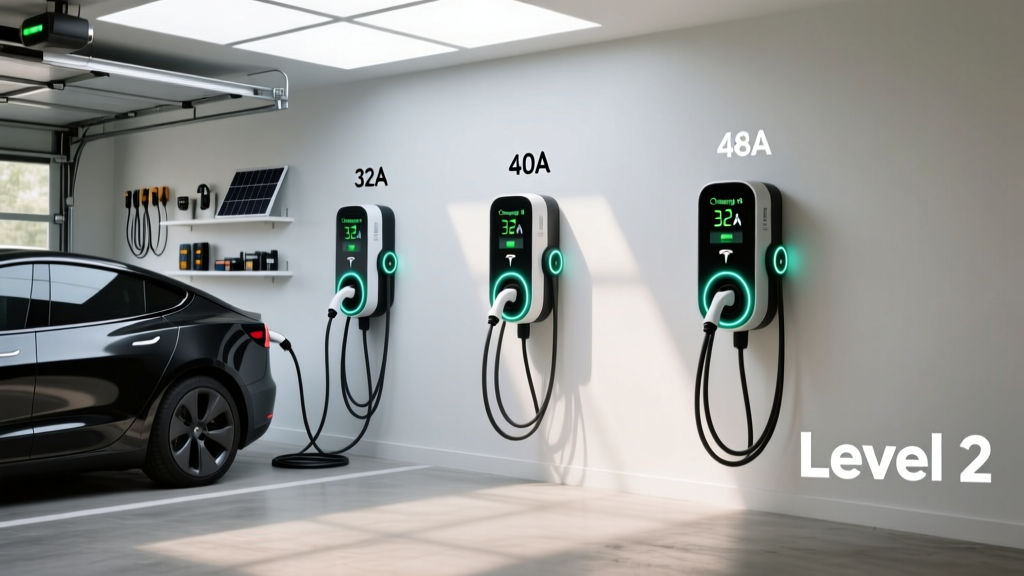
Level 2 Charger Amperage: What 32A, 40A, and 48A Actually Deliver
Here's where amperage directly translates to charging speed. In the U.S., residential Level 2 circuits deliver 240 volts. The formula is straightforward:
Power (kW) = Voltage (V) × Amperage (A) ÷ 1,000
However, the National Electrical Code (NEC) requires that continuous loads (anything running 3+ hours, which includes EV charging) use only 80% of a circuit breaker's rated capacity. This means the breaker must be rated 125% higher than the charger's maximum amperage.
| Charger Amperage | Required Breaker | Power Output (kW) | Miles/ Hour (250 Wh/mi avg) | 10–80% Time (77 kWh battery) |
|---|---|---|---|---|
| 16A | 20A | 3.8 kW | ~15 mi/hr | ~14 hours |
| 32A | 40A | 7.7 kW | ~31 mi/hr | ~7 hours |
| 40A | 50A | 9.6 kW | ~38 mi/hr | ~5.5 hours |
| 48A | 60A | 11.5 kW | ~46 mi/hr | ~4.5 hours |
| 64A | 80A | 15.4 kW | ~62 mi/hr | ~3.5 hours |
| 80A | 100A | 19.2 kW | ~77 mi/hr | ~2.8 hours |
Real-world caveat: The 10–80% times above assume the vehicle's onboard charger can accept the full kW output. Many EVs cap their AC charging at 11.5 kW (48A) or lower. For example, the Ford Mustang Mach-E accepts a maximum of 10.5 kW on AC, so a 64A charger won't charge it any faster than a 48A unit. Always check your vehicle's onboard charger spec before overspending on high-amperage equipment.
For most BEV owners driving 30–50 miles daily, a 32A (7.7 kW) or 40A (9.6 kW) Level 2 charger provides more than enough overnight replenishment. A 48A unit makes sense for larger-battery vehicles (100+ kWh, like the GMC Hummer EV or Rivian R1T) or households with two EVs sharing one charger on alternating nights.
Electrical Requirements: Panel Capacity, Wiring, and Permitting
Amperage isn't just a charger spec — it's a whole-house electrical question. Your home's main service panel determines what's possible without expensive upgrades.
Typical Residential Panel Capacity
- 100A service (older homes, pre-1990s): Likely insufficient for a 48A charger. You may need a panel upgrade or must limit the charger to 32A.
- 150A service: Can typically support a 40A charger circuit with room to spare, depending on existing loads (HVAC, electric range, dryer).
- 200A service (most modern homes): Comfortably supports a 48A or even 64A charger, assuming no other heavy simultaneous loads.
A licensed electrician will perform a load calculation per NEC Article 220 to determine whether your panel has headroom. This calculation adds up all existing continuous and intermittent loads. If you're near capacity, you have three options: downsize the charger amperage, upgrade the panel, or install a smart load-management device (like the Emporia Smart Load Center or Span panel) that dynamically reduces charger draw when other appliances activate.
Wiring Requirements by Amperage
- 32A / 40A breaker: 8 AWG copper wire (typical)
- 40A / 50A breaker: 6 AWG copper wire
- 48A / 60A breaker: 6 AWG copper (short runs) or 4 AWG (longer runs to reduce voltage drop)
- 64A / 80A breaker: 3 AWG copper or 1 AWG aluminum
Wire gauge, run length, and conduit type all affect material cost. A 60-foot run through finished walls with a 60A circuit will cost significantly more than a 15-foot run through an open garage ceiling.
Permits and Inspections
Virtually all jurisdictions require an electrical permit for a new 240V circuit. Permit fees typically range from $50 to $250. The installation must pass a municipal inspection to verify code compliance — this protects you from fire risk and ensures insurance coverage if anything goes wrong. Never skip the permit; unpermitted electrical work can void your homeowner's insurance.
How Much Does It Cost to Install a Home Level 2 EV Charger?
Installation cost varies enormously based on your home's electrical infrastructure, the distance from panel to charger location, and local labor rates. Here's a realistic breakdown for a 2026 installation:
| Component | Simple Install (near panel, open walls) | Complex Install (long run, finished walls) | Panel Upgrade Required |
|---|---|---|---|
| Level 2 charger (hardware) | $400–$700 | $400–$700 | $400–$700 |
| Electrician labor (2–4 hrs vs. 6–10 hrs) | $500–$1,200 | $1,500–$3,500 | $1,500–$3,500 |
| Materials (wire, conduit, breaker) | $100–$300 | $300–$800 | $300–$800 |
| Permit and inspection | $50–$250 | $50–$250 | $150–$400 |
| Electrical panel upgrade (100A→200A) | — | — | $2,000–$5,000 |
| Total estimated cost | $1,050–$2,450 | $2,250–$5,250 | $4,350–$10,400 |
Panel upgrade reality check: If your home has 100A service and you want a 48A charger, expect to pay $2,000–$5,000 for a panel upgrade to 200A. This is the single biggest cost variable that surprises new EV buyers. Get a load-calculation quote before buying your charger.
Federal incentive note: The IRS Residential Clean Energy Credit does not cover EV chargers for most taxpayers as of 2026 (the prior §30C alternative fuel vehicle refueling property credit expired for residential installations after 2021 in most areas, though some targeted census tracts may still qualify). Check current IRS guidance and your state/local utility for rebates, as many utilities offer $250–$1,000 charger rebates or reduced off-peak electricity rates.
Connector Compatibility: NACS, CCS1, CHAdeMO, and What You Need
The connector landscape has consolidated significantly since 2024, when Ford, GM, Rivian, and most major automakers committed to adopting the North American Charging Standard (NACS), originally developed by Tesla. Here's where things stand for 2026 model-year vehicles:
| Connector | Brands Using It (2026) | Home Charger Availability |
|---|---|---|
| NACS (J3400) | Tesla (all), Ford, GM, Rivian, Volvo, Polestar, Mercedes-Benz, BMW, Hyundai/Kia (new platforms) | Widely available — Tesla Wall Connector, ChargePoint Home Flex (NACS), Emporia V2 (NACS) |
| CCS1 (J1772 combo) | VW/ID series, older Hyundai/Kia (pre-2025), Stellantis, Honda Prologue (2024–2025) | Widely available — ChargePoint Home Flex, Emporia V2, JuiceBox |
| CHAdeMO | Nissan Leaf (legacy only, discontinued after 2025) | Rare for home; J1772 adapter available |
Adapter strategy: If you own a CCS1-equipped EV but want a NACS charger (or vice versa), high-quality adapters are available from Tesla, Lectron, and A2Z for $150–$300. For future-proofing, many buyers opt for a NACS-connector charger since the industry is converging on that standard, then use a CCS1 adapter for older vehicles in the household.
For Level 2 home charging, the physical connector matters less than for DC fast charging — both NACS and CCS1 handle 240V AC without issue. The important thing is that the plug matches your car's inlet.
Cost to Charge: Home vs. Public, Per Mile vs. Gas
One of the strongest arguments for home Level 2 charging is cost. Here's how the economics compare across scenarios:
| Scenario | Rate | Cost per kWh | Cost per Mile (250 Wh/mi) | Annual Cost (12,000 mi) |
|---|---|---|---|---|
| Home Level 2 (off-peak TOU rate) | Utility time-of-use | $0.08–$0.14/kWh | $0.020–$0.035 | $240–$420 |
| Home Level 2 (standard rate) | Flat residential | $0.14–$0.20/kWh | $0.035–$0.050 | $420–$600 |
| Public Level 2 (networked) | ChargePoint, EVgo, etc. | $0.25–$0.49/kWh | $0.063–$0.123 | $750–$1,470 |
| DC Fast Charging (public) | Tesla Supercharger, EA, etc. | $0.30–$0.55/kWh | $0.075–$0.138 | $900–$1,650 |
| Gasoline (27 MPG avg sedan) | $3.40/gallon (2026 avg) | — | $0.126 | $1,510 |
Key takeaway: Home Level 2 charging on an off-peak rate delivers fuel costs roughly 70–85% lower than gasoline per mile. Even standard-rate home charging undercuts gas by 60–70%. Public DC fast charging narrows the gap but still typically costs less per mile than gas. According to fueleconomy.gov, EVs convert over 77% of electrical energy to motion at the wheels, compared to 12–30% for gasoline vehicles — this fundamental efficiency advantage is why per-mile costs stay low even at higher electricity rates.
To maximize savings, enroll in your utility's time-of-use (TOU) plan and schedule charging for off-peak hours (typically 10 PM – 6 AM). Most smart Level 2 chargers support scheduled charging via their apps.
Equipment Recommendations: Best Level 2 Chargers by Amperage (2026)
We've selected chargers based on verified power output, build quality, smart features, UL safety certification, and connector options. All recommendations below are UL-listed and support hardwired installation (required for 48A+ units).
Best for 32A (40A Circuit): ChargePoint Home Flex
- Power: Up to 7.7 kW (32A) at 240V
- Connector: NACS or CCS1 (J1772) — select at purchase
- Cable length: 23 feet
- Smart features: Wi-Fi, Alexa, scheduled charging, energy tracking via app
- Price: ~$550 (hardware only)
- Best for: Standard BEVs with 11 kW or lower onboard chargers; most households
Best for 48A (60A Circuit): Tesla Wall Connector (Gen 4)
- Power: Up to 11.5 kW (48A) at 240V
- Connector: NACS native; CCS1 adapter included
- Cable length: 24 feet
- Smart features: Wi-Fi, over-the-air updates, power sharing between two units, Tesla app integration
- Price: ~$475 (hardware only)
- Best for: Tesla owners and NACS-equipped vehicles; excellent value at 48A
Best for 48A (60A Circuit) — Universal: Emporia V2 (48A config)
- Power: Up to 11.5 kW (48A) at 240V; configurable down to 16A
- Connector: NACS or J1772 — select at purchase
- Cable length: 24 feet
- Smart features: Real-time energy monitoring, solar integration, load management with Emporia Vue panel monitor, scheduled charging
- Price: ~$400 (hardware only)
- Best for: Homes with solar panels or those wanting granular energy data; budget-friendly 48A option
Best for 64A–80A (80A–100A Circuit): Tesla Wall Connector (High Power)
- Power: Up to 19.2 kW (80A) at 240V
- Connector: NACS
- Cable length: 24 feet
- Smart features: Same as Gen 4 plus power-sharing across up to 6 units
- Price: ~$600 (hardware only)
- Best for: Large-battery EVs (Hummer EV, F-150 Lightning extended range), dual-EV households
Important: Chargers rated above 40A must be hardwired (no plug) per NEC code. Chargers at 40A or below can use a NEMA 14-50 outlet, which offers portability but requires a properly installed receptacle with a GFCI breaker in many jurisdictions.
Safety, Code, and Installation Best Practices
EV charging is a high-draw, long-duration electrical load — the most demanding continuous use most homes experience. Proper installation isn't optional.
- Dedicated circuit: Your Level 2 charger must be on its own dedicated circuit, shared with no other outlets or appliances.
- GFCI protection: NEC 2023 and later require GFCI (ground-fault circuit interrupter) protection for all EV charging receptacles. Hardwired installations may not require GFCI in all jurisdictions, but many electricians recommend it for outdoor units.
- Outdoor rating: If installing outside, the charger must carry a NEMA 4 (weatherproof) rating. All units recommended above are rated for outdoor use.
- UL certification: Only purchase UL-listed or ETL-listed chargers. Uncertified units from online marketplaces may lack critical safety protections and can void insurance.
- Cable management: Use a wall-mounted holster or retractable cable organizer to prevent tripping hazards and cable damage. Never run a charging cable across a driveway where vehicles will drive over it.
- Load management: In homes with limited panel capacity, consider a smart charger with load-sensing capability (Emporia V2 with Vue, or Span panel integration) that automatically throttles charging when other high-draw appliances are active.
Level 2 Charger Amperage: Frequently Asked Questions
How much does it cost to install a home EV charger?
A straightforward Level 2 installation with a nearby panel and open-wall wiring typically costs $1,050–$2,450 including equipment, labor, and permits. Complex installations with long wire runs through finished walls range from $2,250–$5,250. If your home needs a panel upgrade from 100A to 200A service, add $2,000–$5,000, bringing the total to $4,350–$10,400.
How fast will each charging level add range?
Level 1 (120V) adds roughly 3–5 miles per hour. Level 2 at 32A (7.7 kW) adds ~31 miles per hour. Level 2 at 48A (11.5 kW) adds ~46 miles per hour. DC fast charging at 150+ kW can add 150–300 miles in 20 minutes, though charging speed tapers significantly above 80% state of charge.
Which connector is compatible with my EV?
For 2026 models, Tesla, Ford, GM, Rivian, and most new Hyundai/Kia platforms use NACS. Volkswagen ID vehicles and some pre-2025 models use CCS1. Check your vehicle's charge port — the NACS connector is smaller and lighter, while CCS1 has a larger J1772 upper section with two DC pins below. Adapters are available for cross-compatibility.
How much does charging cost per mile vs. gas?
Home Level 2 charging on off-peak rates costs $0.02–$0.035 per mile, compared to $0.126 per mile for a 27 MPG gasoline car at $3.40/gallon. That's a 70–85% fuel cost reduction. Even public DC fast charging at $0.40/kWh costs roughly $0.10 per mile — still cheaper than gas for most vehicles.
What electrical upgrades might I need?
The most common upgrade is a new 240V circuit with an appropriately sized breaker and wire run from your panel to the charger location. If your home has 100A service and you want a 48A+ charger, you'll likely need a panel upgrade to 200A. Homes with 150A+ service can usually accommodate a 32A–48A charger without a panel upgrade. A licensed electrician's load calculation will determine your exact requirements.
Can I install a Level 2 charger myself?
No. A 240V circuit installation requires a licensed electrician in virtually all U.S. jurisdictions. DIY electrical work at this voltage carries serious fire and electrocution risk, and unpermitted work can void your homeowner's insurance. The charger unit itself simply plugs in or connects to the junction box once the circuit is installed.
Does higher amperage always mean faster charging?
Not necessarily. Your vehicle's onboard charger has a maximum AC acceptance rate. If your EV caps AC charging at 11.5 kW (48A), installing a 64A or 80A charger won't speed things up. Check your vehicle's specifications before investing in a higher-amperage unit. Higher amperage primarily benefits large-battery vehicles (100+ kWh) or households charging multiple EVs sequentially.