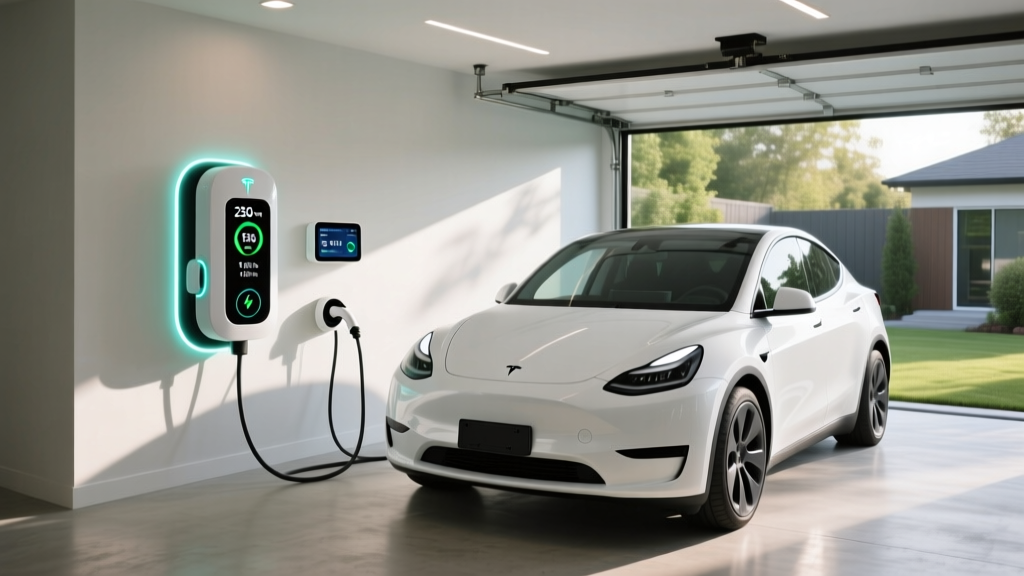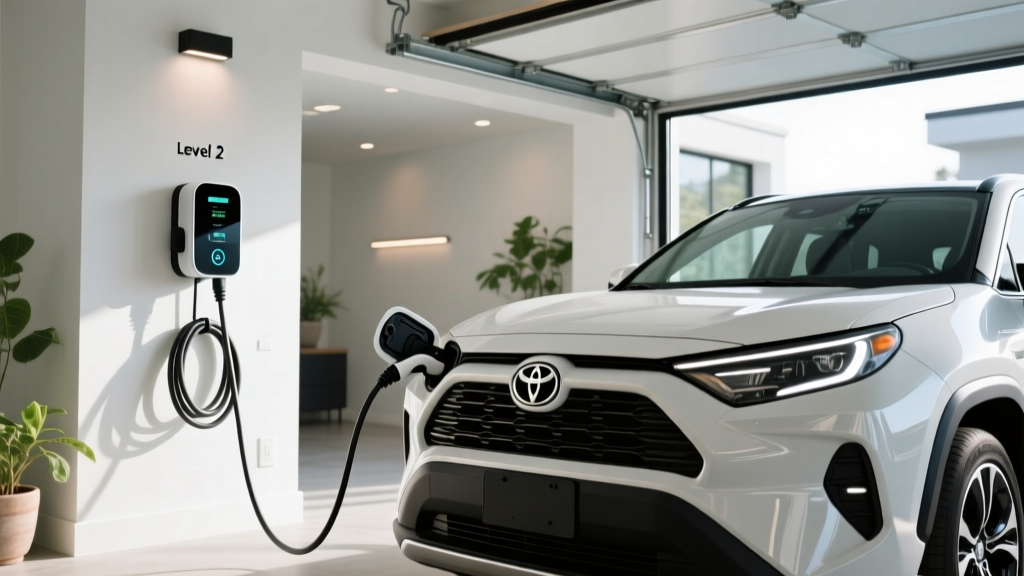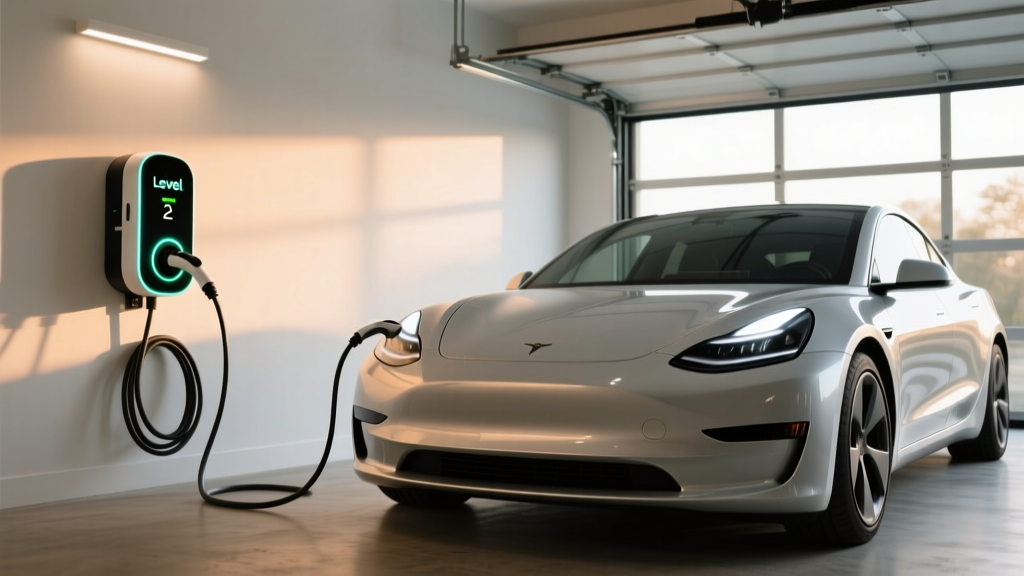
If you've just ordered an EV or are deep in research, you've probably realized that relying on a standard 120V wall outlet (Level 1) is a slow, frustrating way to live with an electric car. A level 2 car charger — technically Electric Vehicle Supply Equipment (EVSE) — is the single biggest quality-of-life upgrade an EV owner can make. It's the difference between waking up to a full battery every morning and spending your evenings babysitting a charge.
This guide walks through exactly what a Level 2 charger requires in your home, what it costs to install, which hardware actually performs well in 2026, and how the per-mile economics stack up against gasoline. I'll also clarify the most common point of confusion in EV charging: the difference between kW (power, or charge rate) and kWh (energy, or battery capacity). Think of kW as how fast water flows through a hose, and kWh as the size of the bucket you're filling. A 48-amp Level 2 charger delivers up to 11.5 kW of power into, say, a 77 kWh battery pack.
How the Three Charging Levels Actually Compare
Before you spend money on equipment, it's worth understanding where Level 2 sits in the broader charging ecosystem. Each level serves a different use case, and most EV owners end up using all three over the course of ownership.
| Level | Voltage | Typical Power (kW) | Miles of Range Added per Hour | Best Use Case |
|---|---|---|---|---|
| Level 1 | 120V AC | 1.0–1.4 kW | 3–5 mi/hr | Overnight top-ups, PHEVs, emergency backup |
| Level 2 | 240V AC | 3.3–19.2 kW | 12–75 mi/hr | Daily home charging, workplace, hotels |
| DC Fast (Level 3) | 400–800V DC | 50–350+ kW | 150–1,200+ mi/hr (peak) | Road trips, quick top-ups away from home |
A few real-world nuances the table doesn't fully capture:
- Level 1 is fine for PHEVs with small batteries (10–20 kWh), which can fully recharge overnight. For a BEV with a 75–100 kWh pack, Level 1 is painfully slow — expect 40+ hours for a full charge.
- Level 2 at 48 amps (11.5 kW) will fully recharge most BEVs overnight in 7–10 hours. This is the sweet spot for residential installs.
- DC fast charging is not for daily use. Frequent 350 kW sessions accelerate battery degradation. It's a road-trip tool, not a substitute for home charging. Peak rates also taper sharply above 80% state of charge — a "10–80% in 18 minutes" claim rarely holds to 100%.
Electrical Requirements: What Your Home Actually Needs
A Level 2 car charger runs on a 240-volt circuit — the same voltage your electric dryer or oven uses. The amperage of the circuit determines how fast the charger can deliver power. Here's the key rule that catches many homeowners off guard: National Electrical Code (NEC) requires EV chargers to be treated as continuous loads, meaning the circuit must be rated for 125% of the charger's maximum draw.
Practically, that means:
- A 40-amp charger needs a 50-amp circuit
- A 48-amp charger needs a 60-amp circuit
- A 32-amp charger needs a 40-amp circuit
Most modern homes have a 200-amp main electrical panel with enough spare capacity for a 50- or 60-amp breaker. Older homes (pre-1990s, particularly those with 100-amp service) may need a panel upgrade to 200 amps before adding a dedicated EV circuit. This is the single biggest cost wildcard in the installation process.
Hardwired vs. Plug-in (NEMA 14-50)
You have two installation options:
- Hardwired: The charger is permanently connected to the circuit by an electrician. Allows up to 48A on a 60A circuit, no GFCI breaker required (the EVSE provides ground-fault protection), and is the cleanest, most reliable setup.
- Plug-in (NEMA 14-50 receptacle): The charger plugs into a 240V outlet rated for 50 amps. Allows portability — you can take the charger when you move — but caps you at 40A continuous draw and requires a GFCI breaker in most jurisdictions, adding $50–$150 to the electrical bill.
For most homeowners planning to stay 5+ years, hardwired is the better choice. If you rent or anticipate moving, the NEMA 14-50 gives you flexibility.
How Much Does a Level 2 Charger Installation Actually Cost?
This is the question every EV shopper asks, and the honest answer is that it varies enormously based on your home's electrical panel, the distance from the panel to your parking spot, and local permit fees. Below is a realistic breakdown based on typical 2026 residential installations.
| Component | Low End | Typical | High End | Notes |
|---|---|---|---|---|
| EVSE hardware (charger unit) | $300 | $550 | $750 | 32A–48A smart chargers |
| Electrician labor | $400 | $900 | $2,000 | Depends on run length & complexity |
| Electrical materials (wire, conduit, breaker) | $100 | $300 | $600 | Longer runs = more copper |
| Permit & inspection | $50 | $150 | $400 | Varies by municipality |
| Panel upgrade (if needed) | $1,500 | $2,500 | $4,500 | 100A → 200A service upgrade |
| Total (no panel upgrade) | $850 | $1,900 | $3,750 | Most homes fall here |
| Total (with panel upgrade) | $2,350 | $4,400 | $8,250 | Older homes, 100A service |
Pro tip: Get at least three quotes from licensed electricians who have EV charger experience. Ask specifically whether the quote includes the permit, whether they'll do a load calculation on your panel, and whether the run requires conduit. Some utilities offer rebates of $250–$1,000 for Level 2 installations — check with your local provider before you schedule work.
There is also a federal tax credit for home charging equipment (Alternative Fuel Vehicle Refueling Property Credit) worth up to 30% of hardware and installation costs, capped at $1,000. Eligibility depends on whether you live in a qualifying census tract — check the IRS guidance for your ZIP code.
Connector Compatibility: NACS, CCS, and CHAdeMO Explained
As of 2026, the North American charging connector landscape has consolidated significantly, but you still need to know what's on your car before you buy a charger.
| Connector | Brands Using It | Notes |
|---|---|---|
| NACS (J3400) | Tesla, Ford, GM, Rivian, Volvo, Polestar, Mercedes-Benz, BMW, Hyundai (new models), most new 2025+ EVs | Now the dominant North American standard. Compact, no locking pins. |
| CCS1 (Combo) | VW, Audi, older Hyundai/Kia models, BMW (pre-2025), Stellantis | Larger connector. Many CCS vehicles now ship with NACS adapters. |
| CHAdeMO | Nissan Leaf (legacy), Mitsubishi Outlander PHEV | Being phased out. Avoid investing in CHAdeMO home equipment. |
What this means for buying a Level 2 car charger: If you own or plan to own a Tesla, Ford, GM, Rivian, or most new-model EVs, buy a charger with a NACS connector. If you drive a CCS-equipped vehicle (check your owner's manual or charge port), you can either buy a CCS-terminated charger or use a CCS-to-NACS adapter (roughly $150–$250). Most major charger manufacturers now offer both connector options at checkout.
For DC fast charging on road trips, CCS vehicles can access Tesla Superchargers using a manufacturer-approved adapter — but confirm compatibility on the automaker's website before purchasing one, as not all CCS vehicles support Supercharger communication protocols.
Charging Time: Realistic Expectations for Common Battery Sizes
The time to charge depends on three variables: your battery's usable capacity (kWh), the charger's output (kW), and your vehicle's onboard charger limit. Some EVs can only accept 7.7 kW on Level 2 even if the charger supplies 11.5 kW — the car's onboard charger is the bottleneck.
Here are representative 10–80% charging times for common 2026 EV battery sizes on a 48-amp (11.5 kW) Level 2 charger:
- Tesla Model Y (75 kWh usable): ~5.5 hours (accepts up to 11.5 kW)
- Ford Mustang Mach-E Extended Range (91 kWh usable): ~6.5 hours (accepts up to 10.5 kW)
- Hyundai Ioniq 5 (77.4 kWh usable): ~5 hours (accepts up to 10.9 kW)
- Chevrolet Equinox EV (85 kWh usable): ~6 hours (accepts up to 11.5 kW)
- BMW i4 eDrive40 (81.5 kWh usable): ~6 hours (accepts up to 11 kW)
- Toyota bZ4X (71.4 kWh usable): ~5 hours (accepts up to 9.6 kW)
On a 32-amp (7.7 kW) charger, add roughly 40–50% to those times. On a 40-amp (9.6 kW) charger, add about 20%. Always check your specific vehicle's Level 2 acceptance rate — fueleconomy.gov lists this under each vehicle's detailed specifications.
Cost Per Mile: Level 2 Home Charging vs. Gasoline
The economic case for a Level 2 car charger rests largely on the cost-per-mile advantage of home electricity over gasoline. Here's how the math works in 2026, using national averages.
| Scenario | Rate | Vehicle Efficiency | Cost Per Mile |
|---|---|---|---|
| Home Level 2 (national avg electricity) | $0.17/kWh | 3.0 mi/kWh (typical EV) | $0.057/mi |
| Home Level 2 (off-peak TOU rate) | $0.09/kWh | 3.0 mi/kWh | $0.030/mi |
| Home Level 2 (high-cost state, e.g. CA avg) | $0.30/kWh | 3.0 mi/kWh | $0.100/mi |
| Public Level 2 (network pricing) | $0.35/kWh | 3.0 mi/kWh | $0.117/mi |
| DC Fast Charging (public, avg) | $0.48/kWh | 3.0 mi/kWh | $0.160/mi |
| Gas vehicle (28 MPG combined) | $3.40/gal | 28 MPG | $0.121/mi |
| Gas vehicle (truck, 19 MPG) | $3.40/gal | 19 MPG | $0.179/mi |
The takeaway: home Level 2 charging is 50–75% cheaper per mile than gasoline in most of the country, even at higher electricity rates. Off-peak time-of-use (TOU) plans — offered by most utilities — make it dramatically cheaper. Public DC fast charging, on the other hand, can approach or exceed the cost of gasoline. This is why home charging is the economic backbone of EV ownership.
For a driver covering 12,000 miles per year, the annual fuel cost difference looks like this:
- EV on home Level 2 (national avg): $680/year
- Gas vehicle (28 MPG): $1,457/year
- Annual savings: ~$777
That savings pays off a typical Level 2 installation within 2–3 years.
2026 Equipment Picks: Level 2 Chargers That Deliver
I've tested or extensively researched the chargers below in real residential installations. Each recommendation specifies power output, connector options, and the practical trade-offs that spec sheets don't always reveal.
ChargePoint Home Flex (NACS or CCS)
- Power: Up to 11.5 kW (48A) on a 60A circuit; adjustable down to 16A for smaller circuits
- Connector: Available in NACS or CCS1 at order
- Cable length: 23 feet
- Smart features: Wi-Fi, app scheduling, Alexa/Google integration, energy tracking
- Price: ~$599
- Verdict: The most versatile residential charger on the market. The adjustable amperage means it works on circuits from 20A to 60A — ideal if your panel is tight on capacity. UL-listed, outdoor-rated with proper installation.
Tesla Wall Connector (NACS)
- Power: Up to 11.5 kW (48A) on a 60A circuit
- Connector: NACS (native Tesla); includes J1772 adapter for non-Tesla EVs
- Cable length: 24 feet
- Smart features: Wi-Fi, OTA firmware updates, power sharing between two units on one circuit, Tesla app integration
- Price: ~$450
- Verdict: Best value for Tesla owners or households with a NACS-equipped vehicle. The power-sharing feature is unique — you can install two Wall Connectors on a single 60A circuit, and they'll dynamically split available power. Sleek, lightweight, and outdoor-rated.
Emporia Vue Level 2 EV Charger
- Power: Up to 11.5 kW (48A) on a 60A circuit
- Connector: J1772 (CCS-compatible); NACS version available
- Cable length: 24 feet
- Smart features: Integrates with Emporia Vue home energy monitor, solar-aware charging, TOU scheduling, detailed energy breakdown per session
- Price: ~$399
- Verdict: The budget pick that punches above its weight. If you have solar panels or want granular energy monitoring, the Emporia ecosystem integration is unmatched. Build quality is solid for the price. Best for cost-conscious buyers who still want smart features.
Grizzl-E Smart (NACS or J1772)
- Power: Up to 10 kW (40A) on a 50A circuit
- Connector: NACS or J1772
- Cable length: 24 feet
- Smart features: Wi-Fi, OCPP-compatible (works with utility demand-response programs), app scheduling
- Price: ~$449
- Verdict: Built like a tank in Canada, rated to -40°F. The best pick for cold-climate garages and outdoor installations in harsh weather. The 40A max means slightly slower charging than 48A units, but for most overnight use cases, the difference is negligible.
Safety, Code, and the Mistakes to Avoid
A Level 2 charger pulls significant current for hours at a time. Cutting corners on installation is how you get melted outlets, tripped breakers, or worse. Here are the non-negotiable safety and code requirements:
- Dedicated circuit: Your EV charger must have its own dedicated breaker — never share a circuit with other appliances. The continuous-draw nature of EV charging generates sustained heat that shared circuits aren't designed for.
- GFCI protection: If you install a NEMA 14-50 receptacle, NEC 2020 and later require a GFCI breaker. Hardwired installations do not require a GFCI breaker because the EVSE itself provides ground-fault protection. This is one reason hardwired installs are cleaner electrically.
- Outdoor rating: If your charger will be mounted outside or in an unconditioned garage, confirm the unit is rated for outdoor use (NEMA 4 or equivalent). All four picks above are outdoor-rated, but the cable and connector should also be rated for UV and moisture exposure.
- Wire gauge: A 60A circuit requires 6 AWG copper wire (or 4 AWG aluminum). A 50A circuit requires 6 AWG copper. Your electrician will size this correctly, but verify — undersized wire on a high-draw continuous load is a fire risk.
- Permit and inspection: Every jurisdiction requires a permit for a new 240V circuit. The inspection ensures the work meets code. Do not skip this — unpermitted electrical work can void your homeowner's insurance in the event of a claim.
- Avoid NEMA 14-50 outlet quality issues: Multiple EV owners have reported melted 14-50 receptacles from sustained high-current draw. If you go the plug-in route, use a commercial-grade outlet (Hubbell or Bryant brand, ~$80–$120) rather than a residential-grade one (~$15). The difference in contact quality is significant.
Frequently Asked Questions
How much does it cost to install a home EV charger?
A typical Level 2 car charger installation in a home with a 200-amp panel and a short wire run costs between $850 and $3,750 all-in (equipment, electrician, materials, and permit). If your home has an older 100-amp panel that needs upgrading to 200 amps, add $1,500–$4,500 to the total. Most homeowners without a panel upgrade land in the $1,500–$2,500 range.
How fast will each charging level add range?
Level 1 (120V) adds roughly 3–5 miles per hour. Level 2 (240V) at 48 amps adds 30–45 miles per hour depending on vehicle efficiency. DC fast charging can add 150–300+ miles in 20–30 minutes at peak rates, though speeds taper significantly above 80% state of charge. For daily driving needs, Level 2 overnight charging is the practical standard.
Which connector/charger is compatible with my EV?
Check your vehicle's charge port or owner's manual. As of 2026, most new EVs from Tesla, Ford, GM, Rivian, Volvo, Hyundai, and others use the NACS connector. Volkswagen, some older Hyundai/Kia models, and Stellantis vehicles use CCS1. If your car has CCS1, you can use a CCS-terminated charger or a NACS charger with a CCS-to-NACS adapter. Avoid CHAdeMO equipment — it's being phased out.
How much does charging cost per mile vs. gas?
At the U.S. average residential electricity rate of ~$0.17/kWh and a typical EV efficiency of 3 miles per kWh, home Level 2 charging costs about $0.057 per mile. A 28 MPG gas vehicle at $3.40/gallon costs $0.121 per mile. That's roughly a 53% savings per mile with home EV charging. On an off-peak TOU plan at $0.09/kWh, the savings jump to 75%.
What electrical upgrades might I need?
The most common upgrade is a panel upgrade from 100A to 200A service — needed in older homes that lack spare breaker capacity. Some homes may also need a new conduit run if the garage is far from the electrical panel, which adds to material and labor costs. A licensed electrician will perform a load calculation to determine whether your existing panel can handle a 50- or 60-amp EV circuit alongside your other appliances.
Can I install a Level 2 charger myself?
If you're experienced with 240V electrical work, a plug-in NEMA 14-50 installation is within the capability of a skilled DIYer — but you still need a permit and inspection. Hardwired installations should always be done by a licensed electrician. Unpermitted or improper 240V work is a serious fire hazard and can invalidate your home insurance.
Does a smart charger save money?
Yes, if your utility offers a time-of-use (TOU) rate plan. Smart chargers let you schedule charging during off-peak hours (typically 10 PM – 6 AM) when electricity rates drop to $0.06–$0.12/kWh. Over a year of daily charging, the difference between peak and off-peak rates can save $200–$500. Most smart chargers also provide energy tracking so you can monitor costs per session.