Two 'Level 2' Definitions Every EV Owner Must Know
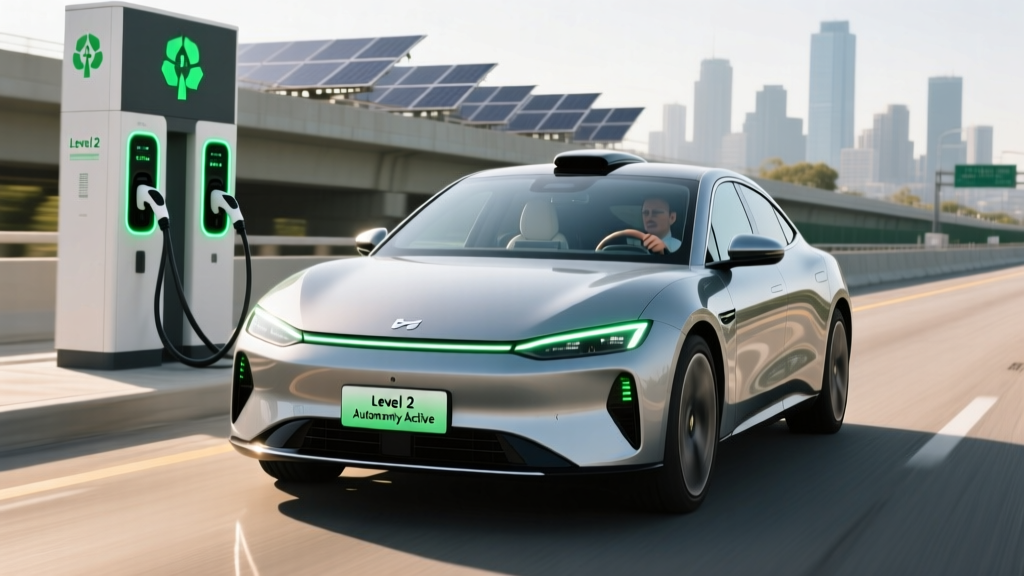
If you've searched "what is level 2 autonomous driving" while researching your next EV, you've probably also run into a completely different "Level 2" — the one that plugs into your car's charge port. The auto industry uses the same phrase for two unrelated systems: SAE Level 2 driver-assist (the software steering your car on the highway) and Level 2 EV charging (the 240-volt hardware refilling your battery at home). Conflating them leads to bad purchase decisions and, in the case of driver-assist, dangerous over-trust of the vehicle.
This guide untangles both definitions with hard numbers: what each Level 2 actually does, what it costs, and how to spec the right equipment for a 2026 EV like the Tesla Model Y, Hyundai Ioniq 5, Ford F-150 Lightning, or Chevrolet Equinox EV.
What Is Level 2 Autonomous Driving? (SAE J3016 Explained)
SAE Level 2 = Partial Driving Automation. Per the SAE J3016 standard, Level 2 means the vehicle can simultaneously control steering and acceleration/braking under specific conditions — but the human driver must continuously supervise and be ready to take over instantly. It is not self-driving.
Every mainstream driver-assist system sold in the U.S. as of 2026 is Level 2: Tesla Autopilot and FSD (Supervised), Ford BlueCruise, GM Super Cruise, Toyota Safety Sense 3.0, Honda Sensing, Hyundai Highway Driving Assist 2, and Nissan ProPILOT Assist 2.0. Even systems that let you take your hands off the wheel on mapped highways (BlueCruise 1.4, Super Cruise) remain Level 2 because the driver is still the responsible agent, monitored by cabin cameras.
What Level 2 driver-assist does NOT do: navigate unmapped roads autonomously, handle construction zones reliably, respond to emergency vehicles consistently, or absolve the driver of legal liability. NHTSA's Standing General Order requires manufacturers to report every crash involving Level 2+ systems — a dataset that shows these systems still require attentive humans behind the wheel.
Only Level 4 robotaxis — Waymo One in Phoenix, San Francisco, and Los Angeles; Zoox in Las Vegas and parts of California — operate without a human driver in the loop. If a salesperson tells you a new 2026 SUV "drives itself," they are either misinformed or misrepresenting a Level 2 system.
Level 2 EV Charging Defined: Power, Speeds, and How It Compares
Switching gears to the other "Level 2": this is the 240-volt AC charging tier that refills your EV's traction battery at home or at public destinations. The term comes from SAE J1772, which defines three AC/DC charging tiers. Here's what each delivers in real-world terms.
| Level | Voltage | Typical Power (kW) | Miles of Range Per Hour | Best Use Case |
|---|---|---|---|---|
| Level 1 | 120V AC | 1.0 – 1.9 kW | 3 – 5 mi/hr | Overnight top-off, PHEVs, emergencies |
| Level 2 | 240V AC | 3.3 – 19.2 kW | 12 – 65 mi/hr | Daily home charging, workplaces, hotels |
| DC Fast (Level 3) | 200 – 900V DC | 50 – 350+ kW | 150 – 1,000+ mi/hr (peak) | Road trips, 10-80% in 15-25 min |
Two critical distinctions: kW (kilowatts) measures power — how fast energy flows into the battery. kWh (kilowatt-hours) measures energy — how much the battery holds. A 77 kWh battery charged at 11.5 kW takes roughly 6.7 hours from empty to full (77 ÷ 11.5). Confusing the two is the single most common EV literacy mistake.
Real-world Level 2 charging times for common 2026 battery packs:
- Tesla Model Y Long Range (75 kWh usable, NMC): ~8 hours at 11.5 kW (48A Wall Connector); ~11 hours at 7.7 kW (32A mobile connector).
- Hyundai Ioniq 5 (77.4 kWh, NMC): ~7 hours at 10.9 kW onboard charger limit.
- Ford F-150 Lightning Extended Range (131 kWh, NMC): ~13 hours at 11.5 kW; ~16 hours at 7.7 kW.
- Chevrolet Equinox EV (85 kWh, NMC): ~7.4 hours at 11.5 kW.
Note: most EVs cap their onboard AC charger between 7.7 kW and 11.5 kW. Installing a 19.2 kW Level 2 station won't charge an Ioniq 5 any faster than its 10.9 kW onboard limit allows.
Home Level 2 Installation: Electrical Requirements and Real Costs
A Level 2 home charger needs a dedicated 240-volt circuit, typically rated 40A to 60A. By NEC Article 625, continuous loads (EV charging runs for hours) must use only 80% of the breaker rating — so a 40A circuit delivers 32A (7.7 kW), a 50A circuit delivers 40A (9.6 kW), and a 60A circuit delivers 48A (11.5 kW).
What Electrical Upgrades Might I Need?
Homes built after 2000 usually have a 200A main panel with enough spare capacity. Older homes with 100A or 125A service, or panels already loaded with electric dryers, ranges, and HVAC, may need one of these upgrades:
- Panel upgrade (100A → 200A): $2,000 – $4,500 installed.
- Sub-panel addition: $800 – $1,800 if the main panel has no physical breaker slots.
- Service drop upgrade (utility side): $1,500 – $3,500 if the meter and utility feed can't support 200A.
- Smart load-management device (e.g., Emporia, Span panel): $400 – $1,200, lets you share capacity between charger and dryer without a panel swap.
How Much Does It Cost to Install a Home EV Charger?
| Line Item | Simple Install (near panel) | Complex Install (long run, panel work) |
|---|---|---|
| Level 2 EVSE hardware | $350 – $650 | $450 – $750 |
| Electrician labor (2–6 hrs @ $90–$160/hr) | $300 – $600 | $800 – $1,800 |
| Materials (wire, conduit, breaker) | $150 – $300 | $400 – $900 |
| Permit and inspection | $75 – $250 | $150 – $400 |
| Panel upgrade (if needed) | $0 | $2,000 – $4,500 |
| Total | $875 – $1,800 | $3,800 – $8,350 |
The federal 30C Alternative Fuel Vehicle Refueling Property Credit (not to be confused with the §30D vehicle credit) can cover up to 30% of home charging equipment and installation costs, capped at $1,000 per year — but only for installations in eligible low-income or rural census tracts per IRS rules. Always confirm eligibility with a tax professional.
Connector Compatibility: NACS, CCS1, CHAdeMO, and Adapter Reality
The 2026 EV market has largely standardized on NACS (North American Charging Standard) — the connector Tesla pioneered and that Ford, GM, Rivian, Volvo, Hyundai, and most other automakers have adopted for new models starting with the 2025 model year. The older CCS1 connector still appears on 2022–2024 used EVs, and CHAdeMO is effectively legacy (Nissan Leaf only).
| Connector | Brands Using It (2026 MY) | Home Level 2? | DC Fast Network Access |
|---|---|---|---|
| NACS (J3400) | Tesla, Ford, GM, Rivian, Hyundai, Kia, Volvo, Polestar, BMW, Mercedes, Nissan (Ariya) | Yes — native | Tesla Supercharger + NACS Electrify America |
| CCS1 | 2022–2024 legacy models (used market), some Stellantis | Yes — native J1772 AC | Electrify America, EVgo, ChargePoint (adapter needed for Superchargers) |
| CHAdeMO | Nissan Leaf (discontinued 2025) | Yes — J1772 AC | Limited, shrinking network |
Adapter needs: CCS1-equipped EVs can use a CCS-to-NACS adapter (~$200–$250 from Tesla or third parties like Lectron) to access Superchargers. NACS-native EVs rarely need adapters except when traveling to older CHAdeMO-only locations. For Level 2 home charging, NACS and CCS1 vehicles both accept a NACS or J1772 wall connector — the AC pins are electrically identical.
Cost to Charge: $/kWh Scenarios and Cost Per Mile vs Gas
How much does charging cost per mile vs gas? The answer depends entirely on where and when you plug in. Electricity prices vary by state, utility, and time-of-use (TOU) rate.
| Scenario | $/kWh | Vehicle Efficiency (kWh/mi) | Cost Per Mile | Gas Equivalent MPG @ $3.60/gal |
|---|---|---|---|---|
| Home off-peak (TOU night rate) | $0.09 | 0.30 (Model Y / Ioniq 5) | $0.027 | 133 MPGe |
| Home standard residential | $0.16 | 0.30 | $0.048 | 75 MPGe |
| Public Level 2 (ChargePoint, Blink) | $0.30 | 0.30 | $0.090 | 40 MPGe |
| DC fast (Electrify America, EVgo) | $0.42 | 0.30 | $0.126 | 29 MPGe |
| Tesla Supercharger V4 | $0.33 | 0.30 | $0.099 | 36 MPGe |
| Gasoline baseline (28 MPG avg sedan) | — | — | $0.129 | 28 MPG |
Bottom line: home off-peak charging is 4–5× cheaper per mile than gasoline. Even public DC fast charging roughly matches a 28 MPG gas car. The savings evaporate only when you rely exclusively on premium-priced public Level 2 stations — a strong argument for installing Level 2 at home.
Per fueleconomy.gov, a 2026 Hyundai Ioniq 5 SE rates at 114 MPGe combined, translating to roughly $0.04/mile on the national average residential rate of ~$0.16/kWh.
Equipment Recommendations: Which Level 2 Chargers to Buy in 2026
When selecting a home Level 2 EVSE, match the charger's power output to both your home's electrical capacity and your EV's onboard charger limit. Here are three proven picks across budgets:
Tesla Wall Connector (Gen 3) — Best Overall
- Power: up to 11.5 kW (48A on 60A circuit)
- Connector: NACS native
- Cable: 24 ft
- Smart features: Wi-Fi, OTA updates, load sharing between two units, Tesla app scheduling
- Price: ~$450
- Best for: Tesla owners, NACS-native EVs, multi-EV households
Emporia Vue Level 2 — Best Value with Smart Load Management
- Power: up to 11.5 kW (48A adjustable down to 16A)
- Connector: J1772 (NACS adapter included)
- Cable: 24 ft
- Smart features: Energy monitoring, solar integration, load management with Emporia panel sensors
- Price: ~$399
- Best for: Solar homes, older panels needing load management, budget buyers
ChargePoint Home Flex — Best for Universal Compatibility
- Power: up to 12 kW (50A adjustable from 16A–50A)
- Connector: J1772 (NACS adapter sold separately)
- Cable: 23 ft
- Smart features: Alexa/Google Home, scheduling, detailed kWh tracking, works with utility demand-response programs
- Price: ~$599
- Best for: Mixed-fleet households, utility rebate participants
All three are NEMA 4 rated for outdoor installation and UL-listed for safety. Hardwired installation is preferred over plug-in (NEMA 14-50 receptacle) because NEC 2023 code updates require GFCI breakers on receptacles — which can nuisance-trip during EV charging. Hardwired connections bypass this issue.
Safety, Code, and Permit Essentials
Skipping permits saves money upfront but creates three real risks: insurance claim denial after an electrical fire, failed home inspection at resale, and potential NEC violations that endanger your household. Here's what code requires:
- Dedicated circuit: the EVSE must have its own breaker, not shared with other appliances (NEC 625.40).
- GFCI protection: required on all receptacle-based installs (NEC 2023 625.54); hardwired units are exempt.
- Outdoor rating: NEMA 4 minimum for outdoor EVSEs; NEMA 3R acceptable in covered carports.
- Cable management: cords cannot cross pedestrian walkways per NEC 625.16 — wall-mount retractors or J-hooks solve this.
- Permit and inspection: required in virtually every U.S. jurisdiction; typical cost $75–$400 depending on locality.
Always hire a licensed electrician who pulls the permit themselves. DIY installs that skip inspection are the leading cause of EV-charging-related insurance disputes.
Frequently Asked Questions
How fast will each charging level add range?
Level 1 adds 3–5 miles per hour. Level 2 adds 12–65 miles per hour depending on amperage (16A–48A) and the vehicle's onboard charger limit. DC fast charging adds 150–1,000+ miles per hour at peak, though the charge curve tapers significantly above 80% State of Charge — expect 10–80% in 15–25 minutes on a 150–350 kW station, then another 20+ minutes for the final 20%.
How much does it cost to install a home EV charger?
A straightforward Level 2 install near the electrical panel with adequate capacity runs $875–$1,800 all-in (hardware, labor, materials, permit). Installations requiring long conduit runs, sub-panels, or a 200A service upgrade can reach $3,800–$8,350. Always get three quotes and verify the electrician pulls a permit.
Which connector/charger is compatible with my EV?
For 2026 model-year vehicles: nearly every new EV sold in the U.S. uses NACS (Tesla, Ford, GM, Hyundai, Kia, Rivian, Volvo, BMW). Older 2022–2024 models may have CCS1. The Nissan Leaf was the last CHAdeMO vehicle and was discontinued in 2025. For home Level 2, a NACS wall connector works natively with new EVs; a J1772 unit works with everything via adapter.
How much does charging cost per mile vs gas?
Home off-peak charging averages $0.027/mile — roughly 4.8× cheaper than the $0.129/mile cost of a 28 MPG gas car at $3.60/gallon. Standard home rates (~$0.16/kWh) yield ~$0.048/mile. Public DC fast charging ($0.33–$0.42/kWh) roughly matches gasoline costs per mile.
Is Level 2 autonomous driving the same as Level 2 charging?
No. SAE Level 2 autonomous driving refers to partial driving automation (lane-centering + adaptive cruise) where the driver must remain engaged. Level 2 EV charging refers to 240V AC charging hardware that delivers 3.3–19.2 kW. The shared numbering is a coincidence of two different SAE standards (J3016 for automation, J1772 for charging).
What electrical upgrades might I need?
If your home has a 200A panel with two or more open breaker slots, you likely need no upgrade. If you have a 100A or 125A panel, a full or heavy electrical load, or no physical space for a new double-pole breaker, expect a panel upgrade ($2,000–$4,500) or a smart load-management device ($400–$1,200) that dynamically shares capacity between the charger and other appliances.