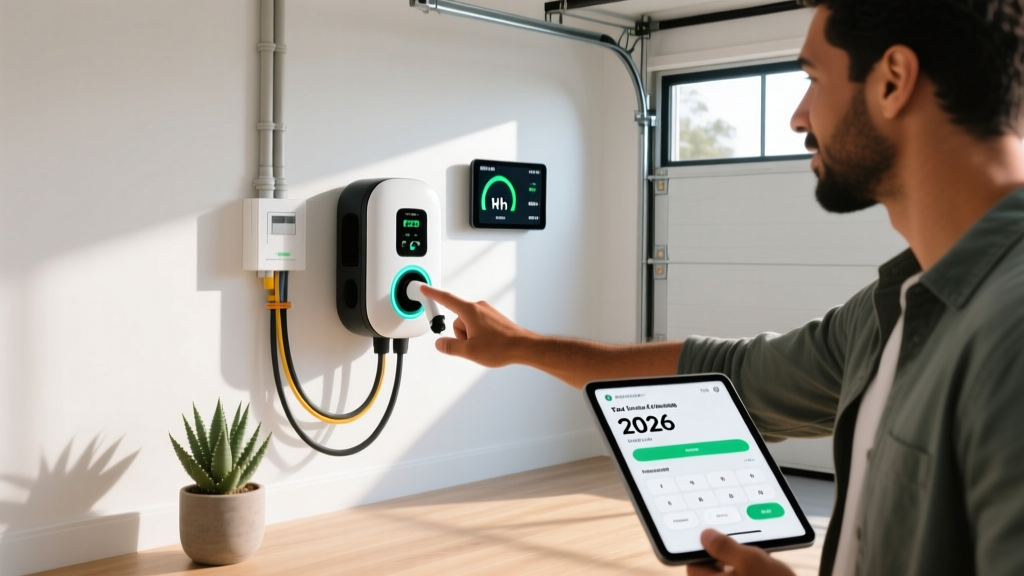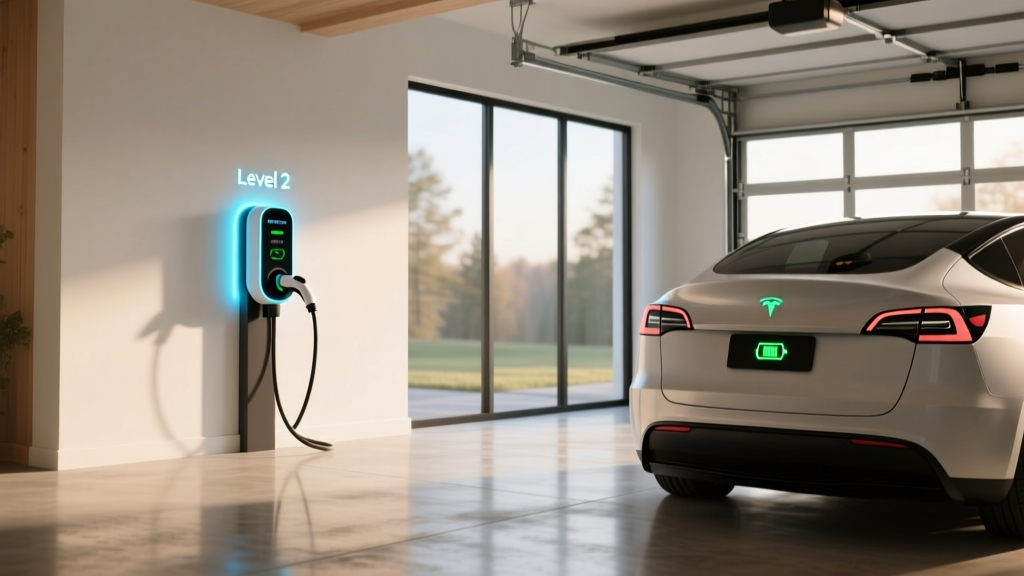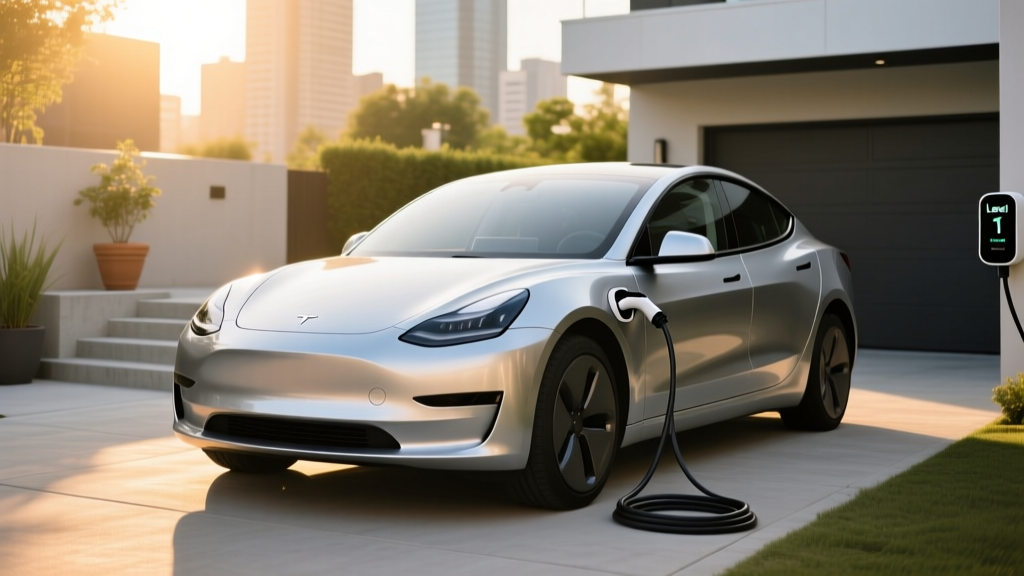
Plug into any standard 120V household outlet and you're Level 1 charging. It's the simplest, cheapest way to fuel an electric vehicle — no electrician, no permits, no $500 wall box. But with EV batteries growing past 80 kWh and daily commutes stretching longer, the question for 2026 buyers is whether level 1 EV chargers can actually keep pace with real life, or if they're just an emergency backup cord gathering dust in your frunk.
The honest answer depends on your battery size, your daily mileage, and how much patience you have. Let's run the numbers.
Charging Levels Explained: kW, Miles Per Hour, and What They Mean
Before evaluating Level 1, you need to understand the three charging tiers and how they differ in power delivery. Power is measured in kW (kilowatts) — the rate of flow. Energy is measured in kWh (kilowatt-hours) — the total amount stored in your battery. A charger's kW rating tells you how fast it can push energy in; your battery's kWh capacity tells you how much it holds.
| Level | Voltage | Power (kW) | Miles of Range Added Per Hour | Typical Use Case |
|---|---|---|---|---|
| Level 1 | 120V AC | 1.0–1.4 kW | 3–5 miles | Overnight home, PHEVs, low-mileage drivers |
| Level 2 | 240V AC | 3.3–19.2 kW | 12–75 miles | Home wall charger, workplace, public AC |
| DC Fast Charge | 400–800V DC | 50–350 kW | 150–1,200+ miles (peak) | Road trips, highway corridors, commercial fleets |
Level 1 charging delivers roughly 1.2 kW continuously on a standard 15-amp household circuit (120V × 12A usable = 1.44 kW, minus conversion losses). That translates to about 3 to 5 miles of range per hour of charging, depending on your vehicle's efficiency. A highly efficient sedan like the Hyundai Ioniq 6 (roughly 3.5 miles/kWh) will squeeze more range from each kWh than a heavier, less aerodynamic SUV like the Ford F-150 Lightning (around 2.0 miles/kWh).
Charging Time Examples: How Long Level 1 Actually Takes
The gap between Level 1 and faster options becomes stark when you look at real charging times. Here's how common 2026 battery sizes fare across charging levels, measured from 10% to 80% state of charge (the practical daily charging window — charging above 80% slows dramatically to protect battery health).
| Vehicle (Example) | Battery (kWh usable) | Level 1 (1.2 kW) | Level 2 (7.7 kW / 32A) | Level 2 (11.5 kW / 48A) | DC Fast (peak kW) |
|---|---|---|---|---|---|
| Chevrolet Equinox EV | 85 kWh | ~49 hours | ~7.7 hours | ~5.2 hours | ~28 min (150 kW peak) |
| Tesla Model Y Long Range | 75 kWh | ~44 hours | ~6.8 hours | ~4.6 hours | ~25 min (250 kW peak) |
| Hyundai Ioniq 5 | 77.4 kWh | ~45 hours | ~7.0 hours | ~4.7 hours | ~18 min (240 kW peak, 800V) |
| Toyota RAV4 Prime (PHEV) | 18.1 kWh | ~10.5 hours | ~1.7 hours | ~1.1 hours | N/A (no DC fast) |
| Ford F-150 Lightning Ext. Range | 131 kWh | ~76 hours | ~12 hours | ~8 hours | ~41 min (150 kW peak) |
The takeaway: Level 1 charging a large-battery BEV from near-empty is measured in days, not hours. But for a PHEV with an 18 kWh battery, an overnight Level 1 session can fully replenish the electric-only range. This is why Level 1 remains genuinely viable for plug-in hybrid owners and low-mileage BEV drivers, but inadequate for high-use BEV households.
Electrical Requirements and Installation: What Level 1 Needs (and Doesn't)
Level 1's biggest advantage is simplicity. Every EV and PHEV sold in the US ships with a Level 1 charging cord (though some manufacturers have moved to selling it as an accessory — check your specific model). You plug it into a standard NEMA 5-15 household outlet. No electrician required, assuming your outlet is in good condition and on a dedicated or lightly loaded 15-amp or 20-amp circuit.
Level 1 Electrical Basics
- Voltage: 120V AC (standard US household)
- Amperage: 12A continuous draw on a 15A circuit (NEC requires continuous loads stay at 80% of circuit rating)
- Circuit requirement: Ideally a dedicated 15A or 20A circuit. Sharing a circuit with a refrigerator, freezer, or space heater risks tripping the breaker during long charging sessions.
- Outlet condition: Older or worn outlets can overheat under sustained 12A draw. If the plug feels warm after an hour, replace the outlet with a commercial-grade NEMA 5-15R.
- GFCI: NEC 2020 and later require GFCI protection for garage and outdoor outlets. If your garage outlet isn't GFCI-protected, an electrician can add one for $50–$150.
When You Need an Electrician for Level 1
Most Level 1 users never call an electrician. But you should if:
- Your nearest outlet is on a shared circuit that trips during charging
- You need a new 120V outlet run to where you park (typical cost: $150–$400)
- Your home has older wiring (knob-and-tube, ungrounded outlets) that isn't safe for sustained EV loads
- You want a dedicated 20A circuit for slightly faster Level 1 (1.9 kW vs 1.4 kW) — some EV cords support this with a NEMA 5-20 adapter
Level 2 Upgrade: Installation Costs and Electrical Upgrades
If Level 1 proves insufficient — and for most BEV owners, it eventually does — the next step is a Level 2 home charger on a 240V circuit. This is where costs and complexity increase significantly, and where many buyers get surprised.
| Item | Low-End Estimate | High-End Estimate | Notes |
|---|---|---|---|
| Level 2 charger (hardware) | $200 | $700 | 32A–48A smart chargers; Wi-Fi enabled models cost more |
| Electrician labor | $400 | $1,500 | Depends on distance from panel to garage/carport |
| Electrical permit | $50 | $250 | Required in most jurisdictions; varies by municipality |
| Panel upgrade (if needed) | $1,500 | $4,000+ | Older 100A panels often need upgrade to 200A for a 40A+ EV circuit |
| Conduit/wiring materials | $100 | $600 | Long runs from panel to parking spot add cost |
| Total (no panel upgrade) | $750 | $3,050 | Typical for homes with 200A service and nearby panel |
| Total (with panel upgrade) | $2,250 | $7,050+ | Common in pre-1990 homes with 100A or 150A service |
Level 2 Electrical Requirements
- Voltage: 240V AC (same as your dryer or oven)
- Amperage: 32A (7.7 kW), 40A (9.6 kW), or 48A (11.5 kW) are the most common
- Circuit sizing: NEC requires a circuit rated 125% of continuous load — a 40A charger needs a 50A circuit; a 48A charger needs a 60A circuit
- Wiring: Typically 6 AWG copper for 48A/60A circuits; 8 AWG for 32A/40A circuits
- Hardwired vs. plug: Hardwired is required for circuits over 50A in many jurisdictions. NEMA 14-50 outlets (50A) are common for plug-in units but require GFCI breakers under current NEC, which can cause nuisance tripping with some chargers.
Connector Compatibility: NACS, CCS1, and CHAdeMO
The connector landscape has consolidated significantly since Ford, GM, Rivian, and most major automakers adopted the North American Charging Standard (NACS) — originally developed by Tesla — starting in the 2025 model year. Here's where things stand for 2026 vehicles:
| Connector | Brands Using It (Native) | Adapter Needed For |
|---|---|---|
| NACS (J3400) | Tesla (all), Ford, GM, Rivian, Volvo, Polestar, Mercedes-Benz, BMW, Hyundai/Kia (2026+), Lucid, Fisker | Legacy CCS1 public chargers (adapter usually included or ~$200) |
| CCS1 | Remaining 2024–2025 models still on the road; VW ID.4 (through 2025), some Stellantis models | Tesla Superchargers (CCS-to-NACS adapter required) |
| CHAdeMO | Nissan Leaf (discontinued after 2025); Mitsubishi Outlander PHEV | Limited public infrastructure; no adapter to NACS for DC fast charging |
For Level 1 and Level 2 AC charging, the connector difference is less critical than it seems. All EVs use the same J1772 inlet for AC charging — or a NACS inlet that accepts J1772 via a small adapter (usually included with the vehicle). The NACS vs. CCS split primarily matters for DC fast charging on public networks. At home, your Level 1 cord will plug into your car regardless of whether it's NACS or CCS-equipped, because the AC portion of both connectors is functionally compatible via adapters.
Cost to Charge: Level 1 vs. Gas and Other Charging Methods
Level 1 charging is almost always done at home, which means you're paying residential electricity rates — the cheapest fuel source available to EV owners. Here's how the per-mile cost stacks up:
| Scenario | Rate | Cost Per Mile (Efficient EV: 3.5 mi/kWh) | Cost Per Mile (Truck/SUV: 2.0 mi/kWh) |
|---|---|---|---|
| Home Level 1 / Level 2 (national avg. $0.17/kWh) | $0.17/kWh | $0.049 | $0.085 |
| Home off-peak TOU rate ($0.08/kWh) | $0.08/kWh | $0.023 | $0.040 |
| Public Level 2 ($0.30–$0.50/kWh) | $0.40/kWh avg. | $0.114 | $0.200 |
| DC Fast Charging ($0.35–$0.65/kWh) | $0.50/kWh avg. | $0.143 | $0.250 |
| Gasoline ($3.40/gal, 28 MPG combined) | $3.40/gal | — | $0.121 (at 28 MPG) |
| Gasoline ($3.40/gal, 18 MPG truck) | $3.40/gal | — | $0.189 (at 18 MPG) |
At residential rates, Level 1 and Level 2 cost exactly the same per kWh — the only difference is how long you wait. Home charging at off-peak time-of-use (TOU) rates delivers fuel costs at roughly one-third to one-quarter the per-mile cost of gasoline. Even DC fast charging at highway rates is competitive with or cheaper than gas for most vehicles.
One Level 1 nuance: because the charge takes longer, some utilities' TOU windows may not accommodate a full session. If your off-peak window runs from 11 PM to 7 AM (8 hours), you'll add roughly 10 kWh — about 20–35 miles of range. That's fine for daily top-ups but won't recover from a long day trip.
Equipment Recommendations: Level 1 Cords and When to Upgrade
Most 2026 EVs ship with a dual-voltage portable cord that handles both Level 1 (120V) and Level 2 (240V with the right outlet). If yours doesn't, or you need a replacement, here are proven options:
Tesla Mobile Connector
Price: $200 (included with new Teslas starting 2025)
Power: 1.2 kW (120V / NEMA 5-15) / 3.3–7.7 kW (240V with adapter)
Cable length: 20 feet
Connector: NACS native
Smart features: None (basic cord); scheduling via Tesla app
Simple, reliable, compact. The NEMA 5-15 adapter is included; NEMA 14-50 and 6-20 adapters sold separately ($35–$45 each).
Emporia Level 2 EV Charger (also does Level 1)
Price: $399
Power: Up to 11.5 kW (240V/48A hardwired) or 1.4 kW (120V with included adapter)
Cable length: 24 feet
Connector: J1772 (NACS adapter included for 2026 models)
Smart features: Wi-Fi, energy monitoring, solar integration, TOU scheduling via app
Best value in smart chargers. Real-time energy tracking pairs with Emporia VUE panel monitor for load management.
ChargePoint Home Flex
Price: $549
Power: Up to 12 kW (240V/50A hardwired) or 1.4 kW (120V)
Cable length: 23 feet
Connector: J1772 or NACS (select at purchase)
Smart features: Wi-Fi, Alexa/Google integration, flexible amperage settings (16A–50A), detailed app scheduling
Adjustable amperage is the standout feature — dial it down to match your circuit if a full 50A isn't available.
If you're a PHEV owner with under 40 miles of electric range and a short commute, a quality Level 1 cord is likely all you need. For BEV owners, treat Level 1 as your travel/emergency cord and invest in a Level 2 installation for daily use.
Safety and Code Considerations
EV charging draws sustained, high-current loads for hours — unlike most household appliances. Safety isn't optional:
- Dedicated circuit: Level 1 should ideally be on a circuit not shared with high-draw appliances. A tripped breaker at 3 AM means no commute in the morning.
- Outlet inspection: Check for discoloration, warmth, or loose plug fit. Replace any suspect outlet with a commercial-grade (spec-grade) NEMA 5-15R rated for continuous use.
- GFCI protection: Required for garage and outdoor outlets under NEC 2020+. Ensure your outlet is GFCI-protected — either via a GFCI breaker or a GFCI receptacle.
- Outdoor rating: If charging outside, use a charger rated NEMA 4 (weatherproof). Don't leave a Level 1 cord's control module sitting in a puddle — mount it or keep it elevated.
- Extension cords: Never use an extension cord with a Level 1 EV charger. The sustained 12A draw can overheat undersized cords. If you need more reach, have an electrician install an outlet closer to your parking spot.
- Permits: Level 1 on an existing outlet requires no permit. Any new circuit or outlet installation does — check your local building department.
Frequently Asked Questions
Can Level 1 EV chargers fully charge a battery electric vehicle overnight?
For most modern BEVs with 70+ kWh batteries, no. A 10-hour overnight session adds roughly 12 kWh — about 30 to 50 miles of range. That's enough for short commutes but won't replenish a depleted battery. PHEVs with 15–20 kWh batteries, however, can fully recharge overnight on Level 1.
Is Level 1 charging bad for my EV battery?
No. Level 1 charging is actually gentle on batteries because the low power generates minimal heat. Slow AC charging is associated with less long-term degradation than repeated DC fast charging. According to data from fueleconomy.gov, modern EV batteries typically retain 85–90% capacity after 100,000 miles regardless of charging method, though heat from frequent DC fast charging in hot climates can accelerate loss slightly.
How much does it cost to install a home EV charger?
Level 1 on an existing outlet: $0. A new dedicated 120V outlet: $150–$400. A full Level 2 installation (charger + electrician + permit, no panel upgrade): $750–$3,050. With a panel upgrade from 100A to 200A: $2,250–$7,050+. Get at least three quotes from licensed electricians — prices vary enormously based on your home's layout and panel location.
Can I use a Level 1 charger with a NACS-equipped vehicle?
Yes. All NACS-equipped vehicles can accept Level 1 AC power through the NACS inlet using the included J1772-to-NACS adapter, or directly if the charging cord has a NACS plug. For 2026 models, most portable cords now ship with NACS connectors or include the adapter in the box.
Is it worth buying a heavier-duty Level 1 cord for 240V capability?
If you have access to a 240V outlet (NEMA 14-50, NEMA 6-20, or NEMA 10-30 — common for dryers and welders), a dual-voltage portable cord can deliver 3.3 to 7.7 kW on 240V — essentially giving you Level 2 speeds without a hardwired installation. This is an excellent middle-ground solution for renters or homeowners who don't want to invest in a permanent wall charger.
How fast will each charging level add range?
Level 1: 3–5 miles per hour. Level 2 (7.7 kW): 20–30 miles per hour. Level 2 (11.5 kW): 30–45 miles per hour. DC fast charging (150+ kW): 150–400+ miles in 20–30 minutes, though the charge curve tapers significantly above 80% SoC. Your actual results depend on vehicle efficiency (miles per kWh), which varies from roughly 2.0 mi/kWh for heavy trucks to 4.0 mi/kWh for efficient sedans.
For more on federal incentives that can offset home charging installation costs, see the IRS clean vehicle credit guidelines, which also cover certain home energy infrastructure under the §25C Energy Efficient Home Improvement Credit — potentially covering up to $1,000 of electrical panel upgrades.