Most electric vehicles ship with a portable Level 1 charging cable that plugs into a standard 120-volt household outlet. For some owners, this is all they need. For others, it is a frustrating bottleneck that adds days to a road-trip recharge. Understanding exactly what level 1 charging speed delivers — in kilowatts, miles per hour, and total charge time — is the first step to deciding whether you can live with it or need to invest in a faster home setup.
This guide covers the physics of Level 1 charging, how it compares to Level 2 and DC fast charging, what electrical upgrades you might need for a home installation, connector compatibility across EV brands, and the true cost of charging at home versus on the road.
What Level 1 Charging Speed Actually Delivers
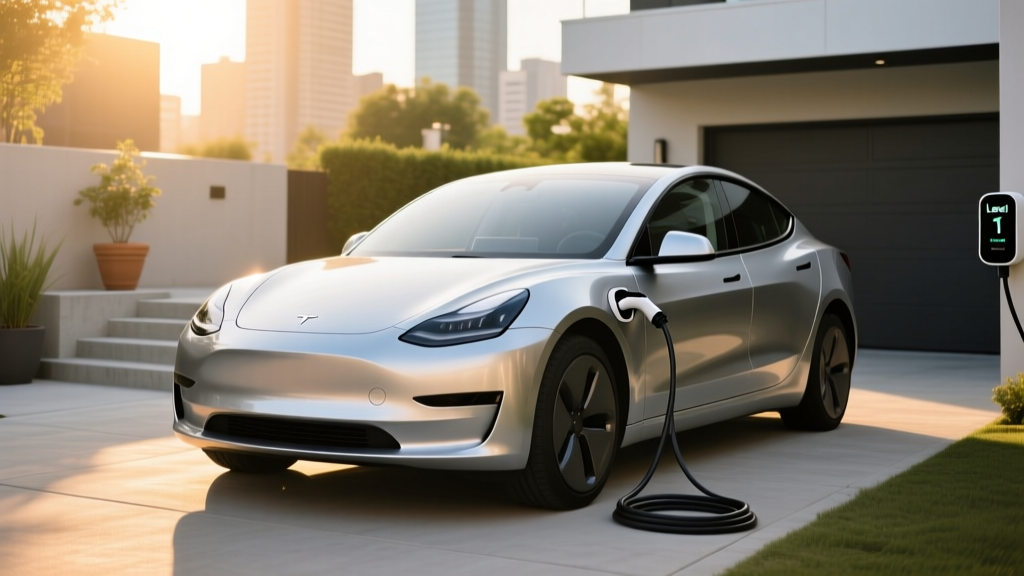
Level 1 charging uses a standard North American 120V AC outlet (NEMA 5-15 or 5-20). The onboard charger inside your EV converts that AC power into DC to store in the battery. Here is what that looks like in real numbers:
- 120V × 12 amps (standard outlet, continuous draw derated 80%) = 1.44 kW
- 120V × 16 amps (20A circuit, 80% derated) = 1.92 kW
Most Level 1 EVSE (electric vehicle supply equipment) cords are rated for 12 amps, yielding a sustained 1.2 to 1.4 kW charge rate. Some aftermarket cords can pull 16 amps on a dedicated 20A circuit, pushing closer to 1.9 kW. At these power levels, you add roughly 3 to 5 miles of range per hour depending on your vehicle's efficiency.
That means a full charge from empty on a 75 kWh battery pack at 1.4 kW takes approximately 54 hours — well over two full days. A more practical scenario: plugging in overnight for 10 hours adds 30 to 50 miles of range, which covers the average American commute round-trip but leaves little buffer for errands or detours.
Level 1 vs. Level 2 vs. DC Fast Charging: Speed Comparison
To put level 1 charging speed in perspective, here is how all three charging levels stack up:
| Charging Level | Voltage / Amps | Power (kW) | Miles of Range Added Per Hour | Best For |
|---|---|---|---|---|
| Level 1 | 120V / 12–16A | 1.2–1.9 kW | 3–5 mi/hr | Overnight top-ups, PHEVs, low-mileage drivers |
| Level 2 | 240V / 32–48A | 7.7–11.5 kW | 20–45 mi/hr | Daily home charging, most BEV owners |
| DC Fast | 200–500V+ DC | 50–350 kW | 150–1,000+ mi/hr | Road trips, quick top-ups away from home |
The distinction between kW (power) and kWh (energy) is critical here. Your battery capacity is measured in kWh — for example, a 2025 Hyundai Ioniq 5 has a 77.4 kWh usable battery. The charger's kW rating tells you how fast energy flows into that battery. Think of kW as the width of a hose and kWh as the size of the bucket. A Level 1 charger at 1.4 kW is a thin straw; a 350 kW DC fast charger is a fire hose.
Charging Time Examples: Level 1 vs. Level 2 for Common EVs
Here is how long a 10% to 80% charge takes at different power levels for several popular EVs. We cap at 80% because charging slows significantly above that threshold to protect battery health — a phenomenon called the charge curve taper.
| Vehicle | Usable Battery (kWh) | Level 1 (1.4 kW): 10–80% | Level 2 (11.5 kW): 10–80% | DC Fast (peak kW): 10–80% |
|---|---|---|---|---|
| 2025 Tesla Model 3 LR | 75 kWh | ~37 hours | ~4.5 hours | ~25 min (250 kW peak) |
| 2025 Hyundai Ioniq 5 | 77.4 kWh | ~38 hours | ~4.7 hours | ~18 min (240 kW peak) |
| 2025 Chevrolet Equinox EV | 85 kWh | ~42 hours | ~5.2 hours | ~30 min (150 kW peak) |
| 2025 Ford F-150 Lightning ER | 131 kWh | ~65 hours | ~8 hours | ~41 min (210 kW peak) |
| 2025 Toyota Prius Prime (PHEV) | 13.6 kWh | ~6.5 hours | ~1 hour | N/A (no DC fast) |
Home Charging Installation: Electrical Requirements and Costs
If Level 1 is not fast enough for your driving pattern, a Level 2 home charger is the most impactful upgrade you can make. Here is what a Level 2 installation requires electrically and what it costs.
Electrical Requirements for Level 2
A Level 2 charger requires a 240V dedicated circuit — the same voltage your electric dryer or oven uses. Common configurations:
- NEMA 14-50 outlet: 240V, 50A circuit (delivers up to 40A continuous / 9.6 kW). This is the most popular option because it allows you to unplug and take the charger if you move.
- Hardwired connection: 240V, 60A circuit (delivers up to 48A continuous / 11.5 kW). Required for the fastest Level 2 chargers. Eliminates the outlet as a potential failure point and may not require GFCI breaker in some jurisdictions.
- NEMA 6-50 outlet: 240V, 50A circuit (3-prong, no neutral). Common in older homes with electric dryers. Works with many Level 2 EVSE units.
Panel Upgrade Considerations
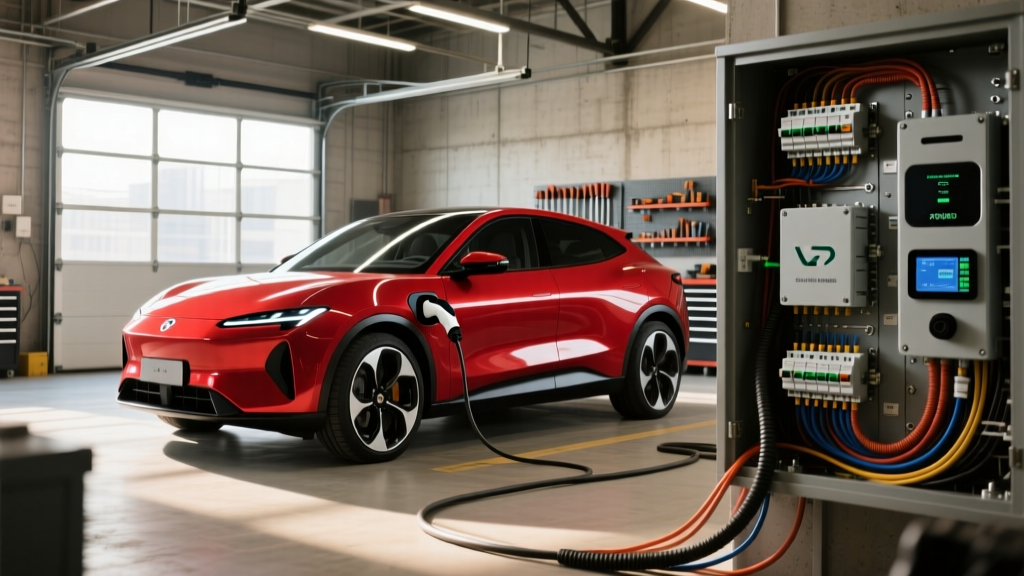
Many homes built before 2000 have 100A or 150A electrical panels. Adding a 50A or 60A EV circuit may push total load beyond the panel's capacity, especially if you already run electric heat, a dryer, and an electric range. An electrician will perform a load calculation (per NEC Article 220) to determine if your panel can handle the additional circuit.
If a panel upgrade is needed — from 100A to 200A, for instance — expect to add $1,500 to $3,500 to your project cost. This is the single biggest variable in home EV charger installation and the one most online cost estimates omit.
| Cost Component | Low End | High End | Notes |
|---|---|---|---|
| Level 2 EVSE equipment | $250 | $700 | Smart chargers with Wi-Fi cost more |
| Electrician labor (outlet install) | $300 | $1,200 | Depends on distance from panel to garage |
| Permit and inspection | $50 | $250 | Required in most jurisdictions |
| Electrical panel upgrade (if needed) | $1,500 | $3,500 | Only if existing panel lacks capacity |
| Total (no panel upgrade) | $600 | $2,150 | Typical for newer homes with 200A panel |
| Total (with panel upgrade) | $2,100 | $5,650 | Older homes or high-load households |
The federal government and many utilities offer incentives that offset installation costs. Some states provide rebates of $250–$500 for Level 2 charger installation, and certain utilities offer off-peak charging rebates. Check with your local utility and visit afdc.energy.gov for a state-by-state incentive database.
Safety and Electrical Code
Any Level 2 installation must comply with NEC Article 625 (Electric Vehicle Charging System Equipment). Key requirements:
- Dedicated circuit: The EV charger must be on its own breaker — no sharing with other outlets or appliances.
- GFCI protection: Required for receptacle-based (outlet) installations. Hardwired units may be exempt depending on local code interpretation.
- Outdoor rating: If your charger is outdoors, the EVSE must carry a NEMA 4 or NEMA 4X rating for weather resistance, and the outlet must have an in-use weatherproof cover.
- Wire gauge: A 50A circuit requires 6 AWG copper wire; a 60A circuit requires 4 AWG. Undersized wire is a fire hazard and will fail inspection.
Always hire a licensed electrician. Permits and inspections protect you — an unpermitted installation can void home insurance coverage if an electrical fire occurs.
Connector Compatibility: NACS, CCS, and CHAdeMO
The physical connector that plugs into your EV matters for both home and public charging. As of 2025–2026, the North American market has largely standardized around two connectors for Level 2 charging, with a third legacy standard still in use:
| Connector | Brands Using It | Level 2 (AC) | DC Fast | Adapter Needed? |
|---|---|---|---|---|
| NACS (Tesla) | Tesla; Ford, GM, Rivian, Hyundai, Kia, Volvo, others (2025+ models) | Yes (J3400 standard) | Yes | CCS→NACS adapter for older CCS vehicles at Superchargers |
| CCS1 (J1772 Combo) | VW ID.4, BMW iX, some 2024 and older models from Ford/GM/Hyundai | Yes (J1772 upper portion) | Yes | NACS→CCS adapter for Tesla Superchargers |
| CHAdeMO | Nissan Leaf (legacy); Mitsubishi Outlander PHEV | Uses J1772 for AC | Yes (separate port) | No adapter for DC; CHAdeMO stations declining |
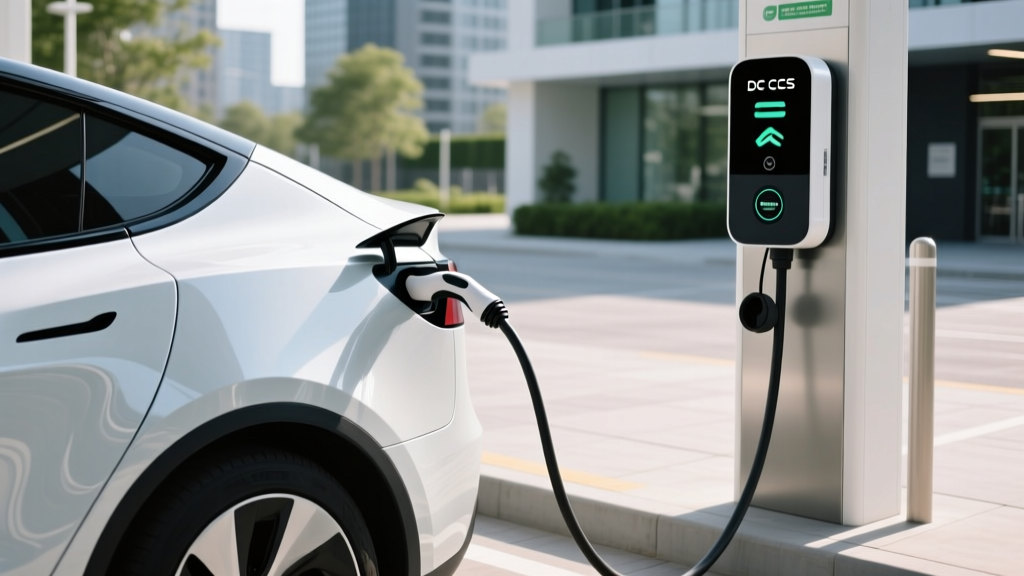
For Level 1 and Level 2 AC charging, all non-Tesla EVs use the J1772 connector (the upper portion of the CCS1 plug). Tesla vehicles include a J1772 adapter in the glovebox. Most Level 2 home chargers ship with a J1772 plug, and Tesla-to-J1772 adapters are widely available for under $30.
Starting in 2025, automakers migrating to NACS (the Tesla connector) are shipping vehicles with native NACS ports. If you buy a Level 2 home charger, confirm it has the correct connector for your vehicle — or buy a charger with a J1772 plug and use your vehicle's included adapter.
Cost to Charge: Level 1, Level 2, and DC Fast Compared to Gas
One of the strongest arguments for EV ownership is fuel cost savings, but the numbers depend heavily on where and when you charge.
| Charging Scenario | Cost per kWh | Cost per Mile (3.5 mi/kWh EV) | Cost per Mile (2.0 mi/kWh EV) |
|---|---|---|---|
| Home off-peak (utility rate) | $0.08–$0.12 | $0.023–$0.034 | $0.040–$0.060 |
| Home standard rate | $0.14–$0.18 | $0.040–$0.051 | $0.070–$0.090 |
| Public Level 2 (ChargePoint, etc.) | $0.20–$0.35 | $0.057–$0.100 | $0.100–$0.175 |
| DC Fast (Electrify America, EVgo) | $0.30–$0.55 | $0.086–$0.157 | $0.150–$0.275 |
| Gasoline baseline (28 MPG, $3.40/gal) | — | $0.121 | $0.121 |
At home off-peak rates, Level 1 and Level 2 charging cost the same per kWh — the speed differs, not the electricity price. Charging an efficient EV like the Model 3 at home costs roughly $0.03 per mile, compared to $0.12 per mile for a 28 MPG gas car. Over 12,000 miles per year, that is a savings of roughly $1,080 annually.
DC fast charging at public stations, however, can approach or even exceed the cost of gasoline on a per-mile basis. This is why home charging — even at Level 1 speeds — is the economic sweet spot for EV ownership.
Recommended Level 1 and Level 2 Home Chargers
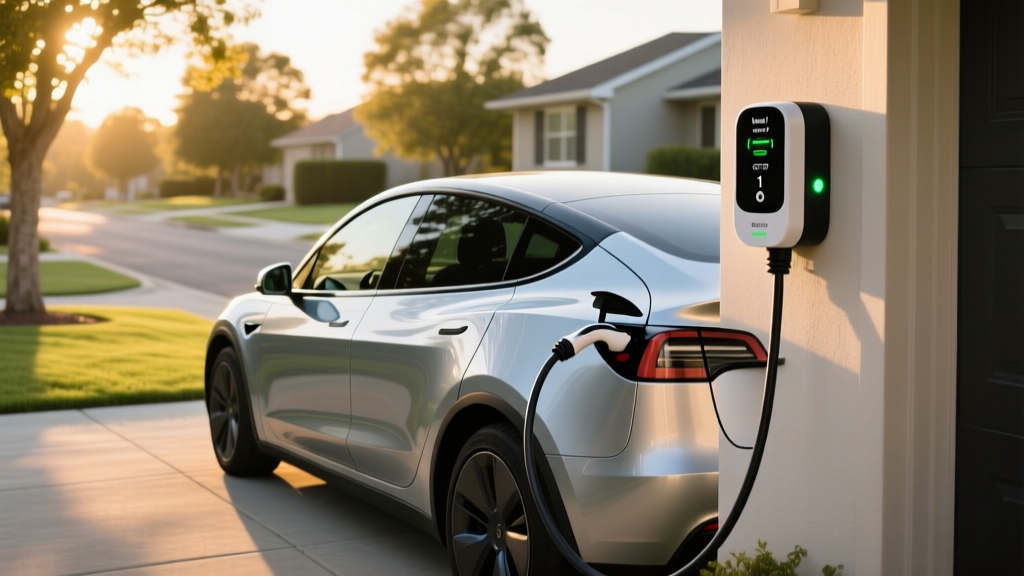
If Level 1 charging speed meets your needs, the portable cord that came with your EV may be sufficient. But if you want a dedicated Level 1 unit with better cable management, or if you are ready to upgrade to Level 2, here are specific recommendations:
Best Level 1 Chargers (120V)
Emporia Level 1 EV Charger
- Power output: 1.44 kW (12A, 120V)
- Connector: J1772
- Cable length: 24 ft
- Smart features: Wi-Fi, app scheduling, energy tracking
- Price: ~$180
Lectron V-BOX Pro (120V mode)
- Power output: 1.44 kW (12A) or 1.92 kW (16A on 20A circuit)
- Connector: J1772 or NACS
- Cable length: 21 ft
- Smart features: Adjustable amperage, LED status indicator
- Price: ~$150
Best Level 2 Chargers (240V) — If You Decide to Upgrade
ChargePoint Home Flex
- Power output: Up to 11.5 kW (48A, hardwired) or 9.6 kW (40A, NEMA 14-50)
- Connector: J1772 (NACS adapter available)
- Cable length: 23 ft
- Smart features: Wi-Fi, Alexa, app scheduling, Alexa integration
- Price: ~$550–$700
Tesla Wall Connector
- Power output: Up to 11.5 kW (48A, hardwired 60A circuit)
- Connector: NACS native (J1772 adapter included)
- Cable length: 24 ft
- Smart features: Wi-Fi, power sharing with second unit, OTA updates
- Price: ~$475
Emporia Vue EV Charger
- Power output: Up to 11.5 kW (48A hardwired) or 9.6 kW (40A plug-in)
- Connector: J1772
- Cable length: 24 ft
- Smart features: Wi-Fi, energy monitoring, solar integration, load management
- Price: ~$400
Grizzl-E Smart
- Power output: Up to 10 kW (40A, NEMA 14-50)
- Connector: J1772
- Cable length: 24 ft
- Smart features: OCPP compatibility, adjustable amperage (16–40A), rugged build
- Price: ~$450
When Level 1 Charging Speed Is Enough (and When It Is Not)
The decision to stick with Level 1 or upgrade to Level 2 comes down to your daily mileage, battery size, and access to alternative charging.
Level 1 is sufficient if:
- You drive fewer than 30–40 miles per day and can plug in for 10+ hours overnight.
- You own a PHEV with a small battery (under 20 kWh).
- You have access to Level 2 or DC fast charging at work or in your community.
- Your daily driving is predictable and you rarely deplete below 50% state of charge.
- Renting prevents you from installing a 240V outlet.
Upgrade to Level 2 if:
- You drive 50+ miles daily and need to recover a large portion of your battery overnight.
- You own a BEV with a 75+ kWh battery that would take 2+ days to charge on Level 1.
- You live in a cold climate where winter range loss of 20–30% means you need more charging headroom.
- You want to precondition your battery and cabin while charging (Level 1 often cannot power preconditioning and charge simultaneously).
- You plan to use your EV for road trips and need quick turnaround between drives.
Frequently Asked Questions
How much does it cost to install a home EV charger?
A Level 2 home charger installation typically costs $600 to $2,150 if your electrical panel has sufficient capacity. This includes the charger ($250–$700), electrician labor ($300–$1,200), and permit ($50–$250). If your panel needs upgrading from 100A to 200A, add $1,500–$3,500. Level 1 requires no installation — just a standard 120V outlet on a dedicated circuit.
How fast will each charging level add range?
Level 1 adds 3–5 miles of range per hour. Level 2 adds 20–45 miles per hour depending on amperage and vehicle efficiency. DC fast charging adds 150–1,000+ miles per hour at peak power, though the charge curve tapers significantly above 80% state of charge.
Which connector/charger is compatible with my EV?
All non-Tesla EVs use the J1772 connector for Level 1 and Level 2 AC charging. Tesla vehicles use NACS and include a J1772 adapter. Starting in 2025, Ford, GM, Rivian, Hyundai, Kia, and others have switched to NACS. For DC fast charging, most new vehicles use either CCS1 or NACS; CHAdeMO is limited to older Nissan Leaf and Mitsubishi models. Check your vehicle's charge port before purchasing a home charger.
How much does charging cost per mile vs gas?
Home charging at standard utility rates ($0.14/kWh) costs an efficient EV about $0.04 per mile, versus $0.12 per mile for a 28 MPG gas car at $3.40/gallon. That is roughly a 65% fuel cost reduction. DC fast charging at $0.45/kWh costs about $0.13 per mile — comparable to gas — which is why home charging is the economic advantage.
What electrical upgrades might I need?
For Level 1, you need a 120V outlet on a dedicated 15A or 20A circuit. If your garage outlet shares a circuit with other loads, an electrician may need to run a dedicated line ($150–$400). For Level 2, you need a 240V circuit (50A or 60A). If your electrical panel is maxed out — common in homes with 100A service — a panel upgrade to 200A costs $1,500–$3,500. Always get a load calculation from a licensed electrician before committing to a charger purchase.
Can Level 1 charging damage my EV battery?
No. Level 1 charging is actually gentle on batteries because the low power generates minimal heat. Slow charging is associated with less degradation over time compared to frequent DC fast charging. The main downside of Level 1 is time, not battery health.
Is a smart charger worth the extra cost?
Smart chargers ($100–$200 more than dumb units) offer Wi-Fi connectivity, app-based scheduling, energy tracking, and integration with utility TOU rate programs. If your utility offers off-peak rebates, a smart charger can pay for itself within a year by automatically shifting charging to cheaper overnight hours. For Level 1, the options are more limited, but the Emporia Level 1 charger offers smart scheduling at a budget price.
Sources: U.S. Department of Energy Alternative Fuels Data Center (afdc.energy.gov), EPA Fuel Economy (fueleconomy.gov), National Electrical Code Article 625 via NFPA. Pricing and incentive data current as of early 2026; verify local utility rates and electrician quotes for your area. Consult a licensed electrician for installation specifications specific to your home.