Plug into a standard household outlet and you're level 1 charging — the slowest, simplest, and most universally accessible way to power an electric vehicle. But is it actually enough? For some EV owners, the answer is a surprising yes. For others, relying on a 120-volt wall plug is a recipe for frustration. The difference comes down to your daily mileage, your battery size, and how much patience you have for overnight replenishment.
This guide breaks down exactly what level 1 charging delivers in real-world conditions, how it compares to Level 2 and DC fast charging, what it costs per mile versus gasoline, and when you should invest in a proper 240V home setup. We'll also cover the electrical requirements, installation costs, and equipment you need to make an informed decision.
Understanding the Three EV Charging Levels
Before evaluating whether level 1 charging fits your routine, it helps to see all three levels side by side. The critical distinction in EV charging is between kW (kilowatts), which measures power — the rate at which energy flows — and kWh (kilowatt-hours), which measures energy — the total amount stored in your battery. Think of kW as the width of a hose and kWh as the size of the bucket you're filling.
| Level | Voltage | Power (kW) | Miles of Range Added per Hour | Typical Use Case |
|---|---|---|---|---|
| Level 1 | 120V AC | 1.0–1.4 kW | 3–5 miles | Overnight home charging, PHEVs, low-mileage drivers |
| Level 2 | 240V AC | 7.2–19.2 kW | 25–75 miles | Home daily charging, workplace, public destinations |
| DC Fast Charging | 400–800V DC | 50–350 kW | 150–1,200+ miles (equivalent rate) | Road trips, rapid top-ups, commercial fleets |
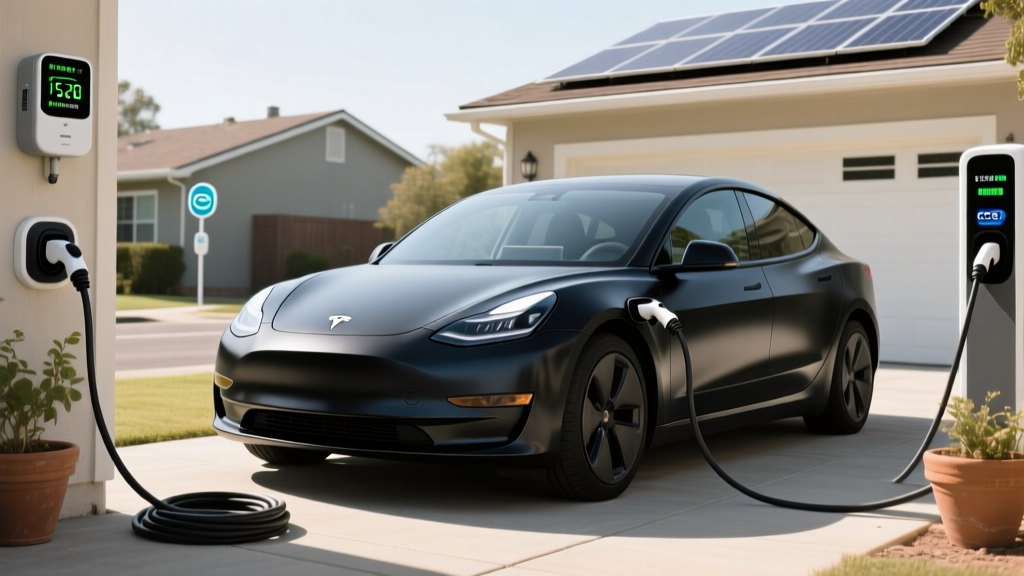
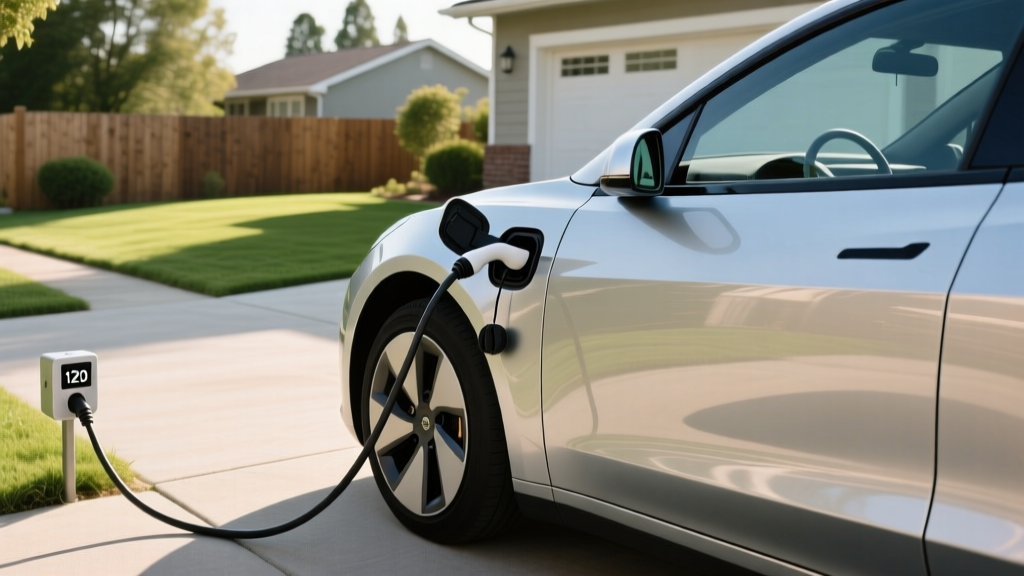
Level 1 charging draws from a standard NEMA 5-15 household outlet — the same 120V plug powering your lamp or phone charger. Most EVs and PHEVs ship with a portable charging cord that handles Level 1 out of the box. At 12 amps continuous (the safe limit for a 15-amp circuit), you get roughly 1.4 kW of power delivery. At 1.4 kW, a vehicle averaging 3.5 miles per kWh will recover about 4 to 5 miles of range per hour. Drop to a 12-amp draw on an older circuit and you might see closer to 3 miles per hour.
Level 1 Charging Cost Per Mile vs. Gasoline
One of the strongest arguments for level 1 charging is economics. Even at the slowest charge rate, electricity is dramatically cheaper per mile than gasoline in most US markets. The exact savings depend on your local utility rate and your vehicle's efficiency.
| Scenario | Energy Cost | Vehicle Efficiency | Cost Per Mile |
|---|---|---|---|
| Level 1 home (national avg electricity) | $0.17/kWh | 3.5 mi/kWh (EV avg) | $0.049 |
| Level 1 home (off-peak utility rate) | $0.09/kWh | 3.5 mi/kWh | $0.026 |
| Public Level 2 (network average) | $0.35/kWh | 3.5 mi/kWh | $0.100 |
| DC Fast Charging (Electrify America) | $0.48/kWh | 3.0 mi/kWh (highway) | $0.160 |
| Gasoline (national avg $3.40/gal) | $3.40/gallon | 28 MPG (avg sedan) | $0.121 |
| Gasoline (truck/SUV, 20 MPG) | $3.40/gallon | 20 MPG | $0.170 |
At the national average residential electricity rate of roughly $0.17/kWh (U.S. EIA), level 1 charging costs about 5 cents per mile. If your utility offers time-of-use (TOU) rates and you schedule charging overnight at $0.09/kWh, you're paying under 3 cents per mile — roughly one-quarter the cost of a 28-MPG gasoline car. Over 12,000 miles of annual driving, that's a savings of $850 to $1,100 per year just from home charging.
However, DC fast charging at public stations can approach or even exceed gasoline costs per mile. The financial advantage of EV ownership is strongest when you charge at home — and level 1 charging, while slow, keeps you in that lowest-cost tier.
Charging Times by Battery Size: What to Expect from Level 1
The time required to charge depends on your battery's usable capacity (measured in kWh) and the power delivery rate. Here's what a full Level 1 session looks like for popular battery sizes when charging from 10% to 80% state of charge (SoC):
| Vehicle Example | Usable Battery (kWh) | Energy Needed (10–80%) | Time at 1.4 kW | Time at 7.7 kW (Level 2) |
|---|---|---|---|---|
| Toyota Prius Prime (PHEV) | 10.5 kWh | 7.4 kWh | ~5.3 hours | ~1.0 hour |
| Hyundai Ioniq 6 SE (BEV) | 54.0 kWh | 37.8 kWh | ~27 hours | ~4.9 hours |
| Tesla Model Y Long Range | 75.0 kWh | 52.5 kWh | ~37.5 hours | ~6.8 hours |
| Ford F-150 Lightning (Std Range) | 98.0 kWh | 68.6 kWh | ~49 hours | ~8.9 hours |
| Chevrolet Silverado EV (Max Range) | 200.0 kWh | 140.0 kWh | ~100 hours | ~18.2 hours |
For plug-in hybrids with smaller batteries (8–15 kWh), level 1 charging is often perfectly adequate — a full overnight session refills the pack. For battery-electric vehicles with 60+ kWh packs, Level 1 becomes a supplementary option rather than a primary strategy. You can maintain your battery with nightly top-ups if your daily driving stays under 40 miles, but recovering from a near-empty state requires multiple days.
Connector Compatibility: What Plugs Into Level 1?
Every EV and PHEV sold in the United States supports Level 1 charging through a standard J1772 connector (for non-Tesla vehicles) or a Tesla proprietary connector (NACS). Most manufacturer-supplied portable charging cords include a NEMA 5-15 plug on one end and the vehicle connector on the other.
| Connector Type | Brands Using It | Level 1 Compatible? | Adapter Needed? |
|---|---|---|---|
| NACS (Tesla / North American Charging Standard) | Tesla, Ford, GM, Rivian, Volvo, Polestar, BMW, Hyundai, Kia (2025+) | Yes — via mobile connector | J1772-to-NACS adapter for non-Tesla Level 2 public stations; Level 1 cords ship with NACS |
| J1772 / CCS1 | Remaining 2024–2026 models from VW, Subaru, Toyota (non-NACS trims), Mitsubishi, Nissan | Yes — J1772 is the Level 1/2 standard | None for Level 1; CCS1-to-NACS adapter needed for Tesla Superchargers |
| CHAdeMO | Nissan Leaf (legacy, discontinued 2025) | Yes — J1772 for Level 1 | CHAdeMO only used for DC fast charging; Level 1 uses J1772 |
The transition to NACS as the dominant North American standard means most 2025–2026 EVs now use the Tesla-style connector. However, Level 1 charging remains straightforward regardless of which connector your vehicle uses — the portable cord supplied with your car handles the interface. The connector differences matter far more for DC fast charging and public Level 2 networks.
When Level 1 Charging Works — and When It Doesn't
Level 1 charging is the right primary strategy if:
- You drive fewer than 35–40 miles per day on average
- You own a PHEV with a battery under 20 kWh
- You park within cord-reach of a standard 120V outlet (garage or carport)
- Your home's electrical panel cannot support a 240V circuit without a costly upgrade
- You're renting and cannot install permanent charging equipment
Level 1 charging falls short when:
- Your daily driving exceeds 50 miles consistently
- You own a long-range BEV (80+ kWh) and need to recover from road-trip depletion
- You live in extreme cold — cold weather reduces EV range by 20–40%, meaning you need more miles of charging to cover the same commute
- You frequently need to precondition your battery for DC fast charging (preconditioning draws power from the grid while warming the pack — at 1.4 kW, there isn't enough surplus power to heat the battery and charge simultaneously)
Choose Level 1 if: Your daily round-trip commute is under 35 miles, you have a PHEV or a BEV you rarely deplete below 50%, and installing a 240V circuit would cost $2,000+ due to panel upgrades.
Upgrade to Level 2 if: You drive 40+ miles daily, you own a BEV with a 70+ kWh battery, you want to precondition for fast charging in winter, or you need to fully recharge overnight after a long trip.
Upgrading to Level 2: Electrical Requirements and Installation Costs
If Level 1 proves insufficient, a Level 2 home charger operating on a 240V circuit delivers 5 to 15 times the charging speed. But installation involves real costs that vary enormously based on your home's electrical infrastructure.
Electrical requirements for a typical Level 2 installation:
- Circuit: Dedicated 40-amp or 50-amp 240V circuit (NEMA 14-50 outlet or hardwired connection)
- Wire gauge: 6 AWG copper for 50A circuits; 8 AWG for 40A
- Panel capacity: Your main service panel must have sufficient amperage headroom — a 200-amp panel is standard for modern homes, but older homes with 100-amp service may require an upgrade
- GFCI protection: NEC 2020 and later require GFCI protection for EV charging outlets in garages; hardwired chargers may bypass this requirement depending on local code
- Permit: Most jurisdictions require an electrical permit for new 240V circuits, typically $50–$200
| Component | Low Estimate | High Estimate | Notes |
|---|---|---|---|
| Level 2 charger unit (hardware) | $350 | $750 | 40A–48A smart chargers (e.g., Emporia, ChargePoint, Wallbox) |
| Electrician labor (standard install) | $400 | $1,200 | Short run from panel to garage, drywall, standard outlet or hardwire |
| Electrician labor (complex install) | $1,200 | $3,000 | Long wire runs, conduit, trenching, sub-panel addition |
| Electrical permit | $50 | $200 | Varies by municipality |
| Panel upgrade (if needed) | $1,500 | $4,000 | 100A → 200A service upgrade; common in pre-1990 homes |
| Total (no panel upgrade) | $800 | $2,150 | Most homes with 200A panels fall in this range |
| Total (with panel upgrade) | $2,300 | $6,150 | Older homes with 100A service |
The panel upgrade is the wildcard that catches many homeowners off guard. If your home was built before 1990 and still has a 100-amp main panel, adding a 40- or 50-amp EV circuit may push your total load beyond safe limits. A licensed electrician will perform a load calculation per NEC Article 220 to determine whether an upgrade is necessary. Some utilities offer rebates of $200–$500 for panel upgrades tied to EV adoption — check with your local provider.
For the electrical work, always hire a licensed electrician familiar with EV charging installations. The National Electrical Contractors Association maintains a directory of qualified professionals, and many charger manufacturers (ChargePoint, Wallbox) offer installation partnerships.
Level 2 Equipment Recommendations for 2026
If you've decided to upgrade from level 1 charging, here are proven Level 2 units suited to different budgets and needs:
Emporia Vue Level 2 Charger — Best Value
- Power output: 48A / 11.5 kW (hardwired) or 40A / 9.6 kW (NEMA 14-50 plug)
- Connector: J1772 (NACS adapter included with 2025+ models)
- Cable length: 24 feet
- Smart features: Wi-Fi connected, energy monitoring via Emporia app, solar integration, scheduling
- Price: ~$399 (plug-in) / ~$399 (hardwired)
- Best for: Budget-conscious buyers wanting full smart features and energy tracking
ChargePoint Home Flex — Best All-Rounder
- Power output: Up to 50A / 12 kW (adjustable via DIP switch: 16A–50A)
- Connector: J1772 or NACS (select at purchase)
- Cable length: 23 feet
- Smart features: Wi-Fi, ChargePoint app scheduling, Alexa integration, utility demand-response programs
- Price: ~$649
- Best for: Drivers wanting flexible amperage settings and broad utility-program compatibility
Tesla Wall Connector — Best for NACS Vehicles
- Power output: Up to 48A / 11.5 kW (hardwired, 60A circuit required)
- Connector: NACS native (J1772 adapter available separately)
- Cable length: 24 feet
- Smart features: Wi-Fi, over-the-air updates, Power Sharing (link multiple units on one circuit), Tesla app integration
- Price: ~$475
- Best for: Tesla owners and NACS-equipped Ford/GM/Rivian drivers wanting native compatibility
Wallbox Pulsar Plus — Best Compact Option
- Power output: 40A / 9.6 kW (plug-in) or 48A / 11.5 kW (hardwired)
- Connector: J1772 or NACS
- Cable length: 25 feet
- Smart features: Wi-Fi + Bluetooth, myWallbox app, Eco-Smart solar mode, load balancing
- Price: ~$599 (40A) / ~$649 (48A)
- Best for: Tight garage spaces (smallest physical footprint) and solar-panel homes
One critical note: a charger rated for 48A requires a dedicated 60-amp circuit (NEC requires circuits to be rated at 125% of continuous load). A 40A charger needs a 50-amp circuit. Confirm your electrician sizes the circuit correctly — undersizing is a fire hazard and will fail inspection.
Safety and Code Considerations for Home Charging
Whether you're using level 1 charging on a standard outlet or installing a full Level 2 system, electrical safety is non-negotiable. EV charging represents a sustained, high-draw electrical load — far more demanding than intermittent appliances like a microwave or hair dryer.
For Level 1 charging:
- Use only the manufacturer-supplied or UL-listed portable charging cord — never an extension cord
- Inspect the outlet for signs of heat damage (discoloration, melting, warm faceplate) — a worn 15-amp receptacle can overheat under 12-amp continuous draw
- Consider upgrading to a commercial-grade NEMA 5-15R outlet ($10–$15 part) rated for sustained loads if you charge nightly
- Ensure the circuit is not shared with other high-draw devices (space heaters, window AC units)
- Outdoor outlets must have a weatherproof in-use cover rated for wet locations
For Level 2 installations:
- The circuit must be dedicated — no other outlets or devices on the same breaker
- Hardwired installations eliminate the outlet as a failure point and may not require GFCI breakers (which can nuisance-trip on EV loads)
- Outdoor-rated chargers must carry a NEMA 4 or IP65 rating for weather resistance
- All work must comply with NEC Article 511 (Electric Vehicle Charging) and local amendments
- Your electrician should pull a permit and schedule a final inspection — unpermitted work can void homeowner's insurance claims
Frequently Asked Questions About Level 1 Charging
How much does it cost to install a home EV charger?
For level 1 charging, installation cost is essentially zero — you plug into an existing 120V outlet. For a Level 2 (240V) installation, expect $800–$2,150 in homes with adequate panel capacity, or $2,300–$6,150 if a panel upgrade from 100A to 200A service is required. The charger hardware itself costs $350–$750.
How fast will level 1 charging add range to my EV?
Level 1 charging at 1.4 kW adds approximately 3 to 5 miles of range per hour, depending on your vehicle's efficiency. Over a 10-hour overnight session, that's roughly 35–50 miles — sufficient for most daily commutes but inadequate for recovering a depleted large battery.
Which connector is compatible with my EV for Level 1?
All EVs support Level 1 charging. Vehicles with NACS (Tesla, 2025+ Ford, GM, Rivian, and others) use the Tesla-style connector with the supplied mobile cord. Vehicles with J1772/CCS1 (VW, Subaru, some Toyota trims) use the J1772 connector. The portable cord included with your vehicle handles Level 1 regardless of connector type.
How much does charging cost per mile compared to gas?
Level 1 home charging at the national average electricity rate ($0.17/kWh) costs approximately $0.05 per mile. Gasoline at $3.40/gallon in a 28-MPG vehicle costs about $0.12 per mile. That's a per-mile savings of roughly 58% with home EV charging.
What electrical upgrades might I need for Level 2 charging?
The most common upgrade is a dedicated 240V circuit (40A or 50A) run from your main panel. Older homes with 100-amp service panels may need a full service upgrade to 200 amps, costing $1,500–$4,000. A licensed electrician will perform a NEC Article 220 load calculation to determine your panel's available capacity before any installation.
Can level 1 charging damage my EV battery?
No. Level 1 charging is gentle on the battery — the low charge rate generates minimal heat, which is actually beneficial for long-term battery health. The primary downside is time, not degradation. According to fueleconomy.gov, slow charging is among the least stressful charging methods for lithium-ion cells.
Is it safe to use an extension cord with Level 1 charging?
No. EV manufacturers and electrical safety standards explicitly prohibit extension cords for EV charging. The sustained 12-amp draw over hours can overheat undersized extension cords, creating a fire hazard. If your outlet is too far from your parking spot, have an electrician install a new dedicated outlet closer to your vehicle.