Understanding EV Charging Levels: What a Level 1 Charger Actually Delivers
Every new electric vehicle ships with a Level 1 charger — a portable cord that plugs into a standard 120-volt household outlet. It's the simplest, cheapest way to add electrons to your battery, and for some drivers, it's genuinely sufficient. But before you dismiss Level 2 or assume a Level 1 charger is all you need, you should understand exactly what each tier delivers in real-world terms.
The critical distinction in EV charging is between kW (kilowatts), which measures power or charge rate, and kWh (kilowatt-hours), which measures energy capacity — think of kW as how fast water flows from a hose and kWh as the size of the bucket you're filling. A Level 1 charger flows very slowly; a DC fast charger is a firehose.
| Level | Voltage | Power (kW) | Miles of Range Added per Hour | Typical Use Case |
|---|---|---|---|---|
| Level 1 | 120V AC | 1.0–1.4 kW | 3–5 mi/hr | Overnight topping, PHEVs, low-mileage drivers |
| Level 2 | 240V AC | 7.2–19.2 kW | 25–75 mi/hr | Daily home charging, workplace |
| DC Fast Charge | 400–800V DC | 50–350+ kW | 150–1,200+ mi/hr | Road trips, public stations |
A Level 1 charger delivering 1.4 kW adds roughly 4 miles of range per hour of charging. Plug in a Tesla Model Y (75 kWh usable battery, ~310 miles EPA range) at 6 PM and unplug at 7 AM — that's 13 hours and approximately 52 miles recovered. If your daily commute is 30 miles round-trip and you charge every night, a Level 1 charger keeps you whole. If you drive 60+ miles daily or want to recover from a road-trip depletion, Level 1 won't cut it.
Level 1 Charger vs Level 2: Charging Time Examples for Common Battery Sizes
To put the speed gap in perspective, here's how long it takes to charge from 10% to 80% State of Charge (SoC) — the typical daily charging window — across several popular EVs:
| Vehicle | Usable Battery (kWh) | Level 1 (1.4 kW) | Level 2 (11.5 kW / 48A) | Level 2 (7.7 kW / 32A) | DC Fast (peak kW) |
|---|---|---|---|---|---|
| Chevrolet Equinox EV (2025+) | 85 kWh | ~42 hrs | ~5.2 hrs | ~7.8 hrs | ~30 min (150 kW peak) |
| Tesla Model Y Long Range | 75 kWh | ~37 hrs | ~4.6 hrs | ~6.8 hrs | ~25 min (250 kW peak) |
| Hyundai Ioniq 5 (Long Range) | 77.4 kWh | ~38 hrs | ~4.7 hrs | ~7.0 hrs | ~18 min (240 kW peak) |
| Toyota RAV4 Prime (PHEV) | 19.4 kWh | ~9.5 hrs | ~1.2 hrs | ~1.8 hrs | N/A (no DCFC) |
| Ford F-150 Lightning Ext. Range | 131 kWh | ~65 hrs | ~8.0 hrs | ~12 hrs | ~41 min (150 kW peak) |
Two things jump out. First, for any battery-electric vehicle with 75+ kWh of capacity, a Level 1 charger is essentially an emergency backup or a supplement — not a primary charging solution. Second, for PHEVs with batteries under 20 kWh, Level 1 is genuinely viable as a daily charger.
One nuance that matters: DC fast charging speeds are peak rates, not sustained rates. A Hyundai Ioniq 5 may peak at 240 kW at 10% SoC but tapers to roughly 100 kW by 60% SoC and under 50 kW above 80%. The 10–80% time is the metric that matters, not the peak kW number.
Home Charger Installation: Electrical Requirements, Costs, and Panel Upgrade Reality
A Level 1 charger requires no installation — it plugs into any standard 120V/15A or 120V/20A household outlet. But if you're reading this, you're likely considering a Level 2 home charger, which is where electrical requirements and real costs come into play.
Electrical Requirements for a Level 2 Home Charger
A Level 2 charger operates on a 240-volt circuit — the same type of outlet your electric dryer or oven uses. Common configurations:
- 32A circuit (7.7 kW): Requires a 40A breaker (NEC 80% continuous-load rule). Adequate for most daily driving needs.
- 48A circuit (11.5 kW): Requires a 60A breaker. Ideal for large-battery EVs or households with two EVs charging sequentially.
- 80A circuit (19.2 kW): Requires a 100A breaker. Supported by vehicles like the Ford F-150 Lightning and some luxury EVs; overkill for most buyers.
What Electrical Upgrades Might You Need?
This is the cost variable that catches many homeowners off guard. Your electrical panel's total capacity (measured in amps — typically 100A, 150A, or 200A in US homes) determines whether you can add a 40A or 60A EV circuit without an upgrade.
A licensed electrician will perform a load calculation per NEC Article 220 to determine available headroom. Homes with 200A panels and gas appliances (gas range, gas water heater, gas furnace) often have sufficient capacity. Homes with 100A panels and all-electric appliances (electric heat, electric water heater, electric dryer) frequently need a panel upgrade to 200A — a significant additional cost.
| Component | Simple Install (panel has capacity, short run) | Moderate Install (longer wire run, conduit) | Complex Install (panel upgrade needed) |
|---|---|---|---|
| Level 2 Charger Equipment | $400–$700 | $400–$700 | $400–$700 |
| Electrical Permit | $50–$200 | $50–$200 | $100–$300 |
| Electrician Labor + Materials | $400–$800 | $800–$1,800 | $1,200–$2,500 |
| Panel Upgrade (if needed) | $0 | $0 | $1,500–$4,000 |
| Total Estimated Cost | $850–$1,700 | $1,250–$2,700 | $3,200–$7,500 |
The wide range in the "complex" column reflects regional labor rates (an electrician in San Francisco charges more than one in Indianapolis), wire-run distance from panel to charger location, and whether trenching is needed for a detached garage.
Cost-saving tip: The federal Alternative Fuel Vehicle Refueling Property Credit (IRS Form 8911) may cover up to 30% of home charging equipment and installation costs (capped at $1,000 for residential). Eligibility depends on census-tract requirements — check the IRS guidance or consult a tax professional.
Connector Compatibility: NACS, CCS, and CHAdeMO Explained
The North American EV charging connector landscape has consolidated dramatically. As of 2026, the North American Charging Standard (NACS) — originally developed by Tesla — is the dominant connector for new vehicles. Here's what you need to know:
| Connector | Used By | Notes |
|---|---|---|
| NACS (J3400) | Tesla (all models), Ford, GM, Rivian, Volvo, Polestar, Hyundai, Kia (2025+ models), and most other OEMs | Industry standard for new vehicles. Smaller, lighter plug. Access to Tesla Supercharger network. |
| CCS1 (Combo) | Legacy models: pre-2025 VW ID.4, BMW i4, older Chevrolet Bolt, some remaining 2024–2025 inventory | Phasing out on new vehicles. CCS-to-NACS adapters available (~$150–$250) for Supercharger access. |
| CHAdeMO | Nissan Leaf (discontinued after 2025 model year), Mitsubishi Outlander PHEV | Effectively legacy. Declining public infrastructure support. |
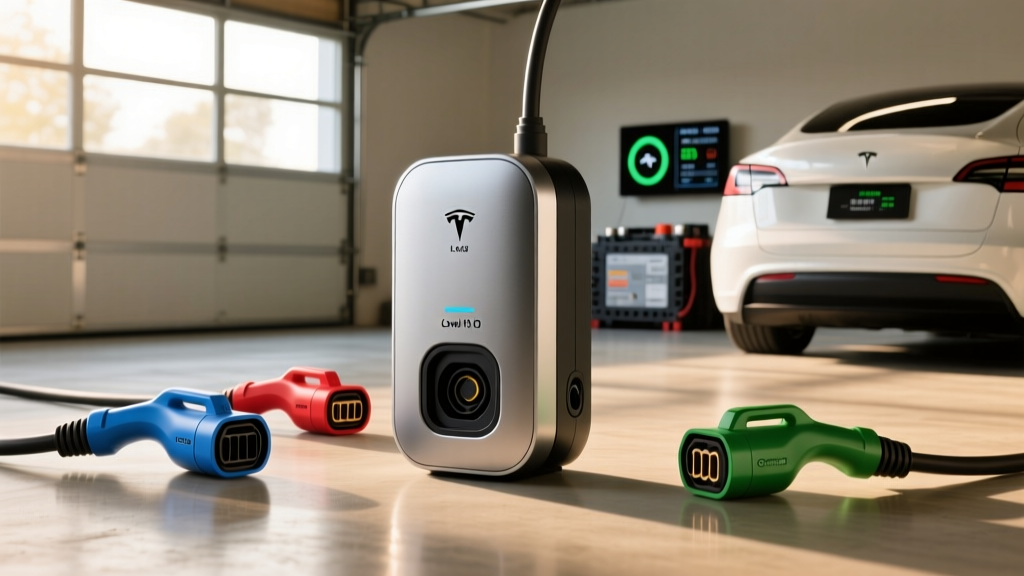
For Level 1 and Level 2 charging at home, the connector matters less than you might think. All Level 1 chargers use a J1772 plug (or a NACS plug for Teslas), and most Level 2 home chargers come with either a J1772 connector (compatible with CCS vehicles via the same inlet) or NACS. If you buy a J1772 Level 2 charger and later switch to a NACS vehicle, a simple J1772-to-NACS adapter (~$100–$150) resolves the issue. Tesla's Mobile Connector ships with NACS and includes a J1772 adapter in the box.
Cost to Charge: Dollars per kWh and Cost per Mile vs Gas
The economic case for home charging is compelling — but the savings depend heavily on where and when you charge.
| Charging Scenario | Rate ($/kWh) | Cost per Mile (EV at 3.5 mi/kWh) | Equivalent Gas MPG at $3.40/gal |
|---|---|---|---|
| Home, off-peak utility rate | $0.08–$0.13 | $0.023–$0.037 | 92–148 MPG |
| Home, standard residential rate | $0.14–$0.20 | $0.040–$0.057 | 60–85 MPG |
| Public Level 2 (ChargePoint, etc.) | $0.25–$0.49 | $0.071–$0.140 | 24–48 MPG |
| DC Fast Charge (Electrify America, EVgo) | $0.35–$0.58 | $0.100–$0.166 | 20–34 MPG |
| Gasoline vehicle (27 MPG combined avg) | — | $0.126 | 27 MPG |
The takeaway: charging at home on off-peak rates is roughly one-quarter the per-mile cost of gasoline. DC fast charging on the road approaches gas-car costs, which is why road-trip charging budgets should be factored in separately.
To optimize home charging costs, most utilities offer time-of-use (TOU) plans with off-peak rates between 10 PM and 6 AM. Smart Level 2 chargers (like the Emporia Vue or ChargePoint Home Flex) can be scheduled to charge only during these windows, maximizing savings automatically. According to fueleconomy.gov, the national average electricity cost for EV driving is roughly $0.04 per mile at residential rates — a significant edge over gasoline.
Best Level 2 Home Chargers for 2026: Equipment Picks
If a Level 1 charger is your included-but-limited baseline, a Level 2 home charger is the upgrade that transforms daily EV ownership. Here are top-performing units based on power output, reliability, smart features, and value:
ChargePoint Home Flex
- Power Output: Up to 12 kW (50A) — adjustable down to 16A for lower-capacity panels
- Connector: J1772 (NACS adapter included for newer shipments)
- Cable Length: 23 feet
- Smart Features: Wi-Fi, scheduling, energy tracking, Alexa integration
- Price: ~$649 (unit only)
- Best For: Flexible amperage adjustment for homes with limited panel capacity
Tesla Wall Connector
- Power Output: Up to 11.5 kW (48A)
- Connector: NACS native (J1772 adapter available separately, ~$100)
- Cable Length: 24 feet
- Smart Features: Wi-Fi, OTA updates, power sharing (link two units on one circuit), Tesla app integration
- Price: ~$475
- Best For: Tesla owners and NACS-equipped households seeking best value
Emporia Level 2 EV Charger
- Power Output: Up to 11.5 kW (48A)
- Connector: J1772 (NACS adapter available)
- Cable Length: 24 feet
- Smart Features: Wi-Fi, solar integration, TOU scheduling, energy monitoring via Emporia Vue panel
- Price: ~$399
- Best For: Budget-conscious buyers and homes with solar panels
Grizzl-E Smart
- Power Output: Up to 10 kW (40A)
- Connector: J1772
- Cable Length: 24 feet
- Smart Features: Wi-Fi, OCPP support, adjustable amperage
- Price: ~$549
- Best For: Cold-climate durability (rated to -40°F), Canadian-made build quality
All of these units are hardwired (no plug — required for circuits above 40A per NEC) and require professional installation. If your home already has a NEMA 14-50 outlet (common for electric dryers or RV hookups), the Tesla Mobile Connector or ChargePoint Home Flex can plug in directly at up to 40A / 9.6 kW — saving the cost of a hardwired install, though you'll sacrifice some charging speed.
Safety, Code, and Installation Best Practices
EV charging draws sustained, high-current loads for hours — unlike most household appliances that cycle on and off. This makes proper installation non-negotiable.
- Dedicated circuit: Your Level 2 charger must be on its own dedicated breaker — it cannot share a circuit with other appliances.
- NEC 80% rule: Continuous loads (defined as operating for 3+ hours) must not exceed 80% of a circuit breaker's rated capacity. A 48A charger requires a 60A breaker. A 32A charger requires a 40A breaker.
- GFCI protection: The 2023 NEC update requires GFCI protection for EV charging outlets. Hardwired installations may not require a GFCI breaker in all jurisdictions — your electrician will confirm local code.
- Outdoor rating: If your charger is installed outdoors (driveway, exterior wall), ensure the unit carries a NEMA 4 or IP65 weather-resistance rating. All units listed above meet this standard.
- Wire gauge: A 60A circuit typically requires 6 AWG copper wire; a 40A circuit requires 8 AWG. Longer wire runs may need thicker gauge to prevent voltage drop.
- Permits: Most jurisdictions require an electrical permit for EV charger installation. The permit ensures a city/county inspector verifies the work — protecting your home insurance coverage and resale value.
Always hire a licensed electrician. Per the National Fire Protection Association (NFPA), improper EV charger wiring is a fire risk — and unpermitted work can void homeowner's insurance claims.
Frequently Asked Questions
How much does it cost to install a home EV charger?
A Level 1 charger costs $0 to install — it plugs into a standard 120V outlet. A Level 2 home charger installation typically ranges from $850 to $2,700 for homes with adequate panel capacity, and $3,200 to $7,500 if a panel upgrade is required. Equipment costs $400–$700; electrician labor and materials make up the rest.
How fast will each charging level add range?
Level 1 (120V, 1.4 kW): 3–5 miles per hour. Level 2 (240V, 11.5 kW): 30–45 miles per hour depending on vehicle efficiency. DC fast charging (150+ kW): can add 150–300+ miles in 20–30 minutes, depending on the vehicle's charge curve and battery size.
Which connector/charger is compatible with my EV?
If your EV is a 2025+ model from Tesla, Ford, GM, Hyundai, Kia, Rivian, Volvo, or most other major brands, it uses NACS. Older models (pre-2025) from Volkswagen, BMW, and others may use CCS1. The Nissan Leaf used CHAdeMO. For home Level 2 charging, a J1772 charger works with CCS and CHAdeMO vehicles natively and with NACS vehicles via a simple adapter.
How much does charging cost per mile vs gas?
At home on off-peak utility rates ($0.10/kWh), charging costs roughly $0.03 per mile — equivalent to a gas car getting 113 MPG at $3.40/gallon. At standard residential rates ($0.17/kWh), it's about $0.05 per mile, still equivalent to 68 MPG. Public DC fast charging at $0.48/kWh costs roughly $0.14 per mile — comparable to a 24 MPG gas car.
What electrical upgrades might I need?
The most common upgrade is a panel capacity increase from 100A to 200A ($1,500–$4,000), needed when your existing panel doesn't have headroom for a new 40A or 60A circuit. Homes with 200A panels and gas appliances rarely need upgrades. An electrician will perform a NEC Article 220 load calculation to determine your specific needs. Some utilities offer rebates for panel upgrades that support EV adoption.
Is a Level 1 charger enough for my EV?
For plug-in hybrids with batteries under 20 kWh (RAV4 Prime, Jeep Wrangler 4xe, Chrysler Pacifica Hybrid), a Level 1 charger fully replenishes the battery overnight and is a practical daily solution. For battery-electric vehicles with 60+ kWh batteries, Level 1 adds only 30–50 miles overnight — sufficient only if your daily driving is under 35 miles and you charge every night. Most BEV owners find Level 2 essential for practical ownership.
Can I use a Level 1 charger on a 120V outlet in my garage?
Yes — that's exactly what it's designed for. Ensure the outlet is on a dedicated 15A or 20A circuit (not shared with a freezer, sump pump, or other appliance) and that the wiring is in good condition. If the outlet feels warm during charging, stop immediately and have an electrician inspect it. Per energy.gov, a properly maintained 120V outlet is safe for Level 1 EV charging.