If you just took delivery of a new electric vehicle, the charging cable in the trunk is almost certainly a Level 1 unit — a simple cord that plugs into a standard 120-volt household outlet. For many new EV owners, that level 1 charger for EV use is the first real introduction to what electrified ownership looks like day to day. The question most buyers eventually ask is whether Level 1 is genuinely sufficient, or whether upgrading to a 240V Level 2 home station is a necessary investment.
The honest answer depends on three numbers: your daily driving distance, your battery size (in kWh), and the amperage your electrical panel can spare. Below, we walk through the physics, the costs, and the equipment options so you can make the call based on data — not marketing.
Charging Levels Explained: Level 1, Level 2, and DC Fast
Before comparing hardware, let's lock in the terminology that trips up most new EV buyers. A kilowatt (kW) is a measure of power — how fast energy flows into the battery at any given moment. A kilowatt-hour (kWh) is a measure of energy — how much total capacity the battery holds. Think of kW as the width of the hose and kWh as the size of the bucket. Charging speed is always expressed in kW; battery size is always in kWh.
| Level | Voltage | Typical Power (kW) | Miles of Range Added per Hour | Best Use Case |
|---|---|---|---|---|
| Level 1 | 120V AC | 1.0 – 1.9 kW | 3 – 5 miles | Overnight top-ups, PHEVs, low-mileage drivers |
| Level 2 | 240V AC | 7.2 – 19.2 kW | 25 – 70 miles | Daily home charging for BEVs |
| DC Fast (Level 3) | 200 – 900V DC | 50 – 350+ kW | 150 – 1,000+ miles (equivalent) | Road trips, commercial fleets, quick top-ups |
A Level 1 charger for EV use delivers, at best, about 1.9 kW on a 15-amp circuit (120V × 16A continuous = ~1.9 kW, since EVSEs derate to 80% of circuit capacity). On a more common 12-amp setting, you'll see roughly 1.4 kW. That translates to 3 to 5 miles of range per hour of charging for a typical midsize EV consuming around 3 to 4 miles per kWh.
How Fast Will Each Charging Level Add Range?
Charging speed is not a single number — it's a curve. DC fast chargers, for instance, peak early (often between 10% and 40% state of charge) and taper dramatically above 80%. Level 1 and Level 2 charging, by contrast, deliver a relatively flat rate until the battery nears full, at which point the onboard charger reduces current for cell balancing.
Here's what charging times look like for two common battery sizes across the three levels:
Charging Time Examples: 60 kWh Battery (e.g., base Tesla Model 3, Hyundai Kona Electric)
- Level 1 (1.4 kW): 0–100% in ~43 hours. A 10–80% session takes roughly 30 hours.
- Level 2 (11.5 kW, 48A): 0–100% in ~5.2 hours. 10–80% in ~3.6 hours.
- DC Fast (150 kW peak): 10–80% in ~25 minutes (tapers heavily after 80%).
Charging Time Examples: 85 kWh Battery (e.g., Ford F-150 Lightning Extended Range)
- Level 1 (1.4 kW): 0–100% in ~61 hours. Overnight charging adds roughly 25–30% state of charge.
- Level 2 (11.5 kW, 48A): 0–100% in ~7.4 hours. 10–80% in ~5.1 hours.
- DC Fast (150 kW peak): 10–80% in ~40 minutes.
For plug-in hybrids with smaller batteries (typically 12–20 kWh usable), Level 1 is often perfectly adequate — a 15 kWh PHEV battery reaches full in roughly 10–11 hours on a 120V outlet, which aligns well with an overnight park.
Home Electrical Requirements and Installation Cost
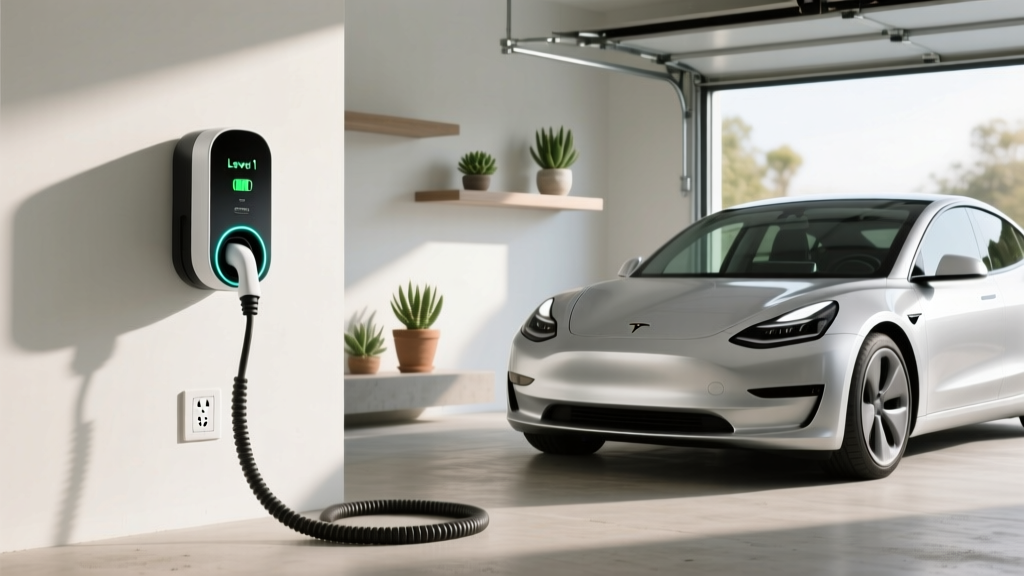
Level 1 charging requires nothing more than a standard 120V, 15-amp (or ideally 20-amp) grounded outlet on a dedicated circuit. No electrician is strictly necessary if you already have an accessible outlet near your parking spot. However, there are important caveats:
- Dedicated circuit: The National Electrical Code (NEC) requires that a continuous load (which EV charging qualifies as) not exceed 80% of the circuit's rated amperage. A 15A circuit can sustain 12A; a 20A circuit can sustain 16A. Sharing the circuit with other appliances risks tripping the breaker.
- GFCI protection: NEC 2020 and later require GFCI (ground-fault circuit interrupter) protection on 120V outlets used for EV charging in garages. Older homes may need an outlet upgrade.
- Outdoor rating: If your outlet is exterior, it must be in a weatherproof enclosure with an in-use cover rated for the plug.
Level 2 Installation: When You Need an Electrician
If Level 1 proves insufficient, a Level 2 home charger requires a 240V circuit — typically 40A, 50A, or 60A — wired from your main electrical panel to a NEMA 14-50 outlet or hardwired directly to the EVSE (electric vehicle supply equipment). Here's what that investment actually costs:
| Component | Cost Range | Notes |
|---|---|---|
| Level 2 EVSE (equipment) | $350 – $750 | Smart Wi-Fi-enabled units; dumb units from $250 |
| Electrician labor | $500 – $2,000 | Depends on run length from panel, wall material, conduit |
| Permit and inspection | $50 – $250 | Required in most jurisdictions; varies by municipality |
| Electrical panel upgrade (if needed) | $1,500 – $4,000 | Older 100A panels often need a 200A service upgrade |
| Total (no panel upgrade) | $900 – $3,000 | Most homes with 200A service and short wire runs |
| Total (with panel upgrade) | $2,400 – $7,000 | Common in pre-1990 homes or those with high existing loads |
The federal Residential Clean Energy Credit (IRC §25C/25D) may cover up to 30% of home charging equipment and installation costs, with a $1,000 annual cap under §25C for certain equipment. Consult a tax professional for eligibility specifics, as rules around qualified property and income limits can shift.
Connector Compatibility: NACS, CCS1, and CHAdeMO
The connector on the end of your charging cable must match the inlet on your vehicle. As of 2026, the North American market has largely consolidated around two standards for AC (Level 1 and Level 2) charging, with a third legacy standard still in use on older vehicles.
| Connector | Used By | Notes |
|---|---|---|
| NACS (North American Charging Standard) | Tesla (all models), Ford (2025+), GM (2025+), Rivian, Volvo, Polestar, Mercedes-Benz, BMW, Hyundai, Kia, and most others | Now the dominant standard; compact design. Most 2025–2026 EVs ship with NACS inlets. |
| CCS1 (Combined Charging System) | Older VW ID.4, Audi e-tron (pre-2025), some legacy models | Being phased out for AC charging on new models; adapters available for NACS-to-CCS. |
| CHAdeMO | Nissan Leaf (legacy), Mitsubishi Outlander PHEV | Largely discontinued for new vehicles; DC-only connector, distinct from AC inlet. |
| J1772 | All non-Tesla EVs pre-2025 (Level 1/2 AC) | Being replaced by NACS on new vehicles; adapters widely available. |
For Level 1 charging specifically, nearly every EV and PHEV sold in North America ships with a portable Level 1 cord that has a J1772 or NACS vehicle-side connector and a standard NEMA 5-15 household plug on the other end. If your 2025+ vehicle has a NACS inlet, your included Level 1 cord will have a NACS connector. If you own an older CCS-equipped vehicle and want to use a NACS-equipped charger, a CCS-to-NACS adapter (typically $150–$250) resolves the mismatch.
Cost to Charge: $/kWh and Cost Per Mile vs Gas
One of the strongest arguments for home charging — even at Level 1 speeds — is cost. Residential electricity rates vary enormously by state, but the national average in 2026 hovers around $0.16–$0.18 per kWh, with time-of-use (TOU) plans offering off-peak rates as low as $0.08–$0.12 per kWh in many regions.
| Scenario | $/kWh | Vehicle Efficiency | Cost Per Mile | Annual Cost (12,000 mi) |
|---|---|---|---|---|
| Home Level 1/2, off-peak TOU | $0.10 | 3.5 mi/kWh | $0.029 | $343 |
| Home Level 1/2, standard rate | $0.17 | 3.5 mi/kWh | $0.049 | $583 |
| Public Level 2 (network pricing) | $0.30 | 3.5 mi/kWh | $0.086 | $1,029 |
| DC Fast Charging ( Electrify America, Tesla Supercharger) | $0.35 – $0.48 | 3.5 mi/kWh | $0.10 – $0.14 | $1,200 – $1,646 |
| Gasoline (28 MPG avg, $3.40/gal) | — | 28 MPG | $0.121 | $1,457 |
The takeaway is stark: a Level 1 charger running overnight on an off-peak rate delivers fuel at roughly one-quarter the cost per mile of gasoline. Even at standard residential rates, Level 1 home charging costs less than half what gasoline does per mile. Public DC fast charging, by contrast, narrows the gap considerably — and in some regions, exceeds gasoline cost per mile.
This cost advantage is why Level 1 charging, despite its slowness, remains economically compelling for drivers who can charge at home and don't need rapid replenishment.
Equipment Recommendations: Top Level 1 and Dual-Level Chargers
The portable Level 1 cord included with your EV is functional but often limited — short cables (typically 12–16 feet), no smart scheduling, and no app connectivity. Upgrading to a higher-quality Level 1 unit or a dual-voltage (Level 1 + Level 2) portable charger gives you more flexibility.
Emporia Level 2 Smart EV Charger (with Level 1 adapter)
- Power output: Up to 11.5 kW (48A) at 240V; ~1.6 kW at 120V with adapter
- Connector: NACS (CCS adapter included)
- Cable length: 24 feet
- Smart features: Wi-Fi scheduling, energy monitoring, solar integration via Emporia Vue panel monitor
- Price: ~$400
Lectron V-BOX Pro (Dual Voltage)
- Power output: Up to 12 kW (50A) at 240V; ~1.8 kW at 120V
- Connector: J1772 (NACS adapter available separately)
- Cable length: 20 feet
- Smart features: LED status display, adjustable amperage, no Wi-Fi
- Price: ~$280
Tesla Mobile Connector (Gen 2)
- Power output: Up to 7.2 kW (30A) at 240V with NEMA 14-50 adapter; ~1.4 kW at 120V
- Connector: NACS
- Cable length: 20 feet
- Smart features: Integrates with Tesla app for scheduling and preconditioning
- Price: ~$200 (adapter kit sold separately)
If you're committed to Level 1 for now but want the option to upgrade later, a dual-voltage portable unit is the pragmatic choice. You plug it into a 120V outlet today and, when you're ready to invest in a 240V circuit, the same unit handles Level 2 without replacement.
Safety, Code Compliance, and Common Mistakes
Level 1 charging is low-risk, but it's not risk-free. The most common safety issues we see in the field:
- Extension cords: Never use an extension cord with a Level 1 EV charger. EVSEs draw continuous maximum load for hours; undersized extension cords overheat and present a fire risk. If the outlet is too far from the vehicle, install a new outlet closer to the parking spot.
- Shared circuits: A 15A circuit powering an EV at 12A continuous cannot safely also run a space heater, dehumidifier, or other significant load. Verify the circuit is dedicated.
- Worn outlets: Standard 120V receptacles degrade over time. If your outlet feels warm to the touch during charging, shows discoloration, or the plug feels loose, replace it with a commercial-grade (spec-grade) outlet rated for continuous duty.
- Outdoor installations: Any outdoor 120V outlet used for EV charging must have a weatherproof in-use cover. The EVSE brick itself should be rated for outdoor use (most modern units carry an IP55 or IP67 rating).
For Level 2 installations, the NEC requires a dedicated circuit with appropriate overcurrent protection, proper wire gauge (typically 6 AWG copper for a 50A circuit), and a permit/inspection in virtually all jurisdictions. Hardwired installations (no plug) eliminate the NEMA 14-50 receptacle as a potential failure point and are generally preferred by electricians for permanent setups.
Frequently Asked Questions
How much does it cost to install a home EV charger?
Level 1 requires no installation if a suitable 120V outlet already exists — total cost is $0 beyond the charger itself. Level 2 installation typically runs $900–$3,000 for homes with adequate electrical panel capacity, or $2,400–$7,000 if a panel upgrade from 100A to 200A service is needed. Federal and utility rebates can offset a portion of these costs.
How fast will each charging level add range?
Level 1 adds 3–5 miles of range per hour. Level 2 at 11.5 kW adds roughly 35–40 miles per hour. DC fast charging adds 150–300+ miles in 20–30 minutes, depending on the vehicle's peak charge rate and battery state of charge.
Which connector/charger is compatible with my EV?
For 2025–2026 model-year vehicles from Tesla, Ford, GM, Rivian, Hyundai, Kia, BMW, Mercedes-Benz, and most others, the NACS connector is now standard. Older non-Tesla EVs (pre-2025) typically use J1772 for AC charging. Check your vehicle's charge port or owner's manual, and purchase a charger with the matching connector — or use a certified adapter.
How much does charging cost per mile vs gas?
Home Level 1 or Level 2 charging on off-peak electricity costs roughly $0.03–$0.05 per mile, compared to $0.12 per mile for a 28 MPG gasoline vehicle at $3.40/gallon. That's a 60–75% fuel cost reduction. Public DC fast charging narrows the gap to roughly $0.10–$0.14 per mile.
What electrical upgrades might I need?
For Level 1, you may need a GFCI outlet upgrade (required by NEC 2020+ for garage outlets) or a dedicated circuit if the existing outlet shares a breaker with other loads. For Level 2, the most significant potential upgrade is a main electrical panel service increase from 100A to 200A, which costs $1,500–$4,000. Homes with modern 200A panels rarely need this.
Is a level 1 charger for EV use enough for daily driving?
For drivers who travel fewer than 40 miles per day, have access to a dedicated 120V outlet near their parking spot, and can charge for 10–12 hours overnight, Level 1 is sufficient — especially for PHEVs with smaller batteries. For BEV owners with larger batteries (75+ kWh) or those who regularly drive 50+ miles daily, Level 2 is strongly recommended to avoid multi-day charging cycles after heavy-use days.
Level 1 charging occupies a specific and legitimate niche in EV ownership. It's the lowest-cost, lowest-complexity entry point into home charging, and for PHEV owners or low-mileage BEV drivers, it may be all you ever need. The math is simple: if your daily driving falls within the 36–60 miles that 12 hours of Level 1 charging provides, and your electrical infrastructure supports a dedicated 120V circuit, there's no urgency to invest in a Level 2 installation. But if your mileage regularly exceeds that envelope, or you own a long-range BEV with an 80+ kWh battery, a 240V Level 2 charger transforms the ownership experience from "adequate" to "effortless."