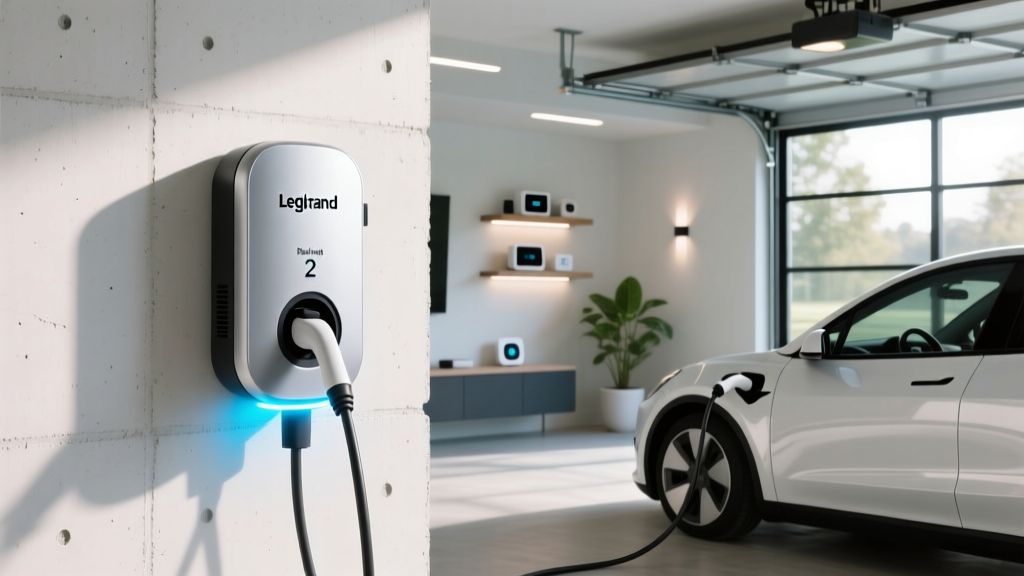
If you've just taken delivery of a new EV or plug-in hybrid, the single most impactful upgrade you can make is a dedicated Level 2 home charger. The Legrand Radiant plug-in home Level 2 EV charger (model EVRH30CCV2) targets buyers who want a clean, contractor-grade unit from a brand electricians already trust — without paying premium prices for features they won't use. In this guide, we break down exactly what this charger delivers, what it costs to install, how fast it charges real-world battery packs, and whether it's the right pick for your garage in 2026.
Quick Verdict: Who the Legrand Radiant Level 2 Charger Is For
Understanding Charging Levels: Level 1, Level 2, and DC Fast
Before evaluating any home charger, you need to understand the three charging tiers available to EV owners. The critical distinction in EV charging is between kW (kilowatts — the rate of power delivery, like water pressure) and kWh (kilowatt-hours — the amount of energy stored in your battery, like gallons in a tank). A charger's kW rating tells you how fast it can push energy into your car; your battery's kWh capacity tells you how much it holds.
| Level | Voltage | Max Power (kW) | Miles of Range Added per Hour | Typical Use Case |
|---|---|---|---|---|
| Level 1 | 120V AC | 1.2–1.9 kW | 3–5 mi/hr | Overnight top-ups, PHEVs, emergencies |
| Level 2 | 240V AC | 3.3–19.2 kW | 12–75 mi/hr | Daily home/work charging |
| DC Fast Charge | 200–900V DC | 50–350+ kW | 150–1,200+ mi/hr | Road trips, highway corridors |
The Legrand Radiant is a Level 2 charger rated at 7.2 kW (30 amps × 240 volts). For context, a Level 1 cordset plugged into a standard household outlet would take roughly 50 hours to charge a 75 kWh battery from empty to full. The Legrand at 7.2 kW cuts that to about 10–11 hours — meaning you plug in when you get home at 6 PM and wake up to a full battery by 5 AM.
Legrand Radiant 30A Specs: Power, Cable, and Connector
Here's the exact hardware you're getting with the Legrand Radiant plug-in Level 2 EV charger:
| Specification | Detail |
|---|---|
| Max Power Output | 7.2 kW (30A @ 240V) |
| Input Plug Type | NEMA 14-50P (240V/50A receptacle) |
| Vehicle Connector | SAE J1772 (CCS1 compatible vehicles) |
| Cable Length | 25 feet |
| Indoor/Outdoor Rating | NEMA 4 (indoor and outdoor rated) |
| Smart Features | None (no Wi-Fi, no app, no load management) |
| Safety Certifications | UL Listed, ENERGY STAR certified |
| Approximate Price | $299 (charger unit only) |
| Warranty | 3 years |
A few things to note on these specs. The 7.2 kW output is a middle-of-the-road Level 2 rate. It's less than the 11.5 kW you'd get from a 48A hardwired unit like the ChargePoint Home Flex, but more than the 3.3 kW some older or portable Level 2 cords provide. For most EV owners driving 30–50 miles daily, 7.2 kW is more than adequate — it replaces roughly 200–250 miles of range overnight, covering even heavy commute days with margin to spare.
The 25-foot cable is generous. Many competing units ship with 18-foot cables, which can be a problem if your NEMA 14-50 outlet is on the far wall of a two-car garage and your charge port is on the driver's side rear quarter panel. With 25 feet, you have slack for most residential garage configurations.
Real-World Charging Times: What 7.2 kW Means for Your EV
Theoretical charge rates only matter if they match your actual battery. Here's how the Legrand Radiant's 7.2 kW output performs with popular 2025–2026 EV battery packs, based on the usable battery capacity and assuming an average charging efficiency of ~90% (some energy is lost to onboard charger conversion and thermal management):
| Vehicle | Usable Battery (kWh) | 0–100% Time | 10–80% Time (approx.) | Miles Added in 8 Hours |
|---|---|---|---|---|
| Tesla Model Y (Long Range) | 75 kWh | ~11.5 hrs | ~8 hrs | ~190 mi |
| Hyundai Ioniq 5 (Long Range) | 77.4 kWh | ~12 hrs | ~8.5 hrs | ~185 mi |
| Ford F-150 Lightning (Std Range) | 98 kWh | ~15 hrs | ~10.5 hrs | ~155 mi |
| Chevrolet Equinox EV (3RS) | 85 kWh | ~13 hrs | ~9 hrs | ~170 mi |
| Toyota RAV4 Prime (PHEV) | 14.9 kWh | ~2.5 hrs | ~1.5 hrs | Full charge |
For daily driving, the key metric is the last column: miles added overnight. If your commute is 40 miles round-trip, any of these vehicles will replenish a full day's driving in 2–3 hours on the Legrand Radiant. You'll rarely need a full 0–100% charge; most EV owners who charge at home plug in every night and keep their state of charge between 20% and 80%, which is also the range that minimizes long-term battery degradation, especially for NMC (nickel manganese cobalt) chemistry packs.
Home Installation: Electrical Requirements, Costs, and Panel Upgrades
The Legrand Radiant is a plug-in unit, meaning it connects to a 240V NEMA 14-50 receptacle rather than being hardwired directly into your electrical panel. This has two practical advantages: you can unplug and take the charger with you if you move, and installation is often simpler since the electrician is installing an outlet rather than a permanent circuit. However, the electrical work on the panel side is identical in complexity.
Electrical Requirements
The NEMA 14-50 outlet requires a dedicated 50-amp, 240-volt circuit. Because the Legrand draws a continuous 30 amps, the National Electrical Code (NEC) requires the circuit to be rated at 125% of the continuous load — so 30A × 1.25 = 37.5A minimum, which a 50A breaker satisfies comfortably. The electrician will run 6 AWG copper wire (or 4 AWG aluminum) from your panel to the outlet location.
Installation Cost Breakdown
Here's what you should budget for a professional installation. Costs vary widely by region, panel condition, and the distance between your electrical panel and the garage or driveway:
| Component | Low Estimate | High Estimate | Notes |
|---|---|---|---|
| Legrand Radiant charger unit | $279 | $329 | Price varies by retailer |
| NEMA 14-50 outlet + wiring (short run, <25 ft) | $350 | $650 | Panel has capacity, outlet near panel |
| NEMA 14-50 outlet + wiring (long run, 25–60 ft) | $650 | $1,200 | Wire cost increases with distance |
| Electrical permit | $50 | $200 | Required in most jurisdictions |
| Panel upgrade (100A → 200A service) | $1,500 | $4,000 | Needed if panel is maxed out or old |
| Total (no panel upgrade) | $679 | $2,179 | |
| Total (with panel upgrade) | $2,179 | $6,179 |
The biggest variable is whether your electrical panel has spare capacity. A modern 200-amp panel in a home without electric heat, an electric oven, or a hot tub usually has room for a 50A breaker. A 100-amp panel in an older home that's already running electric baseboard heat, a dryer, and an electric range may need a service upgrade — which is a separate project involving your utility company and can push costs toward $4,000+.
Practical tip: Before hiring an electrician, check your panel's amperage rating (printed on the main breaker) and count the existing breakers. If you're unsure, many electricians offer a free or low-cost (~$100) panel evaluation to tell you whether you have headroom for a 50A circuit.
Safety and Code Considerations
A few code and safety items to confirm with your electrician:
- Dedicated circuit: The 50A circuit must serve only the EV charger outlet — no sharing with a dryer or workshop equipment.
- GFCI protection: NEC 2020 and later require GFCI (ground-fault circuit interrupter) protection for 240V receptacles in garages. This may require a GFCI breaker ($80–$150) rather than a standard breaker.
- Outdoor rating: If you're installing the outlet outside (for driveway charging), the receptacle must be in a weatherproof "in-use" cover box. The Legrand Radiant carries a NEMA 4 rating, so the unit itself handles outdoor exposure — but the outlet behind it must also be protected.
- Permit and inspection: Most municipalities require an electrical permit and a post-installation inspection. Don't skip this — it protects you and is often required to claim utility rebates.
For a broader look at what utility companies and the Department of Energy recommend for home charging setups, check their installation guidelines before you get quotes.
Connector Compatibility: Will the Legrand Radiant Plug Into Your EV?
The Legrand Radiant ships with a SAE J1772 connector, which is the standard Level 2 plug for all non-Tesla EVs sold in North America. Here's how connector compatibility breaks down across the current EV landscape:
| Vehicle Brand / Standard | Level 2 Port | Works with Legrand Radiant? | Adapter Needed? |
|---|---|---|---|
| Tesla (Model 3/Y/S/X, 2025+ with NACS) | NACS (Tesla) | Yes, with adapter | Tesla J1772-to-NACS adapter (~$95–$200) |
| Hyundai / Kia (Ioniq 5/6, EV6/9) | CCS1 (J1772 upper) | Yes, direct plug | None |
| Ford (Mustang Mach-E, F-150 Lightning) | CCS1 (J1772 upper) | Yes, direct plug | None |
| GM (Equinox EV, Blazer EV, Silverado EV) | CCS1 (J1772 upper) | Yes, direct plug | None |
| Volkswagen (ID.4, ID.7) | CCS1 (J1772 upper) | Yes, direct plug | None |
| BMW (i4, iX, i5) | CCS1 (J1772 upper) | Yes, direct plug | None |
| Nissan (Leaf) | CHAdeMO (DC) + J1772 (L2) | Yes, direct plug | None (J1772 port on all Leafs) |
| Rivian (R1T, R1S) | NACS (2025+) or CCS1 (pre-2025) | Yes | J1772-to-NACS adapter for 2025+ models |
The industry is mid-transition from CCS1 (which uses the J1772 connector for AC Level 2 charging) to NACS (the Tesla-standard connector). As of 2025–2026, most automakers have adopted NACS for new vehicles, but the J1772 connector remains the physical interface for Level 2 AC charging on CCS1-equipped vehicles. The practical result: the Legrand Radiant's J1772 plug works with virtually every EV on the road today, either directly or with an inexpensive adapter for NACS-port vehicles.
If you drive a 2025+ Tesla or a newer Ford/Hyundai/GM model that shipped with a NACS port, you'll need a J1772-to-NACS adapter. Tesla sells an official adapter, and several third-party options (Lectron, A2Z) are available for $95–$200. Keep the adapter in your garage — it stays attached to the charger cable, not the car.
Cost to Charge: Home vs. Public vs. Gas
The financial case for home Level 2 charging rests on the cost-per-mile advantage over gasoline and over public DC fast charging. Here's how the numbers break down using national averages:
| Scenario | Rate | Cost per Mile (at 3 mi/kWh or 30 MPG) |
|---|---|---|
| Home Level 2 (national avg. residential electricity) | $0.16/kWh | $0.053/mile |
| Home Level 2 (off-peak utility rate, e.g., time-of-use) | $0.08/kWh | $0.027/mile |
| Public Level 2 (networks like ChargePoint, EVgo) | $0.25–$0.39/kWh | $0.083–$0.13/mile |
| DC Fast Charging (Electrify America, Tesla Supercharger) | $0.35–$0.55/kWh | $0.12–$0.18/mile |
| Gasoline vehicle (30 MPG, $3.30/gallon) | $3.30/gal | $0.11/mile |
| Gasoline vehicle (25 MPG, $3.30/gallon) | $3.30/gal | $0.132/mile |
The math is clear: charging at home on an off-peak rate is roughly 4–5× cheaper per mile than gasoline, and 3–4× cheaper than DC fast charging. Even at the national average residential electricity rate of ~$0.16/kWh, you're paying about half what a 30 MPG gas car costs per mile.
The Legrand Radiant is a "dumb" charger — it has no built-in scheduling or time-of-use (TOU) optimization. To take advantage of off-peak rates (typically 10 PM–6 AM), you have two options: set a charging schedule in your EV's infotainment system (most modern EVs support delayed charging), or ask your electrician to install a smart panel-level load manager. For most owners, the in-car scheduling approach is free and works perfectly.
For current state and utility incentive programs that can offset your charger cost or electricity rate, the Alternative Fuels Data Center maintains a state-by-state database of EV incentives.
How the Legrand Radiant Compares to Other Level 2 Chargers
The home Level 2 charger market is competitive. Here's how the Legrand Radiant stacks up against three popular alternatives at similar price points:
Legrand Radiant (EVRH30CCV2)
- Power: 7.2 kW (30A)
- Connector: J1772
- Cable: 25 ft
- Smart: No
- Price: ~$299
- Best for: Budget-conscious owners who want a reliable, UL-listed unit with a long cable
ChargePoint Home Flex
- Power: Up to 11.5 kW (48A, hardwired) or 9.6 kW (40A, plug-in)
- Connector: J1772 (NACS adapter available)
- Cable: 23 ft
- Smart: Yes (Wi-Fi, app, scheduling, Alexa)
- Price: ~$549
- Best for: Owners who want app control, higher power, and flexible amperage settings
Emporia Vue Level 2 Charger
- Power: 11.5 kW (48A, hardwired) or 7.7 kW (32A, plug-in)
- Connector: J1772
- Cable: 24 ft
- Smart: Yes (Wi-Fi, app, solar integration)
- Price: ~$399
- Best for: Solar-panel owners and those wanting smart features at a lower price than ChargePoint
Tesla Wall Connector
- Power: Up to 11.5 kW (48A, hardwired)
- Connector: NACS (J1772 adapter included)
- Cable: 24 ft
- Smart: Yes (Wi-Fi, OTA updates, power sharing)
- Price: ~$475
- Best for: Tesla owners or mixed-Tesla households; highest power output at a moderate price
If your primary vehicle is a non-Tesla EV and you charge overnight with no need for app-based scheduling, the Legrand Radiant's value proposition is strong: it undercuts the competition by $100–$250 while delivering adequate 7.2 kW charging. However, if you drive a large-battery EV (100+ kWh, like the F-150 Lightning Extended Range or Rivian R1T Max Pack) and frequently arrive home near-empty, the slower 7.2 kW rate means you may not fully replenish in a single overnight session. In that case, spending $250 more for a 48A/11.5 kW unit like the Emporia or Tesla Wall Connector saves you 3–4 hours on a full charge cycle.
Federal and Utility Incentives for Home Charger Installation
The federal Alternative Fuel Vehicle Refueling Property Credit (IRS §30C) can cover up to 30% of the cost of home EV charging equipment and installation, capped at $1,000. However, this credit has significant limitations: it's only available for installations in eligible census tracts (typically low-income or rural communities), and the property must be your principal residence. Check the IRS §30C guidelines for current eligibility rules and census tract maps.
Beyond the federal credit, many electric utilities offer their own rebates — typically $200–$500 for the charger unit, and in some cases, free or discounted installation. Utilities like PG&E, Con Edison, Xcel Energy, and Duke Energy have run residential EV charger rebate programs. Contact your local utility's EV program page before purchasing to see what's available in your area.
Frequently Asked Questions
How much does it cost to install a home EV charger?
For a plug-in Level 2 charger like the Legrand Radiant, total installed cost (charger + outlet + electrician + permit) typically ranges from $679 to $2,179 if your electrical panel has sufficient capacity. If your home needs a panel upgrade from 100A to 200A service, add $1,500–$4,000. The single biggest cost variable is the distance between your electrical panel and the outlet location — longer wire runs mean higher material and labor costs.
How fast will each charging level add range?
Level 1 (120V) adds 3–5 miles of range per hour — adequate for PHEVs with small batteries but impractical for full EVs. Level 2 (240V) at 7.2 kW, like the Legrand Radiant, adds roughly 20–30 miles per hour depending on the vehicle's efficiency. DC fast charging at 150 kW+ can add 150–300+ miles in 20–30 minutes but is intended for road trips, not daily use.
Which connector/charger is compatible with my EV?
The Legrand Radiant uses a J1772 connector, which plugs directly into all CCS1-equipped EVs (Hyundai, Kia, Ford, GM, VW, BMW, and most others). For NACS-equipped vehicles (2025+ Tesla, and newer Ford/GM/Hyundai models), you'll need a J1772-to-NACS adapter ($95–$200). The Nissan Leaf uses CHAdeMO for DC fast charging but has a standard J1772 port for Level 2 — so the Legrand works directly.
How much does charging cost per mile vs. gas?
At the national average residential electricity rate of $0.16/kWh and an EV efficiency of 3 miles per kWh, home charging costs approximately $0.05 per mile. A comparable gasoline vehicle getting 30 MPG at $3.30/gallon costs $0.11 per mile — more than double. With off-peak utility rates (~$0.08/kWh), the EV cost drops to under $0.03/mile.
What electrical upgrades might I need?
The most common upgrade is a panel capacity increase. If your home has a 100-amp electrical service and you're already running high-draw appliances (electric range, dryer, HVAC), you may need a 200-amp upgrade ($1,500–$4,000). Other potential upgrades include: replacing a Federal Pacific or Zinsco panel (known fire hazards, $1,500–$3,000 to replace), adding a sub-panel in a detached garage ($500–$1,500), or upgrading from a 3-prong dryer outlet to a 4-wire NEMA 14-50. Your electrician will identify these during a panel evaluation.
Is the Legrand Radiant charger safe for outdoor installation?
Yes. The unit carries a NEMA 4 rating, meaning it's protected against rain, splashing water, and external ice formation. However, the NEMA 14-50 receptacle it plugs into must also be housed in a weatherproof "in-use" cover box (typically $30–$60) to meet code for outdoor installations. Confirm this with your electrician.
Can I use the Legrand Radiant with a NEMA 14-50 outlet I already have for my dryer?
Possibly, but with caveats. The NEC requires EV chargers to be on a dedicated circuit — meaning you cannot share the outlet with a dryer. If your existing 14-50 outlet is on a dedicated 50A breaker with appropriate wire gauge, you could repurpose it (moving the dryer to a different circuit or switching to a gas dryer). If the circuit is shared, your electrician will need to run a new dedicated circuit. Never use a splitter or extension cord with a Level 2 EV charger.