For years, Tesla's Supercharger network was the walled garden of fast charging — proprietary, reliable, and locked to Tesla owners. That changed as automakers adopted the North American Charging Standard (NACS) for their EVs. But if you drive a CCS-equipped vehicle from the 2021–2025 model years — think Hyundai Ioniq 5, Ford Mustang Mach-E, Kia EV6, or BMW i4 — your car still has a CCS1 port. The Lectron NACS adapter bridges that gap, letting you plug into Tesla Superchargers without waiting for a factory port swap.
This guide breaks down exactly what the Lectron NACS adapter does, how fast it charges, what it costs to use, and how it fits into the broader home-and-public charging picture every EV owner needs to understand.
What the Lectron NACS Adapter Actually Does
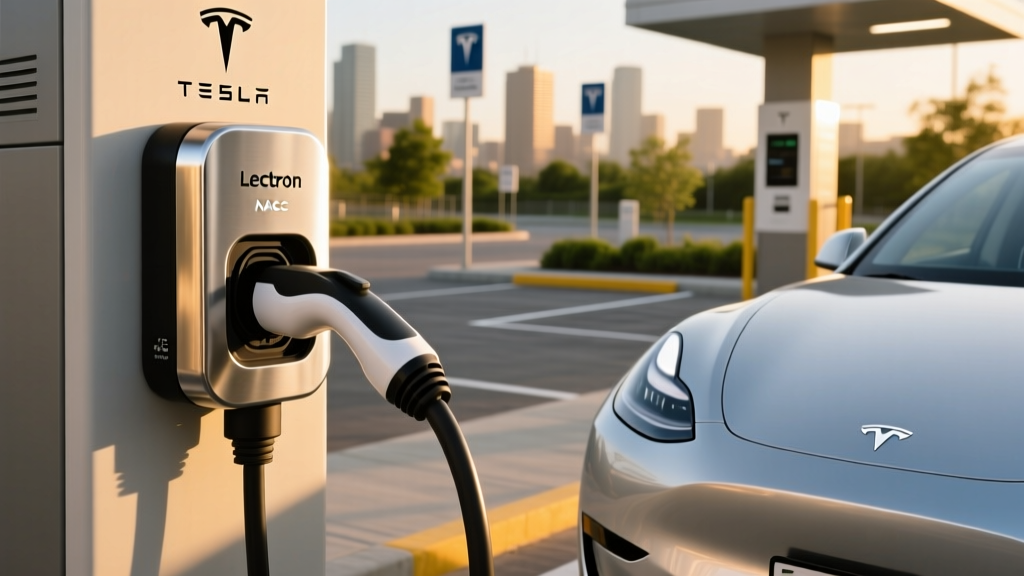
The Lectron NACS adapter is a compact, pass-through dongle that converts your vehicle's CCS1 (Combined Charging System) inlet to accept a NACS (Tesla-style) DC fast-charging plug. You plug the adapter into your car's CCS port, then plug the Supercharger cable into the adapter's NACS receptacle. Communication protocols between the vehicle and charger pass through the adapter — no app pairing or handshake tricks required at most V3 and V4 Superchargers that support non-Tesla access.
Key specs for the current Lectron NACS-to-CCS adapter:
- Max DC power: 150 kW (limited by the adapter's internal contact rating, not your car's peak capability)
- Max current: 300A at up to 500V DC
- Weight: approximately 1.2 lbs
- Certifications: UL-listed components, IP55 weather resistance rating
- Typical retail price: $159–$189 depending on retailer and sales
Understanding Charging Levels: Speeds, Power, and Range Added
Before evaluating any adapter or home setup, you need clarity on the three charging levels. The critical distinction: kW (kilowatts) measures power — how fast energy flows. kWh (kilowatt-hours) measures energy — how much your battery stores. Think of kW as the width of a pipe and kWh as the size of the tank you're filling.
| Level | Voltage / Amps | Power (kW) | Miles of Range Added Per Hour | Typical Use Case |
|---|---|---|---|---|
| Level 1 | 120V / 12A | 1.4 kW | 3–5 miles | Overnight top-up, emergency, PHEVs |
| Level 2 | 240V / 32–48A | 7.7–11.5 kW | 25–44 miles | Daily home charging, workplace |
| DC Fast Charge | 400–800V DC | 50–350 kW | 180–1,000+ miles (peak rate) | Road trips, rapid top-ups |
The Lectron NACS adapter operates exclusively at the DC Fast Charge level. It does not enable Level 2 AC charging at Tesla Destination Chargers — those require a separate NACS-to-J1772 adapter (Lectron and others sell these for roughly $130–$160). If you want full Tesla ecosystem access, budget for both adapters.
Connector Compatibility: Which Adapter Do You Need?
The North American EV landscape in 2026 has largely consolidated around NACS, but millions of CCS1-equipped vehicles remain on the road. Here's how connector compatibility breaks down by brand and model year:
| Connector | Brands / Models Using It | Adapter Needed for Supercharger Access? |
|---|---|---|
| NACS (native) | Tesla (all), Ford F-150 Lightning (2025+), Rivian (2025+), GM Ultium vehicles (2025+), Hyundai/Kia (2026+) | No — plug directly into Superchargers |
| CCS1 | Hyundai Ioniq 5/6 (2022–2025), Kia EV6/EV9 (2022–2025), Ford Mach-E (2021–2024), BMW i4/iX, VW ID.4, most pre-2025 non-Tesla EVs | Yes — Lectron NACS adapter or OEM equivalent |
| CHAdeMO | Nissan Leaf (2011–2025), Mitsubishi Outlander PHEV (older) | No NACS adapter available; network is effectively discontinued |
If your EV has a CCS1 port and you road-trip more than a few times a year, a NACS adapter is nearly essential. Tesla's Supercharger network had over 28,000 stalls in North America by early 2026, with the vast majority now open to non-Tesla vehicles via the "Charge Your Non-Tesla" feature in the Tesla app. According to Tesla's Supercharger page, non-Tesla access is available at most V3 (250 kW) and V4 stalls, though some urban and older locations remain Tesla-only.
Cost to Charge: Home vs. Public vs. DC Fast Charging
Charging economics vary dramatically depending on where and when you plug in. Here's a realistic breakdown using national average electricity rates from the U.S. Energy Information Administration:
| Charging Scenario | Cost per kWh | Cost to Add 200 Miles | Cost per Mile |
|---|---|---|---|
| Home Level 2 (off-peak utility rate) | $0.09–$0.14 | $5.14–$8.00 | $0.026–$0.040 |
| Home Level 2 (standard residential rate) | $0.16–$0.22 | $9.14–$12.57 | $0.046–$0.063 |
| Public Level 2 (ChargePoint, Blink, etc.) | $0.25–$0.49 | $14.29–$28.00 | $0.071–$0.140 |
| DC Fast — Electrify America / EVgo | $0.40–$0.56 | $22.86–$32.00 | $0.114–$0.160 |
| Tesla Supercharger (via Lectron NACS adapter) | $0.35–$0.50 | $20.00–$28.57 | $0.100–$0.143 |
| Gasoline comparison (30 MPG, $3.40/gal) | — | $22.67 | $0.113 |
The math is clear: home Level 2 charging is the economic sweet spot, costing roughly one-quarter to one-third what gasoline does per mile. DC fast charging — whether at a Supercharger with your Lectron adapter or at an Electrify America station — approaches or exceeds gas-car fueling costs. Use DC fast charging for road trips and convenience, not as your daily fueling strategy.
Charging Time Examples: What to Expect with the Lectron Adapter
Charging speed isn't a flat rate — it follows a charge curve. Your EV charges fastest between roughly 10–50% State of Charge (SoC), then progressively tapers as the battery management system protects cell health. Here's what 150 kW-capped charging looks like for popular CCS vehicles:
- Hyundai Ioniq 5 Long Range (77.4 kWh, NMC): 10–80% in approximately 28–32 minutes via Lectron adapter (vs. 18 min at native 240 kW)
- Kia EV6 GT-Line (77.4 kWh, NMC): 10–80% in approximately 28–32 minutes (vs. 18 min native)
- Ford Mustang Mach-E Extended Range (91 kWh, NMC): 10–80% in approximately 38–42 minutes (Mach-E peaks at 150 kW natively, so the adapter doesn't bottleneck it)
- Volkswagen ID.4 Pro S (82 kWh, NMC): 10–80% in approximately 34–38 minutes (peaks at 135 kW natively)
- BMW i4 eDrive40 (81.5 kWh, NMC): 10–80% in approximately 33–37 minutes (peaks at ~200 kW natively, so adapter caps it)
For vehicles that natively peak at or below 150 kW (Mach-E, ID.4), the Lectron adapter introduces zero speed penalty. For 800V-architecture vehicles (Ioniq 5, EV6), you sacrifice peak speed but gain access to a far more reliable and widespread network.
Home Charging Setup: Electrical Requirements and Installation Costs
The Lectron NACS adapter is a road-trip tool. Your daily charging should happen at home on a Level 2 charger. Here's what a proper home Level 2 installation requires:
Electrical requirements:
- Circuit: Dedicated 240V circuit, typically 40A or 50A breaker
- Continuous load rule: NEC requires EV chargers to use no more than 80% of the circuit's rated capacity — a 40A breaker supports a 32A (7.7 kW) charger; a 50A breaker supports a 40A (9.6 kW) charger
- Wire gauge: 6 AWG copper for 50A circuits; 8 AWG for 40A circuits (your electrician will confirm)
- Outlet type: NEMA 14-50 (most common) or hardwired connection (required for circuits above 50A and some local codes)
| Component | Cost Range | Notes |
|---|---|---|
| Level 2 charger equipment | $300–$700 | Varies by brand, power, smart features |
| Electrician labor (standard install) | $500–$1,500 | Assumes panel is nearby, no upgrade needed |
| Permit and inspection | $50–$250 | Varies by municipality; some waive for EV |
| Electrical panel upgrade (if needed) | $1,500–$4,000 | Required if existing panel lacks capacity — common in homes pre-2000 with 100A service |
| Total (no panel upgrade) | $850–$2,450 | Most homes with 200A service fall here |
| Total (with panel upgrade) | $2,350–$6,450 | Older homes or those adding multiple large loads |
Panel upgrade reality: Many homes built before 2000 have 100-amp electrical panels that simply cannot support a 40A or 50A dedicated EV circuit alongside existing loads (HVAC, electric range, dryer). Upgrading to a 200A panel is a significant but one-time investment. Always have a licensed electrician perform a load calculation before committing to a charger amperage. The National Electrical Contractors Association provides guidance on residential EV charging installations.
Safety and code considerations:
- GFCI (Ground Fault Circuit Interrupter) protection is required by NEC 2020+ for outdoor receptacles and in many jurisdictions for indoor EV circuits
- Outdoor installations require a weather-rated (NEMA 3R or 4) enclosure and in-use cover
- Never use an extension cord or plug adapter between your charger and the wall outlet
- Wi-Fi-connected "smart" chargers must have UL certification — avoid uncertified imports
Recommended Home Level 2 Chargers for 2026
Pair your Lectron NACS adapter for road trips with one of these proven home chargers for daily use:
ChargePoint Home Flex (Best Overall)
- Power output: Up to 11.5 kW (48A) on a 60A circuit; adjustable down to 16A
- Connector: J1772 (NACS vehicles need Tesla's J1772 adapter; CCS vehicles plug directly)
- Cable length: 23 feet
- Smart features: Wi-Fi, app scheduling, utility integration, Alexa
- Price: ~$549
Emporia Level 2 EV Charger (Best Value)
- Power output: Up to 11.5 kW (48A) on a 60A circuit
- Connector: J1772
- Cable length: 24 feet
- Smart features: Wi-Fi, app control, solar integration, energy monitoring
- Price: ~$399
Wallbox Pulsar Plus (Best Compact)
- Power output: Up to 11.5 kW (48A)
- Connector: J1772
- Cable length: 25 feet
- Smart features: Wi-Fi + Bluetooth, Power Sharing (two chargers on one circuit), load balancing
- Price: ~$599
Note: All J1772 chargers work with CCS vehicles directly. NACS-equipped vehicles (2025+ Teslas, Ford, GM, Rivian) can use the J1772-to-NACS adapter included with most new vehicles, or purchase one separately from Tesla (~$95).
Frequently Asked Questions
How much does it cost to install a home EV charger?
A standard Level 2 home installation runs $850–$2,450 when your electrical panel has adequate capacity (200A service with available breaker slots). If your home needs a panel upgrade from 100A to 200A service, total costs climb to $2,350–$6,450. Equipment costs $300–$700, electrician labor $500–$1,500, and permits $50–$250 depending on your municipality.
How fast will each charging level add range?
Level 1 (120V) adds 3–5 miles per hour — sufficient only for PHEVs or emergency top-ups. Level 2 (240V, 32–48A) adds 25–44 miles per hour, fully recharging most EVs overnight. DC Fast Charging adds range at 180–1,000+ miles per hour at peak rates, but sessions are typically measured in 10–80% minutes (18–42 minutes depending on vehicle and charger power).
Which connector and charger is compatible with my EV?
Check your vehicle's charge port. If it's CCS1 (most non-Tesla EVs from 2019–2025), you can use any J1772 Level 2 charger directly and any CCS DC fast charger. For Tesla Supercharger access, you need a Lectron NACS adapter. If your EV has a native NACS port (2025+ Ford, GM, Rivian, Tesla), you plug into Superchargers directly and need a NACS-to-J1772 adapter for non-Tesla Level 2 chargers. CHAdeMO vehicles (Nissan Leaf) have no Supercharger adapter option.
How much does charging cost per mile compared to gas?
Home Level 2 charging at off-peak rates costs $0.026–$0.040 per mile — roughly one-third the cost of gasoline at $3.40/gallon and 30 MPG ($0.113/mile). Public DC fast charging at $0.40–$0.56/kWh costs $0.114–$0.160 per mile, approaching or exceeding gas costs. The Lectron NACS adapter at Superchargers ($0.35–$0.50/kWh) costs $0.100–$0.143 per mile.
What electrical upgrades might I need for a home charger?
The most common upgrade is a panel capacity increase from 100A to 200A service ($1,500–$4,000), necessary when your existing panel lacks spare capacity for a 40–50A dedicated circuit. You may also need a new conduit run from the panel to your garage or parking spot ($200–$800 depending on distance and whether walls need to be opened). Homes with existing 200A+ panels and nearby garage sub-panels typically need only the circuit, breaker, outlet, and charger — no major upgrades.
Does the Lectron NACS adapter work at all Tesla Superchargers?
Not all. Tesla has opened most V3 (250 kW) and V4 Supercharger stalls to non-Tesla vehicles, but some older V2 (150 kW) and urban Supercharger locations remain Tesla-only. Before traveling, check Supercharger access in the Tesla app — it shows which specific stalls accept non-Tesla vehicles. The adapter works seamlessly at enabled stalls once you initiate the session through the Tesla app.
Will using a third-party adapter void my EV's warranty?
No. Under the Magnuson-Moss Warranty Act, using a third-party adapter cannot void your vehicle's battery or powertrain warranty unless the manufacturer can prove the adapter directly caused damage. The Lectron adapter is UL-listed for its components and includes overcurrent and thermal protection. That said, if a charging-related warranty claim arises, having documentation of the adapter's certifications is prudent.
The Lectron NACS adapter fills a specific and valuable niche: giving CCS-equipped EVs access to the most reliable DC fast-charging network in North America. At $159–$189, it's a sensible investment for any CCS owner who road-trips more than occasionally. Pair it with a quality home Level 2 charger, and you have a complete charging strategy that covers daily commuting at $0.03–$0.05 per mile and road-trip fast charging at the most dependable stalls available.