LAX Charging Stations: What EV Drivers Need to Know Before Flying
Los Angeles International Airport handles over 75 million passengers annually, and for EV drivers, the question isn't just "where do I park?" — it's "where do I charge?" LAX charging stations span a patchwork of public garages, nearby DC fast chargers, hotel Level 2 setups, and off-airport lots. This guide breaks down every charging option around LAX, explains what speeds and connectors you'll encounter, and shows you how to calculate whether airport charging or home charging saves you more per trip.
Whether you're dropping off for a week-long trip or picking up a rental EV, understanding the kW output, connector types (NACS, CCS1, CHAdeMO), and per-kWh pricing at LAX-area chargers will keep your battery healthy and your wallet intact.
Charging Levels Explained: Speeds, Power, and Range Added
Before evaluating any charger near LAX, you need to understand the three charging levels and what they deliver. Power is measured in kW (kilowatts) — the rate of energy flow — while your battery capacity is measured in kWh (kilowatt-hours) — the total energy stored. Confusing these two is the most common EV literacy mistake.
| Level | Voltage | Max Power (kW) | Miles of Range per Hour | Typical Use Case |
|---|---|---|---|---|
| Level 1 | 120V AC | 1.4 kW | 3–5 mi/hr | Overnight top-ups, emergencies |
| Level 2 | 240V AC | 7.2–19.2 kW | 20–60 mi/hr | Home charging, hotels, airport garages |
| DC Fast Charge | 400–800V DC | 50–350 kW | 150–1,200 mi/hr (peak) | Road trips, quick airport top-ups |
Public Charging Stations Near LAX: Networks, Pricing, and Connectors
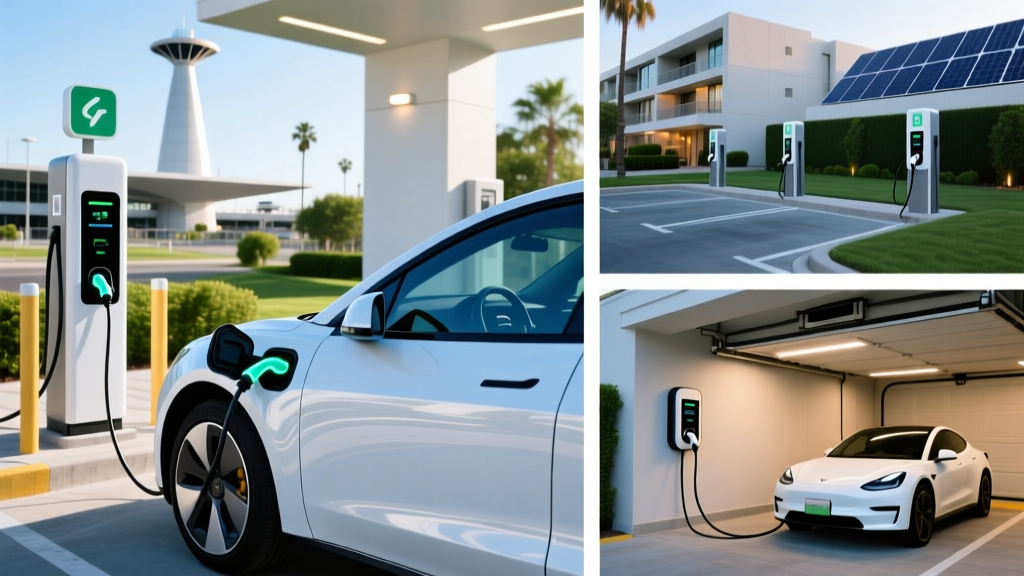
LAX does not currently offer dedicated EV charging inside its central terminal garages at scale. Most airport-adjacent charging is found in:
- Off-airport parking lots (The Parking Spot, WallyPark, Joe's Auto Parks) — typically Level 2, 7.2–11.5 kW
- Nearby hotels (Hilton LAX, Hyatt Regency, Marriott) — Level 2 ChargePoint or Tesla Destination chargers, 7.2–19.2 kW
- Public DC fast stations within 2–5 miles — Electrify America, EVgo, Tesla Superchargers (now open to NACS-equipped non-Tesla EVs)
- Shopping centers (Westfield Culver City, South Bay Galleria) — mixed Level 2 and DC fast
Connector Compatibility at LAX-Area Chargers
The connector landscape shifted dramatically in 2024–2025 when most major automakers adopted the North American Charging Standard (NACS). Here's what you'll find near LAX:
| Connector | Brands Using It | Availability Near LAX | Adapter Needed? |
|---|---|---|---|
| NACS (Tesla) | Tesla, Ford, GM, Rivian, Volvo, Polestar, Hyundai/Kia (2025+) | High — Superchargers + destination | CCS-to-NACS adapter for older non-Tesla |
| CCS1 | Most 2020–2024 non-Tesla EVs (VW, BMW, older Hyundai/Kia) | High — Electrify America, EVgo | NACS-to-CCS adapter at Superchargers |
| CHAdeMO | Nissan Leaf (legacy), Mitsubishi Outlander PHEV | Low — declining availability | No adapter widely available; use CCS/NACS stations |
If you drive a 2025+ model from Ford, GM, or Rivian, your vehicle likely has a native NACS port and can use Tesla Superchargers directly. For older CCS1-equipped vehicles, Tesla provides a NACS adapter that enables Supercharger access — a significant range-expansion benefit around LAX where Supercharger stalls outnumber other DC fast networks.
Charging Time Examples: How Long Will You Wait Near LAX?
Here's what charging actually looks like for common EV battery sizes you'll encounter in rental fleets and personal vehicles:
| Vehicle (Battery kWh) | Level 2 (11.5 kW) | DC Fast 50 kW | DC Fast 150 kW | DC Fast 250+ kW |
|---|---|---|---|---|
| Tesla Model 3 (75 kWh usable) | ~6.5 hrs (0–100%) | 10–80%: ~75 min | 10–80%: ~28 min | 10–80%: ~18 min (V3 Supercharger) |
| Hyundai Ioniq 5 (77.4 kWh) | ~7 hrs (0–100%) | 10–80%: ~80 min | 10–80%: ~25 min | 10–80%: ~18 min (800V architecture) |
| Ford F-150 Lightning (131 kWh ext.) | ~11.5 hrs (0–100%) | 10–80%: ~130 min | 10–80%: ~45 min | 10–80%: ~35 min (150 kW cap) |
| Chevrolet Equinox EV (85 kWh) | ~7.5 hrs (0–100%) | 10–80%: ~90 min | 10–80%: ~30 min | 10–80%: ~22 min |
Cost to Charge Near LAX: Home vs. Public vs. DC Fast
Electricity pricing varies dramatically between home charging and public stations near LAX. Here's a realistic breakdown using Southern California Edison (SCE) rates and typical public network pricing:
| Scenario | Cost per kWh | Cost to Add 200 Miles (at 3.5 mi/kWh) | Cost per Mile |
|---|---|---|---|
| Home Level 2 (SCE off-peak, overnight) | $0.13–$0.18 | $7.43–$10.29 | $0.037–$0.051 |
| Home Level 2 (SCE peak, daytime) | $0.28–$0.35 | $16.00–$20.00 | $0.080–$0.100 |
| Public Level 2 (hotel/parking garage) | $0.30–$0.49 | $17.14–$28.00 | $0.086–$0.140 |
| DC Fast (Electrify America/EVgo) | $0.43–$0.58 | $24.57–$33.14 | $0.123–$0.166 |
| Tesla Supercharger (LAX area) | $0.33–$0.42 | $18.86–$24.00 | $0.094–$0.120 |
| Gasoline baseline (30 MPG, $4.80/gal) | — | $32.00 | $0.160 |
Even at peak public DC fast pricing, EV charging near LAX undercuts gasoline on a per-mile basis. But the savings multiply when you charge at home on off-peak rates — dropping to roughly one-quarter the cost of gas. For frequent flyers who can charge at home before heading to the airport, the economics strongly favor home Level 2 installation.
Home EV Charger Installation: Costs, Electrical Requirements, and Panel Upgrades
If you live within 15–20 miles of LAX and fly regularly, a home Level 2 charger is the single most impactful EV upgrade you can make. Here's what's involved:
Electrical Requirements
- Circuit: Dedicated 240V circuit, typically 40A or 60A breaker
- Charger amperage: A 40A circuit supports a 32A charger (7.7 kW); a 60A circuit supports a 48A charger (11.5 kW)
- Wire gauge: 6 AWG copper for 40A; 4 AWG copper for 60A (your electrician will specify)
- Outlet vs. hardwired: NEMA 14-50 outlet allows portability; hardwired is required for circuits above 50A per NEC code and may be safer for outdoor installs
Panel Upgrade Reality
Homes built before 2000 often have 100A or 125A main service panels. Adding a 40–60A EV circuit may exceed available capacity, especially if you already run electric range, dryer, and HVAC. A panel upgrade to 200A typically costs $1,500–$3,500 and may be required before your permit is approved.
| Component | Cost Range | Notes |
|---|---|---|
| Level 2 charger (hardware) | $300–$700 | Varies by brand, power output, smart features |
| Electrician labor (standard install) | $600–$1,800 | Depends on run length from panel to garage/driveway |
| Permit and inspection | $100–$350 | Required by most LA County jurisdictions |
| Panel upgrade (if needed) | $1,500–$3,500 | 200A service upgrade for older homes |
| Total (no panel upgrade) | $1,000–$2,850 | Most homes with modern 200A panels |
| Total (with panel upgrade) | $2,500–$6,350 | Older homes needing service upgrade |
Always hire a licensed electrician familiar with NEC Article 625 (EV charging equipment). The U.S. Department of Energy recommends getting at least three quotes and verifying that your installer pulls a permit — unpermitted work can void home insurance claims and cause issues at resale.
Federal Tax Credit for Home Charging
The IRS §30D credit applies to vehicles, not chargers. However, the Alternative Fuel Vehicle Refueling Property Credit (IRC §30C) covers up to 30% of home charger hardware and installation costs, capped at $1,000. Eligibility depends on your census tract meeting certain income or rural criteria — check the IRS §30C page for current-year rules, as qualifying areas are updated annually.
Recommended Level 2 Chargers for Home Installation
Here are three proven Level 2 chargers suited for LAX-area homeowners, selected for reliability, power output, and smart features:
ChargePoint Home Flex
- Power: Up to 11.5 kW (48A on 60A circuit)
- Connector: NACS or J1772 (configurable)
- Cable: 23 ft
- Smart features: Wi-Fi, scheduling, Alexa, energy tracking
- Price: ~$549–$649
- Best for: Flexible amperage settings, works with any panel
Tesla Wall Connector
- Power: Up to 11.5 kW (48A on 60A circuit)
- Connector: NACS native
- Cable: 24 ft
- Smart features: Wi-Fi, OTA updates, power sharing (multiple units)
- Price: ~$420–$475
- Best for: Tesla and NACS-equipped Ford/GM/Rivian owners
Emporia Vue Level 2
- Power: Up to 11.5 kW (48A on 60A circuit)
- Connector: J1772 (CCS1 compatible)
- Cable: 24 ft
- Smart features: Wi-Fi, solar integration, whole-home energy monitoring
- Price: ~$399–$499
- Best for: Budget-conscious buyers, solar homes
All three chargers are UL-listed, outdoor-rated (NEMA 4), and support scheduled charging to take advantage of SCE's off-peak rates overnight.
Safety and Electrical Code Considerations
EV charger installation isn't just about plugging in — it must meet National Electrical Code (NEC) and local Los Angeles building requirements:
- Dedicated circuit: Your EV charger must be on its own breaker — no sharing with other appliances
- GFCI protection: NEC 2020+ requires GFCI (Ground Fault Circuit Interrupter) protection for all outdoor receptacles used for EV charging; hardwired units have built-in ground-fault protection
- Outdoor rating: If installing outside, the charger must be rated NEMA 4 or NEMA 4X for weather resistance
- Cable management: Avoid running cables across walkways; wall-mount with a holster or retractable reel
- Load calculation: Your electrician must perform a NEC Article 220 load calculation to verify your panel can handle the additional draw
Frequently Asked Questions About LAX Charging
How much does it cost to install a home EV charger?
A standard Level 2 home installation (40–60A, 240V) costs $1,000–$2,850 if your panel has sufficient capacity. If a panel upgrade to 200A is needed, total costs range from $2,500–$6,350. Equipment alone runs $300–$700, with labor and permits making up the remainder.
How fast will each charging level add range?
Level 1 (120V) adds 3–5 miles per hour — too slow for daily use. Level 2 (240V, 32–48A) adds 20–60 miles per hour, easily replenishing a full overnight charge. DC fast charging (50–350 kW) can add 150–1,200 miles per hour at peak, but sustained rates taper significantly above 80% SoC.
Which connector/charger is compatible with my EV?
2025+ vehicles from Tesla, Ford, GM, Rivian, Volvo, and Hyundai/Kia use NACS. Most 2020–2024 non-Tesla EVs use CCS1. Nissan Leaf uses CHAdeMO (legacy). Check your vehicle's charge port or owner's manual, and carry the appropriate adapter for the networks you plan to use near LAX.
How much does charging cost per mile vs gas?
At home off-peak rates ($0.13–$0.18/kWh), EV charging costs $0.04–$0.05 per mile. Public DC fast charging near LAX ($0.43–$0.58/kWh) runs $0.12–$0.17 per mile. Gasoline at $4.80/gal and 30 MPG costs $0.16 per mile. Even the most expensive public EV charging matches or beats gasoline, while home charging costs roughly one-quarter as much.
What electrical upgrades might I need?
If your home has a 100A or 125A main panel, you'll likely need a 200A service upgrade ($1,500–$3,500). Homes with existing 200A panels usually have sufficient headroom for a 40–60A EV circuit. Your electrician will perform a load calculation to determine this before pulling a permit.
Are there LAX charging stations inside the airport garages?
LAX's central parking structures have limited EV charging availability as of 2026. Most EV drivers rely on off-airport parking facilities with Level 2 chargers, nearby hotel chargers, or DC fast stations within 2–5 miles of the airport. Plan to arrive with sufficient charge or use a DC fast station en route.