If you still own or recently drove a 2012 Land Rover Sport Supercharged, you already know the 5.0L V8's appetite: EPA-rated 12 MPG city and 17 MPG highway, with real-world combined driving often hovering near 14 MPG. That 28.3-gallon tank can cost over $100 to fill at today's pump prices. For many owners of thirsty legacy SUVs, switching to an EV isn't just about emissions — it's a fundamental shift in how much you spend per mile and how you "refuel" at home.
This guide breaks down exactly what home and public EV charging looks like in 2026 — speeds, equipment, installation costs, and per-mile economics — so you can compare apples to apples against that Supercharged V8's fuel bill.
Charging Levels Explained: How Fast Each Adds Range
The single most important distinction in EV ownership is kW (kilowatts) vs. kWh (kilowatt-hours). Kilowatts measure power — the rate at which electricity flows into your car. Kilowatt-hours measure energy — the total capacity of your battery, like gallons in a fuel tank. A 100 kWh battery charged at 10 kW takes roughly 10 hours; charged at 100 kW, about one hour (minus taper losses). Never confuse the two.
| Level | Voltage / Amps | Power (kW) | Miles of Range Added Per Hour | Typical Use |
|---|---|---|---|---|
| Level 1 (120V) | 120V / 12–16A | 1.4–1.9 kW | 3–5 mi/hr | Overnight top-ups, low-mileage drivers |
| Level 2 (240V) | 240V / 32–48A | 7.7–11.5 kW | 25–44 mi/hr | Daily home charging, overnight full charges |
| DC Fast Charging | 400–800V DC | 50–350 kW (peak) | 150–1,000+ mi/hr (at peak) | Road trips, rapid top-ups (10–80% in 15–30 min) |
Level 2 is the home-charging sweet spot. Most modern EVs with 75–100 kWh batteries will fully replenish overnight (8–10 hours) on a 240V/48A circuit. DC fast charging is for road trips — but remember that peak kW is not sustained kW. A vehicle rated for 250 kW peak may only hold that rate for a few minutes before the charge curve tapers, especially above 80% State of Charge (SoC). Expect a 10–80% session on a capable vehicle and 350 kW charger to take 15–25 minutes in ideal conditions.
Home Charger Installation: Electrical Requirements & Costs
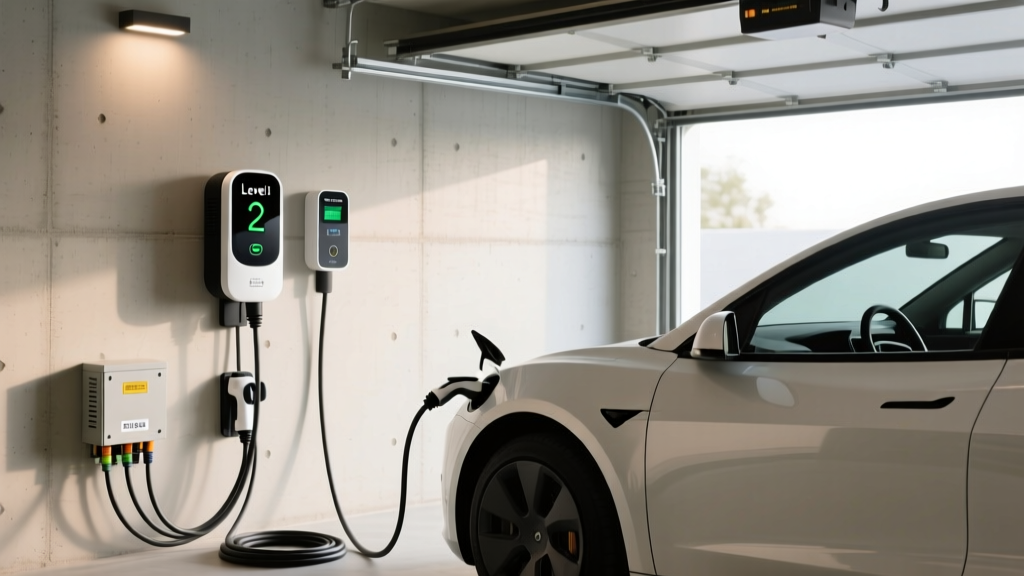
A Level 2 home charger needs a dedicated 240V circuit — the same voltage your electric dryer or oven uses. Most installations require a 50-amp breaker (supporting a 40A continuous charger load) or a 60-amp breaker (for a 48A charger). Here's what that involves:
- Electrical panel capacity: Your main panel must have room for the new double-pole breaker and enough total amperage headroom. Many older homes with 100A service need an upgrade to 200A — a significant added cost.
- Wiring run: 6 AWG copper wire (or 4 AWG for longer runs) from panel to charger location. Longer runs increase material cost.
- Permit: Nearly all jurisdictions require an electrical permit and inspection for a new 240V circuit. This is non-negotiable for safety and insurance.
- GFCI protection: The 2023 NEC (and updated 2026 adoptions) requires GFCI protection for EV charging outlets in garages. Hardwired chargers may have built-in ground-fault protection, but receptacle-based installs need a GFCI breaker.
| Item | Low End | Typical | High End |
|---|---|---|---|
| Level 2 Charger Equipment | $350 | $550 | $750 |
| Electrician Labor (short run, <30 ft) | $400 | $800 | $1,200 |
| Electrician Labor (long run, 30–80 ft) | $800 | $1,400 | $2,500 |
| Electrical Permit & Inspection | $50 | $150 | $350 |
| Panel Upgrade (100A → 200A, if needed) | $1,500 | $2,500 | $4,000 |
| Total (no panel upgrade) | $800 | $1,500 | $3,500 |
| Total (with panel upgrade) | $2,300 | $4,000 | $7,500 |
The panel upgrade is the cost variable that catches many homeowners off guard. If you're in a home built before 2000 with original 100A service, budget for the possibility. Always get a load calculation from a licensed electrician before committing.
What About the Federal Tax Credit for Home Charging?
The IRS §25C residential energy credit covers 30% of qualified home EV charging equipment and installation costs, up to a $1,000 annual cap. Eligibility depends on your home being in a qualifying census tract (non-urban or low-income area). Check the IRS guidelines for current-year tract maps, as these change. The §30D new clean vehicle credit is separate and applies to the vehicle purchase itself, not charging equipment.
Connector Compatibility: NACS, CCS1, and CHAdeMO
The connector landscape has consolidated significantly by 2026. Tesla's North American Charging Standard (NACS) is now the dominant plug, adopted by Ford, GM, Rivian, Hyundai, Kia, and most other major automakers for new vehicles. CCS1 (Combined Charging System) remains on many 2020–2025 models, and adapters are widely available. CHAdeMO is effectively legacy, found on older Nissan Leafs and Mitsubishi Outlander PHEVs.
| Connector | Brands (Native) | Adapter Needed? |
|---|---|---|
| NACS (Tesla) | Tesla, Ford, GM, Rivian, Hyundai, Kia, Volvo, Polestar, BMW (new) | None for Tesla Superchargers; CCS adapters available |
| CCS1 | VW ID.4 (2025 and earlier), older BMW, Mercedes EQ (legacy models) | NACS-to-CCS adapter (~$200) for Tesla Supercharger access |
| CHAdeMO | Nissan Leaf (2011–2025), Mitsubishi Outlander PHEV (older) | Limited network; no practical adapter to NACS for DCFC |
If you're buying a new EV in 2026, NACS is the connector to prioritize. For a home Level 2 charger, most units ship with either a NACS plug or a J1772 plug (the universal Level 2 standard, with a NACS adapter included). Confirm the plug type matches your vehicle before ordering.
Cost to Charge: Per-Mile Math vs. the 2012 Land Rover Sport Supercharged
Here's where the comparison gets concrete. The 2012 Land Rover Sport Supercharged, with its 5.0L supercharged V8 producing 510 hp, averages about 14 MPG combined in real-world driving. At a national average of $3.45/gallon (early 2026), that's roughly $0.246 per mile in fuel alone.
For an EV, the cost depends on electricity rates and efficiency. A comparable mid-size electric SUV (e.g., Hyundai Ioniq 5, Kia EV6, or Ford Mustang Mach-E) averages about 3.0–3.5 miles per kWh, or roughly 30 kWh per 100 miles.
| Scenario | Rate | Cost per kWh | Cost per Mile (EV) | Cost per Mile (LR Sport SC) |
|---|---|---|---|---|
| Home — Off-Peak Utility Rate | Time-of-use, overnight | $0.09–$0.12 | $0.027–$0.036 | $0.246 |
| Home — Standard Residential Rate | Flat rate, avg US | $0.16 | $0.048 | $0.246 |
| Public Level 2 (ChargePoint, etc.) | Varies by network/location | $0.25–$0.39 | $0.075–$0.117 | $0.246 |
| DC Fast Charging (Electrify America, EVgo) | Peak DCFC rate | $0.35–$0.55 | $0.105–$0.165 | $0.246 |
Even at the most expensive DC fast-charging rates, a modern EV costs 30–67% less per mile than the Supercharged Land Rover. At home off-peak rates, you're spending roughly $0.03 per mile — an 88% reduction. Over 15,000 miles per year, that's a difference of approximately $3,240 annually in fuel savings alone.
Source: EPA fuel economy data for the 2012 Land Rover Sport Supercharged confirms the 12/17 MPG city/highway rating. Electricity rates sourced from EIA monthly average retail electricity prices.
Charging Time Examples: 10–80% for Common Battery Sizes
Most EV drivers charge between 10% and 80% SoC for daily use and road-trip fast-charging stops. Charging above 80% slows dramatically due to the charge curve taper — battery management systems reduce current to protect cell health. Here's what to expect:
- 75 kWh battery (e.g., Tesla Model Y, Ford Mach-E Extended Range): On a 250 kW DC fast charger, expect 10–80% in approximately 22–28 minutes. Peak rate of ~170–250 kW held for the first 15–20 minutes, then tapering to 50–80 kW above 70% SoC.
- 84–100 kWh battery (e.g., Hyundai Ioniq 5 Long Range, Rivian R1S): On a 350 kW charger with 800V architecture (Ioniq 5), 10–80% in roughly 18 minutes. On a 400V architecture at 150–175 kW peak, expect 28–35 minutes.
- Level 2 home charging (11.5 kW / 48A): A 75 kWh battery charges from 10–100% in about 6.5 hours. A 100 kWh battery takes roughly 8.5 hours. Both easily complete overnight.
Preconditioning matters. If your EV has battery preconditioning (most 2024+ models do), the car will warm the battery before you arrive at a DC fast charger, enabling faster peak charging. In cold weather (below 40°F), an un-preconditioned battery may charge at less than half its rated peak rate until cells reach optimal temperature.
Recommended Home Level 2 Chargers (2026)
Not all Level 2 chargers are equal. Here are proven units that balance power output, smart features, build quality, and price:
ChargePoint Home Flex
- Power Output: Up to 11.5 kW (240V / 48A), adjustable down to 16A for lower-capacity circuits
- Connector: J1772 (NACS adapter included in 2026 revision)
- Cable Length: 23 feet
- Smart Features: Wi-Fi, app scheduling, Alexa integration, energy tracking
- Price: ~$599
- Best For: Flexible amperage adjustment for older electrical panels
Wallbox Pulsar Plus
- Power Output: Up to 11.5 kW (240V / 48A)
- Connector: J1772 or NACS (select at purchase)
- Cable Length: 20 feet
- Smart Features: Wi-Fi + Bluetooth, app control, Eco-Smart solar integration, Power Sharing for dual installs
- Price: ~$549
- Best For: Compact size, solar-home integration, dual-charger garages
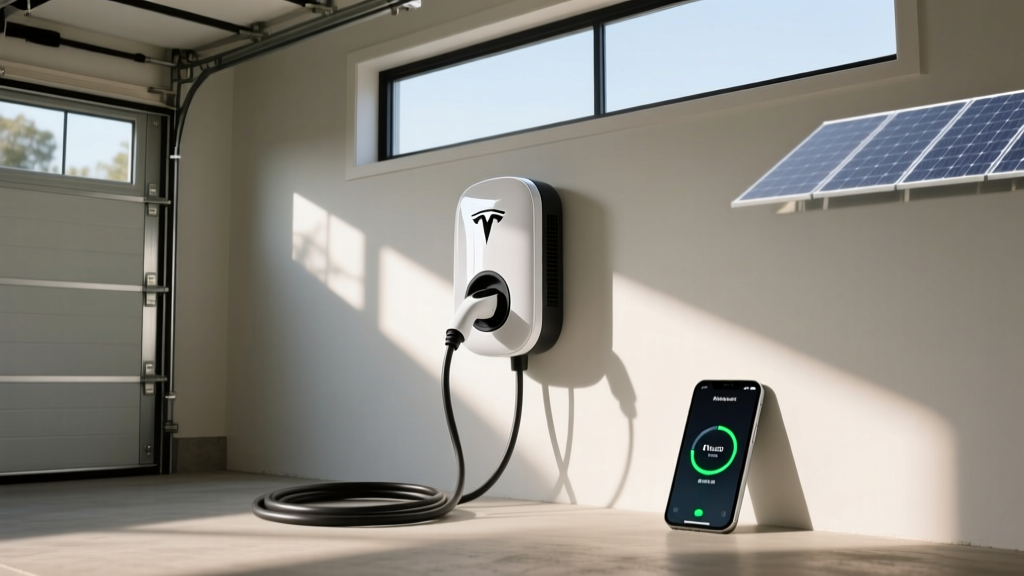
Tesla Wall Connector
- Power Output: Up to 11.5 kW (240V / 48A)
- Connector: NACS native; J1772 adapter included
- Cable Length: 24 feet
- Smart Features: Wi-Fi, OTA updates, power sharing, load management with Tesla Powerwall
- Price: ~$475
- Best For: Tesla owners; best value-to-feature ratio
All three are UL-listed, NEMA 4-rated for outdoor installation, and compatible with hardwired or NEMA 14-50 receptacle mounting. Hardwired installations are preferred for reliability and code compliance in many jurisdictions.
Safety, Code, and Installation Best Practices
EV charging involves sustained high-current draw — more like running a welder than plugging in a lamp. Follow these non-negotiable safety guidelines:
- Dedicated circuit: Your Level 2 charger must be on its own dedicated double-pole breaker. No sharing with other appliances.
- Continuous load derating: NEC rules require EV chargers (continuous loads, 3+ hours) to be derated to 80% of breaker capacity. A 50A breaker supports a 40A charger; a 60A breaker supports 48A.
- Outdoor rating: If installed outside, the charger must be rated NEMA 4 (weather-resistant). Use an in-use cover for receptacle-based installs.
- Conduit and wire gauge: THHN copper wire in conduit is standard. Aluminum wire is cheaper but requires a larger gauge — your electrician will spec this based on run length.
- Smart load management: If your panel is near capacity, some chargers (e.g., Wallbox with Eco-Smart, or Tesla with Powerwall) offer dynamic load management that throttles charging when other household loads spike.
Never use an extension cord or adapter to plug a Level 2 charger into a standard 120V outlet. The sustained current draw will overheat undersized wiring and create a fire hazard.
Frequently Asked Questions
How much does it cost to install a home EV charger?
A typical Level 2 home installation runs $800–$3,500 if your electrical panel has sufficient capacity. If you need a panel upgrade from 100A to 200A service, add $1,500–$4,000. The charger unit itself costs $350–$750. Always budget for the permit ($50–$350) — it's required by code and protects your home insurance coverage.
How fast will each charging level add range?
Level 1 (120V) adds 3–5 miles per hour — fine for overnight top-ups if you drive under 30 miles daily. Level 2 (240V) adds 25–44 miles per hour, fully recharging most EVs overnight. DC fast charging adds 150–1,000+ miles per hour at peak rates, typically delivering a 10–80% charge in 15–30 minutes depending on the vehicle and charger.
Which connector or charger is compatible with my EV?
For 2026 model-year vehicles, most brands now use NACS (Tesla's standard). Older EVs from 2020–2025 may have CCS1. Check your vehicle's charge port. For home Level 2 charging, J1772 is universal with a NACS adapter, or you can buy a native NACS charger. CHAdeMO vehicles (older Nissan Leafs) have limited public charging options and no practical DC fast-charging adapter to NACS.
How much does charging cost per mile vs. gas?
Home charging at average US electricity rates ($0.16/kWh) costs roughly $0.048 per mile for a typical EV. The 2012 Land Rover Sport Supercharged at 14 MPG combined costs about $0.246 per mile. Even the most expensive public DC fast charging ($0.35–$0.55/kWh) at $0.11–$0.17 per mile is still cheaper than gasoline. Over 15,000 annual miles, home charging saves $2,500–$3,200 compared to the Supercharged V8.
What electrical upgrades might I need?
The most common upgrade is a panel capacity increase from 100A to 200A service, required if your existing panel is near its load limit. You may also need a new double-pole breaker slot (2 spaces), upgraded wiring for long runs over 50 feet, or a sub-panel if your charger is far from the main panel (e.g., detached garage). A licensed electrician will perform a load calculation to determine your exact needs.