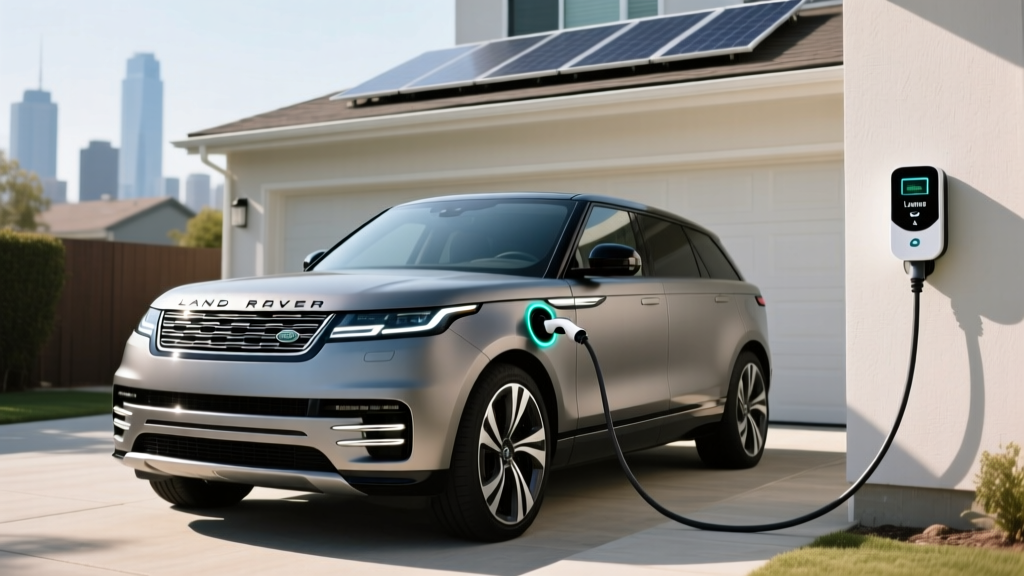
The upcoming Land Rover Range Rover EV represents a pivotal moment for luxury electric SUVs. Built on JLR's new Modular Longitudinal Architecture (MLA), the all-electric Range Rover promises to pair the brand's signature refinement and off-road capability with zero tailpipe emissions. But owning a flagship luxury EV comes with distinct charging considerations — from ensuring your home electrical system can support Level 2 charging to understanding DC fast-charge curves on road trips.
This guide covers everything you need to know about charging the Range Rover EV at home and on the road, including exact power figures, installation costs, connector compatibility, and how the cost per mile stacks up against its gasoline and diesel siblings.
Battery: ~117 kWh usable (NMC chemistry, 800V architecture)
EPA Range: ~300–350 miles (estimated, pending official certification)
Peak DC Fast Charge: up to 350 kW
10–80% DC Fast Charge: ~25–30 minutes (estimated)
Level 2 AC Charge Rate: up to 11 kW
Connector: CCS1 (with NACS adapter compatibility expected)
Note: As of early 2026, the Range Rover EV is in pre-production. JLR has confirmed an 800V electrical architecture and CCS1 charging. Final EPA range and charge-rate figures will be published closer to the on-sale date. All specs above are based on JLR's announced engineering targets and industry reporting.
Charging Levels Explained: Level 1, Level 2, and DC Fast Charging
Understanding the three tiers of EV charging is essential before you invest in equipment or plan a road trip. The key distinction: kW (kilowatts) measures power — how fast energy flows into the battery — while kWh (kilowatt-hours) measures energy — the total capacity of the battery pack. Think of kW as the flow rate of a hose and kWh as the size of the tank.
| Level | Voltage | Power (kW) | Miles of Range Added Per Hour | Best Use Case |
|---|---|---|---|---|
| Level 1 (120V) | 120V AC | 1.2–1.9 kW | 3–5 mi/hr | Overnight top-ups, emergencies |
| Level 2 (240V) | 240V AC | 3.3–19.2 kW | 12–70 mi/hr | Daily home charging, workplace |
| DC Fast Charging | 400–800V DC | 50–350 kW | 150–600+ mi/hr | Road trips, quick top-ups |
What This Means for the Range Rover EV
With an estimated ~117 kWh battery, Level 1 charging at 1.4 kW would take over 80 hours to go from empty to full — essentially impractical for daily use. Level 2 at 11 kW (the vehicle's expected onboard charger limit) adds roughly 30–35 miles of range per hour, meaning a full overnight session of 10 hours restores approximately 300+ miles — enough for a complete recharge.
On a 350 kW DC fast charger, the Range Rover EV's 800V architecture should enable a 10–80% charge in roughly 25–30 minutes. However, peak kW is not sustained kW. Charging curves taper significantly above 80% State of Charge (SoC) to protect battery health, so the final 20% can take as long as the first 70%. For road-trip efficiency, plan stops around the 10–80% window.
Home Level 2 Charger Installation: Electrical Requirements and Costs
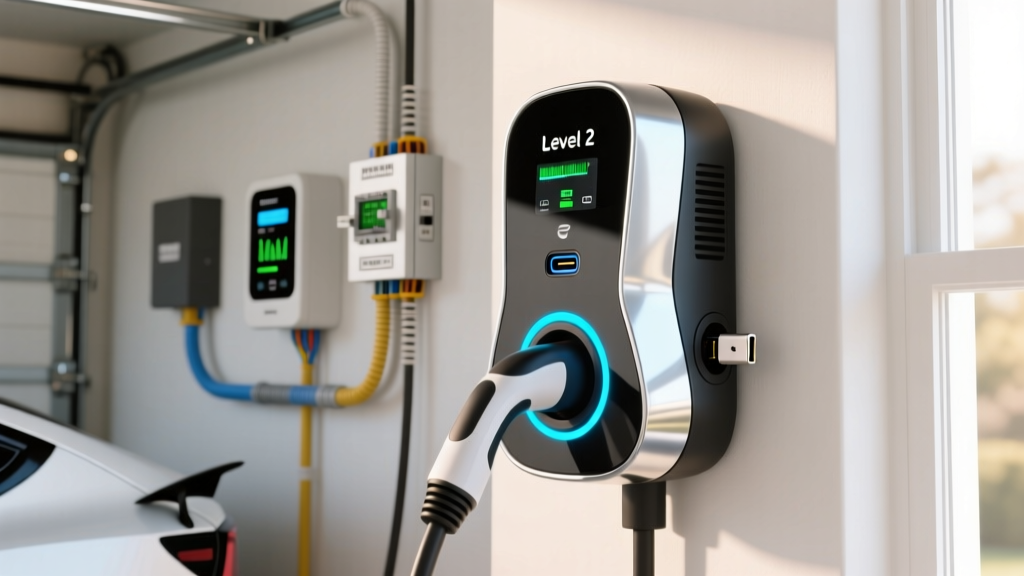
Most Range Rover EV owners will want a dedicated Level 2 home charger. Given the vehicle's ~117 kWh battery, a 48-amp (11.5 kW) hardwired station is the practical minimum to achieve a full overnight charge. Here's what your electrical system needs to support.
Electrical Requirements
- Circuit: Dedicated 60-amp breaker (for a 48A continuous-load charger, NEC requires a circuit rated 125% of the continuous load)
- Voltage: 240V single-phase
- Wiring: 6 AWG copper (or 4 AWG aluminum) for a 60A circuit
- Panel capacity: Minimum 200-amp main service panel recommended
- GFCI protection: Required for outdoor installations per NEC 2020/2023; some jurisdictions also require it indoors
Do You Need a Panel Upgrade?
This is the most expensive surprise for many EV buyers. If your home has a 100-amp or 150-amp main panel — common in homes built before 2000 — adding a 60A dedicated circuit may exceed your panel's capacity. A licensed electrician will perform a load calculation (per NEC Article 220) to determine whether your existing panel can handle the additional draw alongside HVAC, electric range, dryer, and other circuits.
If an upgrade is needed, expect to pay $1,500–$4,000+ for a panel upgrade to 200A or 400A service, depending on your utility's requirements and local labor rates. Homes in the Northeast and California tend to see higher costs due to permitting and labor markets.
| Component | Typical Cost Range | Notes |
|---|---|---|
| Level 2 Charger (Equipment) | $400–$750 | 48A smart charger, Wi-Fi enabled, 25-ft cable |
| Electrician Labor | $600–$2,000 | Depends on run length, wall type, conduit |
| Electrical Permit | $50–$250 | Varies by municipality |
| Panel Upgrade (if needed) | $1,500–$4,000 | 200A or 400A upgrade; not always required |
| Total (no panel upgrade) | $1,050–$3,000 | Most homes with 200A service |
| Total (with panel upgrade) | $2,550–$7,000 | Older homes with 100–150A service |
Always hire a licensed electrician and pull a permit. Unpermitted electrical work can void home insurance claims and create fire hazards. The National Electrical Code (NEC) governs EV charger installations, and your local Authority Having Jurisdiction (AHJ) enforces it.
Connector Compatibility: CCS1, NACS, and Adapter Options
The Range Rover EV is expected to ship with a CCS1 (Combined Charging System) port, consistent with JLR's current global strategy. However, the North American charging landscape is rapidly shifting toward the NACS (North American Charging Standard) connector used by Tesla's Supercharger network, which now boasts over 25,000 stalls in the U.S.
| Connector | Network Access | Range Rover EV Compatibility |
|---|---|---|
| CCS1 | Electrify America, EVgo, ChargePoint, Ionity (EU) | Native — built-in port |
| NACS (Tesla) | Tesla Supercharger network (open to other brands via adapter) | Requires CCS-to-NACS adapter (expected to be included or available from JLR) |
| CHAdeMO | Limited legacy network; mostly discontinued | Not compatible; not needed for new vehicles |
JLR has indicated that NACS adapter compatibility will be supported, allowing Range Rover EV owners to access Tesla Superchargers — a significant advantage for road-trip charging reliability. Ford, Rivian, BMW, and other CCS-native automakers have already confirmed adapter programs. Confirm with your dealer at purchase whether the adapter is included or sold separately (typically $200–$250 if purchased aftermarket).
Home Charger Connector
For Level 2 home charging, all non-Tesla EVs — including the Range Rover EV — use a J1772 connector. Most Level 2 home chargers ship with J1772. If you buy a Tesla Wall Connector (NACS), you'll need a J1772-to-NACS adapter for the Range Rover EV, or simply choose a J1772-native charger.
Charging Cost Per Mile: Range Rover EV vs. Gasoline Range Rover
One of the strongest ownership arguments for the Range Rover EV is fuel-cost savings — particularly given that the gasoline Range Rover P400 returns an EPA-estimated 21 MPG combined and the supercharged P530 V8 manages around 18 MPG combined (per fueleconomy.gov).
| Scenario | Rate | Cost to Add 300 Miles | Cost Per Mile |
|---|---|---|---|
| Home charging (off-peak utility rate) | $0.12/kWh | $14.04 | $0.047 |
| Home charging (national avg. residential) | $0.17/kWh | $19.89 | $0.066 |
| Public Level 2 (network pricing) | $0.30/kWh | $35.10 | $0.117 |
| DC Fast Charging (Electrify America) | $0.48/kWh | $56.16 | $0.187 |
| Gas Range Rover P400 (premium at $4.50/gal, 21 MPG) | — | $64.29 | $0.214 |
| Gas Range Rover P530 V8 (premium at $4.50/gal, 18 MPG) | — | $75.00 | $0.250 |
Calculations assume ~117 kWh used for 300 miles (~2.57 mi/kWh or ~39 kWh/100mi), consistent with full-size luxury EV efficiency estimates. Actual efficiency varies with temperature, speed, and terrain.
At home off-peak rates, the Range Rover EV costs roughly 75–80% less per mile than its gasoline counterpart. Even at DC fast-charging rates, the EV remains cheaper per mile than the V8 Range Rover. Over 15,000 miles per year, home-charging savings alone could total $2,500–$3,500 annually compared to premium gasoline.
Recommended Home Level 2 Chargers for the Range Rover EV
Given the Range Rover EV's ~117 kWh battery and 11 kW onboard charger, you want a Level 2 station that delivers at least 48 amps (11.5 kW) to maximize the vehicle's charging capability. Here are three proven options:
ChargePoint Home Flex
- Power Output: Up to 50A (12 kW at 240V) — adjustable via dip switches
- Connector: J1772 (25-foot cable)
- Smart Features: Wi-Fi, app scheduling, Alexa integration, energy reporting
- Installation: Hardwired or NEMA 14-50 plug
- Price: ~$699 (equipment only)
- Why it fits: Flexible amperage lets you match your circuit; robust app for tracking charge sessions and cost
Emporia Vue 2 EV Charger
- Power Output: 48A (11.5 kW at 240V)
- Connector: J1772 (24-foot cable)
- Smart Features: Wi-Fi, solar integration (pairs with Emporia Vue energy monitor), scheduled charging, load management
- Installation: Hardwired only
- Price: ~$399
- Why it fits: Best value for smart features; solar-aware scheduling is ideal for homes with rooftop panels
Grizzl-E Smart
- Power Output: 40A (9.6 kW at 240V)
- Connector: J1772 (24-foot cable)
- Smart Features: Wi-Fi, OCPP support, adjustable amperage (16/24/32/40A)
- Installation: Hardwired or NEMA 14-50 plug
- Price: ~$549
- Why it fits: Built in Canada for extreme cold (rated to -40°F); excellent for unheated garages and outdoor mounts
For the Range Rover EV's 11 kW onboard charger, the ChargePoint Home Flex at 50A provides the closest match. The Grizzl-E at 40A will charge roughly 15% slower — adding about 26 mi/hr vs. 33 mi/hr — which may mean an extra hour or two for a full charge but is still adequate for overnight replenishment.
Public DC Fast Charging: Networks, Speeds, and Road-Trip Planning
The Range Rover EV's 800V architecture and estimated 350 kW peak charge rate place it in the top tier of DC fast-charging capability — comparable to the Porsche Taycan, Hyundai Ioniq 5, and Lucid Air. Here's how that translates to real-world road-trip charging.
Charge Curve Reality
No EV sustains its peak charge rate from 10% to 80%. The Range Rover EV is expected to hit ~350 kW between roughly 10–30% SoC, then step down to ~200–250 kW through 50%, and further taper to ~100–150 kW approaching 80%. This is normal thermal-management behavior — battery cells must not overheat.
The practical implication: a 10–80% session on a 350 kW charger should take approximately 25–30 minutes, but an 80–100% top-off could add another 20–25 minutes. Plan road-trip stops to charge from ~15% to ~80% and move on.
Network Access
- Electrify America: Largest U.S. CCS1 network; 350 kW stalls at most highway locations. Pricing: $0.48/kWh (guest) or $0.36/kWh (Pass+ subscription at $4/month).
- Tesla Supercharger: Accessible via NACS adapter; 250 kW (V3) stalls most common, with some 325+ kW (V4) locations expanding. Pricing: $0.25–$0.35/kWh depending on location and time.
- EVgo: Growing 350 kW footprint; CCS1 native. Pricing: $0.39–$0.46/kWh (Pay As You Go) or lower with EVgo Plus plans.
- ChargePoint: Mix of 50–350 kW DC stalls; CCS1 native. Pricing varies by site host.
For luxury-EV buyers who road-trip frequently, Supercharger access via adapter is a meaningful advantage. Tesla's network consistently delivers the highest uptime and reliability scores among public charging providers.
Safety, Code, and Installation Best Practices
Installing a high-amperage EV charger is a significant electrical project. Follow these non-negotiable safety guidelines:
- Dedicated circuit: Your Level 2 charger must have its own dedicated breaker — never share a circuit with a dryer, range, or HVAC system.
- Permit and inspection: Required in virtually all U.S. jurisdictions. Your electrician should pull the permit before work begins. The inspection ensures code compliance and protects your home insurance.
- GFCI protection: NEC 2020 (Article 625.54) requires GFCI protection for all EV charging outlets rated 150V to ground or less and 50A or less. Hardwired installations may be exempt in some jurisdictions — confirm with your AHJ.
- Outdoor rating: If mounting outside, ensure the charger carries a NEMA 4 or IP65 rating for weather resistance. Use an in-use cover for plug-in (NEMA 14-50) installations.
- Cable management: A 25-foot cable is recommended to reach the charge port regardless of parking orientation. Avoid extension cords — they introduce resistance, heat, and code violations.
- Load management: If your panel is near capacity, consider a smart charger with load-management features (e.g., Emporia, Wallbox) that dynamically adjusts charge current to prevent tripping the main breaker.
For detailed electrical code guidance, consult the National Electrical Contractors Association (NECA) or hire an electrician certified through the EV Infrastructure Training Program (EVITP).
Federal Tax Credit and Incentives for Home Charger Installation
The Alternative Fuel Vehicle Refueling Property Credit (IRS §30C) covers 30% of the cost of home EV charging equipment and installation, up to $1,000. This applies to both the charger hardware and electrician labor.
- Credit amount: 30% of equipment + installation, capped at $1,000
- Equipment must be installed at your primary residence
- Must be placed in service during the current tax year
- Applies to both hardwired and plug-in Level 2 chargers
- Cannot be combined with utility rebates for the same dollar (reduces basis)
- File IRS Form 8911 with your federal return
Additionally, many utilities offer their own rebates for Level 2 charger installation — commonly $250–$500. Check with your local utility or the Alternative Fuels Data Center for state and local incentive databases.
Tax credit rules are subject to change. Consult a qualified tax professional for eligibility guidance specific to your situation. Current rules reference IRS §30C guidance.
Range Rover EV Charging FAQ
How much does it cost to install a home EV charger for the Range Rover EV?
Expect $1,050–$3,000 for a standard installation (equipment, electrician, permit) if your home already has a 200A panel. If a panel upgrade is needed, total costs can reach $2,500–$7,000. The federal §30C credit covers 30% up to $1,000 of this cost.
How fast will each charging level add range to the Range Rover EV?
Level 1 (120V): approximately 3–5 miles per hour. Level 2 (240V, 48A): approximately 30–35 miles per hour. DC Fast Charging (350 kW peak): approximately 150–200+ miles in 15 minutes during the peak portion of the charge curve.
Which connector is compatible with the Range Rover EV?
The Range Rover EV is expected to use a CCS1 connector natively. A CCS-to-NACS adapter will enable access to Tesla Superchargers. For home Level 2 charging, the standard J1772 connector is used.
How much does charging the Range Rover EV cost per mile vs. a gas Range Rover?
At home off-peak rates ($0.12/kWh), the Range Rover EV costs roughly $0.047 per mile — about 75% less than a gasoline Range Rover P400 at $0.214/mile on premium fuel. Even at public DC fast-charging rates ($0.48/kWh), the EV costs ~$0.187/mile, still less than the gas model.
What electrical upgrades might I need?
A 60-amp dedicated 240V circuit is recommended for a 48A Level 2 charger. If your home has a 100A or 150A main panel, a panel upgrade to 200A or 400A ($1,500–$4,000+) may be required. Your electrician will perform a load calculation to determine this.
Can I use a Tesla Supercharger with the Range Rover EV?
Yes, with a CCS-to-NACS adapter. JLR has indicated adapter compatibility will be supported. Confirm availability and pricing with your dealer at time of purchase.
How long does a full home charge take?
From near-empty to 100% on an 11 kW Level 2 charger: approximately 11–12 hours. In practice, most owners charge from 20–80% overnight, which takes about 6–7 hours and provides roughly 240+ miles of range.