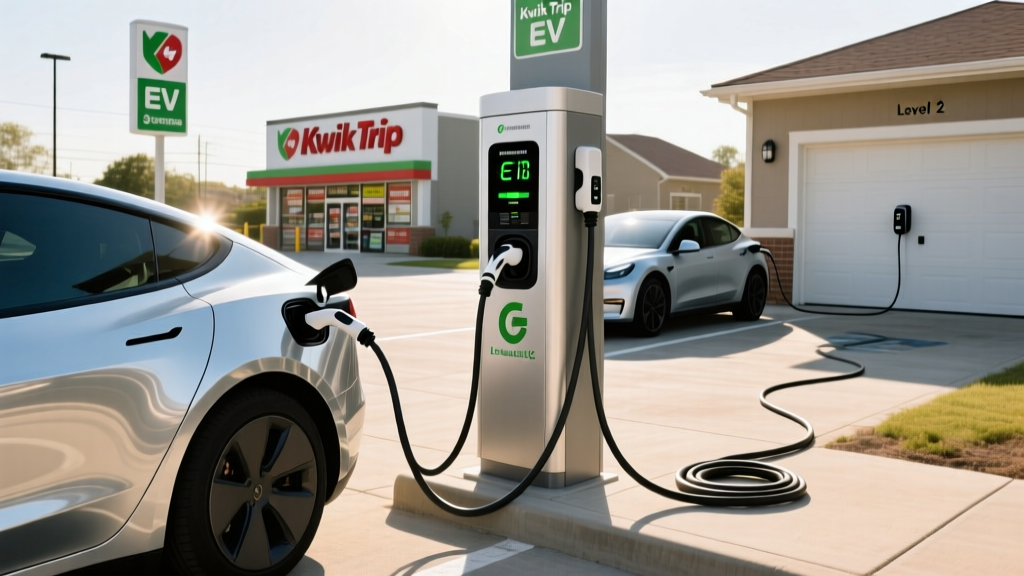
If you have pulled into a Kwik Trip in the Midwest hoping to top off your electric vehicle, you have probably noticed the new DC fast-charging stalls appearing alongside the gas pumps. Kwik Trip has been expanding its EV charging footprint across Wisconsin, Minnesota, and Iowa, positioning itself as a convenience-store charging option for road-trippers and apartment dwellers who cannot charge at home. But how does Kwik Trip EV charging stack up against a dedicated home Level 2 setup in terms of speed, cost, and convenience? This guide breaks down every number you need to decide where and how to charge.
Charging Levels Explained: kW, Miles Per Hour, and What They Mean
The single most important distinction in EV charging is between kW (kilowatts), which measures the rate of power delivery, and kWh (kilowatt-hours), which measures the total energy stored in your battery. Think of kW as the flow rate of a hose and kWh as the size of the bucket. A 150 kW charger fills your 75 kWh battery faster than a 7 kW charger, but the battery capacity stays the same.
| Level | Voltage | Power (kW) | Miles of Range Per Hour | Typical Use Case |
|---|---|---|---|---|
| Level 1 | 120V AC | 1.4 kW | 3-5 mi/hr | Overnight trickle; PHEVs |
| Level 2 (Home) | 240V AC | 7.2-11.5 kW | 25-45 mi/hr | Daily home charging |
| DC Fast (Public) | 400-800V DC | 50-350 kW | 150-900+ mi/hr (peak) | Road trips, quick top-ups |
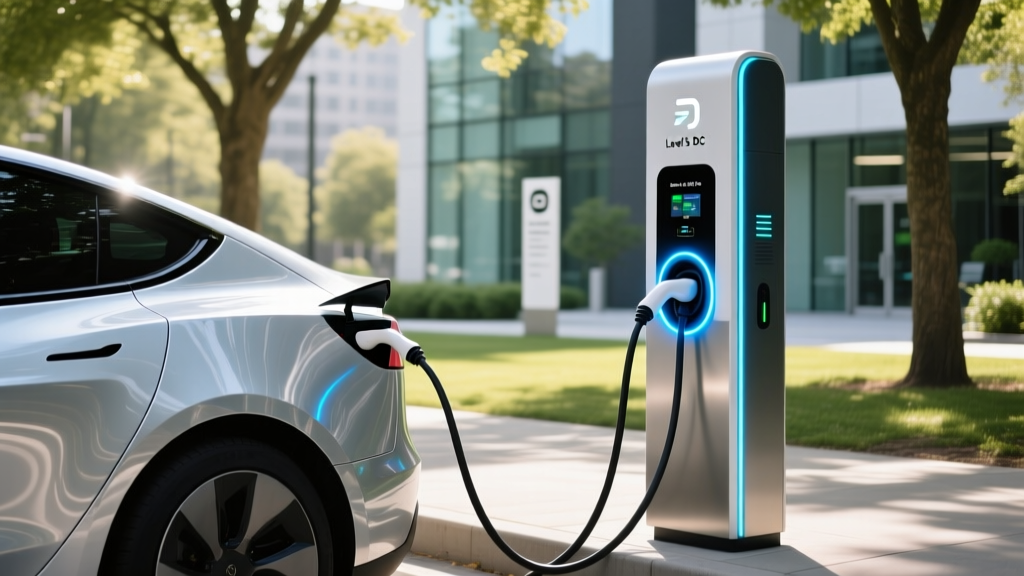
Most Kwik Trip EV charging stations are equipped with DC fast chargers rated between 50 kW and 150 kW, with newer installations featuring 180 kW or 350 kW dispensers. A 150 kW stall can add roughly 100-150 miles of range in 15-20 minutes on a vehicle that can accept that charge rate, such as a Hyundai Ioniq 5 or Tesla Model Y. However, your actual speed depends on your vehicle's maximum charge acceptance rate, battery state of charge, and ambient temperature.
Kwik Trip EV Charging: What to Expect at the Pump
Kwik Trip partners with networks like EVgo and Electrify America to deploy its chargers. As of early 2026, the chain operates DC fast charging at select locations across its three-state footprint, with plans to expand further. Here is what you will encounter:
- Charger types: Most stalls offer CCS1 connectors; newer locations include NACS (Tesla-native) cables. CHAdeMO connectors are increasingly rare and may not be available.
- Power output: Typically 50 kW to 150 kW per stall, with some locations featuring 180-350 kW ultra-fast units.
- Pricing: Kwik Trip chargers generally follow the network partner's pricing, ranging from $0.32 to $0.48 per kWh depending on location, time of day, and membership tier.
- Session experience: Pull up, plug in, activate via the network app or RFID card, and grab a coffee inside. Expect 20-40 minutes for a meaningful charge depending on your vehicle and battery size.
For context, charging a 75 kWh battery (like a Tesla Model Y Long Range) from 10% to 80% at a 150 kW Kwik Trip stall takes approximately 25-30 minutes in moderate weather, adding roughly 210 miles of EPA-rated range. At $0.40/kWh, that session costs about $21.00 for ~52 kWh delivered.
Home Level 2 Charging: Installation Costs and Electrical Requirements
Charging at home on a Level 2 station remains the most convenient and cost-effective method for daily EV ownership. But installation is not as simple as plugging into an outlet. Here is a detailed breakdown of what is involved.
Electrical Requirements
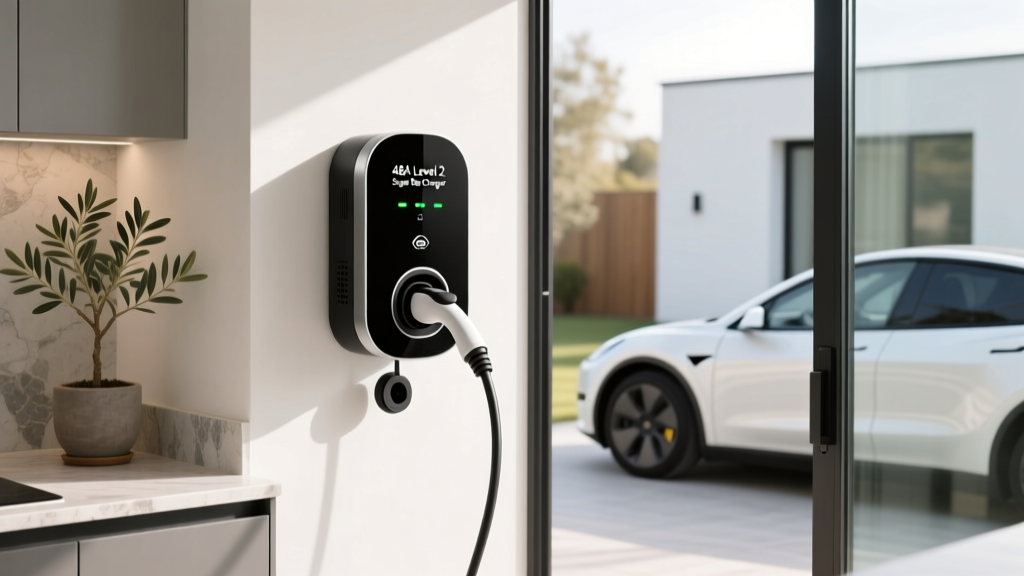
A typical home Level 2 charger requires a dedicated 240V circuit on a breaker rated for the charger's amperage. Common configurations:
- 32A charger (7.7 kW): Requires a 40A breaker (NEC requires 125% headroom for continuous loads)
- 40A charger (9.6 kW): Requires a 50A breaker
- 48A charger (11.5 kW): Requires a 60A breaker
Your home's electrical panel must have sufficient spare capacity to accommodate the new circuit. Many modern homes with 200A service can handle a 40-60A EV circuit without issue. Older homes with 100A panels often need a panel upgrade, which is a significant added cost.
Installation Cost Breakdown
| Component | Cost Range | Notes |
|---|---|---|
| Level 2 Charger (Equipment) | $350 - $700 | Smart WiFi chargers; hardwired or NEMA 14-50 plug |
| Electrician Labor | $400 - $1,500 | Depends on run length, conduit, and wall material |
| Electrical Permit | $50 - $250 | Required in most jurisdictions; varies by municipality |
| Panel Upgrade (if needed) | $1,500 - $3,500 | 200A upgrade from 100A; not always necessary |
| Total (no panel upgrade) | $800 - $2,450 | Most common scenario for 200A-panel homes |
| Total (with panel upgrade) | $2,300 - $5,950 | Older homes; get a quote before committing |
The IRS §30D tax credit does not directly cover home charging equipment for most buyers — that falls under the now-expired §30C alternative fuel infrastructure credit for residential use. However, some states and utilities offer rebates of $250-$1,000 for Level 2 charger installation. Check with your local utility for current programs.
Connector Compatibility: NACS, CCS1, and CHAdeMO
The connector landscape has consolidated significantly. As of 2026, the North American Charging Standard (NACS), originally developed by Tesla, has become the dominant connector. Most legacy CCS1 vehicles now ship with or can obtain NACS adapters.
| Connector | Native Vehicles | Adapter Needed? | Availability at Kwik Trip / Public Chargers |
|---|---|---|---|
| NACS (Tesla) | Tesla (all), Ford, Rivian, GM, Volvo, Polestar, Fisker (2025+) | None for native; CCS-to-NACS adapters available for older chargers | Growing rapidly; most new public stalls include NACS |
| CCS1 | Hyundai, Kia, BMW, VW, Mercedes, older Ford/GM | NACS-to-CCS adapter (~$200) for Tesla Superchargers | Still widely available; being phased out at new installs |
| CHAdeMO | Nissan Leaf (legacy) | Not easily adaptable to NACS | Very limited; avoid relying on this connector |
If you drive a Hyundai Ioniq 5 (native CCS1) and want to use a NACS-only Kwik Trip stall, you will need a CCS-to-NACS adapter. Tesla provides these to owners for Supercharger access, and third-party options from brands like Lectron are available for roughly $150-$200. Always verify adapter compatibility with your specific model year before purchasing.
Cost to Charge: Home vs. Kwik Trip vs. Gas — Per Mile Breakdown
The economic case for EVs hinges on fuel cost savings, but the gap narrows considerably when you rely on public DC fast charging instead of home Level 2.
| Scenario | Rate | Cost Per Mile* | Annual Fuel Cost (12,000 mi) |
|---|---|---|---|
| Home Level 2 (off-peak utility rate) | $0.10/kWh | $0.030 | $360 |
| Home Level 2 (avg. US residential) | $0.17/kWh | $0.051 | $612 |
| Kwik Trip / Public DC Fast | $0.40/kWh | $0.120 | $1,440 |
| Gas vehicle (30 MPG, $3.40/gal) | $3.40/gallon | $0.113 | $1,360 |
*Assumes 3.3 miles per kWh (typical EV efficiency of ~30 kWh/100mi, per fueleconomy.gov data for midsize electric SUVs).
At home off-peak rates, EV charging costs roughly one-third what gasoline costs per mile. But at $0.40/kWh public DC fast-charging rates, the EV is actually slightly more expensive per mile than a 30 MPG gas car at $3.40 per gallon. This is why home charging access is the single biggest factor in EV satisfaction and total cost of ownership.
If you charge 80% at home and 20% on public DC fast chargers (a realistic split for homeowners who road-trip occasionally), your blended cost per mile drops to approximately $0.045 — still a substantial savings over gasoline.
Charging Time Examples: 10-80% for Common Battery Sizes
Here is how long a 10-80% session takes at different charging speeds for popular battery capacities:
| Battery Size | Example Vehicle | 7.7 kW (Home L2) | 50 kW (DC Fast) | 150 kW (DC Fast) | 250 kW (DC Fast) |
|---|---|---|---|---|---|
| 40 kWh | Chevy Equinox EV (base) | 3.5 hrs | 42 min | ~18 min | ~14 min |
| 65 kWh | VW ID.4 | 5.7 hrs | 68 min | ~28 min | ~20 min |
| 75 kWh | Tesla Model Y LR | 6.6 hrs | 78 min | ~25 min | ~18 min |
| 84 kWh | Ford F-150 Lightning (extended) | 7.4 hrs | 88 min | ~35 min | ~24 min |
| 100 kWh | Lucid Air Pure | 8.8 hrs | 105 min | ~32 min | ~18 min |
Note that the 250 kW column assumes the vehicle can accept that charge rate. A VW ID.4 peaks at roughly 170 kW, so a 250 kW stall will not charge it any faster than a 180 kW stall. The Lucid Air, with its 900V+ architecture, can sustain 250+ kW for a significant portion of the charge curve, making it one of the fastest-charging production vehicles available.
Equipment Recommendations: Home Level 2 Chargers Worth Buying
Not all Level 2 chargers are created equal. Here are three proven options for 2026, selected for reliability, smart features, and build quality:
Emporia Vue Level 2
- Power: 48A / 11.5 kW (hardwired) or 40A / 9.6 kW (NEMA 14-50)
- Connector: NACS native (J1772 adapter included)
- Cable: 24 ft
- Smart features: WiFi, scheduling, solar integration, energy monitoring
- Price: ~$449
- Best for: Solar-panel owners wanting integrated energy tracking
ChargePoint Home Flex
- Power: Up to 50A / 12 kW (adjustable via dip switches)
- Connector: NACS or J1772 (select at purchase)
- Cable: 23 ft
- Smart features: WiFi, app scheduling, Alexa integration, load sharing (2 units on 1 circuit)
- Price: ~$599
- Best for: Two-EV households needing load sharing
Tesla Wall Connector
- Power: 48A / 11.5 kW (hardwired, 60A breaker)
- Connector: NACS native
- Cable: 24 ft
- Smart features: WiFi, OTA updates, Power Share (up to 6 units), vehicle-specific access control
- Price: ~$425
- Best for: Tesla, Ford, Rivian, and other NACS-native owners
All three chargers are UL-listed and rated for indoor and outdoor installation (NEMA 4 rating). If you choose a plug-in model with a NEMA 14-50 receptacle, your electrician must install a GFCI breaker to meet NEC 2023+ code requirements for EV charging outlets — this adds roughly $80-$150 to the electrical work but is non-negotiable for safety and inspection.
Safety, Code, and Installation Best Practices
EV charging draws sustained high current for hours at a time, which is fundamentally different from the short bursts of an oven or dryer. This makes proper installation critical:
- Dedicated circuit: Your EV charger must have its own dedicated breaker — never share a circuit with other appliances.
- Continuous-load rule: The NEC requires the breaker to be rated at 125% of the charger's maximum draw. A 40A charger needs a 50A breaker.
- GFCI protection: Required for all receptacle-based (plug-in) EV chargers per NEC 2023 and later. Hardwired chargers do not require GFCI.
- Outdoor rating: If your charger is mounted outside, ensure it carries a NEMA 4 or NEMA 4X rating for weather resistance.
- Wire gauge: A 50A circuit requires 6 AWG copper wire; a 60A circuit requires 4 AWG. Do not let an installer undersize the wire.
- Permit and inspection: Always pull a permit. Unpermitted electrical work can void your homeowner's insurance and create fire risk. The National Electrical Code (NEC) sets the baseline, but local amendments may apply.
Frequently Asked Questions
How much does it cost to install a home EV charger?
For most homes with a 200A electrical panel and a short wire run to the garage, expect $800-$2,450 total (charger + electrician + permit). Older homes with 100A panels may need a $1,500-$3,500 panel upgrade, pushing the total to $2,300-$5,950. Always get a load calculation first.
How fast will each charging level add range?
Level 1 (120V) adds 3-5 miles per hour. Level 2 (240V home) adds 25-45 miles per hour depending on amperage. DC fast charging at 150 kW adds roughly 150-200+ miles in 15-20 minutes at peak, but speed tapers significantly above 80% state of charge.
Which connector and charger is compatible with my EV?
If your EV is a 2025+ Tesla, Ford, Rivian, GM, or Volvo, it has a native NACS port. If it is a Hyundai, Kia, BMW, or Volkswagen, it likely has CCS1 and may need an adapter for NACS-only chargers. The aging Nissan Leaf uses CHAdeMO, which has very limited public infrastructure. Check your owner's manual or the fueleconomy.gov vehicle listing for your specific model year.
How much does charging cost per mile vs. gas?
Home Level 2 charging at average US electricity rates ($0.17/kWh) costs roughly $0.05 per mile. Public DC fast charging at $0.40/kWh costs about $0.12 per mile — comparable to or slightly more than a 30 MPG gas car at $3.40 per gallon ($0.113/mile). The savings are substantial when you charge primarily at home.
What electrical upgrades might I need for a home charger?
The most common upgrade is a panel capacity increase from 100A to 200A, which costs $1,500-$3,500. You may also need a new conduit run if your panel is far from the garage, or a smart load-management device if your panel is near capacity but you want to avoid a full upgrade. A licensed electrician's load calculation will determine exactly what is required.
Is Kwik Trip EV charging reliable for road trips?
Kwik Trip's charging stalls benefit from the chain's reputation for clean, well-maintained facilities and 24/7 staffing. However, reliability depends on the network partner (EVgo, Electrify America) maintaining the hardware. Always check real-time charger status on the network's app before detouring to a specific location, and have a backup charging stop planned on longer trips.