The Quick Answer: kWh Needed for a Tesla Model Y
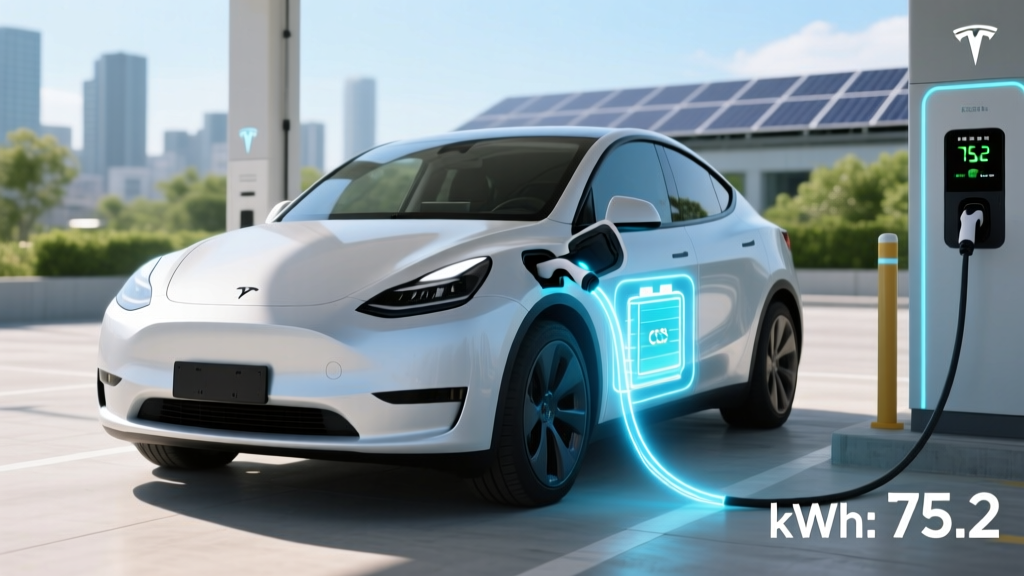
The 2026 Tesla Model Y Long Range AWD carries a usable battery capacity of approximately 75 kWh (the standard-range RWD variant uses roughly 60 kWh). If you arrive at a charger with a nearly empty battery and charge to 100%, you'll put in close to those figures — plus a small efficiency loss of 5–10% from heat and power conversion, meaning a full 0–100% session pulls roughly 79–83 kWh from the wall for the Long Range model.
But most owners rarely charge from 0 to 100%. Daily driving consumes about 28–32 kWh per 100 miles (the Model Y Long Range AWD is EPA-rated at 29 kWh/100mi, or 120 MPGe combined). A typical 40-mile daily commute uses roughly 12 kWh, which a Level 2 home charger replenishes in about 1.5 hours.
kWh (kilowatt-hours) = energy, like gallons in a fuel tank. Your Model Y's battery holds ~75 kWh.
kW (kilowatts) = power, like the flow rate of a gas pump. A 11.5 kW Level 2 charger delivers energy at that rate.
Confusing the two is the single most common EV mistake. When you ask "how many kWh to charge," you're asking about total energy consumed — not the speed of delivery.
Charging Levels: Speed, Power, and Miles Per Hour
Every Tesla Model Y sold in 2026 ships with the North American Charging Standard (NACS) port natively — no adapter needed at Tesla Superchargers. Here's what each charging level delivers in practice:
| Level | Voltage / Amperage | Power (kW) | Miles of Range Per Hour | Best For |
|---|---|---|---|---|
| Level 1 (120V outlet) | 120V / 12A | ~1.4 kW | ~3–5 mi/hr | Emergency top-ups, overnight trickle |
| Level 2 (240V home/public) | 240V / 48A | ~11.5 kW | ~35–44 mi/hr | Daily home charging, workplace |
| DC Fast Charge (Supercharger V3/V4) | 400V+ DC | Up to 250 kW peak | ~200+ mi in 15 min | Road trips, rapid replenishment |
Real-world DC fast charging caveat: The Model Y Long Range peaks at 250 kW only between roughly 10–30% state of charge (SoC). Above 50%, the charge curve tapers significantly — by 80%, you're typically at 40–60 kW. A 10–80% session at a V3 Supercharger takes approximately 25–28 minutes in moderate temperatures. Cold batteries (below 50°F) that haven't been preconditioned can double that time.
Charging Cost: Per kWh, Per Mile, and vs Gas
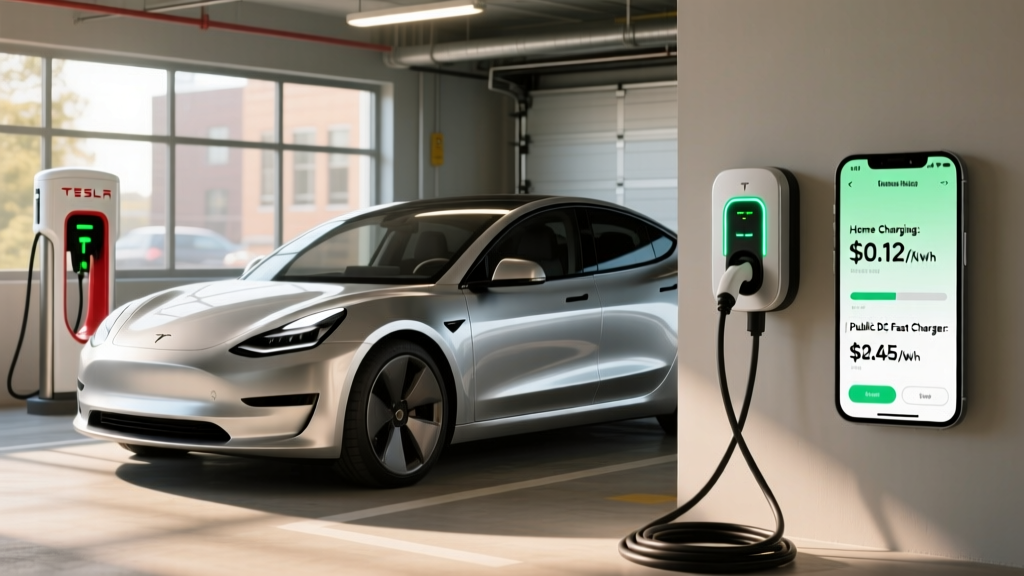
The actual cost to charge a Tesla Model Y depends entirely on your electricity rate. Here are common 2026 scenarios:
| Scenario | $/kWh | Cost for 10–80% | Cost Per Mile |
|---|---|---|---|
| Home off-peak (utility TOU rate) | $0.08–$0.12 | $4.20–$6.30 | $0.025–$0.037 |
| Home standard rate (national avg) | $0.16 | $8.40 | $0.049 |
| Public Level 2 (ChargePoint, EVgo L2) | $0.25–$0.39 | $13.13–$20.48 | $0.077–$0.12 |
| Tesla Supercharger V3/V4 | $0.28–$0.42 | $14.70–$22.05 | $0.086–$0.13 |
| Electrify America / third-party DCFC | $0.35–$0.55 | $18.38–$28.88 | $0.11–$0.17 |
A comparable gas-powered compact SUV averaging 28 MPG at $3.40/gallon costs ~$0.121/mile in fuel alone.
Home-charging a Model Y at the national average rate: ~$0.049/mile — roughly 60% less per mile.
Even at peak Supercharger pricing ($0.42/kWh), the Model Y costs ~$0.13/mile — roughly on par with gas, but with lower maintenance costs.
How Much Does It Cost to Install a Home EV Charger?
Home Level 2 charging is where the economics of EV ownership really shine, but installation costs vary enormously based on your home's electrical panel, the distance from panel to charger location, and local permitting. Here's a realistic 2026 breakdown:
| Component | Simple Install (panel nearby) | Complex Install (panel upgrade / long run) |
|---|---|---|
| Level 2 EVSE equipment (40A–48A smart charger) | $350–$700 | $350–$700 |
| Electrician labor (240V/50A or 60A circuit) | $500–$1,200 | $1,500–$3,500 |
| Electrical permit & inspection | $50–$200 | $50–$200 |
| Panel upgrade (100A → 200A, if needed) | N/A | $1,500–$3,500 |
| Conduit, wiring, mounting hardware | $100–$300 | $300–$800 |
| Total estimated range | $1,000–$2,400 | $3,700–$8,700 |
Panel upgrade reality check: Homes built before 2000 often have 100-amp service panels. Adding a 50A or 60A dedicated circuit for an EV charger may exceed available capacity, especially if you also run electric HVAC, a dryer, and an electric oven. A licensed electrician will perform a load calculation per NEC Article 220. If an upgrade is required, budget an additional $1,500–$3,500 and 2–6 weeks for utility coordination.
Federal incentive: The IRS Residential Clean Energy Credit (§25C) covers 30% of home EV charger equipment and installation costs, up to $1,000 — but only for installations in eligible census tracts. Check your eligibility before committing.
Connector Compatibility: What Plugs Into a Model Y?
As of 2026, the Tesla Model Y uses the NACS (North American Charging Standard) connector natively. This is now the dominant standard in North America, adopted by Ford, GM, Rivian, Hyundai, and most major automakers for 2025+ models.
| Connector | Used By | Model Y Compatible? | Adapter Needed? |
|---|---|---|---|
| NACS (Tesla) | Tesla, Ford, GM, Rivian, Hyundai, Kia, Volvo, others (2025+) | Yes — native | None |
| CCS1 (Combined Charging System) | Legacy VW, BMW, older Ford/GM EVs, Electrify America stations | Yes, with adapter | Tesla CCS Adapter (~$175–$250) |
| CHAdeMO | Nissan Leaf, Mitsubishi (discontinued for new vehicles) | No practical adapter | N/A — avoid for Model Y |
| J1772 (Level 2 AC) | All non-Tesla Level 2 public chargers | Yes, with adapter | Tesla Mobile Connector J1772 adapter (included) |
Practical advice: The Tesla Mobile Connector (included with the vehicle) comes with a NACS plug and a J1772 adapter for public Level 2 stations. For Electrify America or other CCS-only DC fast chargers, Tesla sells a CCS adapter. As NACS rollout continues through 2026, most new public DC fast charger installations include NACS cables, reducing adapter dependency over time.
Recommended Home Level 2 Chargers for Model Y
When selecting a home charger, match the output to your Model Y's onboard charger capacity: the 2026 Model Y accepts up to 11.5 kW (48A) AC. Installing a 48A charger on a 60A circuit maximizes your charging speed.
Tesla Wall Connector (Gen 4)
- Power: Up to 11.5 kW (48A)
- Connector: NACS native
- Cable length: 24 ft
- Smart features: Wi-Fi, OTA updates, power sharing between units, Tesla app integration
- Price: ~$425
- Best for: Tesla-only households
ChargePoint Home Flex
- Power: Up to 12 kW (50A, configurable 16A–50A)
- Connector: NACS or J1772 (select at purchase)
- Cable length: 23 ft
- Smart features: Wi-Fi, Alexa, ChargePoint app, scheduling, energy tracking
- Price: ~$550–$650
- Best for: Multi-EV households, flexible amperage
Emporia Level 2 EV Charger
- Power: Up to 11.5 kW (48A)
- Connector: NACS or J1772
- Cable length: 24 ft
- Smart features: Wi-Fi, solar integration, energy monitoring, load management
- Price: ~$350–$400
- Best for: Budget-conscious, solar homes
Grizzl-E Smart
- Power: Up to 10 kW (40A)
- Connector: NACS or J1772
- Cable length: 24 ft
- Smart features: OCPP-compatible, app control, extreme cold rated (-40°F)
- Price: ~$450–$550
- Best for: Cold climates, outdoor installs
Electrical Requirements, Safety, and Code Considerations
Installing a Level 2 charger isn't just plugging into a wall outlet — it's adding a significant continuous load to your home's electrical system. Here's what the National Electrical Code (NEC) and best practices require:
- Dedicated circuit: Your EV charger must be on its own dedicated 240V circuit — not shared with other appliances. For a 48A charger, NEC continuous-load rules require a 60A breaker (125% of rated load).
- Wire gauge: 6 AWG copper (THHN in conduit) or 4 AWG aluminum for a 60A circuit. Longer runs may require upsizing to prevent voltage drop.
- GFCI protection: NEC 2020+ requires GFCI protection for all EV charging outlets (receptacle-based installs). Hardwired units may be exempt in some jurisdictions — confirm with your local inspector.
- Outdoor rating: If installing outside, the EVSE must carry a NEMA 4 or IP65+ weatherproof rating. All four chargers recommended above are outdoor-rated.
- Permit and inspection: Virtually all jurisdictions require an electrical permit for a new 240V circuit. The inspection ensures code compliance and protects your home insurance coverage. Budget $50–$200 for the permit fee.
- Load calculation: Your electrician will calculate your home's total electrical demand. If your panel is near capacity, options include a panel upgrade, a load-management device (like the Emporia or Tesla Power Sharing), or reducing the charger's amperage setting.
Charging Time Examples: Realistic Expectations
Here's how long common charging scenarios take for the 2026 Tesla Model Y Long Range AWD (~75 kWh usable battery, ~320 miles EPA range):
| Scenario | Energy Needed | Charger Type | Time |
|---|---|---|---|
| Daily commute replenishment (40 mi) | ~12 kWh | Level 2 (11.5 kW) | ~1 hour 3 min |
| 20–80% (road trip prep) | ~45 kWh | Level 2 (11.5 kW) | ~4 hours |
| 10–80% at Supercharger V3 | ~52.5 kWh | DC Fast (250 kW peak) | ~25–28 min |
| 10–80% at 150 kW DCFC | ~52.5 kWh | DC Fast (150 kW peak) | ~35–40 min |
| 0–100% Level 2 (full charge) | ~75 kWh (+ losses) | Level 2 (11.5 kW) | ~7–7.5 hours |
| Overnight trickle (10 hrs, Level 1) | ~14 kWh | Level 1 (1.4 kW) | 10 hours = ~45 mi added |
Cold weather impact: In temperatures below 32°F, expect 15–30% range reduction and significantly slower DC fast charging unless the battery is preconditioned. The Model Y's thermal management system will precondition the battery when you navigate to a Supercharger, but allow 10–15 minutes of driving for the system to warm the pack before you arrive.
Frequently Asked Questions
How many kWh does it take to fully charge a Tesla Model Y from empty?
Approximately 79–83 kWh from the wall for the Long Range AWD model (75 kWh usable battery plus 5–10% charging losses). The Standard Range RWD variant requires roughly 63–66 kWh from the wall for its ~60 kWh usable pack.
How much does it cost to charge a Tesla Model Y at home per month?
If you drive 1,200 miles/month and pay the national average of $0.16/kWh, expect to spend roughly $56/month on home electricity for your Model Y (1,200 mi × 0.29 kWh/mi × $0.16). With a time-of-use plan charging overnight at $0.10/kWh, that drops to about $35/month.
Can I charge a Tesla Model Y on a regular 120V outlet?
Yes, using the Tesla Mobile Connector with a standard NEMA 5-15 plug adapter. However, Level 1 charging adds only 3–5 miles of range per hour — adequate for low-mileage drivers or emergency use, but impractical as a primary charging strategy for most owners.
Do I need a Tesla Wall Connector, or will any Level 2 charger work?
Any NACS-equipped Level 2 charger will work. The Tesla Wall Connector offers the best integration (native app, OTA updates, power sharing), but third-party options like ChargePoint Home Flex or Emporia offer competitive features, often at similar or lower prices, with the advantage of multi-brand compatibility.
What electrical upgrades might I need for a home charger?
The most common upgrade is a panel capacity increase from 100A to 200A service ($1,500–$3,500). You may also need conduit runs if your panel is far from the garage, a new sub-panel, or a load-management device if your panel is near capacity but you want to avoid a full upgrade. Your electrician's load calculation determines the exact requirements.
How does Supercharger pricing compare to home charging?
Tesla Superchargers in 2026 average $0.28–$0.42/kWh depending on location and time of day — roughly 2–3× the cost of home charging. A full 10–80% Supercharger session costs $15–$22, while the same charge at home on a standard rate costs about $8.40. Superchargers are best reserved for road trips, not daily charging.