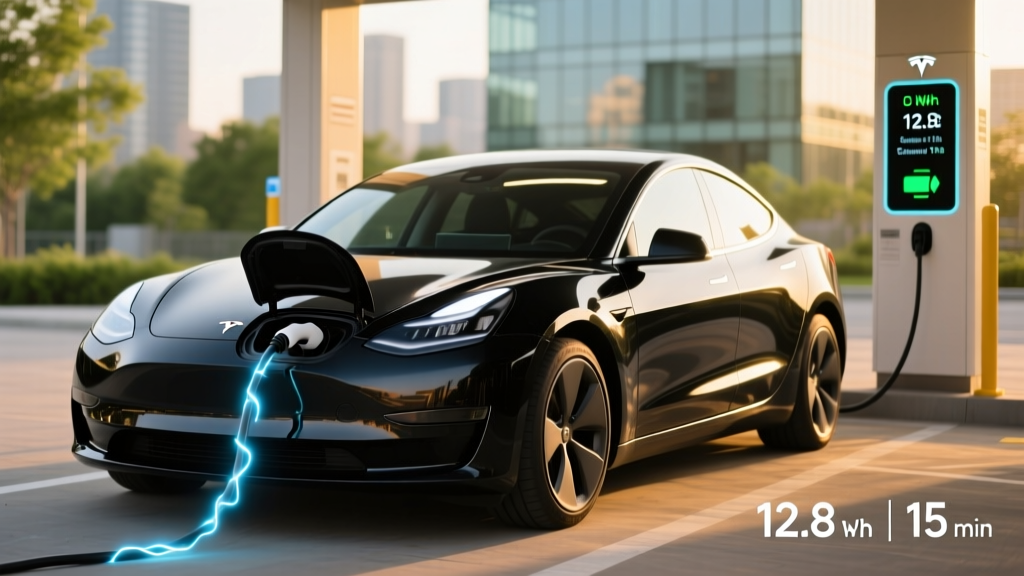
If you're asking how many kWh to charge a Tesla Model 3, the short answer depends on your battery trim and how deeply you've depleted it. The 2026 Tesla Model 3 Long Range AWD carries a usable battery capacity of approximately 75 kWh, while the Rear-Wheel Drive (RWD) variant uses a smaller 57.5 kWh LFP (lithium iron phosphate) pack. Charging from 10% to 80% on the Long Range therefore requires roughly 52.5 kWh of energy delivered to the battery — and slightly more from the grid due to charging losses.
But energy consumed is only half the equation. What most buyers actually want to know is: how much will that cost, how long will it take, and what do I need at home to make it work? This guide answers all three with exact numbers, real-world data, and no marketing fluff.
Tesla Model 3 Battery Capacity and Energy Requirements by Trim
Before calculating cost, you need to know how much energy your specific Model 3 can store. Tesla does not publish official kWh figures on its consumer site, but EPA test data and independent teardowns give us reliable numbers.
| Trim | Battery Chemistry | Usable Capacity (kWh) | EPA Range | Efficiency (kWh/100 mi) | Real-World Highway Range* |
|---|---|---|---|---|---|
| Rear-Wheel Drive | LFP | ~57.5 | 272 mi | 25 | ~220–240 mi |
| Long Range AWD | NMC | ~75 | 341 mi | 25 | ~275–300 mi |
| Performance | NMC | ~75 | 315 mi | 28 | ~250–275 mi |
*Real-world highway range assumes 70–80 mph sustained driving in moderate temperatures. Cold weather (below 32°F) can reduce range an additional 15–30% depending on cabin heating usage and whether the heat pump is active.
kWh (kilowatt-hours) measures energy — the total amount of electricity stored in or delivered to your battery, like gallons of gas. kW (kilowatts) measures power — the rate at which energy flows, like gallons-per-minute at the pump. A 250 kW charger delivers energy fast; your 75 kWh battery is the tank it fills. Never use these interchangeably.
How Many kWh Does a Full Charge Actually Require?
Charging isn't 100% efficient. Energy is lost as heat during AC-to-DC conversion (for Level 1 and Level 2 charging) and during battery thermal management. Here's what you'll actually pull from the grid:
- 10% to 80% on Long Range (75 kWh pack): ~52.5 kWh to the battery, ~55–58 kWh from the grid (accounting for ~5–10% losses)
- 10% to 80% on RWD (57.5 kWh pack): ~40.3 kWh to the battery, ~42–45 kWh from the grid
- 0% to 100% on Long Range: ~75 kWh to the battery, ~80–85 kWh from the grid
- 0% to 100% on RWD: ~57.5 kWh to the battery, ~61–65 kWh from the grid
Level 1 (120V) charging is the least efficient due to prolonged charge times and sustained onboard-converter losses — expect up to 12–15% energy overhead. DC fast charging is more efficient per-session but tapers significantly above 80% State of Charge (SoC), which is why Tesla and most EV makers recommend charging to 80% at public stations.
Charging Speeds by Level: kW, Miles Per Hour, and Real Times
Here's how fast each charging level adds range to a 2026 Tesla Model 3 Long Range (25 kWh/100 mi efficiency):
| Charging Level | Power (kW) | Voltage / Amperage | Miles of Range Per Hour | 10–80% Time (Long Range) |
|---|---|---|---|---|
| Level 1 (Standard 120V Outlet) | ~1.0–1.4 kW | 120V / 12A | ~3–5 mi/hr | ~38–52 hours |
| Level 2 (Home Wall Connector) | ~7.7–11.5 kW | 240V / 32–48A | ~30–44 mi/hr | ~5–7 hours |
| Level 2 (Public AC) | ~7.2–19.2 kW | 208–240V / 30–80A | ~28–44 mi/hr | ~5–7.5 hours |
| DC Fast Charge (V3 Supercharger) | Up to 250 kW peak | 400V architecture | ~170 mi in 15 min | ~25–30 minutes |
| DC Fast Charge (V4 Supercharger) | Up to 350 kW peak* | Higher-current cabinet | ~200 mi in 15 min | ~20–25 minutes |
*V4 Supercharger peak rates depend on vehicle architecture. The current Model 3 (Highland platform) supports up to ~250 kW sustained peak on V4 cabinets; 350 kW capability is limited to vehicles with higher-voltage architectures. Charge speed tapers significantly above 60% SoC — expect the 60–80% portion to take nearly as long as 10–60%.
For daily driving, most owners add 30–50 miles overnight on Level 2, which requires roughly 8–13 kWh and takes 2–4 hours at 240V/32A. You rarely need a full 0–100% charge unless road-tripping.
How Much Does It Cost to Install a Home EV Charger?
Home Level 2 charging is where most Model 3 owners do 85–95% of their charging. But installation costs vary enormously depending on your home's electrical panel, the distance from panel to charger location, and local permit requirements.
| Component | Simple Install (Panel Adjacent) | Moderate Install (50–80 ft Run) | Complex Install (Panel Upgrade Needed) |
|---|---|---|---|
| Level 2 Charger Unit (Hardwired, 48A) | $400–$600 | $400–$600 | $400–$600 |
| Electrical Permit | $50–$150 | $50–$200 | $100–$300 |
| Electrician Labor (Licensed) | $300–$600 | $600–$1,500 | $1,000–$2,500 |
| Conduit, Wiring (6 AWG Copper), Hardware | $100–$250 | $300–$700 | $400–$900 |
| Electrical Panel Upgrade (100A → 200A) | Not needed | Not needed | $1,500–$3,500 |
| Total Estimated Cost | $850–$1,600 | $1,350–$3,000 | $3,400–$7,800 |
Panel upgrade reality check: If your home has a 100-amp service panel — common in homes built before 1990 — adding a 48A continuous-draw EV circuit (which electrical code requires sizing at 60A breaker capacity) may exceed your panel's headroom. A licensed electrician will perform a load calculation per NEC Article 220. If you're over capacity, a panel upgrade to 200A is mandatory. Budget $1,500–$3,500 for this alone, and factor in 1–3 days of work plus utility coordination.
Electrical requirements for a 48A Level 2 circuit:
- Voltage: 240V (split-phase, residential standard)
- Breaker: 60A (NEC requires 125% oversizing for continuous loads: 48A × 1.25 = 60A)
- Wire gauge: 6 AWG copper THHN in conduit, or 4 AWG aluminum for longer runs
- Circuit: Dedicated — no shared loads on this breaker
- GFCI protection: Required by NEC 2020+ for outdoor receptacles; hardwired units may exempt depending on local AHJ (Authority Having Jurisdiction)
According to NEC guidelines, all EV charging installations must comply with Article 625 (Electric Vehicle Charging System Equipment) and local amendments. Always pull a permit — unpermitted work can void home insurance and create fire liability.
Cost to Charge a Tesla Model 3: Per kWh, Per Mile, and vs. Gas
The cost per kWh varies dramatically by where and when you charge. Here's a realistic breakdown for a 2026 Model 3 Long Range:
| Scenario | Cost per kWh | Cost for 10–80% (52.5 kWh) | Cost per Mile (270 mi added) | Annual Cost (12,000 mi/yr) |
|---|---|---|---|---|
| Home — Off-Peak TOU Rate | $0.08–$0.12 | $4.20–$6.30 | $0.016–$0.023 | $192–$276 |
| Home — Standard Flat Rate | $0.13–$0.18 | $6.83–$9.45 | $0.025–$0.035 | $300–$420 |
| Home — Peak / High-Cost State (CA, HI) | $0.25–$0.40 | $13.13–$21.00 | $0.049–$0.078 | $588–$936 |
| Tesla Supercharger (Avg. US) | $0.28–$0.36 | $14.70–$18.90 | $0.054–$0.070 | $648–$840 |
| Third-Party DC Fast (EA, EVgo) | $0.35–$0.55 | $18.38–$28.88 | $0.068–$0.107 | $816–$1,284 |
Gas comparison: A comparable gas sedan getting 30 MPG combined at $3.40/gallon costs $0.113 per mile, or $1,356 annually for 12,000 miles. Even at standard residential rates, the Model 3 costs roughly 70–80% less per mile to fuel. At off-peak TOU rates, savings exceed 85%. Source: fueleconomy.gov.
However, if you rely exclusively on DC fast charging in high-cost states, your per-mile cost can approach or even exceed that of an efficient hybrid. Home charging access is the single biggest variable in EV ownership economics.
Which Connector and Charger Is Compatible with the Tesla Model 3?
The 2026 Tesla Model 3 comes equipped with the North American Charging Standard (NACS) connector — the same plug Tesla has used since 2012, now adopted industry-wide. This means native compatibility with all Tesla Superchargers and a growing number of third-party networks that have added NACS cables.
| Connector Type | Native Support? | Adapter Required? | Networks Available |
|---|---|---|---|
| NACS (Tesla) | Yes — built in | No | Tesla Supercharger, Electrify America (NACS stalls), EVgo, Rivian Adventure Network |
| CCS1 | No | Yes — Tesla CCS Adapter (~$175–$250) | Electrify America, EVgo, ChargePoint DC stations with CCS cables |
| CHAdeMO | No | Yes — Third-party adapter (~$300–$450, limited availability) | Legacy Nissan Leaf stations; largely deprecated in the US |
| J1772 (Level 2 AC Public) | No | Yes — Tesla J1772 Adapter (included with vehicle) | ChargePoint, Blink, public Level 2 stations nationwide |
Practical advice: Your Model 3 ships with a J1772-to-NACS adapter and a Tesla Mobile Connector. For road trips beyond Supercharger coverage, the CCS adapter unlocks hundreds of additional DC fast stations. CHAdeMO is effectively dead for new installations — skip it unless you have a specific legacy station nearby.
Recommended Home Level 2 Chargers for the Tesla Model 3
Not all Level 2 chargers are equal. Here are three proven options matched to the Model 3's 11.5 kW max AC acceptance rate (48A at 240V):
Tesla Wall Connector (Gen 3)
- Max Power Output: 11.5 kW (48A at 240V)
- Connector: NACS (native — no adapter needed)
- Cable Length: 24 feet
- Smart Features: Wi-Fi updates, load sharing (up to 6 units on one circuit), Tesla app integration, power-sharing for multi-EV households
- Price: ~$475
- Best For: Tesla-only households wanting seamless integration and maximum charge speed
ChargePoint Home Flex (NACS Version)
- Max Power Output: 12 kW (50A at 240V) — configurable down to 16A
- Connector: NACS (2025+ models); J1772 versions also available
- Cable Length: 23 feet
- Smart Features: Wi-Fi, ChargePoint app scheduling, Alexa integration, energy reporting, flexible amperage dip-switch settings
- Price: ~$599–$649
- Best For: Mixed-EV households or those wanting detailed energy tracking and flexible amperage
Emporia Level 2 EV Charger
- Max Power Output: 11.5 kW (48A at 240V)
- Connector: J1772 (use included Tesla adapter) or NACS (newer SKU)
- Cable Length: 24 feet
- Smart Features: Wi-Fi, Emporia energy monitoring ecosystem integration, solar-aware charging, TOU scheduling
- Price: ~$349–$399
- Best For: Budget-conscious buyers or homes with Emporia whole-home energy monitors
All three units support hardwired installation (preferred for 48A+ circuits) and NEMA 14-50 plug-in installation (limited to 40A continuous per NEC). Hardwiring eliminates the GFCI breaker requirement for outdoor installs in many jurisdictions and provides a more reliable connection.
Safety, Code, and Installation Best Practices
EV charging draws sustained high current for hours — this is not like plugging in a dryer. Follow these non-negotiable guidelines:
- Dedicated circuit only: Your EV charger must be the sole load on its breaker. No shared circuits with HVAC, water heaters, or workshop equipment.
- Continuous-load sizing: NEC defines EV charging as a continuous load (3+ hours). A 48A charger requires a 60A breaker and wire rated for 60A (6 AWG copper minimum).
- Outdoor rating: If installing outside, the charger must carry a NEMA 3R or NEMA 4 rating. All three recommendations above qualify.
- GFCI: Required for outdoor receptacle (plug-in) installs per NEC 2020+. Hardwired installations may be exempt — confirm with your local inspector.
- Cable management: Use a holster or retractable reel to keep the cable off the ground. Avoid running cables across driveways where vehicles can crush them.
- Utility notification: Some utilities require notification before installing a Level 2 charger, especially if your service is near capacity. Contact your utility to ask about EV-specific TOU rate plans — many offer 30–50% discounts for off-peak charging.
For detailed electrical specifications, always defer to a licensed electrician who can assess your specific panel, service entrance, and local code amendments. The National Fire Protection Association (NFPA) publishes the full NEC text that governs these installations.
Frequently Asked Questions
How many kWh does it take to fully charge a Tesla Model 3 Long Range?
Approximately 80–85 kWh from the grid for a true 0–100% charge, accounting for ~5–10% charging losses. The battery itself stores ~75 kWh usable. In practice, you'll rarely charge from 0% — a typical 20–80% top-up uses about 45–48 kWh from the grid.
Can I charge a Tesla Model 3 on a regular 120V outlet?
Yes, using the included Tesla Mobile Connector with a NEMA 5-15 adapter. Expect ~1.0–1.4 kW and roughly 3–5 miles of range per hour. A full 10–80% charge takes 38–52 hours. This is practical only as emergency backup or for very low daily mileage (under 20 miles/day).
Is it cheaper to charge at home or at a Supercharger?
Home charging is almost always cheaper. At the US average residential rate of ~$0.16/kWh, a 10–80% charge costs about $8.40. The same charge at a Supercharger ($0.32/kWh average) costs ~$16.80 — roughly double. Over a year of 12,000 miles, home charging saves $400–$600 vs. exclusive Supercharger use.
Does the Tesla Model 3 support vehicle-to-home (V2H) or bidirectional charging?
As of the 2026 model year, the Model 3 does not support V2H or V2L (vehicle-to-load) bidirectional charging. Tesla has indicated future support via software and hardware updates, but no official timeline has been confirmed. The Ford F-150 Lightning and Hyundai Ioniq 5 currently offer bidirectional capability.
How does cold weather affect charging speed and energy consumption?
In freezing temperatures (below 32°F), expect 15–30% range reduction due to battery resistance and cabin heating demand. DC fast charging speeds also decrease when the battery is cold — always use the Tesla app to precondition the battery (navigate to a Supercharger and the car preheats automatically) for optimal charge rates. A cold battery at 10% SoC may accept only 50–80 kW initially, ramping to peak speed only after warming.
What electrical upgrades might I need for a home charger?
The most common upgrade is a panel replacement from 100A to 200A service, needed when your existing panel lacks headroom for a 60A EV circuit. Other potential upgrades include: replacing a Federal Pacific or Zinsco panel (known fire hazards, often required replacement by insurance), adding a sub-panel in the garage for a cleaner install, or upgrading the service entrance wire from the utility. A licensed electrician's load calculation will determine exactly what's needed.