What kWh Per Mile Means for Your EV Budget
The single most important efficiency metric for any electric vehicle owner is kWh per mile (or its inverse, miles per kWh). It tells you exactly how much electrical energy your car consumes to travel one mile — and from that number, you can calculate your true charging cost whether you are plugged in at home, at a workplace Level 2 station, or at a 350 kW DC fast charger on the interstate.
Before we go further, let's settle the most common point of confusion in EV ownership: kW (kilowatts) measures power — the rate at which energy flows into your battery. kWh (kilowatt-hours) measures energy — the total amount stored or consumed. Think of kW as the width of a hose and kWh as the total gallons that pass through it. A charger rated at 11.5 kW delivers energy faster than one rated at 7.2 kW, but both are filling the same battery measured in kWh.
Most modern EVs achieve between 0.25 and 0.40 kWh per mile in mixed driving. A highly efficient sedan like the Tesla Model 3 Long Range sits around 0.26 kWh/mi (roughly 3.8 mi/kWh), while a heavier, boxier SUV like the Rivian R1T may consume 0.42–0.45 kWh/mi. Cold weather, highway speeds above 70 mph, and aggressive acceleration all push that number higher.
Once you know your vehicle's kWh per mile, calculating cost is simple arithmetic:
Cost per mile = kWh per mile × price per kWh
Example: 0.30 kWh/mi × $0.16/kWh (national residential average) = $0.048 per mile
That same calculation applied to public DC fast charging at $0.48/kWh yields $0.144 per mile — still competitive with gasoline in many scenarios, and dramatically cheaper when you charge at home on off-peak utility rates.
Charging Levels: Speeds, kW Ratings, and Range Added Per Hour
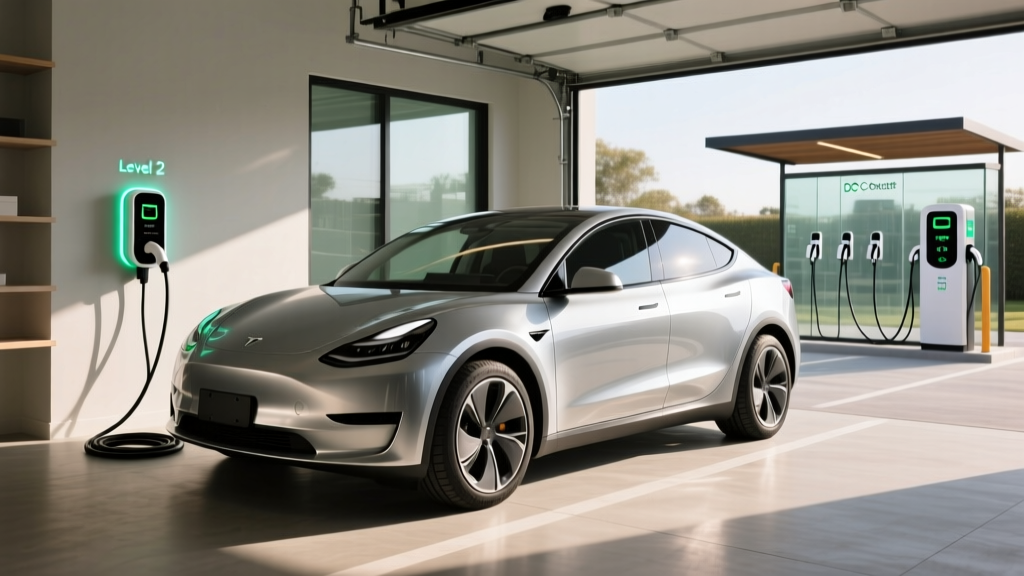
Every EV charging scenario falls into one of three categories. Understanding what each level delivers in real-world miles per hour of charging is essential for planning both daily routines and road trips.
| Level | Voltage / Amperage | Max Power (kW) | Miles of Range Added Per Hour | Typical Use Case |
|---|---|---|---|---|
| Level 1 | 120V / 12–16A | 1.4–1.9 kW | 3–5 mi/hr | Overnight top-up, PHEVs, emergency backup |
| Level 2 | 240V / 32–48A | 7.7–11.5 kW | 25–44 mi/hr | Daily home charging, workplace, retail destinations |
| DC Fast Charging | 400–800V DC | 50–350 kW | 180–1,000+ mi/hr (peak) | Road trips, rapid top-ups, commercial fleets |
A few real-world nuances that spec sheets often gloss over:
- Level 1 is viable for plug-in hybrids with 25–40 miles of electric range (a Toyota RAV4 Prime at ~35 mi can fully recharge overnight). For a BEV with a 75+ kWh battery, Level 1 is a trickle — expect a full charge to take 40–60 hours.
- Level 2 at 48 amps (11.5 kW) is the sweet spot for most BEV owners. An 82 kWh battery (usable) charges from 10% to 100% in roughly 7–8 hours — perfect for overnight replenishment.
- DC fast charging peaks are not sustained. A vehicle rated for 250 kW peak may only hold that rate from roughly 10–30% State of Charge (SoC) before tapering. The more meaningful metric is 10–80% charge time. A Hyundai Ioniq 5 on a 350 kW charger achieves 10–80% in approximately 18 minutes; a Ford F-150 Lightning (extended range) takes roughly 35–41 minutes at a 150+ kW station.
How Much Does It Cost to Install a Home EV Charger?
This is the question I hear most from new EV buyers, and the answer varies enormously depending on your home's electrical infrastructure. Here is an honest breakdown of what you can expect in 2026.
| Component | Basic Install (Existing 240V Circuit) | Standard Install (New 60A Circuit) | Complex Install (Panel Upgrade Required) |
|---|---|---|---|
| Level 2 EVSE (charger hardware) | $200–$650 | $200–$650 | $200–$650 |
| Electrician labor (2–8 hrs) | $300–$500 | $600–$1,500 | $1,500–$3,000 |
| Materials (wire, conduit, breaker) | $50–$150 | $150–$500 | $300–$800 |
| Permit and inspection | $50–$200 | $50–$200 | $100–$350 |
| Electrical panel upgrade (if needed) | — | — | $1,500–$4,000 |
| Total estimated range | $600–$1,500 | $1,000–$2,850 | $3,600–$8,800 |
Electrical Requirements for a Level 2 Home Charger
A typical high-output Level 2 charger draws 48 amps continuously. Per the National Electrical Code (NEC), continuous loads must not exceed 80% of a circuit breaker's rating, which means you need a dedicated 60-amp, 240-volt circuit. If you opt for a 40-amp charger, a 50-amp circuit suffices.
Panel upgrade reality check: Homes built before 1990 often have 100-amp main panels that are already near capacity with existing appliances (electric range, dryer, HVAC). Adding a 60-amp EV circuit may require upgrading to a 200-amp panel — this is the single largest variable in installation cost. Before budgeting, have an electrician perform a load calculation on your panel. Some utilities offer rebates or time-of-use rates that can offset panel-upgrade costs; check with your local provider.
Federal incentive note: The Alternative Fuel Vehicle Refueling Property Credit (IRS Form 8911) may cover up to 30% of home charging equipment and installation costs (capped at $1,000 for residential). Eligibility depends on census tract requirements and current-year IRS rules — consult a tax professional.
Connector Compatibility: NACS, CCS, and CHAdeMO in 2026
The connector landscape has consolidated dramatically since Ford, GM, Rivian, and most major automakers adopted the North American Charging Standard (NACS) — originally Tesla's proprietary connector. Here is where things stand for 2026 model-year vehicles:
| Connector | Brands Using It (2026 Models) | Adapter Needed? |
|---|---|---|
| NACS (J3400) | Tesla (all), Ford, GM, Rivian, Volvo, Polestar, Mercedes-Benz, BMW (newer models), Hyundai/Kia (newer models) | Direct access to Tesla Supercharger network; CCS adapter for legacy public chargers |
| CCS1 (Combo) | Volkswagen ID.4 (remaining stock), some Stellantis models, older Hyundai/Kia models, BMW i4/iX (pre-2025) | NACS adapter required for Supercharger access; direct access to Electrify America, EVgo CCS stalls |
| CHAdeMO | Nissan Leaf (legacy only — discontinued after 2025 model year), Mitsubishi Outlander PHEV (older) | Increasingly limited public infrastructure; CHAdeMO-to-CCS adapters exist but are expensive (~$400+) |
Practical advice: If you are buying a new EV in 2026, prioritize NACS-equipped vehicles for the widest fast-charging access. If your EV has CCS1, purchase a NACS-to-CCS adapter (approximately $150–$250 from manufacturers like Lectron or A2Z) to unlock Tesla Supercharger stalls that have been opened to non-Tesla vehicles. For home Level 2 charging, nearly all chargers use the J1772 connector, and NACS vehicles ship with a J1772-to-NACS adapter in the box.
Charging Cost Per Mile vs. Gasoline: The Real Numbers
This is where kWh per mile becomes a wallet metric. Let's compare real costs across common charging scenarios against a gasoline baseline.
| Scenario | Price per kWh (or Gallon) | Vehicle Efficiency | Cost Per Mile |
|---|---|---|---|
| Home charging (off-peak utility rate) | $0.11/kWh | 0.30 kWh/mi (mid-size EV SUV) | $0.033 |
| Home charging (national avg residential) | $0.16/kWh | 0.30 kWh/mi | $0.048 |
| Public Level 2 (workplace/retail) | $0.25/kWh | 0.30 kWh/mi | $0.075 |
| DC fast charging (Electrify America, EVgo) | $0.48/kWh | 0.30 kWh/mi | $0.144 |
| Tesla Supercharger (typical 2026 rate) | $0.35/kWh | 0.26 kWh/mi (Model 3 LR) | $0.091 |
| Gasoline (28 MPG combined SUV) | $3.40/gallon | 28 MPG | $0.121 |
| Gasoline (22 MPG truck/SUV) | $3.40/gallon | 22 MPG | $0.155 |
Source: Residential electricity rates from EIA monthly data; gasoline prices from EIA weekly surveys; vehicle efficiency from fueleconomy.gov EPA estimates.
The takeaway: Home charging at residential rates delivers fuel cost savings of 60–75% compared to a comparable gasoline vehicle. Even DC fast charging at premium public rates is often cost-competitive with gasoline — and dramatically cheaper when you factor in off-peak utility programs that drop rates to $0.06–$0.10/kWh overnight.
Equipment Recommendations: Best Home Level 2 Chargers for 2026
Not all Level 2 EVSEs (Electric Vehicle Supply Equipment) are created equal. Here are four proven units across different budgets and feature sets:
ChargePoint Home Flex
- Power output: Up to 11.5 kW (48A) on a 60A circuit; configurable down to 16A for smaller circuits
- Connector: J1772 (NACS vehicles use included adapter)
- Cable length: 23 feet
- Smart features: Wi-Fi, app scheduling, Alexa integration, energy tracking, utility demand-response compatible
- Price: ~$550–$650
- Best for: Most homeowners wanting a reliable, flexible smart charger
Grizzl-E Smart
- Power output: Up to 10 kW (40A) on a 50A circuit
- Connector: J1772
- Cable length: 24 feet
- Smart features: Wi-Fi, OCPP protocol, app scheduling, works with utility programs
- Price: ~$450–$550
- Best for: Cold-climate and outdoor installations — rated to -40°F, IP67 weatherproof
Tesla Wall Connector
- Power output: Up to 11.5 kW (48A) on a 60A circuit
- Connector: NACS (native); J1772 adapter included for non-Tesla vehicles
- Cable length: 24 feet
- Smart features: Wi-Fi, OTA firmware updates, load sharing (pair two units on one circuit), Power-Share with Tesla Powerwall
- Price: ~$420–$475
- Best for: Tesla owners or households with NACS-equipped vehicles
Emporia Level 2 EV Charger
- Power output: Up to 11.5 kW (48A) on a 60A circuit
- Connector: J1772
- Cable length: 24 feet
- Smart features: Wi-Fi, integrates with Emporia Vue energy monitor for whole-home load management, solar-aware charging
- Price: ~$350–$400
- Best for: Budget-conscious buyers and homes with solar panels wanting integrated energy management
Safety, Code, and Installation Best Practices
Electrical work for EV charging is not a DIY project. Here is what a proper, code-compliant installation requires:
- Dedicated circuit: Your Level 2 charger must have its own dedicated breaker — it cannot share a circuit with other appliances. This prevents overloads and nuisance tripping.
- GFCI protection: The 2023 NEC (and subsequent local adoptions) requires GFCI (Ground Fault Circuit Interrupter) protection for all EV charging outlets. Hardwired EVSEs with built-in GFCI satisfy this requirement. If you use a NEMA 14-50 receptacle, a GFCI breaker is required — these cost $50–$100 more than standard breakers.
- Outdoor rating: If your charger is installed outdoors or in an unconditioned garage, ensure it carries at least an IP55 or IP67 ingress protection rating. All four chargers recommended above meet this standard.
- Wire gauge: A 60-amp circuit typically requires 6 AWG copper wire (THHN in conduit or NM-B cable). Your electrician will size wire based on run length and local code — longer runs may need 4 AWG to minimize voltage drop.
- Permit and inspection: Nearly all jurisdictions require an electrical permit for a new 240V circuit. Permits typically cost $50–$200 and the work must pass a municipal inspection. Skipping the permit risks insurance claim denial if an electrical fire occurs.
- Hardwired vs. plug: Hardwired installations (no receptacle) avoid the GFCI breaker requirement and provide a slightly cleaner install. Plug-in (NEMA 14-50) offers portability — you can take the charger when you move. Both are code-compliant when done correctly.
Charging Time Examples: 10–80% for Common Battery Sizes
Because the charging curve tapers significantly above 80% SoC (to protect battery health and manage cell temperature), the industry-standard benchmark is 10–80% time. Here is what that looks like for popular vehicles:
| Vehicle (2025–2026 Model Year) | Usable Battery (kWh) | Peak DC Fast Charge (kW) | 10–80% Time (DC Fast) | 0–100% Time (Level 2, 11.5 kW) |
|---|---|---|---|---|
| Tesla Model 3 Long Range | 75 kWh (NMC) | 250 kW | ~25 min | ~7 hrs |
| Hyundai Ioniq 5 (Long Range AWD) | 77.4 kWh (NMC) | 238 kW (800V architecture) | ~18 min | ~7.5 hrs |
| Ford F-150 Lightning (Extended Range) | 131 kWh (NMC) | 150 kW (sustained ~120 kW) | ~41 min | ~12.5 hrs |
| Chevrolet Equinox EV (3RS) | 85 kWh (NMC) | 150 kW | ~30 min | ~8 hrs |
| BMW iX xDrive50 | 105.2 kWh (NMC) | 200 kW | ~31 min | ~10 hrs |
Why the curve matters: A charger rated at 250 kW does not deliver 250 kW for the entire session. Peak power typically occurs between 10–35% SoC, then the battery management system progressively reduces the charge rate. By 80% SoC, a vehicle peaking at 250 kW may be drawing only 40–60 kW. This is why charging from 80–100% on a DC fast charger is painfully slow and generally not recommended — save that for overnight Level 2 at home.
Frequently Asked Questions
How much does it cost to install a home EV charger?
A straightforward Level 2 installation on an existing 240V circuit runs $600–$1,500 including hardware. A new 60-amp circuit installation typically costs $1,000–$2,850. If your home requires an electrical panel upgrade from 100A to 200A, expect $3,600–$8,800 total. Always get a load calculation from a licensed electrician before committing.
How fast will each charging level add range?
Level 1 (120V) adds 3–5 miles of range per hour — suitable only for PHEVs or emergency top-ups. Level 2 (240V) adds 25–44 miles per hour depending on amperage and vehicle efficiency. DC fast charging adds 180–1,000+ miles per hour at peak rates, but the practical measure is 10–80% time, which ranges from 18 to 41 minutes for most current EVs.
Which connector/charger is compatible with my EV?
For 2026 model-year vehicles, most new EVs use NACS (the Tesla-derived standard). Remaining CCS1 vehicles include some Volkswagen and Stellantis models. CHAdeMO is effectively discontinued for new vehicles. For home Level 2 charging, all EVs use J1772 — NACS vehicles include a J1772-to-NACS adapter. Check your vehicle's charge port or owner's manual to confirm.
How much does charging cost per mile vs gas?
At the national average residential electricity rate of $0.16/kWh, a typical EV consuming 0.30 kWh per mile costs about $0.048 per mile to fuel. A comparable gasoline SUV at 28 MPG with gas at $3.40/gallon costs $0.121 per mile. That is a 60% fuel cost savings when charging at home. Public DC fast charging at $0.48/kWh brings cost to $0.144 per mile — roughly equivalent to gasoline.
What electrical upgrades might I need?
The most common upgrade is a new 60-amp, 240-volt dedicated circuit, which requires available capacity in your electrical panel. Homes with 100-amp main panels may need a panel upgrade to 200 amps ($1,500–$4,000) to accommodate EV charging alongside existing loads. Older homes may also need aluminum-to-copper wire remediation, conduit installation for long wire runs, or a sub-panel addition. A licensed electrician's load calculation is the definitive first step.
Can I use a regular household outlet to charge my EV?
Yes, but only at Level 1 speeds (120V, 1.4–1.9 kW). This adds roughly 3–5 miles of range per hour and is practical for PHEVs with small batteries or as an emergency backup for BEVs. A full charge of a 75 kWh battery from empty on Level 1 would take 40–55 hours — not viable as a daily strategy for battery-electric vehicles.