If you've ever stared at your EV's energy consumption screen and wondered what "kWh/mi" actually tells you, you're not alone. This single metric — kilowatt-hours per mile — is the electric vehicle equivalent of gallons-per-mile, and it governs everything from your real-world range to your monthly electricity bill. Unlike the EPA's MPGe sticker, kWh/mi gives you a direct, actionable number you can plug into your utility rate to find out exactly what each mile costs.
As someone who has tracked kWh/mi across multiple EVs in summer heat, winter cold, and mountain passes, I can tell you this number fluctuates far more than gas car MPG ever does. A Tesla Model Y might sip 0.25 kWh/mi on a mild spring commute but gulp 0.40 kWh/mi on a freezing highway run. Understanding these swings — and how they interact with your charging setup — is the key to owning an EV without surprises.
Before going further, let's eliminate the single most common EV confusion. kW (kilowatts) measures power — the rate at which energy flows, like water pressure from a hose. kWh (kilowatt-hours) measures energy — the total amount delivered over time, like gallons in a bucket. Your charger's output is rated in kW. Your battery's capacity and your consumption are measured in kWh. A 10 kW charger running for one hour delivers 10 kWh of energy. Never use these interchangeably.
What kWh/mi Actually Means and Why It Matters
Kilowatt-hours per mile (kWh/mi) tells you how much electrical energy your vehicle consumes to travel one mile. Think of it as the inverse of miles-per-gallon, but with far more precision for cost calculations. Lower kWh/mi means greater efficiency — the vehicle uses less energy to go the same distance.
Here's why this matters for real ownership decisions:
- Range prediction: Divide your battery's usable kWh by your typical kWh/mi to get your actual range — which often differs from the EPA sticker.
- Cost calculation: Multiply kWh/mi by your electricity rate ($/kWh) to get your exact cost per mile.
- Charger sizing: Higher-consumption vehicles (trucks, large SUVs at 0.35+ kWh/mi) benefit more from faster home chargers because each hour of charging adds fewer miles.
- Trip planning: Knowing your highway kWh/mi lets you predict DC fast-charging stops with precision.
Typical kWh/mi values across popular 2026 EVs:
| Vehicle | EPA Combined kWh/mi | Real-World Highway kWh/mi | Cold Weather (20°F) kWh/mi |
|---|---|---|---|
| Tesla Model Y LR AWD | 0.28 | 0.31–0.34 | 0.36–0.40 |
| Hyundai Ioniq 5 SEL AWD | 0.30 | 0.33–0.36 | 0.38–0.43 |
| Ford F-150 Lightning Lariat | 0.47 | 0.50–0.55 | 0.58–0.65 |
| Chevrolet Equinox EV 3RS | 0.31 | 0.34–0.37 | 0.39–0.44 |
| BMW i4 eDrive40 | 0.29 | 0.32–0.35 | 0.37–0.42 |
Source: fueleconomy.gov EPA combined figures. Real-world and cold-weather estimates based on aggregated owner testing data and independent reviews. Expect highway driving at 70+ mph to increase consumption 10–20% above EPA combined. Cold weather below freezing typically adds 15–30% to kWh/mi due to battery heating demands and cabin climate load.
Charging Levels Explained: kW Speeds and Miles Added Per Hour
How fast you add range depends on three factors: your charger's power output (kW), your vehicle's onboard charger or DC fast-charge acceptance rate (kW), and your vehicle's efficiency (kWh/mi). That last variable is why the same charger adds more miles per hour to an efficient sedan than to a heavy truck.
| Level | Voltage | Power (kW) | Miles Added/Hour (Efficient EV ~0.30 kWh/mi) | Miles Added/Hour (Truck ~0.50 kWh/mi) |
|---|---|---|---|---|
| Level 1 (120V outlet) | 120V | 1.0–1.4 kW | 3–5 mi/hr | 2–3 mi/hr |
| Level 2 (240V home/public) | 240V | 3.3–19.2 kW | 11–64 mi/hr | 7–38 mi/hr |
| DC Fast Charging | 200–800V DC | 50–350 kW | 150–500+ mi/hr (peak) | 100–350 mi/hr (peak) |
Notice how the same Level 2 charger at 11.5 kW adds roughly 38 miles of range per hour to a Tesla Model Y but only 23 miles per hour to an F-150 Lightning. This is the practical impact of kWh/mi: less efficient vehicles need either more charging time or a higher-power charger to achieve the same daily range replenishment.
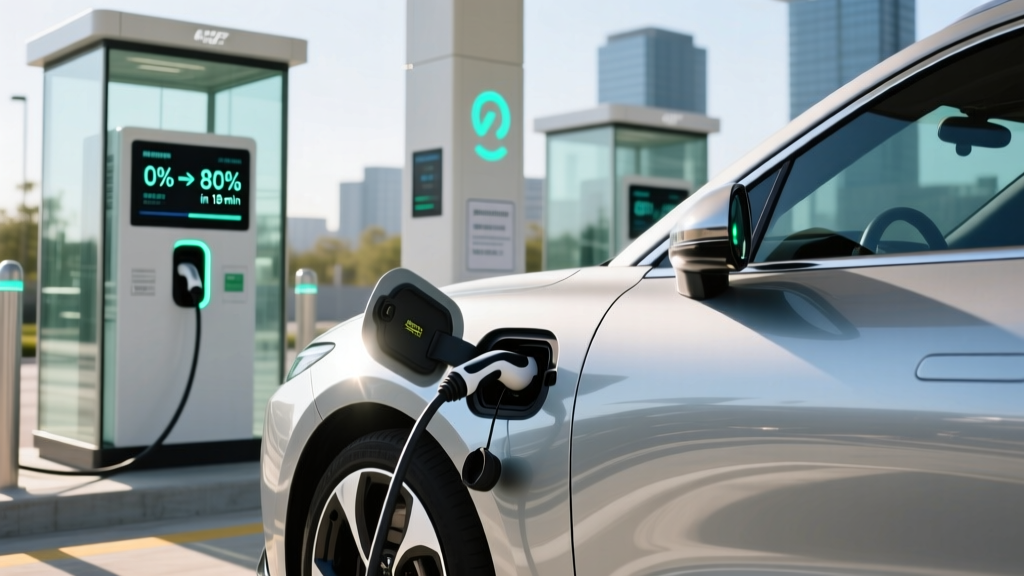
The peak kW number on a DC fast charger is not sustained for the entire session. A vehicle that "accepts 250 kW" may only hold that rate from roughly 10–30% state of charge before tapering. Above 80% SoC, charging speed drops dramatically to protect the battery. A typical 10–80% session on a 250 kW charger with a large-battery EV (84 kWh usable, NMC chemistry) takes approximately 18–25 minutes. Plan road-trip stops around the 10–80% window — charging from 80–100% can take as long as the 10–80% portion.
Home Charger Installation: Electrical Requirements and Costs
The most common question I hear from new EV buyers: "How much does it cost to install a home EV charger?" The honest answer spans a wide range depending on your home's electrical panel, the distance from panel to garage, and local permit fees. Here's the full breakdown.
Electrical requirements for a typical Level 2 home charger:
- Voltage: 240V (same as a dryer or oven circuit)
- Amperage: 40A circuit for a 32A continuous charger (NEC requires circuits rated 125% of continuous load), or 60A circuit for a 48A charger
- Dedicated circuit: Required — you cannot share this circuit with other appliances
- GFCI protection: Required by NEC 2020 and later for garage receptacles; most hardwired EV chargers have built-in ground-fault protection
- Outdoor rating: If installing outside, both the charger and any receptacle must carry a NEMA 4 or NEMA 4X weather rating
| Cost Component | Simple Install (Panel Adjacent) | Moderate Install (50–80 ft Run) | Complex Install (Panel Upgrade Needed) |
|---|---|---|---|
| Level 2 Charger Equipment | $400–$700 | $400–$700 | $400–$700 |
| Electrician Labor | $300–$600 | $600–$1,500 | $1,500–$3,500 |
| Electrical Permit | $50–$150 | $50–$200 | $100–$300 |
| Panel Upgrade (100A→200A) | N/A | N/A | $1,500–$3,000 |
| Total Estimated Cost | $750–$1,450 | $1,050–$2,400 | $3,500–$7,500 |
What electrical upgrades might I need? Homes built before the 1990s often have 100-amp electrical panels. Adding a 40A or 60A EV circuit to an already-loaded 100A panel may exceed its capacity, especially if you run electric HVAC, a dryer, and an oven. A licensed electrician will perform a load calculation per NEC Article 220. If your panel is at capacity, you'll need a service upgrade to 200A — the single biggest cost variable in EV charger installation. Some utilities offer rebates of $200–$500 for panel upgrades tied to EV adoption; check with your local provider.
Always hire a licensed electrician and pull a permit. Unpermitted EV charger installations can void homeowner's insurance claims and create fire hazards from undersized wiring.
Connector Compatibility: NACS, CCS1, and CHAdeMO
As of 2026, the North American connector landscape has consolidated significantly around NACS (North American Charging Standard, originally the Tesla connector), but CCS1 and CHAdeMO vehicles remain on the road and in showrooms. Here's which connector your EV uses and what adapters you might need.
| Connector | Brands Using It (2026 Models) | Adapter Needed for Tesla Superchargers? |
|---|---|---|
| NACS (Tesla-style) | Tesla (all), Ford (2025+), GM (2025+), Rivian (2025+), Hyundai/Kia (2026+), Volvo/Polestar | No — native compatibility |
| CCS1 | Volkswagen ID.4, older BMW i4/iX, some Stellantis models, remaining 2024–2025 inventory | Yes — CCS-to-NACS adapter ($200–$400) required for Supercharger access |
| CHAdeMO | Nissan Ariya (2024–2025), Mitsubishi Outlander PHEV (legacy); being phased out | Limited — CHAdeMO-to-NACS adapters rare; rely on Electrify America and other CCS/CHAdeMO stations |
Most 2026 EVs sold in the US now ship with a NACS charge port. If you own a CCS1-equipped vehicle, Ford, GM, and Rivian provide or sell CCS-to-NACS adapters enabling access to Tesla's Supercharger network — which remains the most reliable DC fast-charging infrastructure in North America. Verify adapter compatibility with your specific model year on the manufacturer's site before purchasing.
Cost Per Mile: EV Charging vs Gasoline
This is where kWh/mi becomes directly actionable. By multiplying your vehicle's kWh/mi by your electricity rate, you get an exact cost-per-mile figure you can compare against a gas car's cost per mile (gallons-per-mile × price-per-gallon).
Scenario: Tesla Model Y LR AWD (0.28 kWh/mi EPA combined) vs Toyota RAV4 AWD (28 MPG combined)
| Charging/Fueling Scenario | Rate | EV Cost/Mile | Gas Cost/Mile (RAV4, 28 MPG) |
|---|---|---|---|
| Home Charging (off-peak utility rate) | $0.12/kWh | $0.034/mi | $0.125/mi (@ $3.50/gal) |
| Home Charging (standard rate) | $0.18/kWh | $0.050/mi | $0.125/mi |
| Public Level 2 (ChargePoint, etc.) | $0.25/kWh | $0.070/mi | $0.125/mi |
| DC Fast Charging (Electrify America) | $0.48/kWh | $0.134/mi | $0.125/mi |
| DC Fast Charging (Tesla Supercharger) | $0.35/kWh | $0.098/mi | $0.125/mi |
The takeaway is clear: home charging at off-peak or standard rates delivers per-mile costs 60–75% below gasoline. Public DC fast charging at premium rates narrows the gap — and at the highest DCFC rates, can actually exceed gas cost per mile. This is why home charging access remains the single biggest economic advantage of EV ownership. If you rely exclusively on expensive public DC fast charging, the fuel-cost savings shrink considerably.
For a driver covering 12,000 miles/year with a Model Y charging primarily at home ($0.14/kWh average), annual fuel cost runs approximately $470. The RAV4 at $3.50/gal costs about $1,500. That's over $1,000/year in fuel savings — roughly $5,000 over five years. Source: fueleconomy.gov EV comparison tool.
Level 2 Home Charger Recommendations
When selecting a home charger, match the unit's output to your vehicle's onboard charger capacity and your daily driving needs. Most EVs accept 11.5 kW on Level 2 (48A on a 60A circuit). Some, like the Ford F-150 Lightning, accept up to 19.2 kW with the optional onboard charger upgrade. Here are proven units for 2026 installations:
Tesla Wall Connector
Power Output: Up to 11.5 kW (48A) on a 60A circuit
Connector: NACS native
Cable Length: 24 ft
Smart Features: Wi-Fi, OTA updates, power-sharing between two units, access control
Price: ~$475
Best For: Tesla owners and NACS-equipped 2025+ Ford/GM/Rivian vehicles. Excellent build quality, fast warranty support.
ChargePoint Home Flex
Power Output: Configurable up to 12 kW (50A) on a 60A circuit, or lower on smaller circuits
Connector: NACS (J1772 adapter included)
Cable Length: 24 ft
Smart Features: Wi-Fi, app scheduling, Alexa integration, flexible amperage settings
Price: ~$599
Best For: Multi-EV households or those wanting circuit flexibility. Amperage is adjustable at install to match your panel capacity.
Emporia Vue Level 2 Charger
Power Output: Up to 11.5 kW (48A) on a 60A circuit
Connector: NACS (J1772 version also available)
Cable Length: 24 ft
Smart Features: Wi-Fi, energy monitoring, solar-integration with Emporia Vue panel monitor, scheduling
Price: ~$399
Best For: Budget-conscious buyers who want smart features and energy tracking. Best value in the smart-charger category.
For all installations, hardwiring is preferred over a NEMA 14-50 receptacle for reliability and to avoid the GFCI nuisance-tripping issues some owners report with receptacle-based setups. If you do use a receptacle, ensure it is an industrial-grade unit (Hubbell or Bryant) installed by your electrician — residential-grade 14-50 outlets have been linked to overheating under continuous EV charging loads.
Charging Time Examples for Common Battery Sizes
Charging time depends on battery capacity (kWh), charger output (kW), and the 10–80% window most EV owners use to preserve battery health and avoid the slow taper above 80% SoC.
| Vehicle (Usable Battery kWh) | Level 1 (1.2 kW) | Level 2 (11.5 kW) | DC Fast 10–80% |
|---|---|---|---|
| Chevy Equinox EV (85 kWh, NMC) | ~49 hrs (full) | ~5.2 hrs (full) | ~28 min (150 kW peak) |
| Tesla Model Y LR (75 kWh, NMC) | ~44 hrs (full) | ~4.6 hrs (full) | ~22 min (250 kW peak) |
| Hyundai Ioniq 5 (77.4 kWh, NMC) | ~45 hrs (full) | ~4.8 hrs (full) | ~18 min (350 kW peak, 800V) |
| Ford F-150 Lightning ER (131 kWh, NMC) | ~77 hrs (full) | ~8 hrs (full at 19.2 kW) | ~40 min (150 kW peak) |
| Tesla Model 3 RWD (57.5 kWh, LFP) | ~33 hrs (full) | ~3.5 hrs (full) | ~22 min (170 kW peak) |
The Ioniq 5's 800V architecture stands out: it sustains higher charge rates longer than 400V competitors, delivering a genuinely faster 10–80% time on 350 kW chargers. The F-150 Lightning's massive 131 kWh battery is the longest to charge by any measure — if you drive a Lightning daily, a 19.2 kW Level 2 home charger (60A+ circuit) is nearly essential rather than optional.
A note on LFP batteries: Vehicles with lithium iron phosphate (LFP) chemistry, like the base Model 3 RWD, can be charged to 100% regularly without the degradation concerns of NMC cells. Tesla and Ford recommend periodic 100% charges for LFP to allow the battery management system to recalibrate. This means LFP owners can use the full battery capacity daily, partially offsetting the smaller kWh.
Safety, Code, and Best Practices
EV charging draws continuous high current for hours — a duty cycle unlike anything else in your home. Follow these guidelines:
- Dedicated circuit only: Never share the EV charger circuit with other loads. NEC Article 511 governs EV charging installations.
- Hardwired over receptacle: Hardwired chargers eliminate the receptacle as a failure point. If using a NEMA 14-50, specify a commercial-grade Hubbell 9450A or Bryant 9450FR — not a residential-grade outlet from a big-box store.
- GFCI compliance: NEC 2020+ requires GFCI protection for garage receptacles. Hardwired units integrate ground-fault protection internally.
- Cable management: Use a wall-mounted holster or retractable cable system to prevent tripping hazards and cable damage. Never let the cable rest on a garage floor where vehicles can run over it.
- Outdoor installations: Ensure the charger carries a NEMA 4 rating. Verify the electrician uses outdoor-rated conduit and junction boxes.
- Load calculation: Before installation, have your electrician perform a NEC Article 220 load calculation. If your panel is near capacity, consider a smart panel or load-management device (like the Emporia Smart Panel or Span Drive) that dynamically reduces charger amperage when other household loads spike.
For authoritative installation guidance, refer to the National Electrical Code (NFPA 70) and your local building department's EV-specific permitting requirements, which vary by jurisdiction.
Frequently Asked Questions
How much does it cost to install a home EV charger?
A straightforward Level 2 installation with an adequate electrical panel typically costs $750–$1,450 including equipment, electrician labor, and permit. If your home needs a panel upgrade from 100A to 200A, total costs can reach $3,500–$7,500. Always get at least two quotes from licensed electricians, and confirm the quote includes permit fees and a load calculation.
How fast will each charging level add range?
Level 1 (120V) adds 3–5 miles per hour — sufficient only for PHEVs or EVs driven under 30 miles daily. Level 2 (240V, 11.5 kW) adds 25–40 miles per hour depending on your vehicle's kWh/mi efficiency, replenishing most EVs overnight. DC fast charging at 150–350 kW can add 150–500+ miles per hour at peak rates, but sustained rates taper significantly above 80% SoC.
Which connector or charger is compatible with my EV?
Most 2026 EVs use the NACS connector natively, including Tesla, Ford, GM, Rivian, Hyundai, Kia, and Volvo. Older CCS1 vehicles can access Tesla Superchargers with a CCS-to-NACS adapter ($200–$400). CHAdeMO vehicles (Nissan Ariya from prior years) rely on Electrify America and other networks. Check your vehicle's charge port or the manufacturer's specification page for your exact connector type.
How much does charging cost per mile compared to gas?
At home with average electricity rates ($0.14/kWh), an efficient EV at 0.28 kWh/mi costs roughly $0.04 per mile — about 68% less than a 28 MPG gas car at $3.50/gallon ($0.125/mile). Public DC fast charging at $0.35–$0.48/kWh raises EV cost to $0.10–$0.13/mile, narrowing or eliminating the advantage. Home charging is where the economics work best.
What electrical upgrades might I need for a home charger?
Homes with 100A panels or panels already near capacity may require a service upgrade to 200A, costing $1,500–$3,000. Older homes with knob-and-tube or aluminum wiring may need partial rewiring. Some homes have sufficient panel capacity but need a new circuit run over a long distance (garage detached from house), increasing wire and conduit costs. A licensed electrician's load calculation is the definitive answer — don't guess.
Does kWh/mi change in cold weather or on the highway?
Yes, significantly. Cold weather below freezing typically increases kWh/mi by 15–30% due to battery thermal management, cabin heating, and increased air density. Highway driving at 75+ mph increases consumption 10–20% over EPA combined figures due to aerodynamic drag, which scales with the square of speed. If your commute is 70-mph highway in January, plan for kWh/mi figures 25–40% above the EPA sticker — and size your charger and daily charging window accordingly.