The kW vs kWh Distinction Every EV Owner Must Know
Before calculating how much energy it takes to charge your Tesla Model Y, Model 3, or any other electric vehicle, you need to lock in the single most important distinction in EV ownership: kW (kilowatts) measures power — the rate at which energy flows into your battery. kWh (kilowatt-hours) measures energy — the total amount stored or consumed. Think of kW as the width of a hose and kWh as the total gallons in the bucket.
When you ask "how many kWh to charge my Tesla," you're asking about total energy consumed. When you ask "how fast does my charger deliver," you're asking about kW. Confusing these two leads to bad purchase decisions, misquoted install costs, and range miscalculations. We'll keep them strictly separated throughout this guide.
Charging Levels Explained: Speed, Power, and Real-World Range Gains
Every EV sold in the US charges via one of three tiers. The table below uses 2026-spec figures for a Tesla Model Y Long Range (82 kWh usable battery, ~3.5 mi/kWh efficiency) as a representative mid-size EV.
| Level | Voltage / Amperage | Power (kW) | Miles Added per Hour | Best Use Case |
|---|---|---|---|---|
| Level 1 (Standard Outlet) | 120V / 12A | 1.4 kW | ~4–5 mi/hr | Overnight trickle, PHEVs, emergency top-off |
| Level 2 (Home / Workplace) | 240V / 32–48A | 7.7–11.5 kW | ~25–40 mi/hr | Daily home charging, workplace, destination |
| DC Fast Charging | 400V–800V DC | 50–250+ kW | ~175–1,000+ mi/hr (peak) | Road trips, rapid top-up, commercial fleets |
A few real-world caveats: DC fast charging rates are peak values. A Tesla V4 Supercharger may deliver up to 250 kW to a Model Y, but only while the battery is between roughly 10–50% state of charge (SoC). Above 80%, the charge curve tapers sharply to protect battery health — sometimes dropping below 30 kW. This is why manufacturers quote 10–80% times rather than 0–100%.
10–80% Charging Time Examples
| Vehicle (2026) | Usable Battery (kWh) | Peak DC Rate (kW) | 10–80% Time | Level 2 at 11.5 kW |
|---|---|---|---|---|
| Tesla Model 3 RWD | 57.5 (LFP) | 170 | ~25 min | ~5 hrs |
| Tesla Model Y LR AWD | 82 (NMC) | 250 | ~22 min | ~7.5 hrs |
| Hyundai Ioniq 5 (Long Range) | 84 (NMC, 800V) | 240 | ~18 min | ~7.5 hrs |
| Ford F-150 Lightning Ext. Range | 131 (NMC) | 155 | ~41 min | ~12 hrs |
Home Charger Installation: Electrical Requirements, Permits, and Real Costs
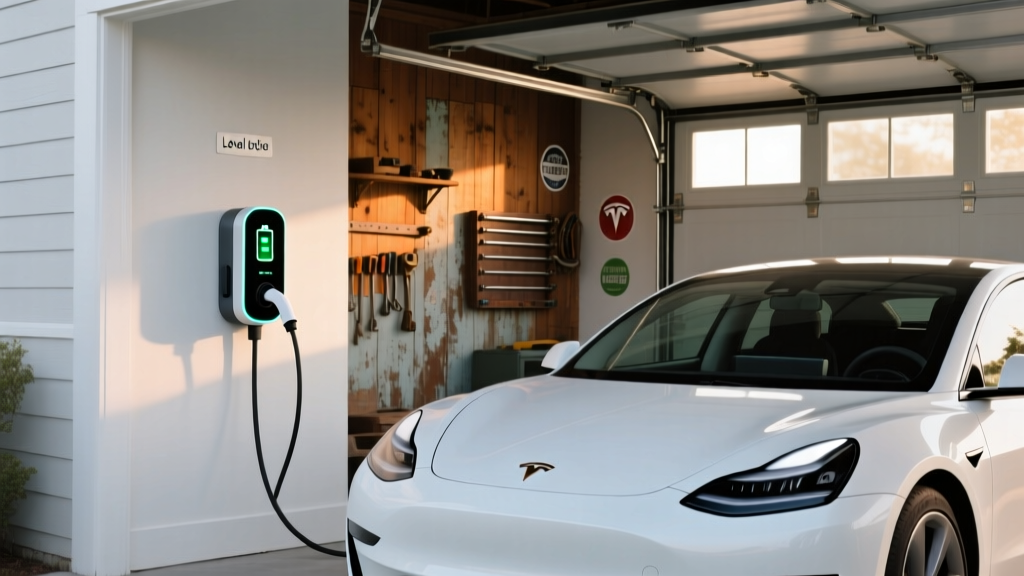
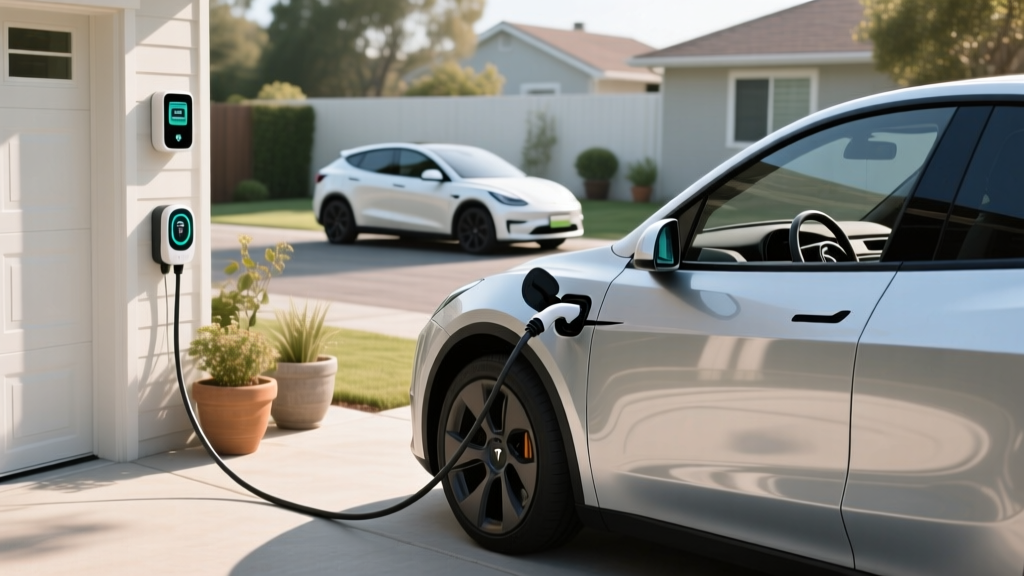
Installing a Level 2 home charger is the single highest-impact upgrade an EV owner can make. It turns charging from a chore into a non-event: plug in at night, wake up full. But costs vary enormously based on your home's electrical panel, the distance from panel to charger location, and local permitting.
Electrical Requirements for a Level 2 Charger
A typical Level 2 charger requires a dedicated 240V circuit. The most common configurations:
- NEMA 14-50 outlet (240V / 50A breaker, 40A continuous): Supports up to 9.6 kW. The most versatile option — you can unplug the charger and take it with you, or use the outlet for a welder or RV.
- Hardwired 60A circuit (240V / 48A continuous): Supports up to 11.5 kW. Required for higher-output chargers like the Tesla Wall Connector at full power. No plug — the unit is permanently wired.
- NEMA 6-20 outlet (240V / 20A breaker, 16A continuous): Supports ~3.8 kW. A budget option for smaller batteries or PHEVs with limited onboard charger capacity.
National Electrical Code (NEC) requires that continuous loads (anything running 3+ hours) use only 80% of the breaker rating. A 50A breaker therefore supports 40A continuous. An electrician will size the wire gauge accordingly — typically 6 AWG copper for 50A circuits, 4 AWG for 60A.
Panel Upgrade: The Hidden Cost
Many homes built before 2000 have 100A or 150A main service panels. Adding a 50A EV circuit to an already-loaded 100A panel may exceed capacity, especially if you run electric heat, an electric dryer, and an electric oven simultaneously. Your electrician will perform a load calculation per NEC Article 220. If you're over capacity, a panel upgrade to 200A (or even 400A for homes adding solar and heat pumps) may be required.
| Component | Simple Install (Panel Nearby, No Upgrade) | Complex Install (Long Run, Panel Upgrade) |
|---|---|---|
| Level 2 Charger Equipment | $400–$700 | $400–$700 |
| Electrical Permit | $50–$200 | $100–$300 |
| Electrician Labor (2–4 hrs simple / 6–12 hrs complex) | $300–$800 | $1,000–$2,500 |
| Wire, Conduit, Breaker, Materials | $100–$300 | $400–$1,200 |
| Panel Upgrade (if needed) | $0 | $1,500–$4,000 |
| Total | $850–$2,000 | $3,400–$8,700 |
Some utilities and states offer rebates of $250–$1,000 for home charger installation, and the federal Alternative Fuel Vehicle Refueling Property Credit (IRC §30C) covers up to 30% of equipment and installation costs, capped at $1,000 — though eligibility depends on whether you live in a qualifying census tract. Check current-year rules on irs.gov before claiming.
Connector Compatibility: NACS, CCS1, CHAdeMO, and What You Need
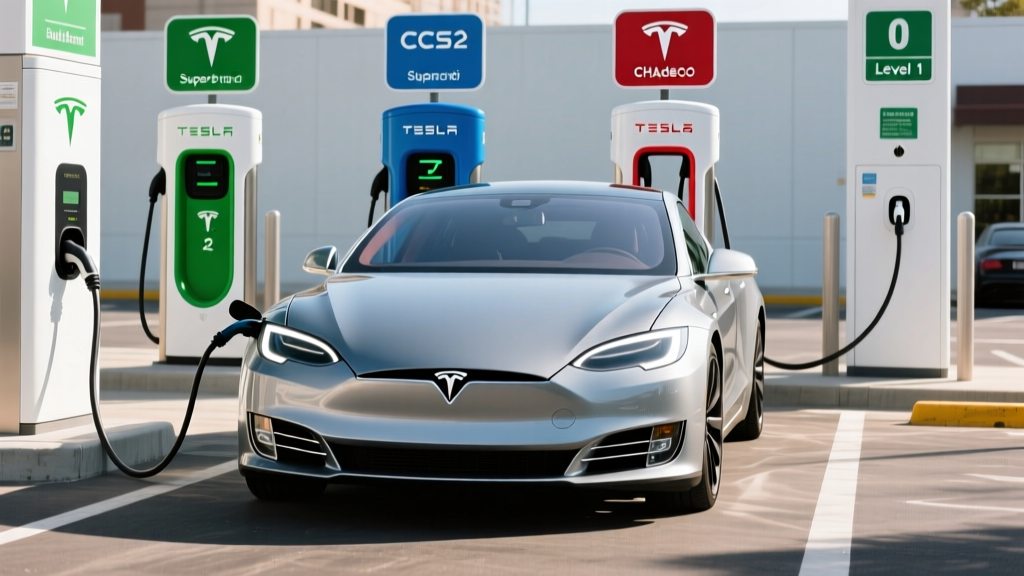
The North American charging connector landscape has consolidated rapidly since Tesla opened its proprietary connector as the North American Charging Standard (NACS) in late 2022. As of 2026, most new EVs from Ford, GM, Rivian, Volvo, Hyundai/Kia, and others ship with native NACS charge ports. Legacy CCS1 vehicles can access Tesla Superchargers via adapter, and Tesla owners can access CCS networks the same way.
| Connector | Native Vehicles | DC Fast Charge Networks | Adapter Needed? |
|---|---|---|---|
| NACS (Tesla) | Tesla (all), Ford, GM, Rivian, Hyundai, Kia, Volvo, Polestar, BMW, Mercedes (select) | Tesla Supercharger, Electrify America, EVgo, ChargePoint | No (native); CCS1→NACS adapter for legacy CCS vehicles (~$150–$250) |
| CCS1 | Legacy VW ID.4 (pre-2025), some older BMW i4/iX, older Hyundai/Kia models | Electrify America, EVgo, ChargePoint, Ionity (EU) | NACS→CCS adapter to use Superchargers (~$200) |
| CHAdeMO | Nissan Leaf (discontinued 2025), Mitsubishi Outlander PHEV (older) | Limited — declining network | No widely available adapter; CHAdeMO is being phased out |
For home Level 2 charging, the J1772 connector is the universal standard for non-Tesla EVs. Tesla vehicles use a proprietary port that also accepts J1772 via the included adapter. Most Level 2 home chargers ship with J1772 or NACS connectors — check your vehicle's port before ordering.
Cost to Charge: $/kWh Scenarios and Per-Mile Cost vs Gas
Electricity pricing varies by location, time of day, and whether you're charging at home or on a public DC fast charger. Here's how the math works for a Tesla Model Y Long Range averaging 3.5 miles per kWh (286 Wh/mi), which aligns with its EPA-rated efficiency.
| Scenario | $/kWh | Cost per Mile (at 3.5 mi/kWh) | Full "Tank" Cost (82 kWh, 10–100%) |
|---|---|---|---|
| Home Off-Peak (Time-of-Use rate) | $0.08–$0.12 | $0.023–$0.034 | $6.56–$9.84 |
| Home Standard Rate (national avg) | $0.16–$0.18 | $0.046–$0.051 | $13.12–$14.76 |
| Public Level 2 (workplace, mall) | $0.20–$0.35 | $0.057–$0.100 | $16.40–$28.70 |
| DC Fast Charger (Tesla Supercharger) | $0.28–$0.40 | $0.080–$0.114 | $22.96–$32.80 |
| DC Fast Charger (Electrify America, peak) | $0.35–$0.55 | $0.100–$0.157 | $28.70–$45.10 |
| Gas Vehicle (25 MPG combined, $3.40/gal) | — | $0.136 | $54.40 (equiv. 14.5 gal) |
The takeaway: home charging is 3–6× cheaper per mile than gasoline, even at standard residential rates. Public DC fast charging narrows the gap but still undercuts gas in most markets. If you have access to off-peak Time-of-Use (TOU) rates — commonly $0.06–$0.10/kWh overnight — the savings are dramatic. A full Model Y charge at $0.10/kWh costs about $8.20 for ~287 real-world miles.
How to Calculate Your Specific kWh Cost
The formula is simple:
Charge cost = Battery kWh needed × $/kWh rate
Example: Charging a Tesla Model Y from 20% to 80% (49.2 kWh needed, 60% of 82 kWh) at home on a $0.14/kWh rate = 49.2 × 0.14 = $6.89 for roughly 172 miles of range.
2026 Home Charger Equipment Recommendations
Based on power output, reliability, smart features, cable length, and connector options, here are four chargers that cover the most common EV ownership scenarios:
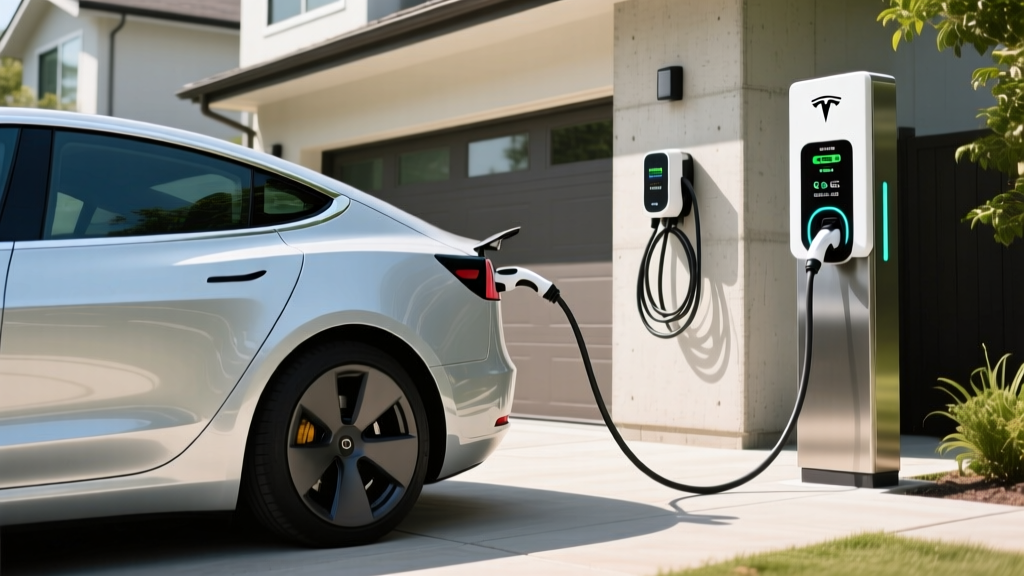
Tesla Wall Connector (Gen 4)
- Power: Up to 11.5 kW (48A hardwired) or 9.6 kW (NEMA 14-50, 40A)
- Connector: Native NACS; J1772 adapter available
- Cable: 24 ft
- Smart features: Wi-Fi, OTA updates, load sharing (pair two units on one circuit), access control, scheduling via Tesla app
- Price: ~$475 (unit only)
- Best for: Tesla owners wanting seamless integration; also charges any NACS-equipped EV
ChargePoint Home Flex (2nd Gen)
- Power: Up to 12 kW (50A, configurable 16–50A)
- Connector: J1772 standard; NACS adapter available
- Cable: 23 ft
- Smart features: Wi-Fi, ChargePoint app scheduling, Alexa integration, energy reporting, flexible amperage dial to match your circuit
- Price: ~$599
- Best for: Multi-EV households with J1772 and NACS vehicles; adjustable amperage avoids oversizing circuits
Emporia Level 2 EV Charger
- Power: Up to 11.5 kW (48A hardwired) or 9.6 kW (14-50 plug)
- Connector: J1772
- Cable: 24 ft
- Smart features: Wi-Fi, Emporia app, integrates with Emporia Vue energy monitor for whole-home load tracking, solar-aware scheduling
- Price: ~$399
- Best for: Budget-conscious buyers with solar panels who want detailed energy data
Grizzl-E Smart (United Chargers)
- Power: Up to 10 kW (40A) on NEMA 14-50; up to 11.5 kW hardwired
- Connector: J1772 or NACS (configurable at order)
- Cable: 24 ft
- Smart features: Wi-Fi, OCPP protocol support, app scheduling, durable aluminum enclosure rated for -40°F to +122°F
- Price: ~$499 (J1772) / ~$549 (NACS)
- Best for: Cold-climate garage or outdoor installs; Canadian-built durability
Safety, Code, and Installation Best Practices
EV charging involves sustained high-current loads — more like running an electric furnace than plugging in a phone charger. Cutting corners here risks fire, voided insurance, and failed inspections.
- Dedicated circuit: Your Level 2 charger must be on its own dedicated breaker. Never share a circuit with other high-draw appliances (dryer, oven, HVAC).
- GFCI protection: NEC 2023 (Article 625.54) requires GFCI protection for all receptacles used for EV charging, including NEMA 14-50 outlets. Hardwired installations are exempt from this specific requirement but must still meet all grounding rules. Note: some EVSE units have internal ground-fault protection — check with your electrician whether an external GFCI breaker is needed or could cause nuisance tripping.
- Outdoor rating: If your charger is mounted outside, it must carry a NEMA 4 (weatherproof) or NEMA 4X (corrosion-resistant) rating. All four chargers above meet this standard.
- Permit and inspection: Most US jurisdictions require an electrical permit for a new 240V circuit. The inspection ensures proper wire gauge, breaker sizing, grounding, and GFCI compliance. Skipping the permit risks insurance denial in the event of an electrical fire.
- EVSE vs outlet: A NEMA 14-50 receptacle offers flexibility (unplug and take your charger when you move) but must be installed with the correct strain relief and orientation. Hardwired units eliminate plug-receptacle wear and support higher amperage.
Frequently Asked Questions
How much does it cost to install a home EV charger?
A straightforward Level 2 installation with an adequate electrical panel and a short wire run typically costs $850–$2,000 total (equipment + electrician + permit). If your panel needs upgrading to 200A or the charger is far from the panel requiring long conduit runs, expect $3,400–$8,700. Always get a load calculation from a licensed electrician before committing.
How fast will each charging level add range?
Level 1 (120V) adds roughly 4–5 miles per hour — adequate for PHEVs with small batteries but painfully slow for a full-size BEV. Level 2 (240V, 32–48A) adds 25–40 miles per hour, easily replenishing a daily commute overnight. DC fast charging adds 175–1,000+ miles per hour at peak rates, but sustained averages are lower due to charge-curve tapering above 50–60% SoC.
Which connector and charger is compatible with my EV?
If you own a 2025–2026 Tesla, your vehicle has a native NACS port — use the Tesla Wall Connector or any NACS-equipped charger. If you own a Ford, GM, Rivian, Hyundai, or Kia EV from 2025+, most also have native NACS. Older CCS1 vehicles (pre-2025 VW ID.4, older BMW i4) need a CCS-to-NACS adapter (~$150–$250) to access Tesla Superchargers. For home Level 2, J1772 chargers work with all non-Tesla EVs and Teslas via the included J1772 adapter.
How much does charging cost per mile compared to gas?
At the US average residential electricity rate of ~$0.17/kWh and a Tesla Model Y averaging 3.5 mi/kWh, home charging costs roughly $0.049/mile. A comparable gas SUV at 25 MPG and $3.40/gallon costs $0.136/mile. That's a 64% per-mile savings with home charging. Public DC fast charging at $0.35/kWh still costs ~$0.10/mile — about 26% cheaper than gas.
What electrical upgrades might I need before installing a charger?
The most common upgrade is a panel replacement from 100A to 200A service, costing $1,500–$4,000. You may also need a new breaker slot (if your panel is full), upgraded service wires from the utility meter, or a sub-panel if the charger is in a detached garage. Some utilities offer free or discounted panel upgrades for EV adopters — check with your local provider. A licensed electrician's load calculation (typically $150–$300 if standalone) will determine exactly what's needed before you buy equipment.
Sources: EPA fuel economy data from fueleconomy.gov; IRS Alternative Fuel Vehicle Refueling Property Credit at irs.gov; manufacturer specifications from Tesla, Hyundai, and Ford press sites.