If you're researching the Hyundai Kona EV range, you've probably noticed the 2025-2026 Kona Electric's EPA-estimated 261 miles on the SEL trim. But range is only half the ownership equation — how you recharge that 64.8 kWh battery dictates your daily convenience, road-trip viability, and annual fuel spend. This guide maps every charging scenario Kona Electric owners face, from a standard 120V outlet to a 150 kW DC fast charger, with exact times, costs, and home-installation requirements.
Hyundai Kona Electric Range: EPA vs Real World
The current-generation Kona Electric (redesigned for 2024, carried into 2026) ships with a 64.8 kWh usable lithium-ion NMC battery pack powering a single front-mounted motor producing 201 horsepower and 188 lb-ft of torque. Here's how the EPA rates it and what you should actually expect:
EPA Combined: 261 miles (SEL/Preferred trims with 18" wheels)
Real-World Highway (70 mph, moderate temps): ~220–235 miles
Real-World Cold Weather (below 32°F, highway): ~180–205 miles
Real-World City/Mixed (mild temps, regen heavy): ~250–270 miles
Source: fueleconomy.gov. Cold-weather losses of 20-30% are typical for EVs without a heat pump; the Kona Electric includes a standard heat pump on Limited trims, which helps.
The Kona's combined efficiency rating of 112 MPGe (roughly 30 kWh/100 mi) is competitive with the Chevrolet Bolt EV and Nissan Ariya, though it trails the Tesla Model Y's ~28 kWh/100 mi. The key takeaway: plan your charging around ~210 miles of usable highway range, not the 261-mile sticker.
Charging Levels Explained: How Fast Each Adds Range
Before discussing equipment, let's clarify the single most important distinction in EV charging: kW (kilowatts) measures power — the rate of charging, while kWh (kilowatt-hours) measures energy — the battery's capacity. Think of kW as how fast water flows from a hose, and kWh as the size of the bucket. The Kona Electric's bucket holds 64.8 kWh.
| Level | Voltage | Max Power (kW) | Miles of Range Added per Hour | 0–100% Time | Best Use Case |
|---|---|---|---|---|---|
| Level 1 (120V) | 120V / 12A | ~1.4 kW | ~4–5 mi/hr | ~50–55 hours | Emergency / trickle top-off |
| Level 2 (240V) | 240V / 32–48A | 7.7–11.5 kW | ~26–38 mi/hr | ~6–8.5 hours | Daily home charging |
| DC Fast (CCS) | 400V DC | ~100 kW peak | ~180–220 mi/hr (peak) | 10–80% in ~43 min | Road trips / public charging |
DC fast-charging reality check: The Kona Electric peaks at roughly 100 kW on a CCS1 connector between 10% and 40% State of Charge (SoC). Above 60%, the charge curve tapers significantly — expect 50-60 kW from 60-80%, and under 25 kW above 85%. This is why we quote 10-80% times rather than 0-100%. Hyundai does not equip the Kona Electric with an 800V architecture (that's reserved for the Ioniq 5/6), so don't expect the sub-20-minute DC sessions those vehicles offer.
Home Charger Installation: Costs, Electrical Needs & Permits
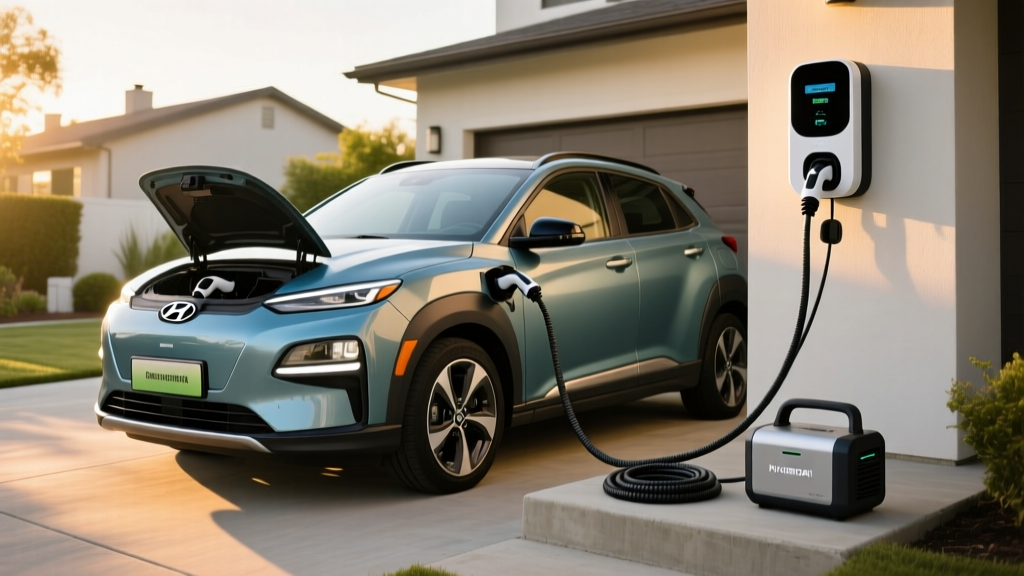
The Kona Electric's onboard charger accepts up to 11.5 kW on Level 2 (240V, 48A). To unlock that speed, you need a hardwired Level 2 EVSE (Electric Vehicle Supply Equipment) on a dedicated 60A circuit. Most homeowners install a 40A charger on a 50A breaker, which delivers 9.6 kW — still enough to fully replenish the Kona overnight in about 7 hours.
Electrical Requirements for Kona Electric Home Charging
- Minimum viable setup: 240V / 20A outlet (NEMA 6-20) = 3.8 kW, ~13 mi/hr. Functional but slow for daily use if you drive more than 50 miles per day.
- Recommended setup: 240V / 40A dedicated circuit with hardwired EVSE = 9.6 kW, ~32 mi/hr. Refills the full battery in ~7 hours.
- Maximum setup: 240V / 48A dedicated circuit (60A breaker) = 11.5 kW, ~38 mi/hr. Refills in ~5.5 hours. Requires a 200A electrical panel with available capacity.
Do You Need a Panel Upgrade?
This is the cost variable most online guides gloss over. If your home has a 100A service panel (common in pre-1990 construction), adding a 40A or 50A dedicated EV circuit may exceed your panel's capacity — especially if you already run electric dryer, oven, and HVAC loads. An electrician will perform a NEC Article 220 load calculation to determine headroom. If you need a panel upgrade to 200A, expect:
| Component | Low End | High End | Notes |
|---|---|---|---|
| Level 2 EVSE Equipment | $350 | $700 | 32A–48A smart chargers (Emporia, ChargePoint, Grizzl-E) |
| Electrician Labor (standard install) | $400 | $1,200 | Run 6 AWG copper, mount EVSE, install breaker. Varies by distance from panel. |
| Permit & Inspection | $50 | $300 | Required in most jurisdictions; ensures code compliance |
| Panel Upgrade (if needed) | $1,500 | $3,500 | 100A → 200A service upgrade. Not needed in most modern homes. |
| Total (no panel upgrade) | $800 | $2,200 | Typical for homes with 200A panel and garage near panel |
| Total (with panel upgrade) | $2,300 | $5,700 | Older homes needing full service upgrade |
Federal incentive: The IRS §30C credit covers 30% of home EV charger equipment and installation costs, up to $1,000, for equipment placed in service through 2025 (check current-year eligibility — this credit has specific census-tract requirements and may have changed for 2026). Consult a tax professional for your situation.
Which Connector and Charger Is Compatible with the Kona Electric?
The Hyundai Kona Electric sold in North America uses the CCS1 (Combined Charging System) connector for both Level 2 AC charging (the J1772 portion) and DC fast charging (the two additional DC pins below). However, the connector landscape shifted dramatically in 2024-2025 when most major automakers adopted Tesla's NACS (North American Charging Standard). Hyundai began transitioning to NACS on new models starting with 2025 model-year vehicles, but the Kona Electric sold through early 2026 retains CCS1 in most markets.
| Connector | Use | Kona Electric Support | Adapter Needed? |
|---|---|---|---|
| J1772 (Type 1 AC) | Level 1 & Level 2 public/home | ✅ Native (CCS1 upper portion) | No |
| CCS1 | DC Fast Charging | ✅ Native | No |
| NACS (Tesla) | Tesla Superchargers, newer public stations | ❌ Not native (current models) | Yes — CCS-to-NACS adapter (~$200–$250) |
| CHAdeMO | Legacy DC Fast (Nissan Leaf standard) | ❌ Not supported | No adapter available (different protocol) |
Practical advice: If you plan road trips using Tesla Superchargers (now open to non-Tesla EVs at many locations), budget ~$200–$250 for a certified CCS-to-NACS adapter from a reputable brand like Lectron or A2Z. Hyundai has also announced that future model-year Kona Electrics will ship with NACS natively, so confirm your vehicle's build date and connector type before purchasing an adapter. Check Hyundai's official specs for your exact model year.
Recommended Level 2 Home Chargers for the Kona Electric
Based on the Kona Electric's 11.5 kW onboard charger maximum, here are three proven Level 2 units that match its capabilities. All listed chargers use a J1772 connector (native to the Kona) and include smart features like Wi-Fi scheduling for off-peak utility rates.
Emporia Vue Level 2 EVSE — Best Value
- Power Output: 48A / 11.5 kW (hardwired) or 40A / 9.6 kW (NEMA 14-50 plug)
- Cable Length: 24 feet
- Smart Features: Wi-Fi, app-based scheduling, energy monitoring, solar integration
- Price: ~$399 (hardwired), ~$449 (plug-in)
- Why for Kona: Maximizes the Kona's 11.5 kW onboard charger at the lowest price point. Energy monitoring helps track charging cost per session.
ChargePoint Home Flex — Most Versatile
- Power Output: Adjustable 16A–50A / 3.8–12 kW (hardwired or plug-in)
- Cable Length: 23 feet
- Smart Features: Wi-Fi, Alexa integration, detailed app analytics, scheduled charging, utility demand-response compatible
- Price: ~$699
- Why for Kona: Adjustable amperage means you can set it to 40A for a 50A circuit or 48A for a 60A circuit — future-proofs your install. UL-listed and widely supported.
Grizzl-E Smart — Most Durable
- Power Output: 40A / 9.6 kW (NEMA 14-50) or 48A / 11.5 kW (hardwired)
- Cable Length: 24 feet
- Smart Features: Wi-Fi (Smart model), OCPP-compatible, extreme cold rated (-40°F)
- Price: ~$449 (Smart), ~$369 (non-smart)
- Why for Kona: Built in Canada for harsh climates — ideal if your Kona charges outdoors in freezing weather. Aluminum enclosure resists UV and impact.
Charging Cost: Kona Electric vs Gas Per Mile
The Kona Electric's efficiency of ~30 kWh/100 miles makes it one of the more affordable EVs to fuel. Here's how charging costs compare across scenarios, benchmarked against a gas-powered Hyundai Kona (28 MPG combined) at $3.40/gallon:
| Charging Scenario | Rate ($/kWh) | Cost to Fill 64.8 kWh | Cost per Mile | Annual Fuel Cost (12,000 mi) |
|---|---|---|---|---|
| Home Off-Peak (utility TOU rate) | $0.09 | $5.83 | $0.027 | $324 |
| Home Standard Rate | $0.14 | $9.07 | $0.042 | $504 |
| Public Level 2 (ChargePoint, EVgo L2) | $0.25 | $16.20 | $0.075 | $900 |
| DC Fast (Electrify America, EVgo) | $0.40 | $25.92 | $0.120 | $1,440 |
| Gas Kona (28 MPG, $3.40/gal) | — | $13.12 per gallon-equiv | $0.121 | $1,457 |
Key takeaway: Home charging at off-peak rates saves the average Kona Electric owner roughly $1,100–$1,130 per year compared to the gas Kona. Even at standard residential rates, the EV saves ~$950/year. However, if you rely exclusively on DC fast charging, your fuel costs effectively match gasoline — the economic advantage of an EV depends on consistent home or workplace Level 2 access.
Safety, Electrical Code & Installation Best Practices
Level 2 EV charging draws sustained high current for hours — this is not like plugging in a phone. The National Electrical Code (NEC) and your local jurisdiction have specific requirements:
- Dedicated circuit: Your EVSE must be on its own dedicated breaker — no sharing with other outlets or appliances.
- Breaker sizing: NEC requires the breaker to be rated at 125% of the continuous load. A 40A charger needs a 50A breaker; a 48A charger needs a 60A breaker.
- GFCI protection: The 2020 NEC (Article 625.54) requires GFCI protection for all receptacles used for EV charging. Hardwired EVSEs are exempt from this specific requirement, which is one reason electricians often recommend hardwiring.
- Outdoor rating: If your charger is mounted outside, ensure the EVSE carries a NEMA 4 or NEMA 4X rating (weatherproof). All three chargers recommended above meet this standard.
- Permit required: Most municipalities require an electrical permit for a new 240V circuit. The permit ensures an inspector verifies the work — this protects your home insurance coverage in the event of an electrical fire. Permits typically cost $50–$300 depending on jurisdiction.
- Wire gauge: 40A circuits require minimum 8 AWG copper; 48A circuits require 6 AWG copper. Aluminum wire is cheaper but requires larger gauge and is less common for EV installs.
Hire a licensed electrician. DIY 240V work on a dedicated circuit carries real fire and insurance-liability risk. A licensed electrician will pull the permit, perform the load calculation, and ensure the work passes inspection. Look for electricians certified by programs like EVITP (Electric Vehicle Infrastructure Training Program) for installers specifically trained in EV charging.
Frequently Asked Questions
How much does it cost to install a home EV charger for the Kona Electric?
Most homeowners pay between $800 and $2,200 for a complete Level 2 installation (equipment + electrician + permit) when no panel upgrade is needed. If your home has a 100A electrical panel and needs an upgrade to 200A, total costs can reach $2,300–$5,700. Always get 2-3 quotes from licensed electricians and verify they include permit costs.
How fast will each charging level add range to the Kona Electric?
Level 1 (120V) adds roughly 4-5 miles per hour — adequate only for overnight trickle charging if you drive under 40 miles daily. Level 2 (240V, 40A) adds ~32 miles per hour, fully replenishing the 261-mile battery overnight in about 7 hours. DC fast charging at peak (~100 kW) can add up to 220 miles per hour, but only in the 10-40% SoC window; expect a 10-80% session to take about 43 minutes.
Which connector and charger is compatible with my Kona Electric?
Current-model Kona Electrics use CCS1 (J1772 for AC, CCS combo for DC fast charging). For home Level 2 charging, any J1772-equipped EVSE will work natively. To use Tesla Superchargers (now open to non-Tesla EVs at select locations), you'll need a CCS-to-NACS adapter (~$200-$250). Confirm your specific model year's connector before purchasing adapters.
How much does charging the Kona Electric cost per mile vs gas?
At home off-peak rates ($0.09/kWh), the Kona Electric costs about $0.027 per mile — roughly 78% cheaper than the gas Kona at $0.121 per mile ($3.40/gal, 28 MPG). At standard home rates ($0.14/kWh), EV fuel cost is ~$0.042 per mile. Exclusive reliance on DC fast charging at $0.40/kWh brings costs to ~$0.12/mile, essentially matching gasoline.
What electrical upgrades might I need for a Level 2 charger?
If your home has a 200A electrical panel with available breaker slots and load capacity, you likely only need a new dedicated 50A or 60A breaker and a wire run to your garage or parking spot. Homes with 100A service, older wiring (knob-and-tube, aluminum), or panels near capacity may require a full service upgrade ($1,500-$3,500) before adding an EV circuit. A licensed electrician's load calculation will determine this upfront.
Does DC fast charging degrade the Kona Electric's battery faster?
Occasional DC fast charging has minimal impact on long-term battery health. However, exclusive reliance on DCFC (daily or near-daily) can accelerate degradation compared to Level 2 charging. Hyundai's battery warranty covers 10 years/100,000 miles with a capacity retention threshold (typically 70% of original capacity). To maximize longevity, favor Level 2 home charging for daily use and reserve DCFC for road trips. Avoid regularly charging to 100% or discharging below 10% for daily driving — the 20-80% SoC window is the battery's sweet spot.