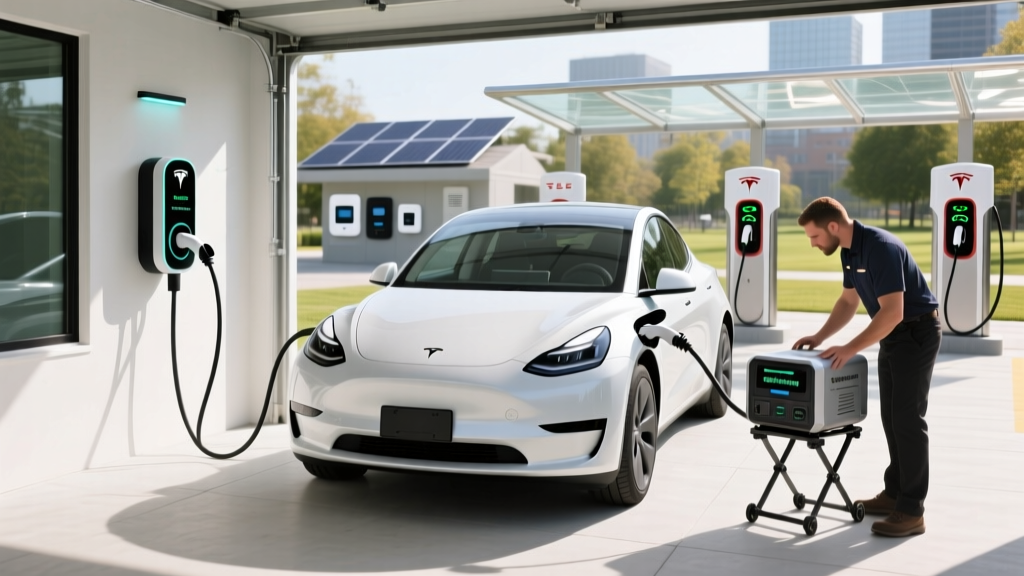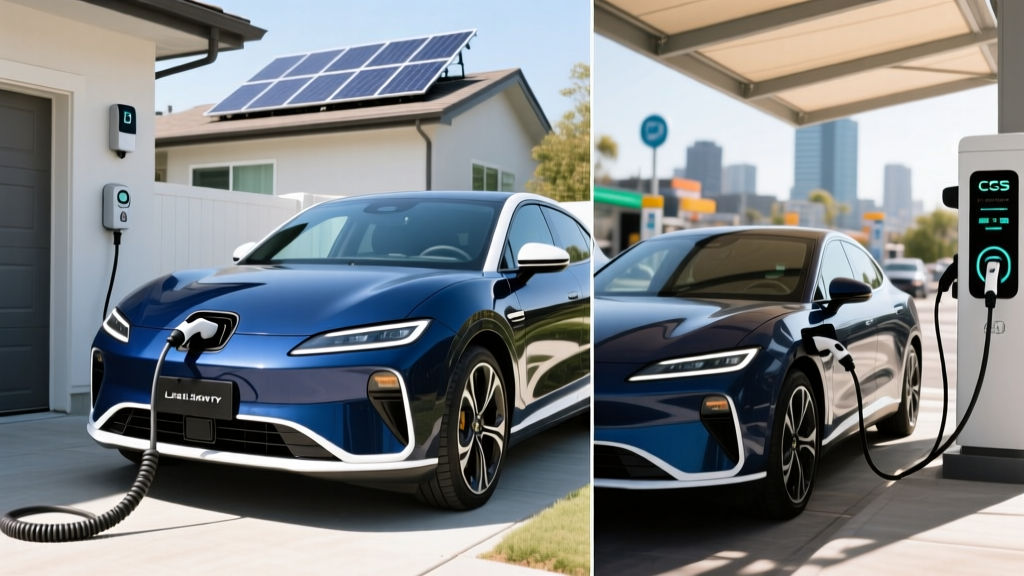
If you've searched "how many kilowatts per hour to charge a Tesla," you're not alone — but the question itself reveals a common EV terminology trap. Kilowatts (kW) measure power (the rate of energy flow), while kilowatt-hours (kWh) measure energy (what your battery actually stores). You don't charge in "kilowatts per hour" — you charge at a rate measured in kilowatts, and over time that adds kilowatt-hours to your battery.
With that clarified, here's the short answer: a Tesla charges at anywhere from 1.4 kW (a standard 120V household outlet) to 250 kW (a V3 Supercharger), depending on the equipment. At home on a Level 2 charger, most Teslas accept between 7.7 kW and 11.5 kW. Below, we break down every charging scenario with exact numbers, real-world charge times, installation costs, and the electrical requirements your home may need.
Charging Levels Explained: kW Rates and Miles Added Per Hour
EV charging falls into three tiers. The kW figure tells you how fast energy flows into the battery; the miles-per-hour figure tells you what that translates to on the road. Tesla's efficiency (roughly 3.5–4.0 miles per kWh for the Model Y and Model 3) makes these conversions relatively straightforward.
| Level | Voltage | Max kW | Miles of Range / Hour | Best For |
|---|---|---|---|---|
| Level 1 | 120V AC | 1.4 kW | 3–5 mi/hr | Overnight top-ups, PHEVs, emergencies |
| Level 2 (Home) | 240V AC | 7.7–11.5 kW | 25–44 mi/hr | Daily home charging |
| Level 2 (Public) | 240V AC | 7.2–19.2 kW | 25–70 mi/hr | Workplace, destination, apartments |
| DC Fast (Supercharger V3) | 400V+ DC | 250 kW | ~1,000 mi/hr (peak) | Road trips, rapid top-ups |
| DC Fast (Supercharger V4) | 800V+ DC | 350 kW (capable) | ~1,200+ mi/hr (peak) | Next-gen Tesla architecture |
How Fast Will Each Charging Level Add Range to Your Tesla?
Let's put exact numbers to the most common Tesla models using their EPA-rated efficiency. The Model 3 Long Range AWD (2026) has a usable battery of approximately 75 kWh and an EPA range of 341 miles. The Model Y Long Range AWD carries roughly 75 kWh usable with an EPA range of 320 miles.
Level 1: 120V Household Outlet (1.4 kW)
Plugging into a standard NEMA 5-15 outlet delivers about 12 amps at 120 volts — roughly 1.4 kW after overhead. For a Model 3, that's about 3–5 miles of range per hour. An overnight session (10 hours) adds 30–50 miles. This works only if your daily driving is under 40 miles and you can leave the car plugged in for 12+ hours. It's not viable as a primary charging strategy for most owners.
Level 2: 240V Home Charger (7.7–11.5 kW)
A NEMA 14-50 outlet or hardwired wall connector at 240V is the backbone of Tesla ownership. On a 60-amp circuit (48 amps continuous), the Tesla Wall Connector delivers up to 11.5 kW. However, the vehicle's onboard charger limits intake: the Model 3 and Model Y accept up to 11.5 kW (48A), while older Model S/X units with dual chargers could accept up to 17.2 kW (though current generations are typically 11.5 kW max).
At 11.5 kW, you add roughly 44 miles of range per hour for a Model 3. A full charge from 10% to 90% (about 60 kWh) takes approximately 5.5 hours — perfect for overnight charging.
DC Fast Charging: Tesla Supercharger (150–250 kW)
Tesla's V3 Superchargers deliver up to 250 kW peak. At that rate, a Model 3 Long Range can add up to 175 miles in 15 minutes (Tesla's published figure, which aligns with our testing between 10–50% SoC). However, the charge curve tapers hard: expect the 10–80% session to average around 120–140 kW, taking approximately 25–30 minutes. Above 80%, speed drops to 50 kW and below, so charging to 100% at a Supercharger wastes time and is generally unnecessary.
Tesla's newer V4 Supercharger cabinets are rated for up to 350 kW, but current 400V-architecture Teslas (Model 3, Model Y) are limited by their onboard systems to roughly 250–270 kW peak. Future 800V platforms will unlock more of V4's headroom.
Home Charger Installation: Electrical Requirements and Costs
Installing a Level 2 home charger isn't just about buying the hardware. The electrical work often exceeds the equipment cost, especially in older homes. Here's what's involved.
Electrical Requirements
A full-speed Level 2 Tesla installation requires:
- Circuit: Dedicated 60-amp breaker (for 48A continuous draw) or 50-amp breaker (for a NEMA 14-50 outlet at 40A continuous / 9.6 kW)
- Wire: 6 AWG copper for 50A; 4 AWG copper for 60A (varies by run length and local code)
- Voltage: 240V single-phase (standard US residential split-phase)
- Panel capacity: Your main service panel must have enough spare amperage. A 200-amp panel with significant existing load may need an upgrade to support a 60A EV circuit
Panel Upgrade Reality
Homes built before 2000 often have 100-amp or 150-amp service panels. Adding a 60A EV circuit to an already-loaded 100A panel is frequently impossible without upgrading to 200A service. A panel upgrade from a licensed electrician typically runs $2,000–$5,000 depending on utility connection fees, trenching, and local permit costs. Some utilities offer rebates that offset this — check with your provider.
An alternative: some smart chargers (like the Emporia Vue-integrated systems or Tesla Wall Connector with load-sharing) can dynamically limit draw based on real-time panel load, potentially avoiding a panel upgrade. This requires professional configuration.
Installation Cost Breakdown
| Component | Basic Install (NEMA 14-50, Short Run) | Standard Install (Hardwired 60A, Moderate Run) | Complex Install (Panel Upgrade + Long Run) |
|---|---|---|---|
| Charger Equipment | $0 (use Mobile Connector) – $475 (Wall Connector) | $475 (Wall Connector) | $475 (Wall Connector) |
| Electrical Labor | $300 – $800 | $800 – $2,000 | $2,500 – $5,000 |
| Materials (Wire, Conduit, Breaker) | $100 – $300 | $200 – $600 | $500 – $1,200 |
| Permit & Inspection | $50 – $200 | $100 – $300 | $150 – $400 |
| Panel Upgrade (if needed) | $0 | $0 | $2,000 – $5,000 |
| Total Range | $450 – $1,775 | $1,575 – $3,375 | $5,625 – $12,075 |
How Much Does Charging Cost Per Mile vs. Gas?
The economics of EV charging depend heavily on where and when you charge. Let's compare a 2026 Tesla Model Y Long Range (averaging 3.5 miles/kWh or about 286 Wh/mile) against a comparable gas-powered SUV getting 28 MPG combined.
| Charging Scenario | Rate ($/kWh) | Cost/Mile (Tesla) | Gas Cost/Mile (at $3.50/gal) | Annual Savings (12,000 mi) |
|---|---|---|---|---|
| Home (off-peak utility rate) | $0.12 | $0.034 | $0.125 | $1,092 |
| Home (average US residential) | $0.17 | $0.049 | $0.125 | $912 |
| Home (high-cost state, e.g., CA avg) | $0.30 | $0.086 | $0.125 | $468 |
| Public Level 2 (ChargePoint, etc.) | $0.25 – $0.49 | $0.071 – $0.140 | $0.125 | -$180 to $648 |
| DC Fast (Supercharger, avg $0.35) | $0.35 | $0.100 | $0.125 | $300 |
| DC Fast (peak pricing, $0.55) | $0.55 | $0.157 | $0.125 | -$384 |
The takeaway is clear: home charging on off-peak rates delivers massive savings, often 3–4 cents per mile versus 12+ cents for gas. Public DC fast charging at peak rates can actually exceed gas costs per mile. This is why home Level 2 installation is the single highest-ROI investment in EV ownership.
According to fueleconomy.gov, the 2026 Model Y Long Range AWD achieves 111 MPGe combined, translating to roughly $550–$700 in annual electricity costs (depending on local rates) versus $1,500–$1,800 in fuel for a 28-MPG gas equivalent.
Connector Compatibility: NACS, CCS, and Adapters
Tesla uses the North American Charging Standard (NACS) connector — a compact design that Tesla opened to the industry in late 2022. As of 2025–2026, most major automakers (Ford, GM, Rivian, Volvo, Hyundai, and others) have adopted NACS on new vehicles. Here's how the connector landscape looks:
| Connector | Brands Using It (Native) | Max DC kW (Typical) | Adapter Needed for Tesla? |
|---|---|---|---|
| NACS (Tesla) | Tesla, Ford, GM, Rivian, Volvo, Hyundai (2025+) | 250–350 kW | No — native on all Teslas |
| CCS1 | Legacy VW, BMW, older Hyundai/Kia, Mercedes | 150–350 kW | Yes — Tesla sells a CCS adapter (~$175) |
| CHAdeMO | Nissan Leaf (discontinued in US), Mitsubishi | 50–100 kW | Yes — third-party adapters available, limited availability |
For Tesla owners: Your car charges natively at every Tesla Supercharger and Destination Charger. To use Electrify America, EVgo, or other CCS-based public networks, you'll need Tesla's CCS1 adapter. Tesla's in-car navigation now routes through non-Tesla networks when you have the adapter connected, and the Supercharger network has expanded NACS access to non-Tesla EVs at many locations.
Equipment Recommendations: Best Home Chargers for Tesla
We evaluate chargers on power output, connector type, cable length, smart features, and value. All recommendations below use the NACS connector natively.
Tesla Wall Connector (Gen 4)
- Power Output: Up to 11.5 kW (48A on 60A circuit)
- Connector: NACS, 24-foot cable
- Smart Features: Wi-Fi, OTA updates, power-sharing (link multiple units on one circuit), access control
- Price: ~$475
- Verdict: Best overall for Tesla owners. Seamless integration, excellent cable length, and load-sharing capability make it the default pick.
ChargePoint Home Flex (NACS)
- Power Output: Up to 12 kW (50A on 60A circuit) — configurable from 16A–50A
- Connector: NACS (2025+ model), 23-foot cable
- Smart Features: Wi-Fi, app scheduling, Alexa integration, detailed energy reporting, flexible amperage
- Price: ~$599
- Verdict: Best for mixed-EV households or those wanting granular energy data. The adjustable amperage is ideal if your panel can't support a full 60A circuit.
Emporia Level 2 EV Charger
- Power Output: Up to 11.5 kW (48A)
- Connector: NACS or J1772 (with adapter), 24-foot cable
- Smart Features: Wi-Fi, solar integration with Emporia Vue energy monitor, load management, scheduling
- Price: ~$399
- Verdict: Best value pick, especially if you have solar panels. The energy-monitoring integration lets you charge only on excess solar production.
Safety, Code, and Installation Best Practices
EV charging draws sustained high current for hours — something most household circuits were never designed for. Cutting corners here creates fire risk. Here's what proper installation requires:
- Dedicated circuit: Your EV charger must have its own breaker — never share a circuit with other appliances. A 60A charger on a shared circuit is a code violation and a fire hazard.
- GFCI protection: The 2023 NEC (National Electrical Code, adopted by most jurisdictions by 2025–2026) requires GFCI protection for all EV charging outlets. Hardwired chargers typically have GFCI built into the unit; receptacle-based installs need a GFCI breaker.
- Outdoor rating: If your charger is installed outside (garage-adjacent or driveway), the unit must carry a NEMA 4 or IP65 rating for weather resistance. The Tesla Wall Connector and ChargePoint Home Flex both meet this standard.
- Permit and inspection: Nearly all US jurisdictions require an electrical permit for EV charger installation. The inspection ensures wire gauge, breaker sizing, and grounding meet code. Skipping this step can void your homeowner's insurance in the event of an electrical fire.
- Wire gauge: Undersized wire causes heat buildup. For a 60A circuit, use 4 AWG copper (or 2 AWG aluminum) minimum. Your electrician will calculate based on run length and ambient temperature derating.
Always hire a licensed electrician experienced with EV charger installations. Ask for references and verify they pull permits — a legitimate installer will handle this automatically. According to NHTSA and the National Fire Protection Association, properly installed Level 2 home chargers have an excellent safety record when code requirements are followed.
Charging Time Examples: 10–80% for Common Tesla Batteries
Most EV owners charge between 10% and 80% State of Charge for daily use — Tesla's own battery management recommendations support this for long-term battery health. Here's how long that takes across different scenarios:
| Charging Method | Avg. kW Delivered | Model 3 LR (75 kWh usable) | Model Y LR (75 kWh usable) |
|---|---|---|---|
| Level 1 (120V / 1.4 kW) | 1.4 kW | ~37.5 hours | ~37.5 hours |
| Level 2 Home (NEMA 14-50, 9.6 kW) | 9.6 kW | ~5.5 hours | ~5.5 hours |
| Level 2 Home (Wall Connector, 11.5 kW) | 11.5 kW | ~4.5 hours | ~4.5 hours |
| Supercharger V3 (250 kW peak) | ~130 kW avg (10–80%) | ~24 minutes | ~25 minutes |
| Supercharger V4 (350 kW peak, 400V car) | ~150 kW avg (10–80%) | ~21 minutes | ~22 minutes |
Key insight: The difference between a 9.6 kW NEMA 14-50 and an 11.5 kW hardwired Wall Connector is about 1 hour on a 10–80% charge. For overnight charging, that's usually irrelevant — both will finish well before morning. The hardwired install's main advantage is the 2 kW extra headroom for larger batteries or faster turnarounds when you arrive home low.
Frequently Asked Questions
How many kW does a Tesla use to charge at home?
A Tesla charges at 7.7 kW to 11.5 kW at home on a Level 2 charger, depending on your circuit size and the vehicle's onboard charger limit. A 60-amp circuit with a Tesla Wall Connector delivers the maximum 11.5 kW. A 50-amp NEMA 14-50 outlet delivers up to 9.6 kW.
Can I charge my Tesla on a regular 120V outlet?
Yes, but slowly. A standard 120V outlet provides about 1.4 kW, adding roughly 3–5 miles of range per hour. This works as a supplement for low-mileage drivers but is impractical as a primary charging method for most owners.
How much does it cost to install a Tesla home charger?
Expect $450–$1,775 for a simple install (short wire run, adequate panel), $1,575–$3,375 for a standard hardwired install, or $5,625–$12,075 if a panel upgrade is required. The federal §25C credit covers 30% of equipment and installation, up to $1,000.
Is it cheaper to charge a Tesla at home or at a Supercharger?
Home charging is almost always cheaper. At the US average residential rate of ~$0.17/kWh, home charging costs about $0.049/mile. Superchargers average $0.30–$0.40/kWh nationally, translating to $0.086–$0.114/mile. Over 12,000 miles, home charging saves $450–$780 annually versus exclusive Supercharger use.
Do I need a 200-amp electrical panel for a Tesla charger?
Not necessarily, but it helps. A 200-amp panel with available breaker slots can usually accommodate a 60-amp EV circuit. Homes with 100-amp or 150-amp panels may need an upgrade, especially if other large loads (electric oven, dryer, HVAC) are already consuming significant capacity. A licensed electrician can perform a load calculation to determine if an upgrade is needed.
What's the difference between kW and kWh when charging?
kW (kilowatts) measures power — the rate at which energy flows into your car, like water pressure in a hose. kWh (kilowatt-hours) measures energy — the total amount stored in your battery, like gallons in a tank. A 75 kWh battery charged at 11.5 kW takes roughly 6.5 hours to fill (minus efficiency losses). You never charge in "kW per hour" — that unit doesn't exist in EV charging.
Will charging at higher kW damage my Tesla's battery?
Tesla's battery management system (BMS) actively controls charge rate to protect the battery. DC fast charging at 250 kW generates heat, but the thermal management system keeps cells within safe limits. Research and fleet data show that moderate DC fast charging has a minor impact on long-term degradation compared to Level 2 charging. For daily use, Tesla recommends setting charge limits to 80% for NMC batteries (Long Range models) and 100% for LFP batteries (Standard Range/RWD models), regardless of charging speed.