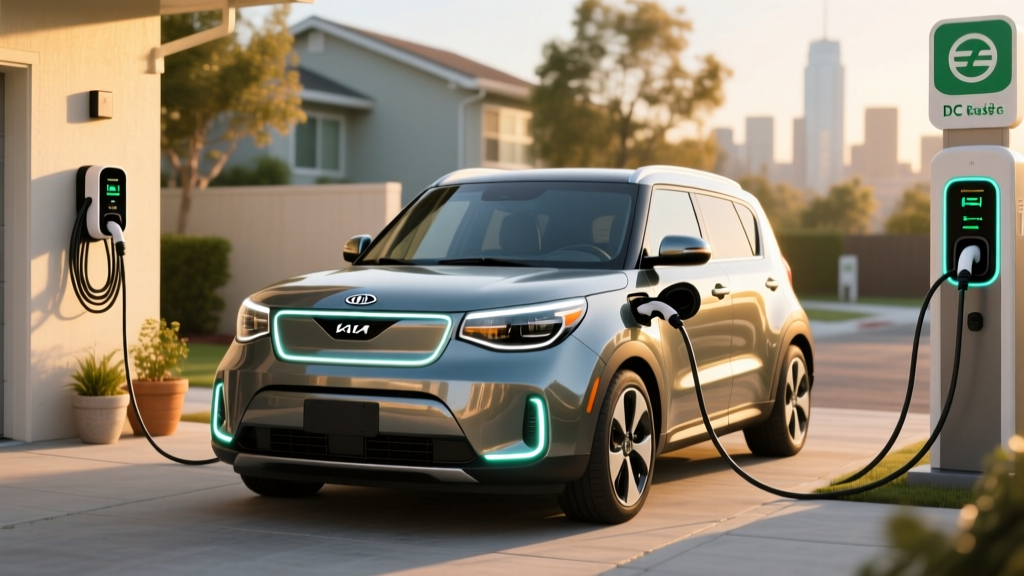
If you own or are considering a Kia Soul EV, understanding its real-world range and charging behavior is the difference between confident daily driving and frustrating range management. The Soul EV's 64 kWh battery delivers an EPA-estimated 243 miles, but actual range depends heavily on driving style, temperature, and charging infrastructure. This guide breaks down exactly what to expect — and how to charge it efficiently at home and on the road.
Kia Soul EV Range: EPA Sticker vs. Real-World Reality
Real-World Highway (70 mph): ~200–220 miles
Cold Weather (below 32°F): ~170–190 miles
City/Stop-and-Go: ~250+ miles (regen-heavy driving)
The Kia Soul EV's 64 kWh usable battery (lithium-ion polymer, NMC chemistry) achieves 120 MPGe combined according to fueleconomy.gov. That translates to roughly 28 kWh/100 miles in mixed driving.
Highway driving at sustained speeds reduces range by 10–15% due to aerodynamic drag. Cold weather compounds this — expect 20–30% range loss when temperatures drop below freezing, especially if you're using cabin heating without preconditioning. The Soul EV's heat pump (standard on 2020+ models) mitigates some cold-weather loss, but physics wins in extreme conditions.
Charging Levels Explained: Speed, Time, and What You'll Actually Get
| Level | Power (kW) | Miles Added/Hour | 10-80% Time | Best For |
|---|---|---|---|---|
| Level 1 (120V) | 1.4 kW | 4–5 miles | ~45 hours | Emergency/trickle only |
| Level 2 (240V) | 7.2 kW (max) | 22–25 miles | ~7–8 hours | Daily home charging |
| DC Fast (CCS) | 77 kW (peak) | 150+ miles (first 20 min) | ~54 minutes | Road trips |
Important: The Kia Soul EV's onboard charger maxes at 7.2 kW on Level 2. Even if you install a 48A (11.5 kW) home charger, the car will only draw 7.2 kW. That's ~32 amps at 240V. DC fast charging peaks at 77 kW on CCS-equipped models (2020+), but expect the charge curve to taper significantly above 60% state of charge — the final 20% (60-80%) takes nearly as long as the first 50%.
Home Charger Installation: Cost Breakdown and Electrical Requirements
| Component | Cost Range | Notes |
|---|---|---|
| Level 2 Charger (32A–48A) | $350–$700 | Hardwired or NEMA 14-50 plug |
| Electrician Labor | $400–$1,200 | Depends on panel proximity, conduit run |
| Electrical Permit | $50–$200 | Varies by municipality |
| Panel Upgrade (if needed) | $1,500–$3,500 | 100A → 200A service |
| Total (no panel upgrade) | $800–$2,100 | Typical install |
| Total (with panel upgrade) | $2,300–$5,600 | Older homes, 100A service |
Electrical Requirements: A 40-amp circuit (32A continuous draw) is ideal for the Soul EV's 7.2 kW max. This requires a 240V dedicated circuit with 8 AWG copper wire (or 6 AWG aluminum). If your electrical panel is maxed out or you have 100-amp service, a panel upgrade to 200A may be necessary — a $1,500–$3,500 expense that catches many buyers off guard.
Safety & Code: NEC 625 requires a dedicated circuit for EV charging. Outdoor installations need a NEMA 4-rated (weatherproof) enclosure or hardwired connection with appropriate conduit. GFCI protection is required for receptacle-based installations in garages and all outdoor locations.
Connector Compatibility: What Fits the Kia Soul EV?
| Connector Type | Kia Soul EV (2020+) | Adapter Needed? |
|---|---|---|
| CCS1 (Combo) | ✓ Standard | No |
| CHAdeMO | ✗ Not compatible | N/A |
| NACS (Tesla) | ✗ Not native | Yes — CCS-to-NACS adapter ($200–$300) |
| J1772 (Level 2) | ✓ Standard | No |
The 2020+ Kia Soul EV uses CCS1 for DC fast charging and J1772 for Level 2. Tesla Supercharger access requires a CCS-to-NACS adapter — Kia does not include one, but third-party options from Lectron or A2Z exist. Tesla's Magic Dock (built into some Superchargers) allows CCS vehicles to charge without an adapter at select locations.
Charging Cost: $/kWh Scenarios and Cost Per Mile vs. Gas
| Charging Scenario | $/kWh | Cost for 243 miles (full) | Cost Per Mile |
|---|---|---|---|
| Home (off-peak, avg US) | $0.13 | $8.32 | $0.034 |
| Home (peak, high-cost state) | $0.28 | $17.92 | $0.074 |
| Public Level 2 (ChargePoint, EVgo) | $0.35–$0.50 | $22.40–$32.00 | $0.092–$0.132 |
| DC Fast (Electrify America, EVgo) | $0.45–$0.65 | $28.80–$41.60 | $0.119–$0.171 |
| Gas Car (25 MPG, $3.50/gal) | — | $34.02 | $0.140 |
Home charging on off-peak rates delivers the lowest cost per mile — roughly 75% cheaper than gasoline. Public DC fast charging narrows the gap, especially in high-cost states like California or Massachusetts. For Soul EV owners with home Level 2 access, annual fuel savings vs. a 25 MPG gas car average $800–$1,200 (assuming 12,000 miles/year).
Equipment Recommendations: Level 2 Chargers for the Kia Soul EV
ChargePoint Home Flex (32A–50A)
Power: 7.7–12 kW (Soul EV limited to 7.2 kW)
Cable: 23 ft
Connector: J1772
Smart Features: Wi-Fi, app scheduling, energy tracking
Price: $549
Why: Adjustable amperage, UL-listed, reliable app
Emporia Level 2 EV Charger (48A)
Power: 11.5 kW (Soul EV limited to 7.2 kW)
Cable: 24 ft
Connector: J1772
Smart Features: Wi-Fi, solar integration, load management
Price: $399
Why: Budget-friendly, excellent energy monitoring
Grizzl-E Smart (40A)
Power: 9.6 kW (Soul EV limited to 7.2 kW)
Cable: 24 ft
Connector: J1772
Smart Features: Wi-Fi, OCPP-compatible, outdoor-rated
Price: $499
Why: Built for cold climates, -40°C rated, durable
All three chargers exceed the Soul EV's 7.2 kW ceiling, which is fine — the car draws only what it needs. A 32A or 40A circuit is sufficient; there's no benefit to installing a 48A circuit for this specific vehicle unless you plan to upgrade to a higher-power EV later.
Frequently Asked Questions
How much does it cost to install a home EV charger for my Kia Soul EV?
Expect $800–$2,100 for a standard installation (charger + electrician + permit) if your electrical panel has capacity. Homes with 100-amp service may need a $1,500–$3,500 panel upgrade, pushing total cost to $2,300–$5,600.
How fast will each charging level add range to the Soul EV?
Level 1 (120V): ~4–5 miles per hour. Level 2 (240V, 32A): ~22–25 miles per hour. DC Fast (CCS, 77 kW peak): ~150+ miles in the first 20 minutes, tapering significantly above 60% state of charge.
Which connector and charger is compatible with my Kia Soul EV?
The 2020+ Soul EV uses CCS1 for DC fast charging and J1772 for Level 2. Any J1772 Level 2 charger works. For Tesla Supercharger access, you'll need a CCS-to-NACS adapter ($200–$300).
How much does charging cost per mile vs. gas?
Home off-peak charging costs ~$0.034/mile. Public DC fast charging costs $0.12–$0.17/mile. A 25 MPG gas car at $3.50/gallon costs $0.14/mile. Home charging delivers 75% savings; public fast charging is roughly comparable to gas.
What electrical upgrades might I need for a home charger?
A 40-amp, 240V dedicated circuit is required. If your panel is at capacity or you have 100-amp service, a panel upgrade to 200A may be necessary ($1,500–$3,500). Older homes with knob-and-tube or aluminum wiring may need additional upgrades.
Real-World Charging Tips for Kia Soul EV Owners
Precondition before DC fast charging: Use the Soul EV's navigation to route to a charger — the car will warm the battery, enabling faster charge rates. Cold batteries charge significantly slower, sometimes cutting peak kW in half.
Charge to 80%, not 100%: The Soul EV's charge curve tapers dramatically above 80%. That final 20% can take 30+ minutes on DC fast charging. For daily driving, 80% is plenty and preserves battery longevity.
Time-of-use rates matter: If your utility offers off-peak rates (typically 10 PM–6 AM), schedule charging via your Level 2 charger's app. The difference between peak and off-peak can be 2–3x.
Cold-weather strategy: Plug in whenever parked in freezing temperatures. The Soul EV can use grid power to maintain battery temperature, preserving range for actual driving rather than battery heating.