The Kia Niro EV remains one of the most practical, affordable electric crossovers on the market, but understanding its real-world range and charging behavior is the difference between loving EV ownership and feeling stuck. In this guide, we break down the Niro EV's 2026 specifications, what to expect from each charging level, and exactly what it takes to set up fast, reliable home charging — including the electrical upgrades older homes often need.
The Real-World Kia Niro EV Range: EPA vs. Reality
The 2026 Kia Niro EV carries an EPA-estimated range of 239 miles on a full charge, powered by a 64.8 kWh (usable) lithium-ion NMC battery pack. That figure is competitive in the sub-$45,000 electric crossover segment, but EPA estimates assume a mix of city and highway driving at moderate temperatures. Here is what you should actually plan for:
Real-World Highway (70 mph): ~205–220 miles
Real-World Cold Weather (below 32°F): ~170–195 miles
Combined Mixed Driving (typical owner): ~215–230 miles
Source: fueleconomy.gov
Cold weather reduces range because the battery must expend energy on thermal management and cabin heating. The Niro EV uses a heat pump on higher trims (EX and above), which recovers waste heat from the powertrain and significantly reduces winter range loss compared to resistive heating. If you live in a northern climate, the heat pump is worth prioritizing.
Efficiency is rated at 113 MPGe combined (28 kWh/100 miles). For context, that means every 10 miles of driving consumes roughly 2.8 kWh of energy — a useful number for calculating charging costs later.
Charging Levels Explained: Speeds, Times & Range Added
EV charging is measured in kilowatts (kW), which represents the rate of energy delivery — distinct from kilowatt-hours (kWh), which measures the total energy capacity stored in the battery. Think of kW as the speed of water flowing through a hose and kWh as the size of the bucket you are filling.
| Level | Voltage | Power (kW) | Miles of Range per Hour | Best For |
|---|---|---|---|---|
| Level 1 | 120V | 1.0–1.4 kW | 3–5 mi/hr | Overnight top-ups, emergencies |
| Level 2 | 240V | 3.3–11.5 kW | 12–40 mi/hr | Daily home charging |
| DC Fast | 400V+ | 50–85 kW (Niro peak) | 150–240 mi/hr (peak) | Road trips, quick top-ups |
Niro EV Charging Times by Level
With a 64.8 kWh battery, here is how long each method takes:
- Level 1 (120V, 1.4 kW): 0–100% in approximately 46–50 hours. Useful only for adding 30–40 miles overnight.
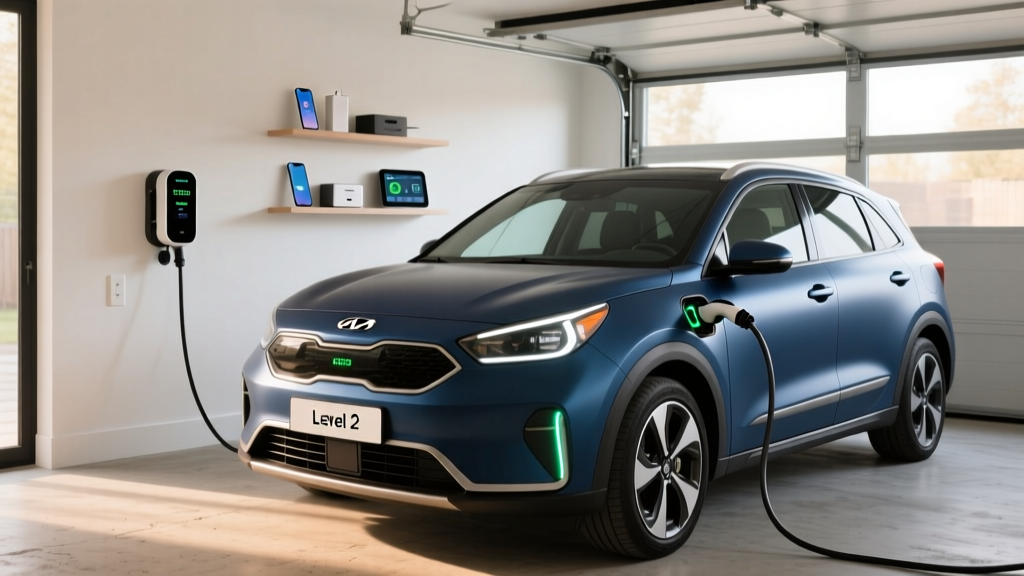
- Level 2 (240V, 7.2 kW): 0–100% in approximately 9.5 hours. A full overnight charge from near-empty.
- Level 2 (240V, 11 kW): 0–100% in approximately 6.5 hours. The Niro EV's onboard charger maxes out at 11 kW on 2026 models.
- DC Fast Charging (peak 85 kW): 10–80% in approximately 45 minutes. Note that charge speed tapers significantly above 80% to protect battery health.
The Niro EV's DC fast-charging curve peaks at roughly 85 kW between 10–40% State of Charge (SoC), then gradually steps down. By 60% SoC, expect roughly 60 kW; by 80%, approximately 35–40 kW. This tapering is normal for all lithium-ion batteries and is why manufacturers quote 10–80% times rather than 0–100%.
Home Charger Installation: Costs, Electrical Requirements & Panel Upgrades
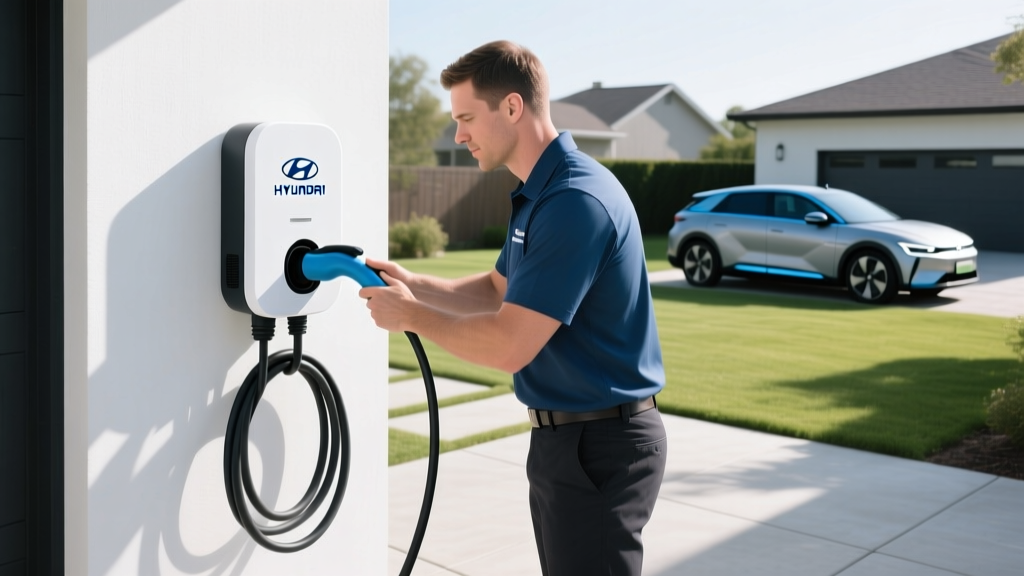
Installing a dedicated Level 2 home charger is the single highest-impact upgrade for EV ownership. Here is what the Niro EV needs and what it will cost.
Electrical Requirements
A Level 2 charger delivering 7.2 kW requires a 240V circuit rated for 40 amps (the charger itself draws 30 amps continuously; the National Electrical Code requires the circuit to be rated at 125% of continuous load). For a full 11 kW charge — matching the Niro's onboard charger maximum — you need a 240V/60A circuit (48A continuous draw).
Key considerations:
- Panel capacity: Your electrical panel must have room for a new double-pole breaker (40A or 60A). Many older homes with 100A service may need a panel upgrade to 200A, especially if you already run electric heat, a dryer, and an oven.
- Dedicated circuit: EV chargers must be on their own dedicated circuit — never shared with other appliances.
- GFCI protection: NEC 2020 and later requires GFCI protection for EV charging outlets in garages and all outdoor locations.
- Outdoor rating: If your charger mounts outside, both the unit and the receptacle (NEMA 14-50 or hardwired junction) must carry a weatherproof rating (NEMA 3R or 4).
Installation Cost Breakdown
| Item | Typical Cost Range | Notes |
|---|---|---|
| Level 2 Charger (Equipment) | $350–$700 | Smart Wi-Fi chargers with cable management |
| Electrician Labor (standard install) | $500–$1,500 | Run conduit, wire, breaker; 2–4 hours typical |
| Electrical Permit | $50–$200 | Required in most jurisdictions; varies by city/county |
| Panel Upgrade (if needed) | $1,500–$3,500 | 100A → 200A upgrade; older homes most affected |
| Total (no panel upgrade) | $900–$2,400 | Most homeowners fall in this range |
| Total (with panel upgrade) | $2,400–$5,900 | Significant but a one-time infrastructure investment |
Always hire a licensed electrician and pull a permit. Unpermitted electrical work can void homeowner's insurance and create fire risk. Some utilities offer rebates of $250–$500 for Level 2 charger installation — check with your local provider.
Connector Compatibility: What Plugs Into the Niro EV?
The 2026 Kia Niro EV sold in North America uses the CCS1 (Combined Charging System) connector for both Level 2 AC charging and DC fast charging. However, the EV industry is rapidly transitioning to the NACS (North American Charging Standard, originally Tesla's connector), and Kia has announced that future models will adopt NACS natively.
| Connector | Used By | Niro EV Compatible? | Adapter Needed? |
|---|---|---|---|
| CCS1 | Kia, Hyundai, VW, BMW, GM (legacy), Ford (legacy) | Yes — native | No |
| NACS (Tesla) | Tesla, Ford (2025+), GM (2025+), Rivian, Volvo, Kia (future) | Via adapter | Yes — CCS1-to-NACS adapter (~$150–$250) |
| CHAdeMO | Nissan Leaf, Mitsubishi (legacy) | No | N/A — increasingly rare |
| J1772 | All EVs (Level 2 AC only) | Yes — CCS1 includes J1772 | No |
For Niro EV owners in 2026, CCS1 remains the native plug and works at Electrify America, EVgo, and most non-Tesla public chargers. If you want access to Tesla Superchargers that have opened to non-Tesla vehicles, you will need a CCS1-to-NACS adapter. Confirm adapter compatibility with your specific model year before purchasing.
Charging Cost Per Mile: Niro EV vs. Gas
One of the strongest ownership arguments for the Niro EV is fuel cost savings. Here is how electricity costs compare to gasoline, based on the Niro's efficiency of 28 kWh/100 miles:
| Scenario | Rate | Cost per kWh | Cost per Mile | Cost for 1,000 Miles |
|---|---|---|---|---|
| Home Off-Peak (utility rate) | $0.12/kWh | $0.12 | $0.034 | $34 |
| Home Average (national) | $0.17/kWh | $0.17 | $0.048 | $48 |
| Public Level 2 (network) | $0.30/kWh | $0.30 | $0.084 | $84 |
| DC Fast Charging (EA/EVgo) | $0.45/kWh | $0.45 | $0.126 | $126 |
| Gas Comparable Crossover | 30 MPG avg, $3.40/gal | — | $0.113 | $113 |
Home charging on an off-peak rate is the clear winner — roughly one-third the per-mile cost of a comparable gas crossover at 30 MPG. Even public DC fast charging is only marginally more expensive than gasoline per mile. If you can charge at home 80%+ of the time, annual fuel savings versus a gas vehicle typically run $800–$1,400 depending on mileage and local rates.
Check whether your utility offers a time-of-use (TOU) rate plan. Charging between 10 PM and 6 AM on a TOU plan can drop your effective rate to $0.08–$0.10/kWh in some regions.
Best Home Chargers for the Kia Niro EV (2026 Recommendations)
The Niro EV's 11 kW onboard charger means you can take full advantage of a 48-amp Level 2 charger. Here are three proven options:
ChargePoint Home Flex
- Power Output: Up to 12 kW (50A circuit, 40A continuous) — configurable down to 16A
- Connector: J1772 (CCS1-compatible)
- Cable Length: 23 feet
- Smart Features: Wi-Fi, app scheduling, Alexa integration, energy tracking
- Price: ~$549
- Verdict: Best all-around for Niro EV owners. Flexible amperage lets you match your circuit exactly. UL-listed and widely recommended by electricians.
Emporia Level 2 EV Charger
- Power Output: Up to 11.5 kW (60A circuit, 48A continuous)
- Connector: J1772
- Cable Length: 24 feet
- Smart Features: Wi-Fi, real-time energy monitoring via Emporia Vue integration, solar-aware scheduling
- Price: ~$399
- Verdict: Best value. Matches the Niro's 11 kW onboard charger perfectly. Ideal if you already use Emporia home energy monitoring.
Grizzl-E Smart
- Power Output: Up to 11.5 kW (60A circuit, 48A continuous)
- Connector: J1772
- Cable Length: 24 feet
- Smart Features: Wi-Fi, OCPP-compatible, adjustable amperage (16A–48A), built-in GFCI
- Price: ~$499
- Verdict: Best for outdoor/cold-climate installs. IP67-rated enclosure and Canadian-built durability. Built-in GFCI simplifies code compliance in some jurisdictions.
All three chargers are hardwired or NEMA 14-50 plug compatible. Hardwired installations eliminate the receptacle as a potential failure point and are preferred for 48A+ circuits.
Federal Tax Credit & Incentives for Home Charging
Under the IRS §30D clean vehicle credit, the Niro EV's eligibility for the full $7,500 federal tax credit depends on battery component sourcing, critical mineral requirements, MSRP caps (under $55,000 for SUVs), and buyer income limits ($150,000 single / $300,000 joint). The credit can now be transferred to the dealer at point of sale as an instant discount. Always verify current-year eligibility at irs.gov before purchasing, as sourcing rules tighten annually.
Separately, the Alternative Fuel Vehicle Refueling Property Credit (§30C) can cover up to 30% of home charger equipment and installation costs (up to $1,000) if you live in an eligible census tract. This credit applies through 2032. Consult a tax professional for your specific eligibility.
Niro EV Quick Specs
| Specification | 2026 Kia Niro EV |
|---|---|
| EPA Range | 239 miles |
| Battery Capacity (Usable) | 64.8 kWh, NMC |
| Efficiency | 113 MPGe / 28 kWh/100 mi |
| Max DC Fast Charge Rate | 85 kW (peak) |
| 10–80% DC Fast Charge Time | ~45 minutes |
| Onboard Charger (Level 2) | 11 kW max |
| Level 2 0–100% Time | ~6.5 hours (at 11 kW) |
| Horsepower | 201 hp / 291 lb-ft torque |
| 0–60 mph | ~7.0 seconds |
| Base MSRP (Wind) | ~$39,600 |
| Battery/Powertrain Warranty | 10 years / 100,000 miles |
Frequently Asked Questions
How much does it cost to install a home EV charger for the Kia Niro EV?
Expect $900–$2,400 for a standard Level 2 installation (equipment, electrician labor, and permit) if your electrical panel has sufficient capacity. If your home needs a 100A-to-200A panel upgrade, add $1,500–$3,500. Always get at least two quotes from licensed electricians.
How fast will each charging level add range to the Niro EV?
Level 1 (120V) adds 3–5 miles per hour. Level 2 (240V at 11 kW) adds roughly 37 miles per hour. DC fast charging at peak 85 kW can add approximately 150+ miles in 30 minutes, though the rate tapers above 60% SoC.
Which connector is compatible with the Kia Niro EV?
The Niro EV uses CCS1 natively for both Level 2 and DC fast charging. For Tesla Supercharger access (where available to non-Tesla vehicles), you will need a CCS1-to-NACS adapter. CHAdeMO is not compatible.
How much does charging the Niro EV cost per mile compared to gas?
Home charging at $0.12–$0.17/kWh costs roughly $0.03–$0.05 per mile. A comparable gas crossover at 30 MPG and $3.40/gallon costs about $0.11 per mile. Home charging saves $600–$1,000+ per year for a typical driver covering 12,000 miles.
What electrical upgrades might my home need for a Level 2 charger?
The most common upgrade is a panel replacement from 100A to 200A service ($1,500–$3,500). You may also need a new conduit run from the panel to the garage or driveway (adds $200–$800 depending on distance), and a GFCI breaker ($50–$120). An electrician can assess your panel during a free or low-cost site visit.
Does the Kia Niro EV support vehicle-to-load (V2L)?
No. The current Niro EV does not include V2L capability, unlike the larger Kia EV6 and EV9. You cannot use the Niro's battery to power external devices or home appliances.
What is the Niro EV battery warranty?
Kia covers the high-voltage battery and electric powertrain for 10 years or 100,000 miles, whichever comes first. The warranty guarantees the battery will retain a minimum capacity threshold (typically 70% of original capacity) during the coverage period. Kia warranty details.
Final Takeaway
The Kia Niro EV's 239-mile EPA range is sufficient for the vast majority of daily driving and moderate road trips when paired with a reliable home Level 2 charger. Budget $1,000–$2,500 for a professional home installation, choose a quality 48-amp smart charger, and take advantage of off-peak utility rates to keep your cost per mile well below gasoline. The Niro EV's 10-year battery warranty provides strong long-term peace of mind, and its sub-$40,000 starting price — potentially reduced by federal and state incentives — makes it one of the most accessible entry points into EV ownership in 2026.