Real-World Kia Niro EV Range: What the EPA Sticker Doesn't Tell You
The 2026 Kia Niro EV carries over its 64.8 kWh usable battery (NMC chemistry) and holds an EPA-estimated 239 miles of range. That number is useful as a baseline, but real-world efficiency depends heavily on conditions. In our experience, highway driving at 70+ mph yields roughly 205–220 miles before you're hunting for a plug. Add winter temperatures below freezing, and that figure can drop to 175–190 miles due to cabin heating demands and reduced battery chemistry efficiency.
The Niro EV's combined efficiency rating sits at 113 MPGe (roughly 29 kWh/100mi). If your commute is mostly suburban at 35–50 mph with liberal use of regenerative braking, you can stretch past the EPA number to around 250 miles. The point: range is a variable, not a guarantee, and your charging setup at home is what makes daily EV ownership effortless regardless of where the battery gauge lands.
- EPA estimate: 239 miles (combined city/highway)
- Real-world highway (70 mph): ~205–220 miles
- Real-world cold weather (below 32°F): ~175–190 miles
- Optimal suburban driving: ~240–255 miles
Charging Levels Explained: How Fast Will Each Add Range?
Before we talk hardware, let's separate kW from kWh — the single most common EV confusion. A kilowatt-hour (kWh) is a unit of energy, like a gallon of gas. The Niro EV's battery holds 64.8 kWh when full. A kilowatt (kW) is a unit of power — how fast energy flows into that battery, like the flow rate of a gas pump nozzle. Higher kW means faster charging, but only up to the vehicle's acceptance rate.
| Level | Voltage | Max Power (kW) | Miles Added per Hour | Niro EV Use Case |
|---|---|---|---|---|
| Level 1 | 120V AC | 1.2–1.4 kW | ~4–5 miles/hr | Overnight top-up, low-mileage drivers |
| Level 2 | 240V AC | 7.2–11.5 kW | ~25–42 miles/hr | Daily home charging, full overnight refill |
| DC Fast | 400V+ DC | Up to 77 kW (Niro max) | ~180–220 miles/hr (peak) | Road trips, rapid top-ups |
The Niro EV's onboard charger accepts up to 11 kW on Level 2 AC. That means a full 0–100% charge at home takes roughly 6.5 hours on a 48A circuit, or about 9 hours on a 32A circuit. On DC fast charging, the Niro peaks around 77 kW — adequate but not class-leading. A 10–80% DC fast charge takes approximately 43–45 minutes. The charge curve tapers noticeably above 60% state of charge (SoC), which is why we recommend charging to 80% on road trips and moving on rather than waiting for the last 20%.
How Much Does It Cost to Install a Home EV Charger?
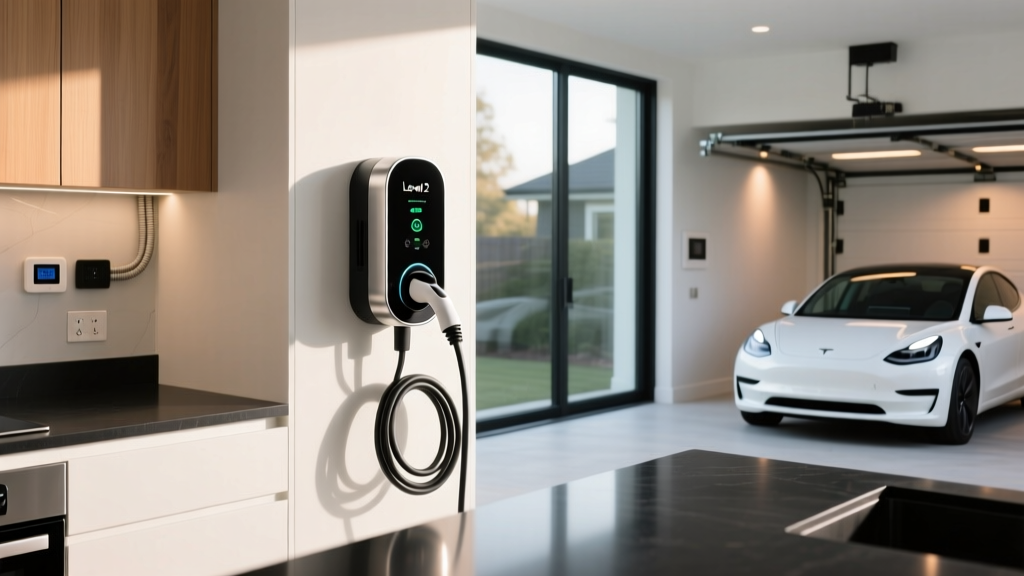
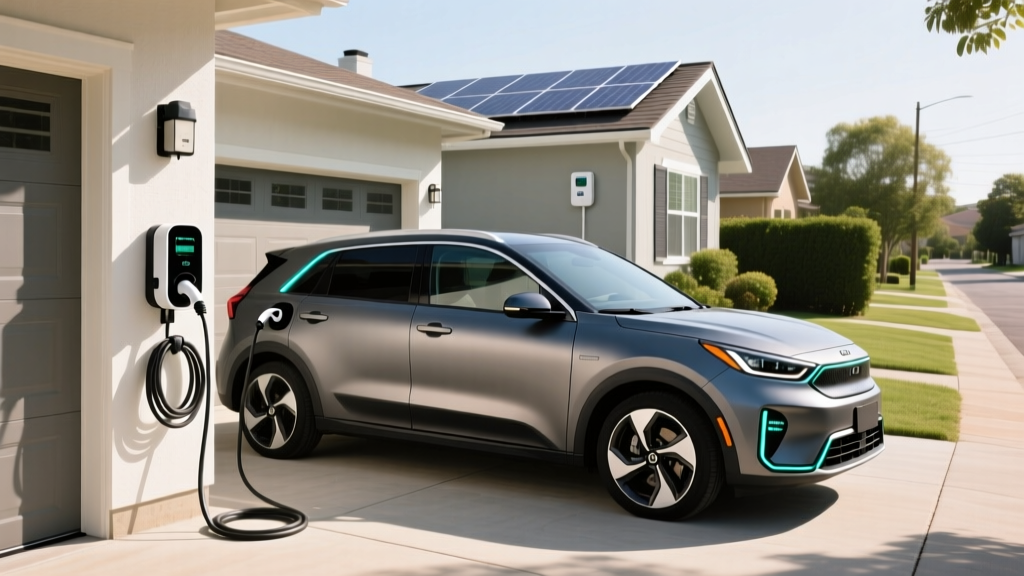
Home charging is where the Niro EV shines economically. Plug in overnight, wake up to 200+ miles every morning, and rarely think about range again. But installation costs vary widely depending on your home's electrical infrastructure.
| Component | Typical Range | Notes |
|---|---|---|
| Level 2 EVSE hardware | $300–$700 | Smart chargers (Wi-Fi, scheduling) cost more |
| Electrician labor (standard install) | $400–$1,200 | Depends on run length from panel to garage |
| Electrical permit | $50–$200 | Required in most jurisdictions |
| Panel upgrade (if needed) | $1,500–$3,500 | Homes with 100A service may need 200A upgrade |
| Total (no panel upgrade) | $750–$2,100 | Most homes with 200A service fall here |
| Total (with panel upgrade) | $2,250–$5,600 | Older homes, pre-1990s construction |
The Niro EV's 11 kW onboard charger pairs best with a 48A hardwired Level 2 station on a dedicated 60A circuit. If your electrical panel is close to the garage (within 20–30 feet of wire run), expect to pay on the lower end. A long conduit run through a finished basement or crawlspace pushes costs toward $1,500+ in labor alone.
Panel upgrade reality: If your home has a 100-amp main panel — common in homes built before 1990 — adding a 60A EV circuit may exceed safe load capacity. A licensed electrician will perform a load calculation per NEC Article 220. If you're over 80% of panel capacity, a 200A upgrade is required. This is the single biggest surprise cost for new EV owners in older homes.
Connector Compatibility: NACS, CCS1, and Adapter Needs
The 2026 Kia Niro EV ships with a CCS1 (Combined Charging System) port for both Level 2 AC and DC fast charging in North America. However, the industry is rapidly shifting toward Tesla's NACS (North American Charging Standard) connector, and Kia has begun offering NACS ports on some 2026 models. Check your specific vehicle — if yours has CCS1, you'll need an adapter to access Tesla Superchargers.
| Connector | Used By | Niro EV Compatibility | Adapter Needed? |
|---|---|---|---|
| CCS1 | Kia, Hyundai, VW, BMW, Ford (legacy) | Native (most 2026 Niros) | No — native port |
| NACS (Tesla) | Tesla, Ford, GM, Rivian, and expanding | Via adapter or native (select trims) | Yes — CCS1-to-NACS adapter (~$200–$250) |
| CHAdeMO | Nissan Leaf (legacy), Mitsubishi | Not compatible | N/A — no adapter available |
| J1772 | All EVs (Level 2 AC only) | Native (top portion of CCS1) | No — built into CCS1 inlet |
The practical implication: with a CCS1-to-NACS adapter, Niro EV owners gain access to Tesla's Supercharger network — over 25,000 stalls in North America — which dramatically expands road-trip charging options. Without the adapter, you're limited to Electrify America, EVgo, ChargePoint, and other CCS1 networks, which vary in reliability by region. We consider the adapter a worthwhile $200–$250 investment for any Niro EV owner who plans road trips.
Cost to Charge: Niro EV Per-Mile Cost vs. Gas
Charging economics are where the Niro EV makes its strongest case against a comparable gas-powered Kia Niro (which gets roughly 30 MPG combined). The Niro EV consumes about 29 kWh per 100 miles. Here's what that costs in different scenarios:
| Scenario | Rate ($/kWh) | Cost per 100 Miles | Cost per Mile |
|---|---|---|---|
| Home, off-peak (utility time-of-use) | $0.09 | $2.61 | $0.026 |
| Home, standard residential rate | $0.16 | $4.64 | $0.046 |
| Public Level 2 (ChargePoint, etc.) | $0.25–$0.35 | $7.25–$10.15 | $0.07–$0.10 |
| DC Fast (Electrify America, EVgo) | $0.35–$0.55 | $10.15–$15.95 | $0.10–$0.16 |
| Gas baseline (30 MPG, $3.40/gal) | — | $11.33 | $0.113 |
Home charging at off-peak rates saves roughly 75% per mile compared to gasoline. Even at standard residential rates, the Niro EV costs less than half per mile to fuel. The caveat: exclusive reliance on DC fast charging at $0.48/kWh pushes per-mile costs above gas. This is why home Level 2 charging is economically essential — it's where the savings live.
For a driver covering 12,000 miles annually, home charging at $0.12/kWh costs roughly $417 per year. The equivalent gas cost at 30 MPG and $3.40/gallon is $1,360 — a yearly savings of approximately $940.
Recommended Home Chargers for the Kia Niro EV
Since the Niro EV accepts up to 11 kW on Level 2, you want a charger that can deliver at least 48A (11.5 kW at 240V) to maximize charging speed. Here are three proven options we recommend:
ChargePoint Home Flex (NACS or J1772)
- Power output: Up to 12 kW (50A) — adjustable down to 16A
- Connector: NACS or J1772 (J1772 plugs into Niro's CCS1 inlet for AC)
- Cable length: 23 feet
- Smart features: Wi-Fi, app scheduling, utility demand-response, energy tracking
- Price: ~$550–$650
- Why it works: Flexible amperage lets you match your circuit capacity; excellent app
Emporia Level 2 EV Charger
- Power output: Up to 11.5 kW (48A)
- Connector: J1772 (fits Niro CCS1 AC inlet)
- Cable length: 24 feet
- Smart features: Wi-Fi, solar integration, real-time energy monitoring, scheduling
- Price: ~$350–$400
- Why it works: Best value for a 48A smart charger; pairs well with solar panels
Grizzl-E Smart (United Chargers)
- Power output: Up to 10 kW (40A)
- Connector: J1772 or NACS
- Cable length: 24 feet
- Smart features: Wi-Fi, OCPP support, adjustable amperage, extreme cold rated (-40°F)
- Price: ~$450–$550
- Why it works: Built in Canada for harsh winters; rugged outdoor performance
All three chargers are NEMA 14-50 plug-in or hardwired. We recommend hardwiring for circuits above 40A — it eliminates the plug as a potential failure point and satisfies NEC requirements for continuous loads above 40A on a receptacle.
Safety, Electrical Code, and Installation Requirements
EV charging is a continuous electrical load, meaning the National Electrical Code (NEC) requires the circuit to be rated at 125% of the charger's maximum draw. A 48A charger needs a 60A circuit with appropriately sized wire (6 AWG copper or 4 AWG aluminum in most jurisdictions). Here's what to verify:
- Dedicated circuit: Your EV charger must be on its own circuit — no sharing with dryers, ovens, or HVAC.
- GFCI protection: NEC 2020 and later requires GFCI protection for EV receptacles. Hardwired installations may be exempt in some jurisdictions — ask your electrician.
- Outdoor rating: If your charger is mounted outside (driveway, carport), the unit must carry a NEMA 4 or IP65 weather resistance rating. All three chargers above qualify.
- Permit and inspection: Most municipalities require an electrical permit for EV charger installation. The inspection ensures code compliance and protects your homeowner's insurance coverage. Budget $50–$200 and 1–3 weeks for the process.
- Load calculation: Your electrician should perform an NEC Article 220 load calculation before installation. If your panel is near capacity, options include a panel upgrade, a load-management device (like the Emporia Smart Panel or Span smart breaker panel), or reducing charger amperage.
Never use an extension cord or adapter to plug a Level 2 charger into a standard 120V outlet or undersized circuit. The sustained high current of EV charging can overheat inadequate wiring, creating a fire hazard.
Niro EV Charging FAQ
How long does it take to fully charge a Kia Niro EV at home?
On a 48A Level 2 charger (11.5 kW), a fully depleted 64.8 kWh battery reaches 100% in approximately 6–6.5 hours. On a 32A charger (7.7 kW), expect about 9 hours. Most owners arrive home with 40–60% battery remaining, so a full overnight charge takes 3–4 hours in practice.
Can I charge the Niro EV at a Tesla Supercharger?
Yes, if you purchase a CCS1-to-NACS adapter (approximately $200–$250 from brands like Lectron or A2Z). Tesla has opened many Supercharger stalls to non-Tesla CCS1 vehicles via adapter. Check the Tesla app for compatible stall locations near you. Note that some Supercharger cables may be short for the Niro's charge port location — positioning matters.
Does the Kia Niro EV qualify for the federal tax credit?
The IRS §30D clean vehicle credit offers up to $7,500 for qualifying new EVs, but eligibility depends on MSRP caps (under $55,000 for SUVs like the Niro EV), buyer income limits ($150,000 single / $300,000 joint AGI), and battery critical-mineral and component sourcing requirements. These rules change frequently — verify current-year eligibility on irs.gov and consult a tax professional. As of 2026, the credit can be transferred to the dealer at point of sale for an instant price reduction.
What's the Niro EV's DC fast charging speed on a road trip?
The Niro EV peaks at approximately 77 kW on DC fast charging, tapering to around 50 kW by 60% SoC and dropping further above 80%. A 10–80% session takes about 43–45 minutes at a compatible 100+ kW station. This is slower than competitors like the Hyundai Ioniq 5 (which peaks at 240 kW on 800V architecture) but acceptable for drivers who plan 45-minute breaks on road trips.
How does cold weather affect Niro EV range and charging?
Below 32°F, expect 20–30% range reduction due to cabin heating loads and reduced battery chemistry efficiency. DC fast charging also slows significantly when the battery is cold — preconditioning (available via the Kia Connect app) warms the battery before you arrive at a charger, restoring near-normal charge speeds. Always precondition before DC fast charging in cold weather.
Is a panel upgrade required for Level 2 home charging?
Not always. Homes with 200A service and available capacity usually accommodate a 48A–60A EV circuit without upgrades. Homes with 100A service, or those already running multiple high-draw appliances (electric range, dryer, HVAC, water heater), often require a 200A panel upgrade costing $1,500–$3,500. Your electrician's load calculation will determine this.