The Kia Niro EV remains a practical entry point into electric ownership, offering a usable 64.8 kWh battery pack and an EPA-estimated range of 239 miles. However, achieving that range and keeping the vehicle charged efficiently depends entirely on your charging strategy. Whether you are relying on a standard 120V wall outlet or installing a dedicated Level 2 station, understanding the relationship between power (kW) and energy (kWh) is essential for Niro owners.
Real-World Range and Efficiency Expectations
While the EPA sticker says 239 miles, real-world conditions rarely match laboratory tests. The Niro EV's efficiency is rated at 113 MPGe combined (roughly 29 kWh/100 miles). In mixed driving at 65-70 mph, expect to see closer to 205-220 miles of range. Cold weather (below 40°F) can reduce that figure by 15-25% due to battery resistance and cabin heating demands. To maintain maximum range, owners should focus on consistent Level 2 charging at home, which is gentler on the battery's long-term health than frequent DC fast charging.
Real-World Highway (70 mph): ~210 miles
Cold Weather (30°F): ~180-190 miles
Charging Levels: Speeds and Range Added
Charging speed is measured in kilowatts (kW), while your battery capacity is measured in kilowatt-hours (kWh). Think of kW as the flow rate of a hose and kWh as the size of the bucket. The 2024-2026 Kia Niro EV features an 11 kW onboard charger for Level 2 and supports up to 85 kW via DC Fast Charge.
| Level | Power (kW) | Voltage/Amps | Miles of Range per Hour | 10-80% Time |
|---|---|---|---|---|
| Level 1 (Trickle) | 1.4 kW | 120V / 12A | ~4-5 miles | ~35+ hours |
| Level 2 (Home) | 11 kW (Max) | 240V / 48A | ~32-38 miles | ~6 hours |
| DC Fast Charge | 85 kW (Peak) | 400V+ DC | ~200+ miles | ~43 minutes |
Home Charger Installation and Electrical Requirements
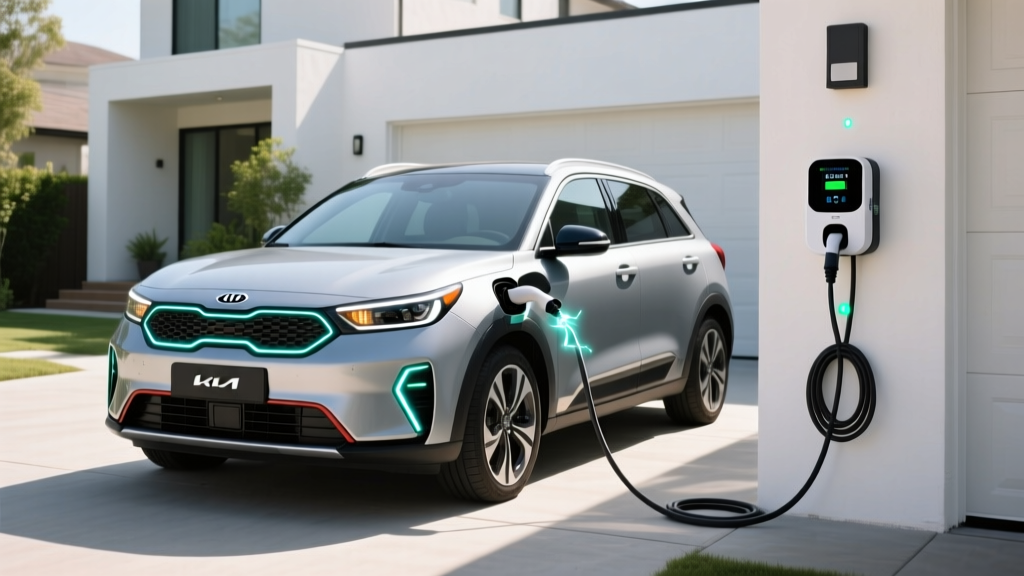
To unlock the Niro EV's full 11 kW AC charging capability, you need a 48-amp Level 2 charger on a dedicated 60-amp circuit. Most older homes with 100-amp electrical panels may require a service upgrade to 200 amps to accommodate this load alongside other major appliances. Installation costs vary widely based on the distance from the panel to the garage and whether conduit is required.
How much does it cost to install a home EV charger?
For a standard installation where the panel is near the garage, expect to pay between $600 and $1,200 for labor and permits, plus the cost of the hardware. If a panel upgrade is necessary, add $1,500-$3,000 to the total.
| Component | Typical Cost Range | Notes |
|---|---|---|
| Level 2 Charger (40A-48A) | $350 - $700 | Smart/Wi-Fi enabled models cost more |
| Electrician Labor (240V) | $500 - $1,500 | Based on $85-$150/hr and run length |
| Permit & Inspection | $50 - $250 | Required by most local codes |
| Panel Upgrade (Optional) | $1,500 - $3,500 | Needed if capacity is below 150-200A |
Connector Compatibility: NACS vs. CCS1
The Kia Niro EV currently uses the CCS1 connector for DC fast charging and the J1772 connector for Level 2 AC charging. As the industry shifts toward the North American Charging Standard (NACS), Kia has announced that future models will adopt the Tesla-style port. For now, Niro owners can access the Tesla Supercharger network using a NACS-to-CCS adapter, though these can cost between $200 and $300 and may slightly reduce peak charging speeds.
| Network | Native Connector | Niro EV Compatibility |
|---|---|---|
| Electrify America / EVgo | CCS1 | Direct Plug-in |
| Tesla Supercharger | NACS | Requires Approved Adapter |
| Public Level 2 | J1772 | Direct Plug-in |
Charging Costs: Electricity vs. Gasoline
One of the primary advantages of the Niro EV is the low cost of "fuel." At a national average residential electricity rate of $0.16/kWh, a full charge from empty costs roughly $10.37. This translates to about $0.04 per mile. By comparison, a 30-MPG gas car at $3.50/gallon costs roughly $0.12 per mile.
| Scenario | Cost per kWh/Gallon | Cost per Mile |
|---|---|---|
| Home Charging (Off-Peak) | $0.12 / kWh | $0.035 |
| Public DC Fast (EA/EVgo) | $0.45 / kWh | $0.13 |
| Gas Vehicle (30 MPG) | $3.50 / Gallon | $0.12 |
Recommended Equipment for the Niro EV
To maximize the 11 kW onboard charger, we recommend a 48-amp hardwired station. While plug-in units (NEMA 14-50) are convenient, hardwired units avoid the potential for outlet overheating and provide a cleaner install.
Emporia Vue 2 + EV Charger
Power: 48A (11.5 kW)
Features: Energy monitoring, solar integration, 24ft cable.
Price: ~$400
ChargePoint Home Flex
Power: Up to 50A (12 kW)
Features: Wi-Fi scheduling, NEMA 14-50 or hardwire, 23ft cable.
Price: ~$699
Safety and Code Considerations
All installations must follow NEC Article 625. For outdoor installations, ensure the charger is NEMA 4-rated for water resistance. GFCI protection is required for all receptacle-based (plug-in) charging stations. We strongly recommend using a licensed electrician who specializes in EVSE (Electric Vehicle Supply Equipment) to ensure your warranty remains valid and your home insurance is not compromised.
Frequently Asked Questions
Does the Kia Niro EV support 800V ultra-fast charging?
No. The Niro EV uses a 400V architecture, which limits its peak DC charge rate to roughly 85 kW. This is slower than the 230+ kW speeds seen on the Kia EV6 or Hyundai Ioniq 5.
How long does a Level 2 charge take from 0-100%?
Using an 11 kW Level 2 charger, a fully depleted 64.8 kWh battery will take approximately 6.5 to 7 hours to reach 100%.
Can I use a standard 120V outlet for daily charging?
Yes, but it will only add about 40 miles of range over a 10-hour overnight session. This is only practical if your daily commute is under 30 miles.