Kia Niro EV Charging: What You Need to Know Before You Plug In
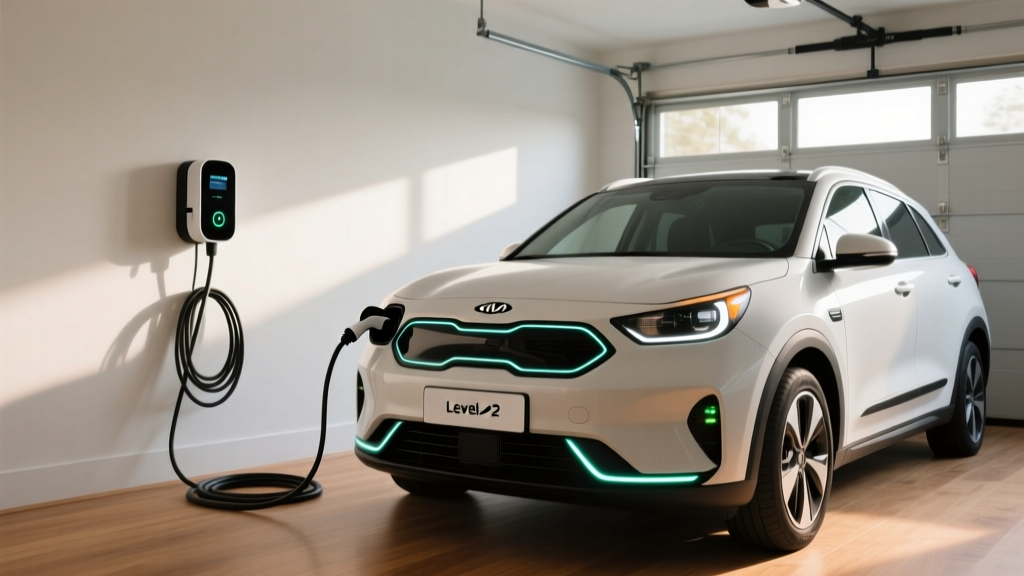
The Kia Niro EV remains one of the most practical compact electric crossovers on the market, offering an EPA-estimated 239 miles of range from its 64.8 kWh (usable) lithium-ion polymer battery pack. But owning an EV is only as good as your charging strategy. Whether you're driving the current-generation Niro EV (SG2 platform) or evaluating one as your next purchase, understanding exactly how fast it charges, what equipment you need at home, and what it costs per mile is essential to making the ownership experience seamless.
This guide covers every charging scenario for the Kia Niro EV — from a standard 120V wall outlet to DC fast charging on a road trip — with exact numbers for charge rates, times, costs, and equipment. We'll also break down the ongoing NACS transition and what it means for Niro EV owners in 2025 and 2026.
- Battery: 64.8 kWh usable capacity
- EPA Range: 239 miles (expect ~200-215 mi highway; ~170-190 mi in cold weather below 30°F)
- Onboard Charger (AC): 11 kW (accepts up to 48A on Level 2)
- Max DC Fast Charge Rate: ~80 kW peak (CCS1 connector)
- 10-80% DC Fast Charge: ~44 minutes (at rated peak, optimal battery temp)
- Efficiency: 113 MPGe combined / 29 kWh per 100 miles (source: fueleconomy.gov)
Charging Levels Explained: How Fast Does the Niro EV Charge?
The three charging levels differ fundamentally in power (measured in kilowatts, or kW), which determines how quickly energy (measured in kilowatt-hours, or kWh) flows into your battery. Think of kW as the flow rate of a hose and kWh as the size of the bucket. The Kia Niro EV's 64.8 kWh battery is the bucket — here's how fast each hose fills it.
| Charging Level | Voltage / Amperage | Power (kW) | Miles of Range Added per Hour | Full Charge Time (0-100%) |
|---|---|---|---|---|
| Level 1 (120V household) | 120V / 12A | ~1.4 kW | ~4-5 mi/hr | ~46-50 hours |
| Level 2 (240V home/public) | 240V / 48A (max) | up to 11 kW | ~33-37 mi/hr | ~6.5-7 hours |
| DC Fast Charging | 400V+ DC supply | ~80 kW peak | ~220-270 mi/hr (at peak) | 10-80% in ~44 min |
Real-World Charging Context for the Niro EV
Level 1 is a trickle — fine for topping off a plug-in hybrid, but inadequate for the Niro EV's 64.8 kWh battery unless your daily driving is under 20 miles and you can leave it plugged in for 12+ hours overnight. Most Niro EV owners will find Level 1 frustrating as a primary charging method.
Level 2 is where the Niro EV thrives for daily ownership. The 11 kW onboard charger is among the better AC acceptance rates in its class. A 48A Level 2 station delivers the full 11 kW, adding roughly 35 miles of range per hour of charging. Plug in when you get home at 6 PM with 40% battery, and you'll wake up to 100% by 5 AM — well within a typical overnight window.
DC Fast Charging on the Niro EV peaks around 80 kW — a modest figure compared to vehicles on 800V architectures (like the Hyundai Ioniq 5 or Kia EV6, which peak at 240-350 kW). On a 350 kW Electrify America or Tesla Supercharger (with adapter), the Niro EV will still only draw its rated ~80 kW maximum. The charging curve tapers noticeably above 60% state of charge (SoC), which is why the 10-80% time of ~44 minutes is the practical benchmark. Plan road-trip stops around 30-40 minute sessions, not the quick 15-18 minute stops that 800V vehicles achieve.
Home Charger Installation: Electrical Requirements, Costs, and Upgrades
Installing a Level 2 home charger for your Kia Niro EV requires a dedicated 240V circuit, typically rated at 60 amps to support a 48A continuous charger load (the National Electrical Code requires circuits rated at 125% of continuous load). Here's what that involves and what it costs.
Electrical Requirements
- Circuit: Dedicated 60A, 240V breaker (for a 48A charger) or 50A breaker (for a 40A charger)
- Wiring: 6 AWG copper (for 60A) or 8 AWG (for 50A), run in conduit as required by local code
- Outlet vs. hardwired: NEMA 14-50 receptacle (allows charger portability) or hardwired connection (often required for 48A+ chargers and preferred for outdoor installations with GFCI compliance)
- GFCI protection: NEC 2020+ requires GFCI breakers for receptacle-based EV circuits in garages — these cost $80-$150 more than standard breakers and can cause nuisance trips with some chargers. Hardwired installations may bypass this requirement in some jurisdictions.
- Permit: Required in most municipalities for new 240V circuits; cost varies by jurisdiction ($50-$200 typical)
Do You Need a Panel Upgrade?
This is the single biggest variable in home charging installation cost. The Niro EV's 11 kW charger draws 48 amps continuously — a significant load. If your home has a 100A or 125A main service panel (common in homes built before 2000), adding a 60A EV circuit may exceed your panel's capacity, especially if you already have electric range, dryer, and HVAC loads.
Signs you may need a panel upgrade:
- Main service panel rated below 150A
- No available breaker slots (2 spaces needed for a 240V circuit)
- Existing panel is at or near calculated load capacity
- Federal Pacific, Zinsco, or other legacy panels that an electrician flags as unsafe
A panel upgrade to 200A service typically costs $2,000-$4,500 depending on your utility's requirements, local labor rates, and whether new service conductors are needed. This is a one-time investment that also benefits future electrification (heat pumps, solar, etc.).
Home Charger Installation Cost Breakdown
| Component | Basic Install (Short Run, 40A) | Standard Install (48A, Moderate Run) | Complex Install (Long Run + Panel) |
|---|---|---|---|
| Level 2 Charger Equipment | $350-$500 | $500-$700 | $500-$700 |
| Electrician Labor | $400-$800 | $800-$1,500 | $1,500-$3,000 |
| Electrical Materials (wire, conduit, breaker) | $100-$250 | $250-$500 | $500-$1,000 |
| Permit & Inspection | $50-$150 | $100-$200 | $100-$200 |
| Panel Upgrade (if needed) | — | — | $2,000-$4,500 |
| Total Estimated Cost | $900-$1,700 | $1,650-$2,900 | $4,600-$9,400 |
Federal incentive note: The Alternative Fuel Vehicle Refueling Property Credit (IRS §30C) may cover up to 30% of home charger equipment and installation costs, capped at $1,000, for installations in eligible census tracts. Check IRS guidelines and consult a tax professional to determine your eligibility.
Connector Compatibility: NACS, CCS1, and the Adapter Question
The Kia Niro EV currently ships with a CCS1 (Combined Charging System) port — the standard J1772 connector with two additional DC pins below it. This is the same connector used by most non-Tesla EVs sold in North America through 2024.
However, the industry is rapidly migrating to NACS (North American Charging Standard), the Tesla-designed connector now adopted by Ford, GM, Rivian, Hyundai/Kia, and most major automakers. Kia has announced that future models will transition to NACS, and the Tesla Supercharger network — the largest and most reliable DC fast-charging network in North America — now accepts NACS-equipped vehicles natively.
| Connector Type | Used By | Niro EV Compatibility | Adapter Needed? |
|---|---|---|---|
| CCS1 | Niro EV (native), VW ID.4, Hyundai Ioniq 5 (pre-2025 refresh), most non-Tesla EVs through 2024 | ✅ Native — no adapter | No |
| NACS (Tesla) | Tesla vehicles, Ford F-150 Lightning/Mach-E (2025+), GM Ultium vehicles (2025+), Kia/Hyundai (upcoming models) | ⚠️ Requires CCS1-to-NACS adapter for Tesla Superchargers | Yes — CCS1-to-NACS DC adapter (~$200-$300) |
| CHAdeMO | Nissan LEAF, Mitsubishi Outlander PHEV (legacy) | ❌ Not compatible | N/A |
| J1772 (AC only) | All non-Tesla EVs for Level 1/Level 2 AC charging | ✅ Native (CCS1 includes J1772 upper portion) | No |
Accessing Tesla Superchargers with a Niro EV
Tesla has opened portions of its Supercharger network to non-Tesla CCS1 vehicles via the "Magic Dock" built-in adapter at select stations. However, availability is limited. For broader Supercharger access, Niro EV owners can purchase a third-party CCS1-to-NACS adapter (from brands like Lectron or A2Z) to use at NACS-only Supercharger stalls. Confirm adapter compatibility with your specific model year and verify that the Supercharger station supports non-Tesla vehicles via the Tesla app before relying on this method.
Charging Cost Breakdown: Niro EV per Mile vs. Gas
One of the strongest arguments for the Niro EV is operating cost. With an efficiency rating of 29 kWh per 100 miles (per the EPA), the cost to charge depends heavily on where and when you plug in.
| Charging Scenario | Rate ($/kWh) | Cost per 100 Miles | Cost per Mile |
|---|---|---|---|
| Home (off-peak utility rate) | $0.10-$0.14 | $2.90-$4.06 | $0.03-$0.04 |
| Home (average US residential rate ~$0.17) | $0.17 | $4.93 | $0.05 |
| Public Level 2 (ChargePoint, EVgo, etc.) | $0.25-$0.49 | $7.25-$14.21 | $0.07-$0.14 |
| DC Fast Charging (Electrify America, EVgo) | $0.35-$0.55 | $10.15-$15.95 | $0.10-$0.16 |
| Gasoline Comparison (30 MPG vehicle @ $3.40/gal) | — | $11.33 | $0.11 |
The bottom line: Charging at home on off-peak rates, the Niro EV costs roughly 3-5 cents per mile — about one-third the cost of a 30 MPG gas vehicle at current fuel prices. Even exclusive DC fast charging ($0.10-$0.16/mi) remains competitive with or cheaper than gasoline. The savings are maximized when you charge primarily at home on a time-of-use (TOU) utility plan that offers lower overnight rates.
Best Level 2 Chargers for the Kia Niro EV: Equipment Recommendations
Since the Niro EV accepts up to 11 kW on AC (48A at 240V), pairing it with a 48A charger extracts the maximum Level 2 speed. A 40A charger (9.6 kW) is a practical alternative if your panel capacity is limited — you'll only sacrifice about 15% in charge speed. Below are three chargers well-suited to the Niro EV, spanning budget to premium.
Emporia Level 2 Smart Charger
- Power: 48A / 11.5 kW (240V)
- Connector: J1772 (CCS1-compatible)
- Cable Length: 24 ft
- Smart Features: Wi-Fi, energy monitoring, scheduling, solar integration, app control
- Installation: Hardwired (60A circuit required)
- Price: ~$400-$450
Best for: Budget-conscious buyers who want smart features and full 48A output. Excellent energy monitoring via the Emporia app. No NEMA plug option — hardwired only.
ChargePoint Home Flex
- Power: Up to 50A / 12 kW (configurable 16-50A)
- Connector: J1772 (CCS1-compatible)
- Cable Length: 23 ft
- Smart Features: Wi-Fi, Alexa integration, scheduling, charge history, flexible amperage setting
- Installation: NEMA 14-50 plug or hardwired
- Price: ~$550-$650
Best for: Flexibility. The adjustable amperage lets you match your circuit capacity (set it to 40A on a 50A circuit, or 48A on a 60A circuit). NEMA 14-50 option means easier relocation.
Tesla Wall Connector (with J1772 adapter)
- Power: 48A / 11.5 kW (240V, 60A circuit)
- Connector: NACS native — requires separate NACS-to-J1772 adapter for Niro EV (~$100-$150)
- Cable Length: 24 ft
- Smart Features: Wi-Fi, OTA updates, power sharing (dual units on one circuit), load management
- Installation: Hardwired only
- Price: ~$475 (charger) + ~$120 (adapter)
Best for: Households with both a Tesla and a CCS1 vehicle like the Niro EV. The power-sharing feature is unique. Factor in the adapter cost and hassle for non-Tesla vehicles.
Safety, Code, and Installation Best Practices
EV charging involves sustained high-current draw — far more demanding than a dryer or oven cycle. Cutting corners on installation creates fire risk. Follow these non-negotiable standards:
- Dedicated circuit only: Never share the EV charger circuit with other appliances. The Niro EV pulling 48A continuously for 6+ hours demands its own breaker.
- Licensed electrician: EV charger installation is not a DIY project. Hire a licensed electrician who pulls a permit and has the work inspected. Many utilities require a permitted installation to qualify for rebates or TOU rates.
- Outdoor-rated equipment: If your charger is installed outdoors or in an exposed carport, ensure the unit carries a NEMA 4 or IP65 weather rating. All three chargers recommended above meet outdoor requirements.
- GFCI compliance: For receptacle-based installations (NEMA 14-50), NEC 2020 and later require GFCI protection on the breaker. Some EV chargers have built-in ground fault protection that can conflict with GFCI breakers, causing nuisance trips. Hardwired installations often avoid this issue — discuss with your electrician.
- Cable management: A 24-foot charging cable is heavy and can be a tripping hazard. Install a cable organizer or retractable hook rated for the cable's weight.
- Surge protection: Consider a whole-home surge protector or a charger with built-in surge protection, especially in areas with frequent lightning or unstable grid power.
Frequently Asked Questions
How much does it cost to install a home EV charger for the Kia Niro EV?
Expect $900-$2,900 for most installations (equipment + electrician + permit), assuming your electrical panel has sufficient capacity. If a panel upgrade to 200A service is needed, total costs can reach $4,600-$9,400. Always get 2-3 quotes from licensed electricians, and ask specifically about your panel's available capacity before committing.
How fast will each charging level add range to the Niro EV?
Level 1 (120V) adds about 4-5 miles per hour — too slow for most owners as a primary method. Level 2 (240V, 48A) adds roughly 33-37 miles per hour, fully recharging the 64.8 kWh battery in about 6.5-7 hours. DC fast charging peaks around 80 kW, adding range at 220-270 miles per hour at peak, though the rate tapers significantly above 60% SoC. The practical 10-80% DC fast charge time is approximately 44 minutes.
Which connector is compatible with the Kia Niro EV?
The Niro EV uses a CCS1 connector natively, which includes J1772 for AC Level 1 and Level 2 charging. For DC fast charging at CCS stations (Electrify America, EVgo, most non-Tesla networks), no adapter is needed. To access Tesla Superchargers, you'll need a CCS1-to-NACS adapter (~$200-$300) and must confirm the specific Supercharger station supports non-Tesla vehicles.
How much does charging the Niro EV cost per mile compared to gas?
At home on average US electricity rates (~$0.17/kWh), the Niro EV costs about $0.05 per mile, given its 29 kWh/100 mi efficiency. A comparable 30 MPG gas vehicle at $3.40/gallon costs about $0.11 per mile — more than double. Off-peak home charging can push the Niro EV cost to $0.03-$0.04 per mile. Even the most expensive DC fast charging ($0.10-$0.16/mi) remains competitive with gasoline.
What electrical upgrades might I need for a home Level 2 charger?
The most common upgrade is a panel replacement if your home has a 100A or 125A main service panel that lacks capacity for an additional 60A circuit. Other potential upgrades include: adding breaker slots (via a sub-panel), upgrading service conductors from the utility, or replacing an outdated panel (Federal Pacific, Zinsco) flagged as a safety hazard. Your electrician will perform a load calculation during the initial assessment to determine if an upgrade is needed.
Can I use a portable Level 2 charger instead of installing a wall unit?
Yes, if you have a NEMA 14-50 outlet installed (common for RV hookups and electric ranges). Portable Level 2 chargers like the Lectron V-Box Pro or Emporia portable unit plug into a 14-50 receptacle and deliver 32-40A (7.7-9.6 kW). This is a good option for renters or those who may move, though you'll sacrifice about 15-25% charge speed compared to a hardwired 48A unit. Ensure the 14-50 outlet is on a dedicated 50A breaker — never use an adapter to plug into a lower-rated outlet.