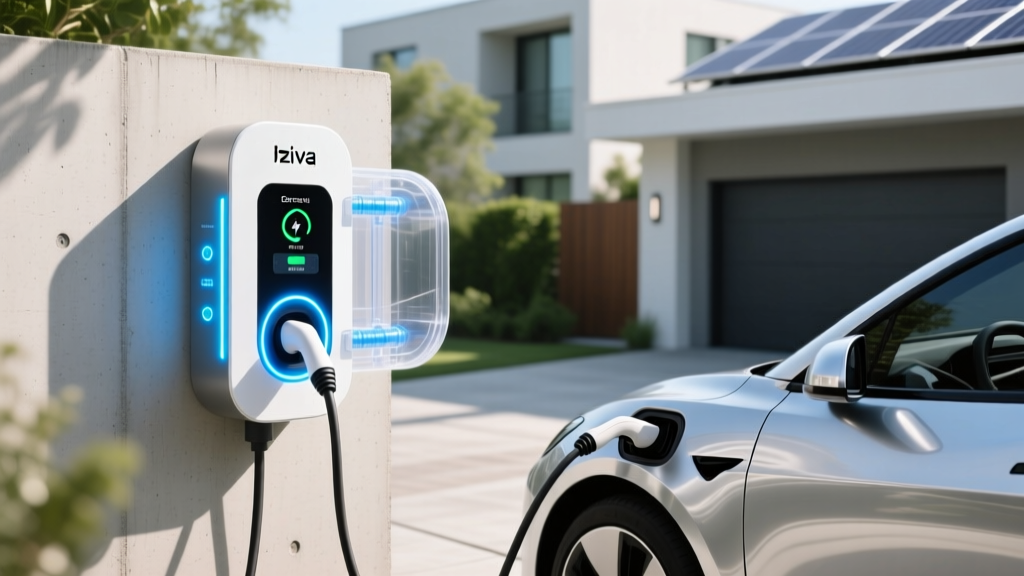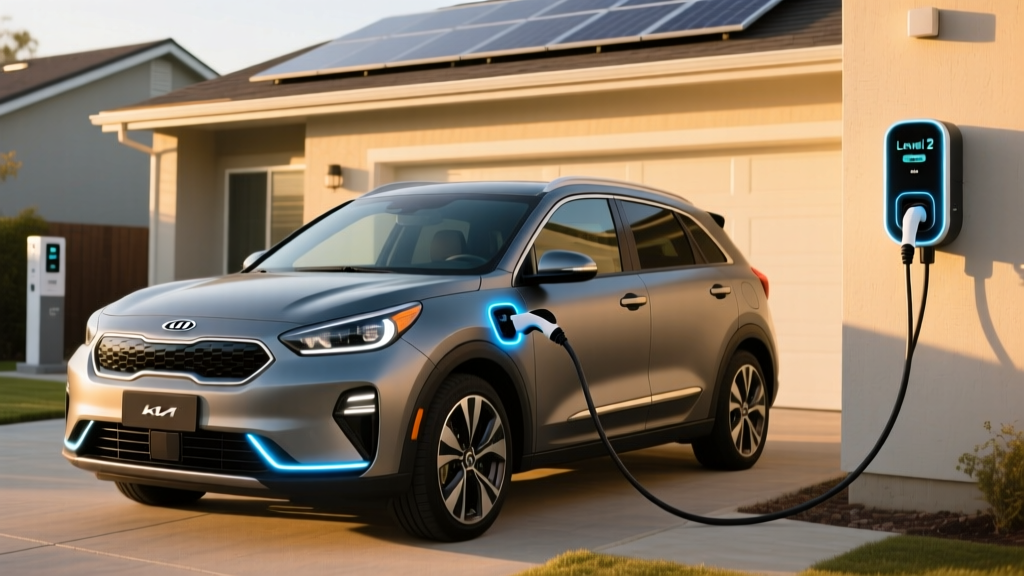
If you own or are shopping for a 2025 Kia Niro Plug-In Hybrid, one question dominates your daily routine: how long does it actually take to charge, and can you schedule it to hit cheap off-peak electricity rates? The Niro PHEV pairs a 1.6-liter gasoline engine with an 11.3 kWh (usable) lithium-ion polymer battery and a 62 kW electric motor, delivering an EPA-estimated 33 miles of electric-only range and 48 MPGe combined. But those numbers only matter if you understand the charging logistics behind them.
This guide breaks down the exact kia niro 2025 hybrid schedule charging time across every charging level, explains how to configure delayed charging for utility time-of-use rates, and walks through what a Level 2 home installation really costs in 2026.
2025 Kia Niro PHEV Battery and Charging Specs at a Glance
Before setting a charging schedule, you need the hard numbers. The 2025 Niro PHEV uses an 11.3 kWh usable battery pack (NMC chemistry). The onboard charger — the component inside the car that converts AC wall power to DC for the battery — is rated at 3.3 kW for the base LX trim and 7.2 kW for EX and SX Touring trims. This is a critical distinction: even if you plug into a 48-amp wall charger capable of 11.5 kW, the car will only accept what its onboard charger allows.
| Specification | Value |
|---|---|
| Battery Capacity (usable) | 11.3 kWh (NMC) |
| EPA Electric-Only Range | 33 miles |
| EPA Combined MPGe | 48 MPGe |
| Onboard Charger (LX trim) | 3.3 kW |
| Onboard Charger (EX / SX Touring) | 7.2 kW |
| Charge Port | J1772 (AC) / CCS1 (DC) |
| Max DC Fast Charge Rate | ~50 kW (CCS1) |
| 0-60 mph (est.) | ~9.8 seconds |
| Combined System Output | 180 hp / 195 lb-ft torque |
| Starting MSRP (LX) | $34,390 |
| Battery/Powertrain Warranty | 10 years / 100,000 miles |
Charging Levels Explained: How Fast Each Adds Range
EV charging is measured in kW (kilowatts), which represents power — the rate at which energy flows into the battery. The battery itself stores energy measured in kWh (kilowatt-hours). Think of kW as the width of a hose and kWh as the size of the bucket. A wider hose (higher kW) fills the bucket faster.
| Charging Level | Power Source | Max kW | Miles of Range Added per Hour | Full 0–100% Time (11.3 kWh) |
|---|---|---|---|---|
| Level 1 (120V household) | Standard outlet | ~1.4 kW | ~4–5 miles/hr | ~8–9 hours |
| Level 2 (240V, 3.3 kW onboard) | Home/public station (LX trim) | 3.3 kW | ~11–13 miles/hr | ~3.5 hours |
| Level 2 (240V, 7.2 kW onboard) | Home/public station (EX/SX) | 7.2 kW | ~22–26 miles/hr | ~1.5–2 hours |
| DC Fast Charging (CCS1) | Public fast charger | ~50 kW peak | N/A (see below) | 10–80% in ~30 min |
For the Niro PHEV's relatively small 11.3 kWh battery, Level 1 charging is genuinely viable for overnight top-ups. If you arrive home with 10 miles of electric range remaining and plug into a standard 120V outlet, you'll wake up to a full battery — roughly 33 miles of electric range — after about 6 hours. However, Level 2 dramatically shortens this window and is essential if you want to take advantage of short off-peak rate windows from your utility.
DC fast charging exists for the Niro PHEV via the CCS1 connector, but it's rarely necessary. The 50 kW peak rate means a 10–80% charge in roughly 30 minutes. Since the battery is small, most owners find that home Level 2 charging is more than sufficient, and DC fast charging is best reserved for the occasional road trip when you need a quick electric-range top-up.
How to Schedule Charging on the 2025 Kia Niro PHEV
This is where the kia niro 2025 hybrid schedule charging time question gets practical. The Niro PHEV supports scheduled charging through two methods: the vehicle's infotainment system and the Kia Access app.
Method 1: In-Vehicle Scheduled Charging
Navigate to EV Settings → Charge Schedule on the 10.25-inch infotainment display. You can set:
- Departure time: The car calculates backward from your departure and begins charging early enough to reach full battery by that time.
- Charge window: Restrict charging to specific hours (e.g., 11:00 PM to 6:00 AM) to align with off-peak utility rates.
- Climate preconditioning: Schedule the cabin to pre-heat or pre-cool while still plugged in, drawing power from the grid rather than the battery. This preserves your 33 miles of range for actual driving.
Method 2: Kia Access App
The Kia Access app allows remote scheduling, letting you adjust charge windows from your phone. If your utility offers dynamic time-of-use rates that shift seasonally, the app makes it easy to update your schedule without entering the car. You can also monitor State of Charge (SoC) remotely and start or stop charging on demand.
Smart Charger Scheduling (Recommended)
For the most granular control, pair the Niro with a smart Level 2 charger (detailed below). Chargers like the ChargePoint Home Flex or Emporia Vue offer their own scheduling interfaces, often with more precision than the vehicle's built-in timer. A smart charger can also track energy consumption and integrate with solar or home battery systems.
Home Level 2 Installation: Electrical Requirements and Costs
Installing a Level 2 home charger is the single biggest infrastructure decision for a Niro PHEV owner. Here's what's involved.
Electrical Requirements
A Level 2 charger requires a 240-volt dedicated circuit, similar to what powers an electric dryer or oven. The circuit amperage determines charging speed:
- 20-amp circuit: Delivers ~3.8 kW (16 amps continuous) — sufficient for the LX trim's 3.3 kW onboard charger.
- 40-amp circuit: Delivers ~7.7 kW (32 amps continuous) — ideal for the EX/SX Touring's 7.2 kW onboard charger.
- 50-amp circuit: Delivers ~9.6 kW (40 amps continuous) — overkill for the Niro PHEV but future-proofs for a full BEV down the road.
Panel Upgrade Considerations
Older homes with 100-amp electrical panels may not have capacity for a dedicated 40-amp EV circuit. A licensed electrician will perform a load calculation to determine if your panel can handle the additional draw. If not, a panel upgrade to 200 amps typically costs $1,500–$3,000. This is one of the most commonly overlooked costs in EV home charging.
Installation Cost Breakdown
| Component | Cost Range |
|---|---|
| Level 2 Charger Equipment (smart, 32–48A) | $350–$700 |
| Electrician Labor (240V circuit, 20–50 ft run) | $500–$1,500 |
| Electrical Permit | $50–$200 |
| Panel Upgrade (if needed, 100A → 200A) | $1,500–$3,000 |
| Total (no panel upgrade) | $900–$2,400 |
| Total (with panel upgrade) | $2,400–$5,400 |
Several states and utilities offer rebates of $250–$1,000 for home charger installation. The federal Residential Clean Energy Credit (IRS Form 5695) may cover 30% of equipment and installation costs up to $1,000, though eligibility depends on your tax situation — consult a tax professional. Always verify current incentive availability with your utility and DSIRE database.
Connector Compatibility: What Plugs Into the Niro PHEV
The 2025 Kia Niro PHEV uses the J1772 connector for all AC charging (Level 1 and Level 2). For DC fast charging, it uses the CCS1 (Combined Charging System) connector, which adds two DC pins below the J1772 inlet.
| Connector Type | Use Case | Compatible with Niro PHEV? | Adapter Needed? |
|---|---|---|---|
| J1772 | Level 1 & Level 2 AC charging | Yes (native) | None |
| CCS1 | DC fast charging | Yes (native) | None |
| NACS (Tesla) | Tesla Superchargers & home chargers | With adapter | Tesla J1772 adapter (~$200–$250) for AC; CCS-to-NACS adapter for DC |
| CHAdeMO | Legacy DC fast charging | With adapter | CHAdeMO-to-CCS adapter (~$300+) |
As of 2026, the industry is rapidly standardizing on NACS (Tesla's connector). Many new public chargers now offer NACS cables alongside CCS1. If you plan to use Tesla Superchargers — which have the largest and most reliable DC fast-charging network — you'll need a CCS-to-NACS adapter. Kia has been shipping adapters with some models; check with your dealer. For home Level 2 charging, a J1772 charger works natively, and a NACS-to-J1772 adapter lets you use a Tesla Wall Connector if desired.
Cost to Charge the Niro PHEV vs. Gasoline
One of the strongest arguments for the Niro PHEV is the per-mile cost advantage of electric driving. Let's run the numbers.
| Scenario | Rate | Cost to Fill 11.3 kWh | Cost per Mile (33 mi range) |
|---|---|---|---|
| Home Off-Peak (national avg.) | $0.12/kWh | $1.36 | $0.041/mile |
| Home Peak Rate | $0.25/kWh | $2.83 | $0.086/mile |
| Public Level 2 (avg.) | $0.35/kWh | $3.96 | $0.120/mile |
| DC Fast Charging (avg.) | $0.48/kWh | $5.42 | $0.164/mile |
| Gasoline (Niro HEV mode, 50 MPG) | $3.40/gal | — | $0.068/mile |
At off-peak home rates, electric driving costs roughly $0.04 per mile — about 40% cheaper than gasoline even in a highly efficient hybrid. However, if you rely on DC fast charging at public stations, the cost per mile can actually exceed gasoline. This is why scheduling home charging during off-peak hours is the economic sweet spot for PHEV ownership.
According to fueleconomy.gov, the 2025 Niro PHEV achieves 48 MPGe in electric mode and 50 MPG combined in hybrid mode. Your real-world savings depend heavily on how consistently you charge at home and your local electricity rates.
Recommended Level 2 Chargers for the Kia Niro PHEV
Given the Niro PHEV's 3.3 kW (LX) or 7.2 kW (EX/SX) onboard charger, you don't need the most powerful charger on the market. But investing in a capable unit future-proofs your garage for a potential BEV upgrade. Here are three proven options:
ChargePoint Home Flex
- Power Output: Up to 11.5 kW (48A, configurable down to 16A)
- Connector: J1772 (NACS adapter available)
- Cable Length: 23 feet
- Smart Features: Wi-Fi, app scheduling, Alexa integration, energy tracking
- Price: ~$549
- Best For: EX/SX Touring owners who want scheduling flexibility and future-proofing
Emporia Level 2 EV Charger
- Power Output: Up to 11.5 kW (48A)
- Connector: J1772
- Cable Length: 24 feet
- Smart Features: Wi-Fi, detailed energy monitoring, solar integration, scheduling via app
- Price: ~$399
- Best For: Budget-conscious buyers with solar panels or those wanting granular energy data
Tesla Wall Connector (with J1772 adapter)
- Power Output: Up to 11.5 kW (48A)
- Connector: NACS native (J1772 adapter needed for Niro)
- Cable Length: 24 feet
- Smart Features: Wi-Fi, firmware updates, power sharing between two units
- Price: ~$475 (charger) + ~$50 (J1772 adapter)
- Best For: Multi-EV households with a Tesla and a Kia/Hyundai
For Niro LX owners with the 3.3 kW onboard charger, even a basic 16-amp Level 2 charger ($250–$350) will max out the car's acceptance rate. But spending slightly more on a 48-amp unit with scheduling features gives you flexibility for your next vehicle.
Safety, Code, and Installation Best Practices
EV charging installations must comply with the National Electrical Code (NEC) and local building codes. Key requirements include:
- Dedicated circuit: Your Level 2 charger must have its own dedicated breaker — it cannot share a circuit with other appliances.
- GFCI protection: NEC 2020 and later require Ground Fault Circuit Interrupter protection for EV charging outlets. Many modern chargers have built-in GFCI; hardwired installations may require a GFCI breaker.
- Outdoor rating: If your charger is installed outdoors or in an exposed garage, ensure it carries a NEMA 4 or IP65 weather-resistance rating.
- Permit and inspection: Most jurisdictions require an electrical permit and post-installation inspection. Skipping this can void your homeowner's insurance coverage for electrical fires.
- Cable management: Use a holster or cable reel to keep the charging cable off the floor and protected from vehicle traffic.
Always hire a licensed electrician experienced with EV charger installations. The National Highway Traffic Safety Administration recommends professional installation to ensure safe operation and compliance with local codes.
Frequently Asked Questions
How much does it cost to install a home EV charger for the Kia Niro PHEV?
Expect $900–$2,400 for a standard Level 2 installation (equipment, electrician labor, and permit) if your electrical panel has sufficient capacity. If a panel upgrade from 100A to 200A is needed, total costs rise to $2,400–$5,400. Utility rebates and the federal Residential Clean Energy Credit can offset some of this cost.
How fast will each charging level add range to the Niro PHEV?
Level 1 (120V) adds roughly 4–5 miles of electric range per hour. Level 2 (240V) adds 11–13 miles/hr on the LX trim (3.3 kW onboard charger) and 22–26 miles/hr on the EX/SX Touring (7.2 kW onboard charger). DC fast charging reaches 10–80% in approximately 30 minutes at ~50 kW peak.
Which connector and charger are compatible with the 2025 Niro PHEV?
The Niro PHEV uses J1772 for AC charging (Level 1 and Level 2) and CCS1 for DC fast charging — both are native, no adapter needed. To use Tesla Superchargers or a Tesla Wall Connector at home, you'll need a CCS-to-NACS adapter (for DC) or a J1772 adapter (for AC).
How much does charging cost per mile compared to gasoline?
At home off-peak rates (~$0.12/kWh), electric driving in the Niro PHEV costs about $0.041/mile — roughly 40% less than gasoline at $3.40/gallon in hybrid mode ($0.068/mile). However, public DC fast charging at $0.48/kWh costs $0.164/mile, which is more expensive than gas. Home charging during off-peak hours is the key to maximizing savings.
What electrical upgrades might I need for a Level 2 charger?
You'll need a dedicated 240V circuit (20–50 amps depending on the charger). If your home has a 100-amp electrical panel, a load calculation may reveal the need for a 200-amp panel upgrade ($1,500–$3,000). Homes built after 2000 typically have 200-amp panels with sufficient spare capacity. A licensed electrician can assess your panel during a site visit.
Can I schedule charging to take advantage of off-peak electricity rates?
Yes. The 2025 Niro PHEV supports charge scheduling through both the in-vehicle infotainment system (EV Settings → Charge Schedule) and the Kia Access app. You can set specific charge windows (e.g., 11 PM–6 AM) and departure times. For more precise control, smart Level 2 chargers like the ChargePoint Home Flex or Emporia offer independent scheduling through their own apps.
How long does the Niro PHEV battery last?
Kia covers the high-voltage battery with a 10-year/100,000-mile warranty against capacity loss below a specified threshold. NMC batteries in PHEVs typically degrade 10–15% over 8–10 years of normal use. Because the Niro PHEV battery is relatively small (11.3 kWh) and the car frequently cycles between electric and hybrid modes, moderate degradation is normal and generally doesn't dramatically affect usability given the gasoline backup.