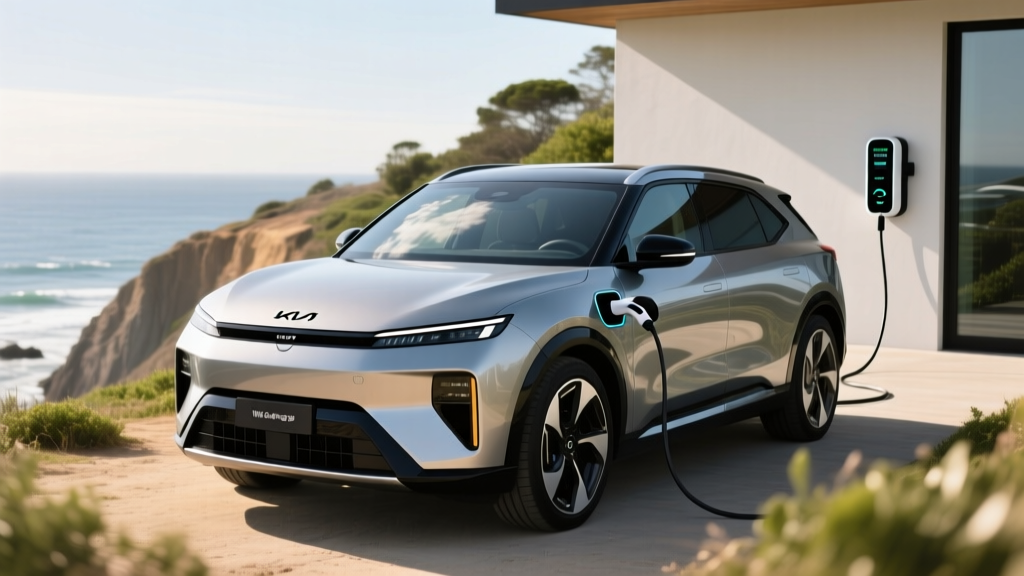
The 2024 Kia EV9 Wind is the volume-selling trim of Kia's flagship three-row electric SUV, and its efficiency numbers make or break the ownership experience. With an EPA-estimated 304 miles of range, the Wind sits between the lighter Long Range RWD (304 mi) and the dual-motor AWD trims (270-280 mi). But EPA stickers only tell part of the story — real-world highway driving, cold weather, and charging-curve taper all reshape what you'll actually see at the battery gauge.
This guide breaks down the EV9 Wind's real-world range expectations, its 800V DC fast-charging capability, and everything you need to know about setting up home charging — from panel upgrades to equipment picks and cost-per-mile math.
2024 Kia EV9 Wind: Key Specs at a Glance
| Spec | Value |
|---|---|
| EPA Range | 304 mi (RWD, 19" wheels) |
| Battery Capacity | 100.0 kWh usable (NMC) |
| Max DC Fast Charge | 236 kW peak (800V architecture) |
| 10–80% DC Fast Charge | ~24 minutes (optimal conditions) |
| Level 2 AC Charge Rate | 10.9 kW (onboard charger) |
| Motor / Drivetrain | 215 hp / 258 lb-ft, RWD |
| 0–60 mph | 7.7 seconds |
| EPA Efficiency | 83 MPGe combined (2.4 kWh/mi) |
| Connector (2024 model year) | CCS1 (NACS adapter available) |
| Base MSRP (Wind trim) | $59,900 (before incentives) |
| Battery/Powertrain Warranty | 10 years / 100,000 miles |
Understanding Charging Levels: How Fast Can You Add Range?
EV charging is measured in kW (kilowatts), which is the rate of power delivery — think of it as how fast water flows through a hose. Your battery capacity is measured in kWh (kilowatt-hours) — the total volume of the tank. The EV9 Wind's 100.0 kWh battery needs different amounts of time to fill depending on the kW rate of your charger.
| Level | Power (kW) | Miles of Range / Hour | Full Charge Time (EV9 Wind) | Best Use Case |
|---|---|---|---|---|
| Level 1 (120V household) | 1.0–1.4 kW | 2–4 mi/hr | 70–100+ hours | Emergency / overnight trickle |
| Level 2 (240V home/public) | 7.2–11.5 kW | 20–35 mi/hr | 9–14 hours (0–100%) | Daily home charging |
| DC Fast (public stations) | 50–236 kW | 140–700+ mi/hr (peak) | ~24 min (10–80%) | Road trips, quick top-ups |
The EV9 Wind's onboard AC charger maxes out at 10.9 kW, meaning even if you plug into a 48-amp (11.5 kW) Level 2 station, the car will only accept 10.9 kW. At that rate, you'll add roughly 32 miles of range per hour of charging — enough to fully replenish overnight from any typical daily drive.
On DC fast charging, the EV9's 800V architecture is a genuine advantage. On a 350 kW-capable charger (like Electrify America's newest stalls), the EV9 can peak near 236 kW, adding 10–80% in approximately 24 minutes. However, the charge curve tapers significantly above 80% — going from 80–100% can take another 20+ minutes. For road trips, plan your stops around 10–80% sessions and skip the final top-off unless you need every mile.
Home Charger Installation: Requirements, Costs & Panel Upgrades
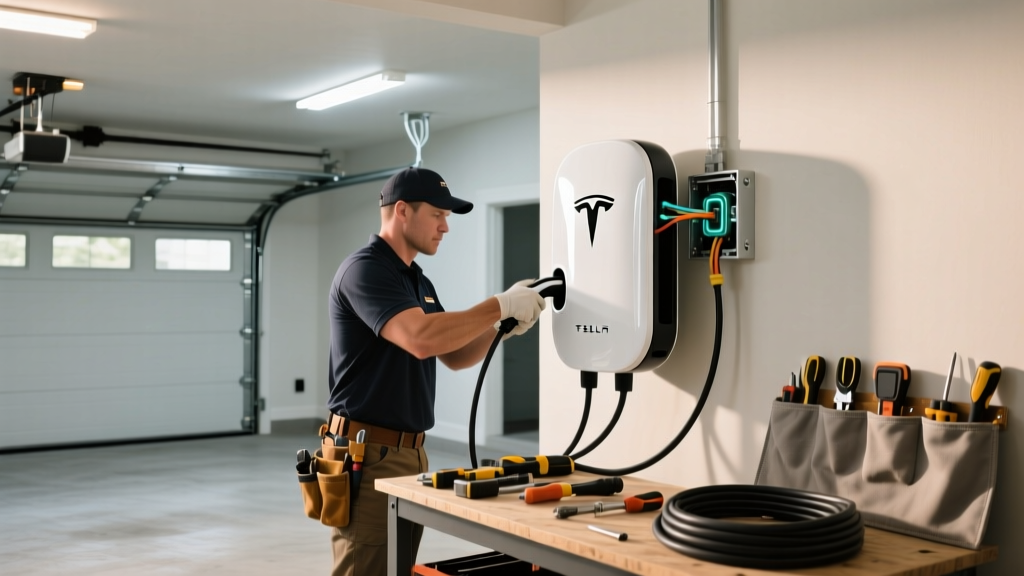
Installing a Level 2 home charger is the single biggest quality-of-life upgrade for EV9 ownership. Here's what the electrical side actually requires.
Electrical Requirements for the EV9 Wind
To take advantage of the EV9 Wind's 10.9 kW onboard charger, you need a 240V circuit rated for at least 50 amps (which delivers 40 amps continuous to the vehicle, per NEC 80% rule). A 48-amp hardwired charger on a 60-amp breaker is the ideal setup. If your panel only supports a 40-amp circuit (32 amps continuous), you'll get about 7.7 kW — still adequate for overnight charging but slower.
Do You Need a Panel Upgrade?
Homes built before 2000 often have 100-amp or 150-amp electrical panels. Adding a 50–60 amp EV circuit may push total load beyond 80% of panel capacity — especially if you also run electric HVAC, a dryer, and an electric oven. A licensed electrician will perform a load calculation to determine if your panel can handle the circuit. If not, a panel upgrade to 200 amps typically costs $1,500–$3,500 and is the single largest line-item surprise in EV home charging.
| Cost Item | Low Estimate | High Estimate | Notes |
|---|---|---|---|
| Level 2 Charger (Equipment) | $350 | $700 | 40–48 amp smart charger |
| Electrician Labor | $400 | $1,500 | Varies by run length & complexity |
| Permit & Inspection | $50 | $250 | Required in most jurisdictions |
| Panel Upgrade (if needed) | $1,500 | $3,500 | 100A → 200A service upgrade |
| Total (No Panel Upgrade) | $800 | $2,450 | Most homes with 200A panels |
| Total (With Panel Upgrade) | $2,300 | $5,950 | Older homes with 100A/150A |
Safety & Code Considerations
- Dedicated circuit: NEC requires a dedicated breaker for EVSE — no sharing with other appliances.
- GFCI protection: 2020 NEC (and later) requires GFCI protection for outdoor receptacles; hardwired units often bypass this requirement but local codes vary.
- Outdoor rating: If your charger mounts outside, ensure it carries a NEMA 4 or IP65 rating for weather resistance.
- Hardwired vs. plug: Hardwired installations (no NEMA 14-50 outlet) are generally safer for 48+ amp circuits and avoid the NEC 125% receptacle derating issue. A licensed electrician should make this call.
Connector Compatibility: CCS1, NACS & Adapters
The 2024 Kia EV9 Wind ships with a CCS1 (Combo) charge port. This is compatible with the majority of public DC fast-charging networks in the U.S. — Electrify America, EVgo, and most ChargePoint stations.
However, the charging landscape is shifting toward NACS (North American Charging Standard), the Tesla-originated connector now adopted by most automakers for 2025+ models. Kia has confirmed NACS ports on future model years, but 2024 EV9 owners will need an adapter for Tesla Supercharger access.
| Connector | EV9 Wind (2024) | Network Access | Adapter Needed? |
|---|---|---|---|
| CCS1 | ✅ Native port | Electrify America, EVgo, ChargePoint, most non-Tesla networks | No |
| NACS (Tesla) | ⚠️ Via adapter | Tesla Supercharger network (16,000+ stalls) | Yes — CCS-to-NACS adapter (~$200–$250) |
| CHAdeMO | ❌ Not compatible | Largely retired in U.S. | N/A |
| J1772 (Level 2 AC) | ✅ Native (upper portion of CCS port) | All public Level 2 stations | No |
Practical tip: If you plan road trips through regions with sparse CCS coverage (rural West, parts of the Midwest), a CCS-to-NACS adapter opens up Tesla's Supercharger network and is worth the $200–$250 investment. Kia has offered approved adapters through dealerships; aftermarket options from brands like Lectron are also available.
Cost to Charge: EV9 Wind vs. Gas SUV Per Mile
The EV9 Wind's efficiency of 2.4 kWh per mile (83 MPGe combined) is competitive for a 5,000+ lb three-row SUV. Here's what charging actually costs in common scenarios, compared to a gas-powered equivalent like the Kia Telluride (22 MPG combined).
| Scenario | Rate | Cost / Full Charge (100 kWh) | Cost per Mile | Telluride (22 MPG, $3.50/gal) |
|---|---|---|---|---|
| Home (off-peak utility rate) | $0.10/kWh | $10.00 | $0.033/mi | $0.159/mi |
| Home (average residential) | $0.16/kWh | $16.00 | $0.053/mi | $0.159/mi |
| Public Level 2 | $0.25/kWh | $25.00 | $0.083/mi | $0.159/mi |
| DC Fast Charging | $0.40/kWh | $40.00 | $0.133/mi | $0.159/mi |
| Premium DC Fast (peak pricing) | $0.55/kWh | $55.00 | $0.183/mi | $0.159/mi |
At home off-peak rates, the EV9 Wind costs roughly one-fifth per mile compared to the Telluride. Even at typical DC fast-charging rates, you're still saving money per mile. Only at premium peak-rate DC chargers does the EV9 become marginally more expensive — which is why home charging is the economic backbone of EV ownership.
Annual fuel savings estimate: At 12,000 miles/year with 80% home charging ($0.13/kWh avg) and 20% DC fast charging ($0.42/kWh avg), the EV9 Wind costs approximately $1,120/year in electricity vs. the Telluride's $1,909/year in gas — a savings of roughly $790 annually.
Recommended Home Chargers for the Kia EV9 Wind
Emporia Vue Level 2 (48A)
- Power Output: 11.5 kW (48A / 240V)
- Connector: J1772 (CCS compatible)
- Cable Length: 24 ft
- Smart Features: Wi-Fi, app scheduling, energy monitoring, solar integration
- Installation: Hardwired (recommended for 48A+)
- Price: ~$399
- Why it works: Maxes out the EV9's 10.9 kW onboard charger; excellent app for tracking session cost and scheduling off-peak charging.
ChargePoint Home Flex (50A)
- Power Output: 12.0 kW (50A / 240V, adjustable down)
- Connector: J1772 (25 ft cable)
- Cable Length: 25 ft
- Smart Features: Wi-Fi, Alexa integration, flexible amperage dial, ChargePoint network account
- Installation: NEMA 14-50 plug or hardwired
- Price: ~$549
- Why it works: Adjustable amperage lets you match your panel's capacity without swapping hardware; 25-ft cable reaches most garage/driveway setups.
Wallbox Pulsar Plus (48A)
- Power Output: 11.5 kW (48A / 240V)
- Connector: J1772 (CCS compatible)
- Cable Length: 25 ft
- Smart Features: Wi-Fi + Bluetooth, app control, Power Sharing (daisy-chain two units on one circuit)
- Installation: Hardwired
- Price: ~$449
- Why it works: Compact form factor, outdoor-rated (NEMA 4), and Power Sharing is ideal if you add a second EV later.
Important note on kW vs. circuit rating: A "48-amp" charger delivers 48A continuous on a 60-amp breaker (NEC requires breakers rated at 125% of continuous load). Never install a 48A charger on a 50A breaker — the electrician must match the breaker to 125% of the charger's rated amperage.
Federal Tax Credit & Incentive Context
The 2024 Kia EV9 Wind has an MSRP of $59,900, which falls under the IRS §30D $80,000 MSRP cap for SUVs/vans/pickups. However, eligibility for the full $7,500 federal tax credit depends on several factors that change frequently:
- Buyer income caps: AGI must not exceed $150,000 (single), $225,000 (head of household), or $300,000 (joint).
- Battery sourcing requirements: Critical minerals and battery components must meet escalating percentage thresholds from U.S. or FTA-partner countries. Kia's supply chain has been adjusting, and eligibility varies by build date.
- Point-of-sale transfer: As of 2024, the credit can be transferred to the dealer at purchase for an immediate price reduction — but only if the specific VIN qualifies.
Always verify eligibility for your specific VIN at IRS.gov's qualified vehicle list before relying on the credit in your purchase math. Additionally, the home charger installation may qualify for the §30C Alternative Fuel Infrastructure Tax Credit (up to $1,000 for residential), though this also has census-tract eligibility requirements.
Frequently Asked Questions
How much does it cost to install a home EV charger for the Kia EV9?
For most homes with a 200-amp panel, expect $800–$2,450 total (charger + electrician + permit). If your home has an older 100A or 150A panel that needs upgrading, add $1,500–$3,500 for a panel upgrade, bringing the total to $2,300–$5,950. Always get a load calculation from a licensed electrician before committing.
How fast will each charging level add range to the EV9 Wind?
Level 1 (120V): roughly 2–4 miles per hour. Level 2 (240V, 48A): approximately 32 miles per hour. DC Fast Charging (236 kW peak): up to 700+ miles per hour at peak, but the charge curve tapers significantly above 80% SoC — the 10–80% session takes about 24 minutes.
Which connector does the 2024 EV9 Wind use?
The 2024 EV9 Wind uses a CCS1 (Combo) connector for DC fast charging and J1772 for Level 2 AC charging. A CCS-to-NACS adapter (~$200–$250) enables access to Tesla Supercharger stations. Future model years will ship with native NACS ports.
How much does charging the EV9 cost per mile vs. a gas SUV?
At home off-peak rates ($0.10/kWh), the EV9 Wind costs about $0.033/mile — roughly one-fifth of a 22 MPG gas SUV at $3.50/gallon ($0.159/mile). Even at public DC fast-charging rates ($0.40/kWh), it costs $0.133/mile, still cheaper than gas. Only at premium peak-rate chargers ($0.55+/kWh) does electricity exceed gas cost per mile.
What electrical upgrades might I need for a Level 2 charger?
The most common upgrade is a new 60-amp breaker and dedicated 240V circuit run from your panel to the garage or driveway. If your panel is at capacity (common in homes with 100A or 150A service), you'll need a panel upgrade to 200A — this costs $1,500–$3,500 and requires a utility service upgrade. Some utilities offer rebates that offset this cost. Always have a licensed electrician perform a load calculation first.
Does the EV9 Wind's 800V architecture really make a difference?
Yes, measurably. The 800V system allows higher charge power (236 kW) at lower current, which reduces heat and cable weight. Compared to 400V competitors that peak at 150–170 kW, the EV9 adds 10–80% roughly 8–12 minutes faster on a capable 350 kW station. The practical benefit: shorter rest stops on road trips and less time tethered to a charger in bad weather.