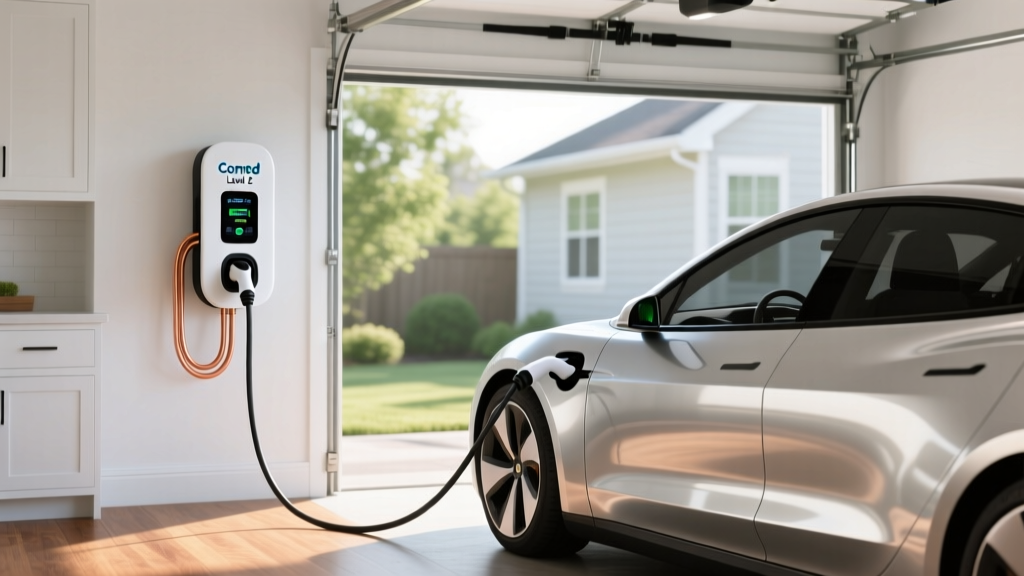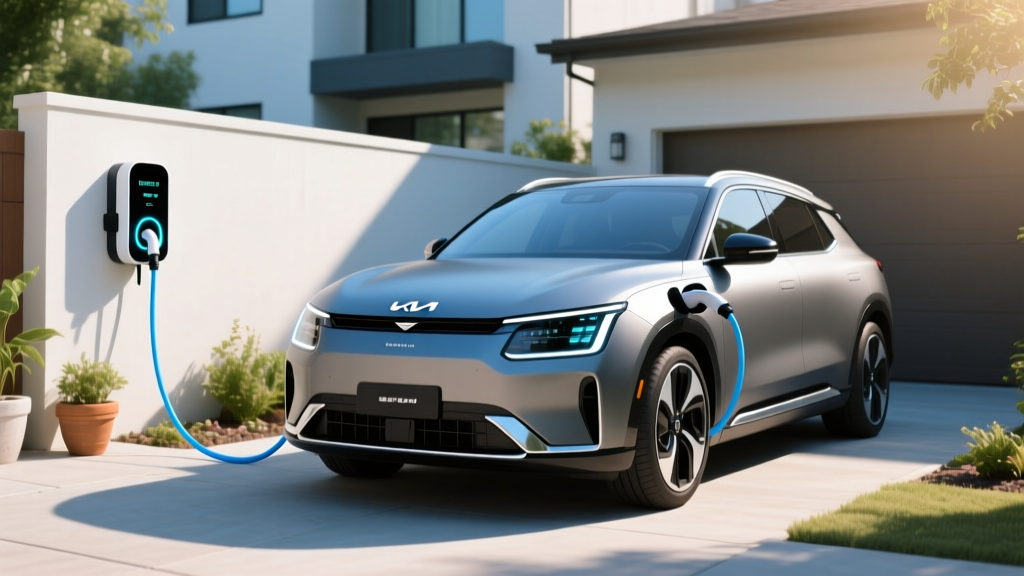
The three-row Kia EV9 is one of the most capable electric SUVs on the market, but its massive 99.8 kWh usable battery pack demands a serious home charging strategy. If you're researching the EV9's range and wondering how you'll actually keep it charged day-to-day, this guide breaks down exactly what electrical work you need, what it costs, and how fast each charging level replenishes that big battery.
Understanding the Kia EV9's Battery and Real-World Range
Before sizing a charger, you need to know what you're filling. The 2025-2026 Kia EV9 comes in two battery configurations:
- Standard Range (Light RWD): 76.1 kWh usable, LFP chemistry — EPA 230 miles
- Long Range (RWD/AWD trims): 99.8 kWh usable, NMC chemistry — EPA 270-304 miles depending on drivetrain and wheel size
That 99.8 kWh battery is enormous by EV standards — larger than most home solar installations produce in a day. Filling it from empty on a standard wall outlet would take nearly a week. This is why a proper Level 2 home charger isn't optional for EV9 ownership; it's essential infrastructure.
Charging Levels Explained: Speeds in kW and Miles Per Hour
EV charging comes in three tiers. The key distinction every owner must internalize: kW (kilowatts) measures power — how fast energy flows. kWh (kilowatt-hours) measures energy — the total amount stored in the battery. Think of kW as the width of the hose and kWh as the size of the bucket.
| Level | Power Source | Max kW | Miles Added/Hour | 10-80% Time (99.8 kWh) |
|---|---|---|---|---|
| Level 1 (Trickle) | 120V household outlet | 1.4 kW | 3-5 mi/hr | ~50 hours |
| Level 2 (Home/Public) | 240V dedicated circuit | 7.2-19.2 kW | 21-57 mi/hr | ~3.5-10 hours |
| DC Fast Charging | 480V+ commercial station | Up to 210 kW (peak) | N/A (measured in minutes) | ~24 minutes (10-80%) |
The EV9's onboard charger accepts up to 10.9 kW on Level 2 AC (single-phase). That means even if you install a 19.2 kW (80A) charger, the car will only draw 10.9 kW — roughly 32 miles of range per hour of charging. For the 99.8 kWh pack, a full 10-80% session at 10.9 kW takes approximately 6.5 hours, which is ideal for overnight replenishment.
On DC fast chargers, the EV9 peaks at 210 kW using its 800V architecture, but remember that peak rate is only sustained between roughly 10-45% state of charge. The charging curve tapers significantly above 60%, which is why manufacturers quote 10-80% times rather than 0-100%. Kia's official 10-80% claim is approximately 24 minutes on a 350 kW station, though real-world sessions on 150 kW Electrify America units typically run 28-33 minutes depending on battery temperature and preconditioning.
Home Level 2 Installation: Electrical Requirements and Total Cost
Installing a Level 2 charger for the EV9 is a significant electrical project. Here's what the installation actually requires and what you'll pay.
Electrical Specifications
- Circuit: Dedicated 240V circuit, minimum 50 amps (for a 40A continuous charger) or 60 amps (for a 48A charger)
- Wire gauge: 6 AWG copper for 50A; 4 AWG for 60A circuits
- Breaker: Double-pole breaker matching circuit amperage
- Outlet vs. hardwired: NEMA 14-50 receptacle (plug-in) or direct hardwire — hardwired is often required for circuits above 50A and eliminates a common failure point
Panel Capacity Check
Before anything else, determine whether your electrical panel can handle a new 50-60A load. A typical 200A residential panel may already be near capacity with HVAC, electric range, dryer, and water heater. An electrician will perform a load calculation per NEC Article 220 to determine available headroom. If your panel is maxed out — or if you have an older 100A or 150A service — a panel upgrade or a smart load-management device will be necessary.
| Component | Low End | High End | Notes |
|---|---|---|---|
| Level 2 Charger (hardware) | $350 | $750 | 40A-48A smart charger |
| Electrician labor (standard run) | $500 | $1,500 | Depends on panel-to-garage distance, wall type |
| Permit and inspection | $50 | $300 | Varies by municipality |
| Materials (wire, conduit, breaker) | $100 | $400 | Longer runs = more copper |
| Total (no panel upgrade) | $1,000 | $2,950 | Typical suburban install |
| Panel upgrade (if needed) | $2,000 | $5,000+ | 100A→200A service upgrade |
| Total (with panel upgrade) | $3,000 | $7,950+ | Older homes common scenario |
As of 2026, the federal Residential Clean Energy Credit does not cover EV charger hardware or installation (the separate Alternative Fuel Vehicle Refueling Property Credit, §30C, was modified under recent legislation — consult a tax professional for your specific eligibility and any state-level rebates that may apply in your area).
Connector Compatibility: NACS, CCS1, and the EV9
The connector landscape has shifted dramatically. Here's where the Kia EV9 stands as of the 2025-2026 model years:
- 2025 Kia EV9: Ships with a CCS1 (Combined Charging System) port for both Level 2 AC and DC fast charging.
- 2026 Kia EV9: Kia has confirmed the transition to the NACS (North American Charging Standard, aka Tesla connector) for the 2026 model year. If you purchase a 2026 EV9, it will have a native NACS port.
| Connector | Used By | Level 2 AC | DC Fast | Adapter Needed for EV9? |
|---|---|---|---|---|
| NACS (J3400) | Tesla, 2025+ Ford/GM/Rivian, 2026+ Kia/Hyundai | Yes | Yes | 2025 EV9: CCS-to-NACS adapter (~$200) for Supercharger access |
| CCS1 | Most 2024-2025 non-Tesla EVs | Yes (J1772 upper) | Yes | 2026 EV9: NACS-to-CCS adapter for legacy Electrify America stations |
| CHAdeMO | Nissan Leaf (legacy, discontinued) | No | Yes | Not compatible — network is effectively retired |
For home Level 2 charging, any J1772-connector charger will work with both the 2025 (CCS1) and 2026 (NACS) EV9, because NACS ports accept J1772 AC charging via a simple passive adapter included with the vehicle. For DC fast charging on road trips, verify your model year's native port and plan adapter strategy accordingly. Kia provides a CCS-to-NACS adapter for 2025 EV9 owners to access Tesla Superchargers; 2026 NACS-native owners may need an aftermarket NACS-to-CCS adapter for older Electrify America and EVgo stations still equipped with CCS cables.
Recommended Level 2 Chargers for the Kia EV9
Given the EV9's 10.9 kW onboard charger ceiling, a 48A (11.5 kW-capable) charger is the optimal pairing — it maxes out the car's AC acceptance without wasting money on 80A hardware the car can't use. Here are top picks for 2026:
Emporia Vue Smart Charger (48A)
- Power: 48A / 11.5 kW max (240V)
- Connector: J1772 (NACS adapter included in box for 2026)
- Cable length: 24 ft
- Smart features: Wi-Fi, energy monitoring, solar integration, load management with Span panel, scheduling
- Price: ~$399
- Best for: Solar owners and budget-conscious smart charging
ChargePoint Home Flex (up to 50A)
- Power: Configurable 16A-50A / up to 12 kW (240V)
- Connector: J1772 (NACS version available)
- Cable length: 23 ft
- Smart features: Wi-Fi, Alexa, scheduling, charge history, flexible amperage dip-switch
- Price: ~$549
- Best for: Flexible amperage to match your circuit capacity
Tesla Wall Connector (48A)
- Power: 48A / 11.5 kW max (240V)
- Connector: NACS native (J1772 adapter for 2025 EV9 CCS port)
- Cable length: 24 ft
- Smart features: Wi-Fi, OTA updates, power sharing between two units, load management
- Price: ~$450
- Best for: 2026 NACS-native EV9 owners, multi-EV households
Editor's pick for the EV9: The Emporia Vue at 48A hits the EV9's 10.9 kW ceiling precisely, and its real-time energy monitoring helps you understand exactly how many kWh each session delivers — useful for tracking battery health and electricity costs over time. If you're buying a 2026 NACS-native EV9, the Tesla Wall Connector is a seamless match.
Cost to Charge the EV9: Per-Mile Breakdown vs. Gas
Charging economics vary enormously depending on where and when you plug in. Here's what EV9 owners actually pay, using the 99.8 kWh Long Range battery and EPA combined efficiency of 2.9-3.1 kWh/mile (roughly 83 MPGe combined for the AWD model per fueleconomy.gov):
| Scenario | Rate ($/kWh) | Full Charge Cost | Cost Per Mile | Cost Per 300 mi |
|---|---|---|---|---|
| Home off-peak (utility TOU rate) | $0.08-$0.12 | $8.00-$12.00 | $0.025-$0.038 | $7.50-$11.40 |
| Home standard rate (no TOU) | $0.14-$0.18 | $14.00-$18.00 | $0.044-$0.057 | $13.20-$17.10 |
| Public Level 2 (ChargePoint, etc.) | $0.20-$0.35 | $20.00-$35.00 | $0.063-$0.110 | $18.90-$33.00 |
| DC Fast Charge (Electrify America) | $0.35-$0.55 | $35.00-$55.00 | $0.110-$0.173 | $33.00-$51.90 |
| Gas SUV comparison (22 MPG, $3.40/gal) | — | — | $0.155 | $46.50 |
Home charging on an off-peak rate is the clear winner — roughly 3-4 cents per mile versus 15.5 cents for a comparable gas SUV like the Kia Telluride. Even at standard residential rates, the EV9 costs about one-third what a gas three-row SUV costs per mile. However, exclusive DC fast charging on road trips can approach or exceed gas costs on a per-mile basis. The financial case for the EV9 depends heavily on having reliable home or workplace Level 2 access.
Safety, Permits, and Code Requirements
A Level 2 EV charger installation is not a DIY project. The National Electrical Code (NEC) treats EV charging as a continuous load, which triggers specific requirements:
- 125% rule: The circuit breaker must be rated at 125% of the charger's maximum continuous draw. A 48A charger requires a 60A breaker. A 40A charger requires a 50A breaker.
- Dedicated circuit: The EV charger must have its own dedicated circuit — it cannot share with a dryer, oven, or other appliance.
- GFCI protection: NEC 2020 and later requires GFCI protection for 14-50 receptacles in garages. Hardwired installations are exempt from this requirement, which is one reason many electricians prefer hardwiring.
- Outdoor rating: If your charger is mounted outside (driveway or exterior wall), it must carry a NEMA 4 or IP65 weather rating. All recommended chargers above meet this standard.
- Permit required: Virtually all jurisdictions require an electrical permit for a new 240V circuit. The inspection ensures wire gauge, breaker sizing, and grounding meet code. Skipping the permit risks insurance claim denial in the event of an electrical fire.
DC Fast Charging the EV9 on Road Trips
The EV9's 800V electrical architecture enables charging speeds that were flagship-Tesla territory just a few years ago. Here's what to expect on the road:
- Peak rate: 210 kW on a 350 kW charger (Ionity, Electrify America 350)
- 10-80% time: ~24 minutes (manufacturer claim, ideal conditions)
- Real-world 10-80%: 28-35 minutes on 150-350 kW stations, depending on battery temperature
- Preconditioning: The EV9 automatically warms the battery when a DC fast charger is set as your navigation destination — this is essential in cold weather and can shave 5-10 minutes off your charge time
- Charging curve: Expect peak 210 kW from roughly 10-45% SoC, tapering to ~100 kW by 65%, and ~50 kW by 80%. Charging past 80% is rarely time-efficient on road trips
For road trip planning, use Kia's built-in route planner or apps like A Better Route Planner (ABRP) to map charging stops. With a 270-304 mile EPA range and the practical 80% planning buffer, expect to stop every 180-220 miles for a 25-30 minute fast charge. The EV9's charging speed is competitive with the best in its class, including the Hyundai Ioniq 5 and Rivian R1S.
Frequently Asked Questions
How much does it cost to install a home EV charger for the Kia EV9?
A standard Level 2 installation with a 50A circuit, no panel upgrade, and a short wire run from panel to garage costs between $1,000 and $2,950 including equipment, electrician labor, materials, and permit. If your home needs an electrical panel upgrade (common in pre-1990 homes with 100A service), total costs range from $3,000 to $7,950 or more. Always get at least three quotes from licensed electricians and confirm they include the permit in their estimate.
How fast will each charging level add range to the EV9?
Level 1 (120V) adds roughly 3-5 miles per hour — adequate only for plug-in hybrids or emergency top-ups. Level 2 (240V, 48A) adds approximately 32 miles per hour to the EV9, enough to fully replenish overnight. DC fast charging at 210 kW can add roughly 180 miles of range in 20 minutes under ideal conditions.
Which charger connector is compatible with my EV9?
The 2025 EV9 uses a CCS1 port; the 2026 EV9 uses a NACS port. For home Level 2 charging, any J1772-connector charger works with both model years (NACS ports accept J1772 via an included adapter). For DC fast charging, 2025 owners need a CCS-to-NACS adapter to access Tesla Superchargers; 2026 owners may need a NACS-to-CCS adapter for older non-Tesla DC fast stations.
How much does charging the EV9 cost per mile compared to gas?
Home charging on off-peak electricity costs approximately 2.5-3.8 cents per mile — roughly one-quarter to one-fifth the cost of fueling a comparable gas SUV at 15.5 cents per mile (22 MPG, $3.40/gallon). Even at standard residential rates of $0.15/kWh, the EV9 costs about 4.7 cents per mile. DC fast charging exclusively on road trips can cost 11-17 cents per mile, approaching gas parity.
What electrical upgrades might I need for a Level 2 charger?
The most common upgrade is a panel capacity increase from 100A or 150A to 200A service, costing $2,000-$5,000+. You may also need a new dedicated 50A or 60A double-pole breaker, 6 AWG or 4 AWG copper wire run, and a NEMA 14-50 receptacle or hardwire junction box. Smart load-management devices can sometimes avoid a panel upgrade by throttling charger power when other heavy appliances are running.