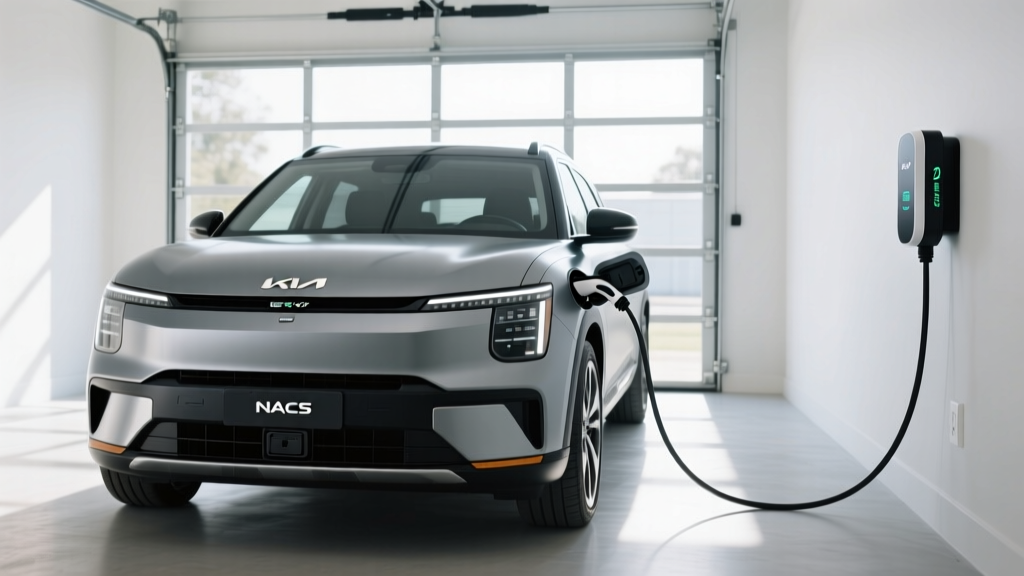
The Kia EV9 is one of the most capable three-row electric SUVs on the market, offering up to 304 miles of EPA-estimated range and a 100.0 kWh battery pack (NMC chemistry). But as Kia transitions to the North American Charging Standard (NACS) for DC fast charging, current EV9 owners face a critical question: how do you access Tesla's Supercharger network without a native NACS port? The answer is the Kia EV9 NACS adapter — and understanding how it fits into a broader charging strategy is essential for maximizing this SUV's road-trip potential and daily usability.
This guide covers the Kia EV9 NACS adapter in detail, then zooms out to explain every charging level, home installation requirements, costs, and the best Level 2 equipment for EV9 owners in 2026.
Kia EV9 NACS Adapter: Accessing Tesla Superchargers
The 2024–2025 Kia EV9 ships with a CCS1 (Combined Charging System) DC fast-charging port. Beginning with the 2026 model year, Kia is transitioning new EVs to the native NACS connector, aligning with the broader industry shift adopted by Ford, GM, Hyundai, Rivian, and others. For existing EV9 owners, Kia provides a CCS1-to-NACS adapter that plugs into the vehicle's CCS1 port and allows connection to Tesla Supercharger stalls equipped with the NACS connector.
What the Adapter Does and Doesn't Do
The NACS adapter is a passive physical connector adapter — it does not change the EV9's charging speed, battery chemistry, or onboard charge controller behavior. When you plug into a V3 Tesla Supercharger (250 kW max) using the adapter, the EV9 will still negotiate its own peak charge rate, which Kia rates at up to 236 kW under ideal conditions. In real-world testing, the EV9 sustains roughly 170–200 kW through the 10–50% state of charge window before tapering, achieving a 10–80% charge in approximately 24 minutes on a capable DC fast charger.
How to Get the Kia EV9 NACS Adapter
Kia has offered the CCS1-to-NACS adapter at no cost to qualifying EV9 owners through a redemption program, similar to Ford and Hyundai's adapter distribution. Check the Kia Owners portal or contact your local dealer for availability. Third-party adapters from brands like Lectron are also available (typically $150–$200), but Kia's official adapter is recommended for warranty and firmware compatibility.
Connector Compatibility Overview
| Scenario | Connector Needed | Adapter Required? |
|---|---|---|
| Home Level 2 (J1772) | J1772 (standard EV9 port) | No |
| Public CCS DC Fast Charger | CCS1 | No |
| Tesla Supercharger (NACS) | NACS | Yes — CCS1-to-NACS adapter |
| Tesla Destination Charger (Level 2) | J1772 or NACS | Yes — Tesla-to-J1772 adapter (often included) |
| CHAdeMO (legacy) | CHAdeMO | Not available for EV9 |
Charging Levels Explained: Speeds, kW, and Miles Per Hour
Understanding the three charging levels is fundamental to planning both daily charging and road trips. The critical distinction: kW (kilowatts) measures power — how fast energy flows into the battery. kWh (kilowatt-hours) measures energy — the total capacity of the battery, like gallons in a fuel tank. The EV9's battery holds 100.0 kWh of usable energy.
| Level | Voltage | Max Power (kW) | Miles of Range Added Per Hour | Typical Use Case |
|---|---|---|---|---|
| Level 1 | 120V AC | 1.4 kW | ~4–5 miles | Emergency/trickle (standard outlet) |
| Level 2 | 240V AC | 7.2–19.2 kW | ~22–60 miles | Home, workplace, public destinations |
| DC Fast Charging | 400V+ DC | 50–236 kW | ~180–650 miles/hr equivalent | Road trips, highway corridors |
The EV9's onboard charger accepts up to 10.9 kW on Level 2 AC (single-phase, 48A). This means a full 10–100% charge at home takes roughly 9.5 hours — practical for overnight charging. On a 240V/48A circuit, you'll add approximately 35–40 miles of range per hour of Level 2 charging.
Home Level 2 Charger Installation: Requirements, Costs, and Upgrades
Installing a dedicated Level 2 home charger is the single biggest quality-of-life upgrade for EV9 ownership. Here's what's involved electrically and financially.
Electrical Requirements
For optimal EV9 Level 2 charging at the full 10.9 kW, you need a 240V circuit rated for at least 60 amps (the National Electrical Code requires the circuit breaker to be rated at 125% of the continuous load, so a 48A charger needs a 60A breaker). If your home's electrical panel has spare capacity — typically 200A service or larger — the installation is straightforward: a new double-pole breaker, conduit, and a NEMA 14-50 receptacle or hardwired connection.
Panel Upgrade: The Hidden Cost
Homes with 100A electrical service or panels already near capacity (common in older construction) may require a panel upgrade to 200A, which adds $1,500–$3,500 to the project. Some utility companies offer rebates for panel upgrades tied to EV adoption. A load calculation by a licensed electrician will determine whether your panel can handle the additional 60A circuit.
Installation Cost Breakdown
| Component | Low Estimate | High Estimate | Notes |
|---|---|---|---|
| Level 2 Charger (equipment) | $350 | $750 | Depends on brand, power, smart features |
| Electrician labor | $400 | $1,500 | Varies by run length, conduit, wall material |
| Electrical permit | $50 | $250 | Required in most jurisdictions |
| Panel upgrade (if needed) | $1,500 | $3,500 | Only if existing panel lacks capacity |
| Total (no panel upgrade) | $800 | $2,500 | Most common scenario |
| Total (with panel upgrade) | $2,300 | $6,000 | Older homes with 100A service |
The federal Alternative Fuel Vehicle Refueling Property Credit (IRS Form 8911) covers up to 30% of home charger equipment and installation costs, capped at $1,000, subject to income and census-tract eligibility. Check current-year IRS rules before filing.
Safety and Code Considerations
- Dedicated circuit: The charger must have its own dedicated breaker — never share a circuit with other high-draw appliances.
- GFCI protection: Required for outdoor receptacles (NEMA 14-50) per NEC 2023 and later. Hardwired chargers may not require a separate GFCI breaker depending on local code.
- Outdoor rating: If installing outdoors, ensure the charger carries a NEMA 4 or IP65 weatherproof rating.
- Cable management: Wall-mounted cable organizers prevent tripping hazards and cord damage.
Cost to Charge the Kia EV9: Home vs. Public vs. Gas
The EV9's efficiency varies by trim. The rear-wheel-drive Light model achieves approximately 88 MPGe combined (per fueleconomy.gov), which translates to roughly 38 kWh per 100 miles in real-world mixed driving. The AWD GT-Line is less efficient at around 84 MPGe, or ~40 kWh/100mi. Using these figures, here's how charging costs compare:
| Charging/Fueling Scenario | Rate | Cost Per Mile |
|---|---|---|
| Home Level 2 (off-peak utility rate) | $0.12/kWh | $0.048 |
| Home Level 2 (average US rate) | $0.17/kWh | $0.068 |
| Public Level 2 (network pricing) | $0.30/kWh | $0.12 |
| DC Fast Charging (Electrify America) | $0.48/kWh | $0.19 |
| DC Fast Charging (Tesla Supercharger avg) | $0.35/kWh | $0.14 |
| Gas SUV (25 MPG combined, $3.50/gal) | — | $0.14 |
| Gas SUV (25 MPG combined, $4.00/gal) | — | $0.16 |
At home on off-peak rates, the EV9 costs roughly one-third what a comparable gas SUV costs per mile. Even on DC fast chargers, costs are competitive with gasoline. The key economic advantage is home charging — public DC fast charging erodes the savings significantly, which is why a Level 2 home install pays for itself quickly for high-mileage drivers.
Best Level 2 Chargers for the Kia EV9 (2026 Recommendations)
Since the EV9's onboard charger maxes at 10.9 kW (48A), you'll want a charger rated for at least 48A to capture full charging speed. Here are top picks across price tiers:
Emporia Vue Level 2 Smart Charger
- Power: 48A / 11.5 kW (240V)
- Connector: J1772 (NACS variant available)
- Cable length: 24 feet
- Smart features: Wi-Fi, app scheduling, solar integration, energy monitoring
- Price: ~$399
- Best for: Budget-conscious owners wanting smart scheduling and energy tracking
ChargePoint Home Flex
- Power: Up to 50A / 12 kW (configurable via DIP switches)
- Connector: J1772 (NACS version available for 2026)
- Cable length: 23 feet
- Smart features: Wi-Fi, app control, Alexa integration, flexible amperage
- Price: ~$599
- Best for: Owners who want adjustable amperage to match their circuit capacity
Wallbox Pulsar Plus
- Power: 48A / 11.5 kW (240V)
- Connector: J1772
- Cable length: 25 feet
- Smart features: Wi-Fi + Bluetooth, app scheduling, Power Sharing for dual installs
- Price: ~$549
- Best for: Garages with limited space — compact form factor with full power
Tesla Wall Connector (with J1772 adapter)
- Power: 48A / 11.5 kW (240V/60A circuit)
- Connector: NACS native (J1772 adapter included for non-Tesla EVs)
- Cable length: 24 feet
- Smart features: Wi-Fi, OTA updates, load sharing between units
- Price: ~$475
- Best for: Multi-EV households with a Tesla and a Kia/Hyundai — future-proof NACS native
All four chargers will fully utilize the EV9's 10.9 kW onboard charger. For the best overnight experience, schedule charging during off-peak utility hours (typically 11 PM–7 AM) to minimize electricity cost and reduce grid strain.
DC Fast Charging the EV9: Real-World Times and the NACS Advantage
On road trips, the EV9 NACS adapter unlocks access to over 25,000 Tesla Supercharger stalls across the US, many in locations where CCS-based networks (Electrify America, EVgo) have limited coverage. This dramatically reduces range anxiety on interstate corridors.
Charging Time Examples
| Charger Type | Peak Power | 10–80% Time | Miles Added in 15 Min |
|---|---|---|---|
| 350 kW CCS charger (EA, EVgo) | ~236 kW peak | ~24 minutes | ~150 miles |
| Tesla V3 Supercharger (NACS adapter) | ~236 kW peak (250 kW stall) | ~24 minutes | ~150 miles |
| Tesla V4 Supercharger (NACS adapter) | ~236 kW peak (350 kW capable stall) | ~24 minutes | ~150 miles |
| 50 kW legacy DC charger | 50 kW | ~85 minutes | ~45 miles |
Ownership Economics: The Full Charging Picture
Over five years and 75,000 miles, a Kia EV9 owner charging primarily at home (80%) with occasional DC fast charging (20%) would spend approximately $3,200–$4,100 on electricity. A comparable three-row gas SUV averaging 22 MPG at $3.75/gallon would spend roughly $12,800 on fuel over the same distance. That's $8,700–$9,600 in fuel savings — enough to cover the home charger installation, the EV9's insurance premium difference, and still come out ahead.
The EV9 qualifies for the §30D federal clean vehicle credit of up to $7,500 (subject to MSRP caps of $80,000 for SUVs, buyer income limits, and critical-mineral/battery-sourcing requirements that change annually). The point-of-sale transfer option allows dealers to apply the credit as a purchase-price reduction at the time of sale. Confirm current-year eligibility on IRS.gov or with a tax professional.
Frequently Asked Questions
How much does it cost to install a home EV charger for the Kia EV9?
Most installations run $800–$2,500 including the charger, electrician labor, and permit — assuming your electrical panel has spare capacity. If a 200A panel upgrade is required, add $1,500–$3,500. The federal Alternative Fuel Vehicle Refueling Property Credit can offset up to $1,000 (30% of costs) if you meet eligibility requirements.
How fast will each charging level add range to my EV9?
Level 1 (120V) adds about 4–5 miles per hour — suitable only for overnight trickle or emergencies. Level 2 (240V, 48A) adds roughly 35–40 miles per hour, enough for a full overnight charge. DC fast charging at 236 kW adds up to 150 miles in 15 minutes during the peak portion of the charge curve.
Which connector and charger is compatible with my Kia EV9?
The 2024–2025 EV9 uses CCS1 for DC fast charging and J1772 for Level 1/2 AC charging. To use Tesla Superchargers, you need the Kia-provided CCS1-to-NACS adapter. For home Level 2, any J1772 charger (or a Tesla Wall Connector with its included J1772 adapter) works natively.
How much does charging cost per mile compared to gas?
At home on average US electricity rates ($0.17/kWh), the EV9 costs roughly $0.07 per mile. A comparable gas SUV at 25 MPG and $3.50/gallon costs $0.14 per mile — double. Even public DC fast charging at $0.35–$0.48/kWh is cost-competitive with gasoline.
What electrical upgrades might I need for a Level 2 charger?
You need a dedicated 240V circuit with a 60A breaker to support the EV9's 48A Level 2 charging. Homes with 100A electrical service or panels already near capacity may require an upgrade to 200A service ($1,500–$3,500). A licensed electrician will perform a load calculation to determine if your panel can accommodate the new circuit.
Does the Kia EV9 NACS adapter affect charging speed?
No. The adapter is a passive physical connector — it does not limit or change the EV9's charging performance. The vehicle still negotiates up to 236 kW on a capable Supercharger stall, identical to its performance on a 350 kW CCS charger.
Can I charge the EV9 at Tesla Destination Chargers?
Tesla Destination Chargers (Level 2, typically at hotels and restaurants) use the NACS connector. You'll need a Tesla-to-J1772 adapter (often included with the EV9 or available separately for ~$100–$150) to use these chargers. Some newer Destination Chargers offer both NACS and J1772 connectors.