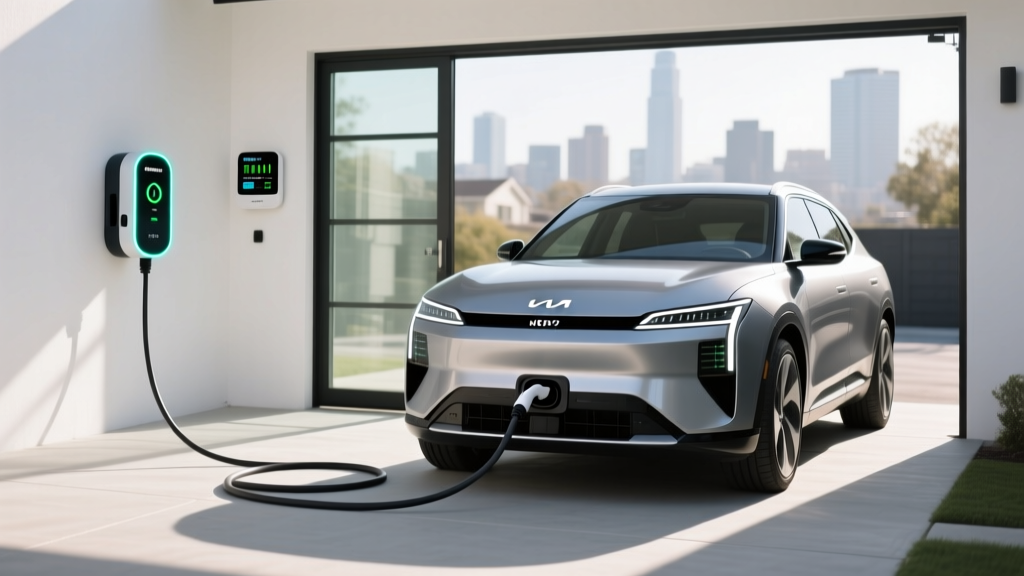
The three-row Kia EV9 Long Range is one of the most capable family electric SUVs on the market, offering an EPA-estimated 283 miles of range from its 86.3 kWh (usable) NMC battery pack. But owning a large-battery EV means your charging strategy directly determines whether you enjoy effortless daily driving or frustrating delays. With a battery this size, Level 1 charging is impractical for anything beyond emergency trickle-top-ups, a properly sized Level 2 home charger is essentially mandatory, and knowing the EV9's DC fast-charging behavior can save you 20+ minutes on road trips.
This guide covers every charging scenario for the Kia EV9 Long Range — home installation requirements and real costs, public charging networks and connector compatibility, equipment recommendations, and the actual cost per mile compared to a gas-powered three-row SUV.
Kia EV9 Long Range: Battery and Charging Specs at a Glance
Before sizing your charger or planning a road trip, you need the hard numbers. The EV9 Long Range is a rear-wheel-drive configuration; the dual-motor AWD variant uses a similar battery but has slightly lower range due to higher weight and drivetrain losses.
| Specification | Value |
|---|---|
| Battery capacity (usable) | 86.3 kWh, NMC chemistry |
| EPA range | 283 miles (Long Range RWD); expect ~240–260 mi real-world highway, ~210–230 mi in freezing temps) |
| Onboard AC charger (Level 2 max) | 10.9 kW |
| DC fast-charge peak rate | ~210 kW (peak, 800V architecture) |
| DC 10–80% charge time | ~24 minutes (at a 350 kW-capable station, optimal battery temp) |
| Connector (2025 model year) | CCS1 (NACS adapter required for Tesla Superchargers) |
| Efficiency | 87 MPGe combined (fueleconomy.gov) |
| Battery warranty | 10 years / 100,000 miles (capacity retention threshold: 70%) |
Charging Levels Explained: Speeds, Times, and What Each Means for the EV9
Understanding the three charging levels is essential. The critical distinction: kW (kilowatts) measures power — how fast energy flows into the battery. kWh (kilowatt-hours) measures energy — the total capacity of the battery, like gallons in a fuel tank. A 10 kW charger delivers 10 kWh of energy in one hour (theoretically — real-world losses are ~10–15%).
| Level | Voltage / Power | Miles of Range per Hour | Full Charge Time (EV9) | Best For |
|---|---|---|---|---|
| Level 1 | 120V / ~1.4 kW | ~3–5 mi/hr | ~60+ hours | Emergency top-up only |
| Level 2 | 240V / 7.7–10.9 kW | ~25–38 mi/hr | ~8–11 hours | Daily home charging |
| DC Fast | 400–800V / 50–210+ kW | ~180–500+ mi/hr (peak) | 10–80% in ~24 min | Road trips, rapid top-ups |
Why Level 1 won't work for the EV9: At 1.4 kW, recovering even 100 miles of range takes roughly 20–25 hours. With an 86.3 kWh battery, a full recharge would take well over two days. Level 1 is fine for a PHEV with a 15 kWh battery, but for a large BEV like the EV9, it's an emergency backup — not a daily solution.
Level 2 is your daily workhorse: The EV9's onboard AC charger maxes out at 10.9 kW, meaning even if you install a 48-amp (11.5 kW) home charger, the car will only accept 10.9 kW. A 40-amp circuit delivering 9.6 kW is the practical sweet spot — it'll add roughly 33 miles of range per hour and fully recharge the EV9 overnight in about 9 hours.
DC fast charging and the charge curve: The EV9's 800V electrical architecture enables peak charging at up to ~210 kW, but that peak rate only holds between roughly 10–40% state of charge (SoC). Above 60%, the rate tapers significantly to protect battery health. By 80%, you're typically at 60–80 kW. This is why the industry-standard metric is 10–80% time (~24 minutes for the EV9 at a 350 kW station). Charging from 80–100% on DC fast can take nearly as long as the 10–80% session — plan accordingly and skip the top-off unless you truly need it.
Home Level 2 Charger Installation: Electrical Requirements, Costs, and Gotchas
Installing a Level 2 home charger for the EV9 Long Range involves more than buying a wallbox. Your home's electrical panel, available circuit capacity, and local code requirements all factor in — and costs vary enormously depending on your situation.
Electrical Requirements
- Circuit: A dedicated 240V circuit, either 40-amp (for a 32-amp / 7.7 kW charger) or 50-amp (for a 40-amp / 9.6 kW charger). A 60-amp circuit supports 48-amp / 11.5 kW chargers, but the EV9 caps at 10.9 kW, so 50-amp is the sweet spot.
- Wire gauge: 6 AWG copper for a 50-amp circuit; 4 AWG for 60-amp. Your electrician will specify based on run length.
- Connector: NEMA 14-50 outlet (for plug-in chargers) or hardwired connection (required for some 48-amp+ units and preferred by many inspectors for safety).
- GFCI protection: NEC 2020 and later require GFCI protection for EV receptacles. Hardwired chargers with built-in ground-fault protection often satisfy this without a separate GFCI breaker (which can cost $100–$150 extra and is prone to nuisance tripping).
- Outdoor rating: If your charger is mounted outside or in an unsealed garage, it must carry a NEMA 4 or NEMA 4X rating for weather resistance.
Installation Cost Breakdown
Home charger installation costs vary wildly based on panel capacity, wire run distance, and local labor rates. Here's what to budget:
| Component | Simple Install (panel near garage) | Complex Install (long run or panel upgrade) |
|---|---|---|
| Level 2 charger (equipment) | $400 – $750 | $400 – $750 |
| Electrician labor (2–4 hrs simple; 6–12+ hrs complex) | $300 – $800 | $1,000 – $3,000 |
| Electrical permit | $50 – $150 | $50 – $200 |
| Panel upgrade (100A → 200A, if needed) | N/A | $1,500 – $4,000 |
| Conduit, wire, breaker, misc. | $100 – $300 | $300 – $800 |
| Total estimated cost | $850 – $2,000 | $2,750 – $8,750 |
What About the Federal Tax Credit?
The IRS §30D credit applies to the vehicle itself, not home charging equipment. However, the Alternative Fuel Vehicle Refueling Property Credit (IRS §30C) may cover up to 30% of home charger installation costs (max $1,000) if you live in a qualifying census tract. Check irs.gov for current eligibility rules, as these are subject to change and have specific geographic and income requirements.
Connector Compatibility: CCS1, NACS, and What the EV9 Needs
The 2025 Kia EV9 ships with a CCS1 (Combined Charging System) port. This is the standard connector used by Electrify America, EVgo, ChargePoint, and most non-Tesla DC fast-charging networks. However, the North American charging landscape is shifting rapidly toward NACS (the Tesla connector), and understanding your options is critical.
| Connector | Network Access | EV9 Compatibility |
|---|---|---|
| CCS1 | Electrify America, EVgo, ChargePoint, most non-Tesla DCFC | Native — no adapter needed |
| NACS (Tesla) | Tesla Supercharger network (17,000+ stalls in North America) | Requires CCS-to-NACS adapter (Kia-approved or Tesla-authorized; ~$200–$250) |
| CHAdeMO | Largely legacy/deprecated in North America | Not compatible; not relevant for new EV9 owners |
| J1772 (Level 2 AC) | Public Level 2 chargers everywhere | Native — included adapter typically ships with vehicle |
Adapter reality check: Kia has confirmed that future model-year EVs will adopt NACS natively, but the 2025 EV9 still uses CCS1. If you plan to use Tesla Superchargers — which offer the most reliable and extensive DC fast-charging network — budget for a quality CCS-to-NACS adapter. Not all adapters are equal: ensure yours is rated for at least 250 kW DC and carries proper safety certifications. Kia has also begun offering an official adapter through dealerships.
Preconditioning note: The EV9 can precondition its battery when you navigate to a DC fast charger via the built-in navigation system. This warms or cools the battery to the optimal temperature for charging, which can shave 5–10 minutes off your 10–80% time in cold weather. Always use nav-directed preconditioning when possible — it's one of the most impactful charging habits you can adopt.
Cost to Charge the EV9 Long Range: Home vs. Public vs. Gas
The cost advantage of home charging is where EV ownership economics really shine — but public DC fast charging narrows the gap considerably. Here's a realistic breakdown for the EV9 Long Range.
| Scenario | Rate ($/kWh) | Full Charge Cost (0–100%) | Cost per Mile (283 mi EPA) |
|---|---|---|---|
| Home (off-peak utility rate) | $0.10 – $0.15 | $8.63 – $12.95 | $0.03 – $0.05 |
| Home (standard residential avg.) | $0.16 – $0.20 | $13.81 – $17.26 | $0.05 – $0.06 |
| Public Level 2 (network) | $0.25 – $0.49 | $21.58 – $42.29 | $0.08 – $0.15 |
| DC Fast Charging (public) | $0.35 – $0.60 | $30.21 – $51.78 | $0.11 – $0.18 |
Gas comparison: A comparable gas-powered three-row SUV (e.g., Kia Telluride) averages about 22 MPG combined. At $3.50/gallon, that's $0.16 per mile. Even at standard residential electricity rates, the EV9 Long Range at $0.05–$0.06/mile costs roughly one-third as much to fuel. However, if you rely exclusively on DC fast charging at $0.50+/kWh, your cost per mile ($0.15–$0.18) approaches or exceeds the gas vehicle. Home charging access is the single biggest factor in EV operating cost savings.
Best Home Level 2 Chargers for the Kia EV9 Long Range
Since the EV9 caps AC charging at 10.9 kW, you want a charger that delivers at least 40 amps (9.6 kW) to get close to that ceiling. Going to 48 amps (11.5 kW) provides marginal benefit given the car's onboard limit, but future-proofs for your next EV. Here are proven picks:
ChargePoint Home Flex
- Power: Up to 12 kW (50A) — configurable via DIP switches
- Connector: J1772 (NACS version also available for 2026)
- Cable length: 23 feet
- Smart features: Wi-Fi, app scheduling, Alexa, utility demand-response integration
- Price: ~$550–$650
- Why for EV9: Adjustable amperage lets you match your circuit exactly. UL-listed, NEMA 4 rated for outdoor use.
Emporia Level 2 EV Charger
- Power: Up to 11.5 kW (48A)
- Connector: J1772
- Cable length: 24 feet
- Smart features: Wi-Fi, app with energy monitoring, solar integration, load management
- Price: ~$400–$500
- Why for EV9: Best value smart charger. Energy monitoring helps track charging costs. Load-management feature pairs with Emporia Vue panel monitor to avoid panel overload.
Tesla Wall Connector (with J1772 adapter)
- Power: Up to 11.5 kW (48A)
- Connector: NACS native (use J1772 adapter for EV9) — or J1772 version available
- Cable length: 24 feet
- Smart features: Wi-Fi, OTA updates, power-sharing between two units
- Price: ~$400–$475
- Why for EV9: Sleek, reliable, and future-proof if your next EV is NACS-native. Power-sharing is useful for two-EV households.
Pro tip: For the EV9, set your charger to schedule charging during off-peak utility hours (typically 10 PM – 6 AM). Most utilities offer time-of-use (TOU) plans that can drop your rate to $0.08–$0.12/kWh overnight — cutting your "fuel" cost to under $10 for a full charge.
Public DC Fast Charging: Networks, Speeds, and Road-Trip Strategy
The EV9 Long Range's 800V architecture and ~210 kW peak DC charging rate put it in the upper tier of family EVs for road-trip practicality. Here's how to leverage it:
- Electrify America: Offers 150 kW and 350 kW stalls. The EV9 can pull close to its 210 kW peak on a 350 kW stall, delivering a 10–80% charge in roughly 24–27 minutes. Expect to pay $0.37–$0.57/kWh depending on location and membership tier.
- Tesla Supercharger (with adapter): V3 Superchargers deliver up to 250 kW. The EV9 will charge quickly here, and the Supercharger network offers the best reliability and coverage. You'll need the CCS-to-NACS adapter and the Tesla app for payment (or use the built-in adapter integration if supported by your model year).
- EVgo: Growing network of 350 kW-capable stalls. Pricing varies by plan; the EV9's CCS1 connector works natively.
- ChargePoint: Primarily Level 2, with some DC fast locations. Useful for destination charging but not your primary road-trip network.
Safety and Code Considerations for Home Charging
EV charging draws sustained high current for hours — far more demanding than typical household appliances. Proper installation isn't optional; it's a safety and insurance requirement.
- Dedicated circuit: Your EV charger must have its own dedicated breaker — never share a circuit with other appliances. A 50-amp charger needs a 50-amp breaker on a dedicated 240V line.
- Permit and inspection: Virtually all jurisdictions require an electrical permit for EV charger installation. The inspection ensures code compliance and protects your home insurance coverage. Unpermitted work can void claims in the event of an electrical fire.
- Hardwired vs. plug-in: Hardwired installations eliminate the NEMA 14-50 receptacle (a known failure point if low-quality outlets are used) and are preferred for 48-amp+ chargers. If you use a 14-50 outlet, invest in a commercial-grade receptacle (Hubbell or Bryant, ~$80–$120) — cheap residential-grade outlets have been linked to overheating under sustained EV charging loads.
- Cable management: Use a holster or cable organizer to keep the charging cable off the ground and protected from damage. The EV9's charging cable is thick and heavy — a proper mount prevents wear on the connector.
- Load management: If your panel is near capacity, consider a smart charger with load-management capability (like the Emporia or ChargePoint with a panel monitor). These devices dynamically reduce charging power if other household loads spike, preventing breaker trips without requiring a panel upgrade.
Frequently Asked Questions
How much does it cost to install a home EV charger for the Kia EV9?
A straightforward installation with an adequate electrical panel typically costs $850–$2,000 including the charger, electrician labor, permit, and materials. If your home needs a panel upgrade (100A to 200A), costs can rise to $2,750–$8,750. Always get a load calculation from a licensed electrician before committing.
How fast will each charging level add range to the EV9 Long Range?
Level 1 (120V) adds about 3–5 miles per hour — impractical for the 86.3 kWh battery. Level 2 (240V, 40–50A) adds 25–38 miles per hour, fully recharging overnight in 8–11 hours. DC fast charging at peak rate (~210 kW) can add 100+ miles in under 10 minutes, with a 10–80% session taking approximately 24 minutes at a 350 kW-capable station.
Which connector and charger is compatible with my Kia EV9?
The 2025 EV9 uses CCS1 for DC fast charging and J1772 for Level 2 AC charging — both are native. For Tesla Supercharger access, you'll need a CCS-to-NACS adapter (~$200–$250). Any J1772 Level 2 home charger rated 40–50 amps is compatible and will deliver close to the EV9's 10.9 kW onboard charging maximum.
How much does charging the EV9 cost per mile compared to gas?
At home on off-peak electricity ($0.12/kWh), the EV9 costs roughly $0.04 per mile — about 75% less than a comparable gas SUV at $0.16/mile (22 MPG, $3.50/gal). On public DC fast chargers at $0.50/kWh, the cost rises to ~$0.15–$0.18/mile, which is comparable to gas. Home charging is where the savings are.
What electrical upgrades might I need for a Level 2 charger?
The most common upgrade is a panel service increase from 100A to 200A, costing $1,500–$4,000. You may also need a new 240V circuit with appropriate wire gauge (6 AWG for 50A), a dedicated breaker, and a NEMA 14-50 outlet or hardwired connection. Older homes with 60A service will almost certainly need a full panel upgrade. An electrician's load calculation will determine your exact needs.
Does the Kia EV9 support vehicle-to-load (V2L) or vehicle-to-home (V2H)?
The EV9 supports V2L via an available adapter that plugs into the charging port, providing up to 3.6 kW of 120V AC power — enough to run appliances, tools, or camping equipment. V2H (powering your home during an outage) is not yet available on the US-spec EV9 but is part of Kia's stated roadmap for future capability.