Kia EV9 EPA Range: What the Sticker Says vs. Reality
The three-row Kia EV9 arrives with a big battery and big ambitions, but buyers searching for the Kia EV9 EPA range will find the number varies significantly by trim and drivetrain. For the 2026 model year, here's what the EPA rates and what you should actually plan for on a road trip.
| Trim | Drivetrain | Battery (kWh usable) | EPA Range | MPGe (combined) | Real-World Highway Expectation |
|---|---|---|---|---|---|
| Light / Wind RWD | RWD (201 hp) | 76.1 kWh (std) / 99.8 kWh (ext) | 230 mi (std) / 304 mi (ext) | 88–89 MPGe | ~250–275 mi |
| Wind / Land AWD | AWD (379 hp) | 99.8 kWh | 280 mi | 85 MPGe | ~235–255 mi |
| GT-Line AWD | AWD (379 hp) | 99.8 kWh | 270 mi | 83 MPGe | ~225–245 mi |
For reference, the EV9 uses NMC chemistry in its larger 99.8 kWh pack and LFP in the standard-range 76.1 kWh pack on Light RWD. That matters for charging habits: LFP tolerates (and prefers) regular 100% charges, while NMC benefits from daily charging to 80% with occasional 100% for long trips. Source: fueleconomy.gov.
Charging Levels Explained: kW, Miles Per Hour, and the EV9
Before plugging in, clarify the single most common EV confusion: kW is power (the rate of charging, like water pressure), while kWh is energy (what the battery stores, like tank size). The EV9's extended pack holds 99.8 kWh of energy; how fast you refill it depends on the charger's kW output.
| Level | Voltage / Amps | Power (kW) | Miles Added per Hour | 0–100% or 10–80% Time |
|---|---|---|---|---|
| Level 1 (120V) | 120V / 12A | ~1.4 kW | ~3–4 mi/hr | ~70+ hours (full) |
| Level 2 (240V home) | 240V / 40–48A | 9.6–11.5 kW | ~28–34 mi/hr | ~9–10 hours (full) |
| DC Fast (CCS/NACS) | 400V architecture | Up to ~210 kW peak | N/A (burst) | 10–80% in ~24 min |
On a DC fast charger, the EV9 peaks around 210 kW but — and this is critical — that peak only holds roughly between 10% and 35% SoC. Above 60%, the curve tapers sharply; above 80% it slows to near-Level-2 speeds to protect the battery. That's why the industry standard metric is 10–80% time, not 0–100%. Plan road-trip stops around that 10–80% window for the fastest throughput.
Home Charger Installation: Costs, Electrical Requirements, and Gotchas
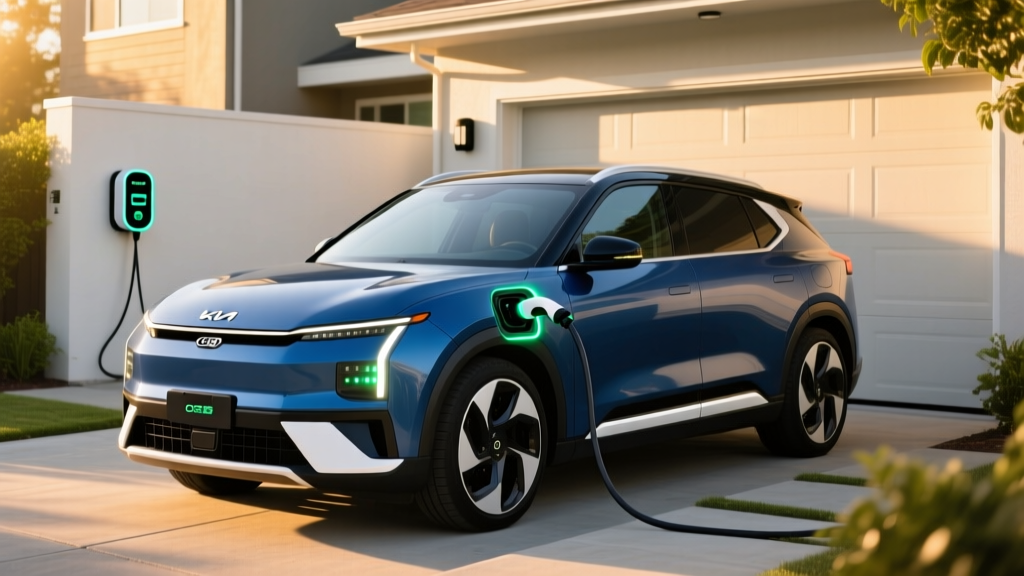
Charging the EV9 at home on Level 2 is where ownership makes sense. But installation costs vary wildly depending on your electrical panel, the run distance, and local code. Here's the realistic breakdown for a typical 48-amp Level 2 charger install in 2026.
| Item | Low End | High End | Notes |
|---|---|---|---|
| Level 2 charger hardware | $400 | $750 | 40A–48A hardwired or NEMA 14-50 plug |
| Electrician labor | $500 | $1,500 | Depends on run length, wall type, conduit |
| Permit & inspection | $50 | $300 | Varies by municipality |
| Panel upgrade (if needed) | $1,500 | $4,000 | Required if existing panel is 100A or near capacity |
| Total (no panel upgrade) | $950 | $2,550 | |
| Total (with panel upgrade) | $2,450 | $6,550 |
Electrical Requirements for the EV9
A 48-amp Level 2 charger requires a dedicated 60-amp circuit (NEC 80% continuous-load rule: 48A continuous draw needs a 60A breaker). You'll need 240V service, 6-gauge copper wire for runs up to ~50 feet, and a hardwired connection or NEMA 14-50 receptacle. Hardwired is preferred for 48A units because many 14-50 receptacles are only rated for 40A continuous.
Panel-upgrade warning: Homes built before 2000 often have 100-amp or 150-amp panels. Adding a 60-amp EV circuit to a 100-amp panel that's already running electric range, dryer, and A/C will likely trip the main breaker or fail inspection. Budget for a 200-amp panel upgrade if your electrician flags capacity — this is the single biggest surprise cost for new EV owners in older homes.
Safety and Code Considerations
- Dedicated circuit: EV chargers must have their own breaker — no sharing with other appliances.
- GFCI protection: NEC 2020+ requires GFCI on 240V receptacles in garages. Hardwired units typically don't require external GFCI (they have internal ground-fault protection).
- Outdoor rating: If mounting outside, the charger must be NEMA 4 rated, and the connector holster should protect the plug from rain and debris.
- Permit and inspection: Most jurisdictions require a permit for new 240V circuits. Skipping this can void homeowner's insurance coverage for electrical fires.
Connector Compatibility: NACS, CCS1, and the EV9 in 2026
The Kia EV9 sold in North America for 2026 uses the NACS (Tesla-style) charge port natively, a change from earlier model years that shipped with CCS1. This gives the EV9 direct access to the Tesla Supercharger network without an adapter — a significant advantage for road-trip charging reliability.
| Connector | Native on EV9? | Adapter Needed? | Network Access |
|---|---|---|---|
| NACS (Tesla) | Yes (2026+) | No | Tesla Supercharger, Electrify America (new stalls), Rivian Adventure Network |
| CCS1 | No (legacy 2024–2025 models have it) | CCS-to-NACS adapter (~$200) | Electrify America, EVgo, ChargePoint DC |
| CHAdeMO | No | Not practical (no adapter exists) | Legacy Nissan/Mitsubishi network — largely sunset |
| J1772 (Level 2 AC) | Adapter included | NACS-to-J1772 adapter | Public Level 2 stations, home chargers with J1772 cables |
If you own a 2024 or 2025 EV9 with CCS1, Kia offers a NACS adapter that unlocks Supercharger access. For 2026 models, the reverse adapter (NACS-to-CCS) is needed only at older Electrify America stalls that haven't been retrofitted with NACS cables. Always check the station's connector listing in the Kia Access app or PlugShare before driving to a charger.
Cost to Charge: Home vs. Public vs. Gas
The economics of EV9 ownership depend heavily on where you charge. Let's compare real 2026 electricity rates against the EPA-rated efficiency of the EV9 AWD (~34 kWh/100 miles, or 85 MPGe).
| Scenario | Rate | Cost per 100 mi | Cost per mile |
|---|---|---|---|
| Home Level 2 (off-peak) | $0.13/kWh | $4.42 | $0.044 |
| Home Level 2 (peak) | $0.25/kWh | $8.50 | $0.085 |
| Public Level 2 (ChargePoint, etc.) | $0.35/kWh | $11.90 | $0.119 |
| DC Fast Charging (EA, EVgo) | $0.48/kWh | $16.32 | $0.163 |
| Gasoline 3-row SUV (22 MPG avg) | $3.40/gal | $15.45 | $0.155 |
At home off-peak rates, the EV9 costs roughly one-quarter what a comparable gas SUV (like a Telluride at 22 MPG combined) costs per mile. Even at DC fast-charging rates, the EV9 is roughly cost-competitive with gas — and cheaper if you use a Kia Charge Pass subscription or Electrify America Pass+ plan that lowers the per-kWh rate to ~$0.36.
For a driver covering 12,000 miles per year with 80% home charging and 20% DC fast charging, annual fuel cost lands around $650–$800 versus $1,850+ for the gas equivalent. That's a $1,000+ annual savings, with payback on a home charger installation in roughly 1–2 years.
Recommended Home Chargers for the Kia EV9
Based on the EV9's 10.9 kW onboard AC charger acceptance rate, you need a Level 2 unit capable of at least 48 amps to maximize charge speed. Here are three proven options for 2026:
ChargePoint Home Flex (NACS)
- Power output: Up to 11.5 kW (48A / 240V)
- Connector: Native NACS cable (2026 version)
- Cable length: 24 ft (18 ft option available)
- Smart features: Wi-Fi, app scheduling, utility demand-response, energy tracking
- Price: ~$599
- Best for: Most EV9 owners — reliable, UL-listed, flexible amperage via internal DIP switch
Emporia Level 2 Smart Charger
- Power output: Up to 11.5 kW (48A / 240V)
- Connector: NACS (2026 model) or J1772 with adapter
- Cable length: 24 ft
- Smart features: Wi-Fi, solar integration, energy monitoring, Alexa
- Price: ~$399
- Best for: Budget-conscious owners or homes with solar panels
Wallbox Pulsar Plus (NACS)
- Power output: Up to 11.5 kW (48A / 240V)
- Connector: NACS native
- Cable length: 25 ft
- Smart features: Wi-Fi + Bluetooth, Power Sharing (two chargers on one circuit), app control
- Price: ~$649
- Best for: Two-EV households needing dual chargers on a shared 60A circuit
All three units are hardwired-capable and UL-listed (important for insurance and inspection). For the EV9's 99.8 kWh pack, a 48A charger delivers a full overnight charge in roughly 9–10 hours from near-empty — more than sufficient for daily use. There's no benefit to buying a higher-amperage charger (60A/80A units exist) because the EV9's onboard charger caps AC acceptance at 10.9 kW.
Charging the EV9 on Road Trips: DC Fast Charging in Practice
On a 300-mile road trip, the EV9 AWD (280-mile EPA range) will need one DC fast stop. Here's how to plan it:
- Depart at 90% SoC (~252 miles real-world highway range).
- Drive ~180–200 miles to stay above a 15% buffer.
- Stop at a 150+ kW NACS Supercharger or Electrify America stall. Precondition the battery via the EV9's navigation system — it will warm the pack for faster charge acceptance.
- Charge 10–80% in ~24 minutes. Expect to add roughly 190 miles of range.
- Continue to destination.
Without battery preconditioning (if you drive to a charger without routing through nav), expect the 10–80% time to stretch to 30+ minutes in cold weather because the pack will be too cool for peak charge rates. The EV9's 400V architecture is capable but not class-leading — the Hyundai Ioniq 5's 800V system charges 10–80% in ~18 minutes under similar conditions.
For towing, range drops sharply. Kia rates the EV9 AWD at 5,000 lbs towing capacity, but expect a 35–45% range reduction when pulling a loaded trailer. That turns a 280-mile EPA range into ~155–180 real miles — plan DC stops accordingly.
Frequently Asked Questions
How much does it cost to install a home EV charger for the Kia EV9?
Between $950 and $2,550 for a standard 48-amp Level 2 installation (equipment, electrician, and permit). If your home needs a 200-amp panel upgrade, add $1,500–$4,000. Most 2000+ homes with existing 200A panels fall in the lower range.
How fast will each charging level add range to the EV9?
Level 1 (120V) adds roughly 3–4 miles per hour — only useful for overnight top-ups or emergencies. Level 2 (240V, 48A) adds about 28–34 miles per hour, fully recharging the 99.8 kWh pack overnight. DC fast charging adds ~190 miles in 24 minutes (10–80% SoC) at a 150+ kW station.
Which connector is compatible with the 2026 Kia EV9?
The 2026 EV9 uses NACS natively for both AC and DC charging. It can plug directly into Tesla Superchargers and newer Electrify America stalls. For older CCS1-only DC stations, you'll need a CCS-to-NACS adapter. A NACS-to-J1772 adapter (usually included) is needed for older public Level 2 stations.
How much does charging the EV9 cost per mile vs. gas?
At home off-peak rates ($0.13/kWh), the EV9 costs about $0.044 per mile — roughly one-third the $0.155/mile cost of a 22-MPG gas SUV at $3.40/gallon. Even at public DC fast-charging rates ($0.48/kWh), the EV9 is cost-competitive with gas at $0.163/mile.
What electrical upgrades might I need for a home charger?
If your home has a 100-amp electrical panel, you'll likely need an upgrade to 200 amps ($1,500–$4,000) to support a dedicated 60-amp EV circuit alongside existing loads. Homes with 200A panels usually have sufficient capacity. Your electrician will perform a load calculation per NEC Article 220 to determine this. Some utilities offer rebates of $200–$500 for panel upgrades tied to EV adoption — check with your local provider.
Does the Kia EV9 qualify for the federal EV tax credit?
Under current IRS §30D rules, the EV9 may qualify for up to $7,500 in federal tax credits, but eligibility depends on the buyer's modified adjusted gross income (AGI caps: $150K single, $300K joint), the vehicle's MSRP (must be under $80,000 for SUVs), and battery critical-mineral and component sourcing requirements that change annually. As of 2026, the credit can be transferred to the dealer as a point-of-sale discount. Confirm current eligibility on fueleconomy.gov before purchasing, as sourcing rules shift frequently.