If you own a 2025–2026 Kia EV6 or are shopping for one, you have likely seen Tesla Superchargers at nearly every highway rest stop and wondered: can I actually plug in? The short answer is yes — Kia has adopted the North American Charging Standard (NACS) for its EV lineup, and the Supercharger network is now open to non-Tesla vehicles. But the details around adapters, charge speeds, connector compatibility, and home charging setup matter far more than a simple yes or no.
This guide walks through every layer of charging a Kia EV6 in 2026 — from plugging into a V4 Supercharger on a road trip to wiring a Level 2 charger in your garage — with exact kW figures, real-world charge times, and honest cost breakdowns.
Kia EV6 and the Tesla Supercharger Network: How It Works in 2026
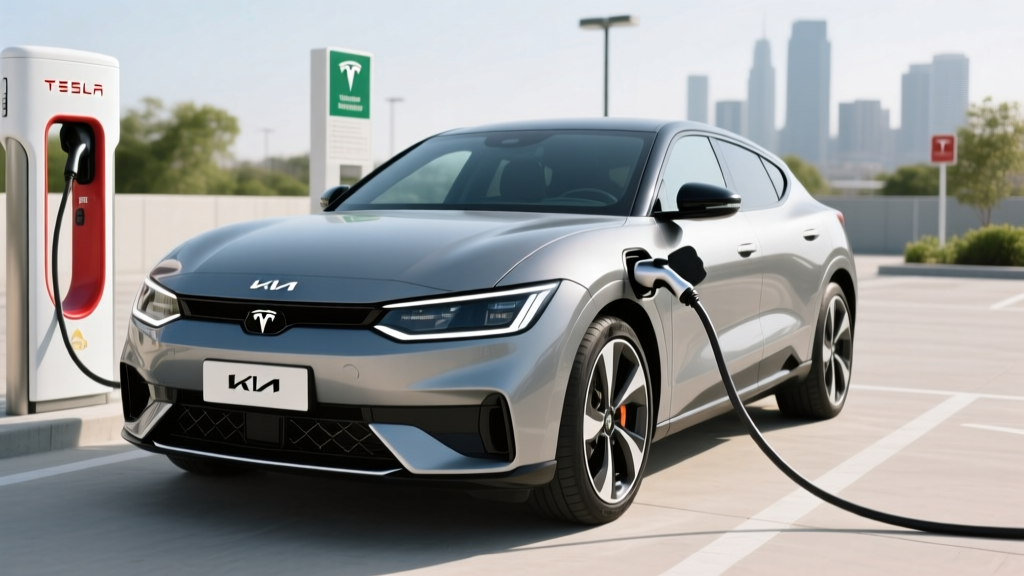
Starting with the 2025 model year, Kia transitioned the EV6 (and EV9) to the NACS charge port, replacing the CCS1 connector used on 2022–2024 models. This means a 2025 or 2026 Kia EV6 can plug directly into any Tesla Supercharger stall equipped with a NACS (Tesla) connector — no adapter required.
Owners of 2022–2024 Kia EV6 models with CCS1 ports can access Superchargers using a NACS-to-CCS adapter. Kia offers an official adapter through dealerships, and third-party options from brands like Lectron and A2Z are also available. Expect to pay $150–$250 for a quality adapter rated for DC fast charging at up to 250 kW.
| Model Year | Native Port | Tesla Supercharger Access | Adapter Needed? |
|---|---|---|---|
| 2022–2024 | CCS1 | Yes, with adapter | NACS-to-CCS1 adapter (~$150–$250) |
| 2025–2026 | NACS | Yes, native plug | None for Superchargers; CCS adapter for legacy stations |
Important caveat: Not every Supercharger location has been opened to non-Tesla vehicles. Use the Tesla app or the in-car navigation on the EV6 (which now integrates Supercharger locations) to confirm a stall is available to your vehicle. As of early 2026, the vast majority of V3 and V4 Supercharger sites in the U.S. welcome NACS-equipped vehicles.
Charging Levels Explained: kW, Speeds, and What They Mean for Your EV6
Before we get to costs and install requirements, let's nail down the three charging levels. The critical distinction: kW (kilowatts) measures power — the rate at which electricity flows into your battery. kWh (kilowatt-hours) measures energy — the total capacity stored in your battery. Think of kW as the width of a hose and kWh as the size of the bucket.
The 2026 Kia EV6 carries a 77.4 kWh usable battery (NMC chemistry) and supports up to 240 kW peak DC fast charging on its 800-volt architecture. Here is how each level translates to real range added:
| Level | Voltage / Amps | Power (kW) | Miles of Range Per Hour | Typical Use Case |
|---|---|---|---|---|
| Level 1 | 120V / 12A | ~1.4 kW | ~4–5 mi/hr | Emergency / overnight trickle |
| Level 2 (Home) | 240V / 40A | ~9.6 kW | ~30–35 mi/hr | Daily home charging |
| Level 2 (Max) | 240V / 48A | ~11.5 kW | ~36–40 mi/hr | Home / workplace (faster L2) |
| DC Fast (V3 Supercharger) | 400V+ DC | Up to 240 kW peak | ~900+ mi/hr (at peak) | Road trips |
Real-world DC fast charging times for the EV6:
- 10–80% at a 250 kW V3 Supercharger: approximately 18–22 minutes (peak rate tapers above ~55% SoC)
- 10–80% at a 150 kW CCS station: approximately 28–35 minutes
- Full Level 2 charge (10–100% at 9.6 kW): roughly 7.5–8 hours
The EV6's 800-volt architecture is its charging superpower. While most competitors peak at 150–175 kW on DC fast chargers, the EV6 sustains higher power deeper into the charge curve, meaning your 10–80% stop is genuinely one of the fastest in the segment. Just remember: peak kW is not sustained kW. You will see 230+ kW briefly in the 10–30% SoC window, then a gradual taper. This is normal physics, not a defect.
Home Charger Installation: Electrical Requirements, Costs, and Gotchas
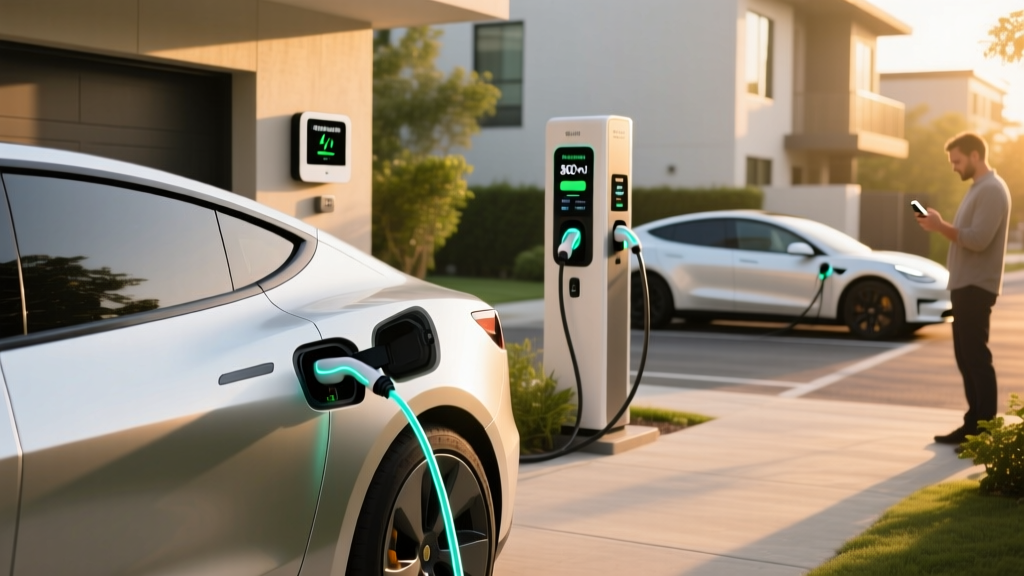
Charging at home is where EV ownership becomes effortless — you wake up every morning with a "full tank." But getting a Level 2 charger wired correctly requires understanding your home's electrical capacity.
Electrical Requirements for a Level 2 Home Charger
A typical Level 2 charger delivering 9.6 kW requires a 240-volt, 50-amp dedicated circuit (the charger draws a continuous 40 amps, and NEC code requires circuits to be rated at 125% of continuous load). For a more powerful 11.5 kW charger, you will need a 60-amp circuit (48A continuous draw).
Panel upgrade considerations: Most homes built after 1990 have a 200-amp main panel, which can usually accommodate a 50-amp EV circuit. Older homes with 100-amp service, or homes already running heavy loads (electric range, dryer, HVAC, hot tub), may need a panel upgrade to 200A or even 400A. A panel upgrade adds $1,500–$4,000+ to your project and should be evaluated by a licensed electrician during a load calculation.
Installation Cost Breakdown
| Component | Cost Range | Notes |
|---|---|---|
| Level 2 Charger (Equipment) | $350–$700 | Smart Wi-Fi chargers; hardwired or NEMA 14-50 plug |
| Electrician Labor | $500–$2,000 | Depends on run length, wall type, conduit needs |
| Permit & Inspection | $50–$250 | Required by most jurisdictions; varies by city/county |
| Panel Upgrade (if needed) | $1,500–$4,000+ | Only if existing panel lacks capacity |
| Total (no panel upgrade) | $900–$2,950 | Most common scenario for modern homes |
| Total (with panel upgrade) | $2,400–$6,950+ | Older homes or heavy-load households |
Safety and code requirements to verify with your electrician:
- Dedicated circuit: Your EV charger must have its own breaker — no sharing with other appliances.
- GFCI protection: NEC 2020 and later require GFCI protection for outdoor receptacles; hardwired installations may bypass this requirement in some jurisdictions.
- Outdoor rating: If your charger is mounted outside, it must carry a NEMA 4 or NEMA 4X weather rating.
- Wire gauge: 6 AWG copper for a 50A circuit; 4 AWG for 60A. Your electrician will spec this based on run length and local code.
- Wi-Fi smart features: Most modern chargers offer app-based scheduling to take advantage of off-peak utility rates — a significant cost saver.
Recommended Level 2 Chargers for the Kia EV6
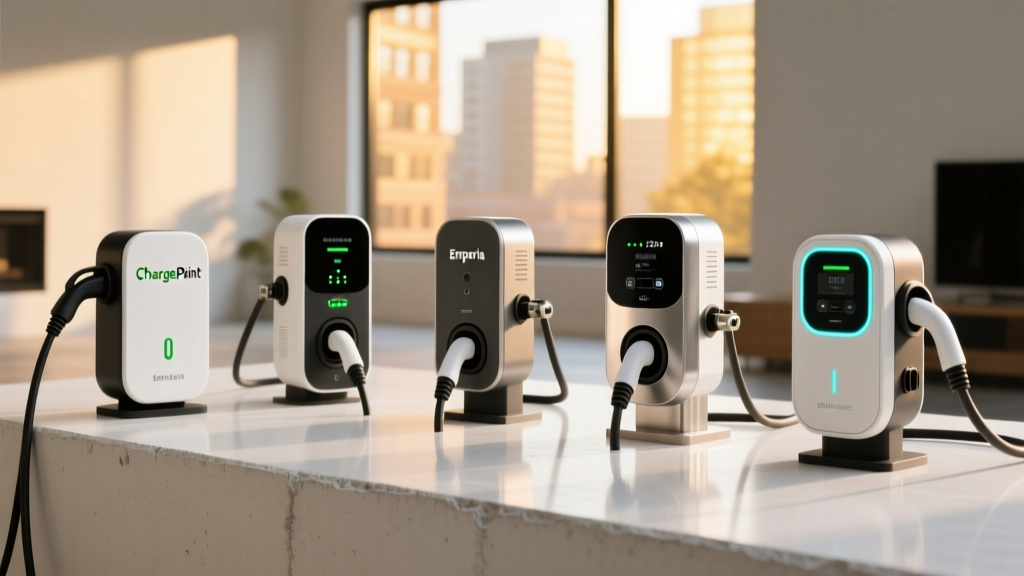
Here are three chargers that pair well with the EV6's capabilities and the realities of home electrical systems. All support NACS connectors natively for 2025–2026 models or can be ordered with a CCS1 plug for older EV6s.
Emporia Vue Level 2 Smart Charger
- Power Output: 48A / 11.5 kW (240V)
- Connector: NACS (native) or J1772 with adapter
- Cable Length: 24 ft
- Smart Features: Wi-Fi, app scheduling, solar integration, energy monitoring
- Price: ~$399
- Best For: Budget-conscious buyers who want smart scheduling and energy tracking
ChargePoint Home Flex (2nd Gen)
- Power Output: Up to 50A / 12 kW (240V, adjustable)
- Connector: NACS or J1772 (configurable)
- Cable Length: 23 ft
- Smart Features: Wi-Fi, Alexa integration, charge scheduling, amperage adjustment via app
- Price: ~$599
- Best For: Flexibility — adjust amperage down if your panel is tight
Wallbox Pulsar Plus (NACS)
- Power Output: 48A / 11.5 kW (240V)
- Connector: NACS native
- Cable Length: 25 ft
- Smart Features: Wi-Fi + Bluetooth, app control, Power Sharing for dual-charger setups
- Price: ~$549
- Best For: Compact design, outdoor-rated (NEMA 4), and dual-EV households
Pro tip: The EV6's onboard charger maxes out at 10.9 kW (AC), so an 11.5 kW / 48A charger will fully utilize it. Going to a 19.2 kW charger offers no benefit for the EV6 specifically.
Cost to Charge: Home vs. Public vs. Gas — The Per-Mile Breakdown
The economic case for EVs hinges on charging costs. Let's run real numbers for the 2026 Kia EV6 (AWD Long Range, EPA-rated 310 miles of range, approximately 3.5 miles per kWh combined efficiency per fueleconomy.gov).
| Scenario | Rate | Cost Per kWh | Cost Per Mile (EV6) |
|---|---|---|---|
| Home (off-peak utility rate) | $0.12/kWh | $0.12 | $0.034 |
| Home (average U.S. rate) | $0.17/kWh | $0.17 | $0.049 |
| Public Level 2 (ChargePoint, etc.) | $0.25–$0.40/kWh | $0.32 avg | $0.091 |
| Tesla Supercharger (V3/V4) | $0.28–$0.48/kWh | $0.36 avg | $0.103 |
| Electrify America DC Fast | $0.35–$0.55/kWh | $0.45 avg | $0.129 |
| Vehicle | MPG Combined | Fuel Price | Cost Per Mile |
|---|---|---|---|
| Kia Sportage (2.5L AWD) | 26 MPG | $3.30/gal | $0.127 |
| Toyota RAV4 (AWD) | 30 MPG | $3.30/gal | $0.110 |
The bottom line: Charging at home on off-peak rates costs roughly $0.03–$0.05 per mile — about one-quarter to one-third the cost of fueling a comparable gas crossover. Even at Supercharger prices ($0.10/mi), you are still saving versus gasoline. The savings evaporate only if you rely exclusively on the most expensive public DC fast chargers daily, which is not how most EV owners charge.
For a driver covering 12,000 miles per year, home charging at $0.17/kWh costs approximately $588 annually. The equivalent gas cost in a 26-MPG crossover is $1,524. That is roughly $936 in annual fuel savings, not accounting for reduced maintenance (no oil changes, fewer brake replacements due to regenerative braking).
Real-World Range and Charging: What the EPA Sticker Doesn't Tell You
EPA Range (2026 EV6 Long Range AWD): 310 miles
Real-World Expectations:
- Mixed driving (city + highway, 65–75°F): ~280–300 miles
- Highway-only at 75 mph: ~250–270 miles
- Cold weather (below 32°F, highway): ~210–240 miles (20–30% reduction)
- Cold weather + cabin heat + mountain terrain: ~190–220 miles
Plan road-trip charging stops with the real-world figure, not the EPA sticker. The EV6's heat pump (standard on most trims) helps mitigate cold-weather losses compared to EVs without one.
Preconditioning matters: The EV6 can precondition its battery for DC fast charging when you navigate to a charge station in the infotainment system. This warms the battery to optimal temperature, enabling faster charge acceptance — especially critical in cold weather. Without preconditioning, your first several minutes at a Supercharger may be limited to 80–120 kW instead of the 230+ kW peak. Always use navigation to route to a charger.
Kia EV6 Key Specs at a Glance
| EPA Range | 310 miles |
| Battery Capacity (Usable) | 77.4 kWh (NMC) |
| Max DC Fast Charge Rate | 240 kW peak (800V architecture) |
| 10–80% DC Fast Charge Time | ~18–22 minutes (at 250 kW station) |
| Onboard Charger (AC Level 2) | 10.9 kW |
| Charge Port (2025+ Models) | NACS (native Tesla/Supercharger compatible) |
| Efficiency | 117 MPGe combined (~3.5 mi/kWh) |
| 0–60 mph | 5.1 seconds (AWD) / 7.2 seconds (RWD) |
| Horsepower | 320 hp (AWD) / 225 hp (RWD) |
| Starting MSRP | ~$42,900 (Light RWD) – $61,600 (GT AWD) |
| Battery / Powertrain Warranty | 10 years / 100,000 miles |
Federal tax credit note: The EV6's eligibility for the §30D federal tax credit (up to $7,500) depends on current-year battery sourcing, critical-mineral requirements, MSRP caps ($55,000 for SUVs/crossovers), and buyer income limits ($150K single / $300K joint). The credit can now be transferred to the dealer at point of sale as an instant discount. Verify eligibility with your dealer and a tax professional before purchase, as rules are subject to change.
Frequently Asked Questions
Can my 2023 Kia EV6 charge at a Tesla Supercharger?
Yes, but you will need a NACS-to-CCS1 adapter. Your 2022–2024 EV6 has a CCS1 port, while Tesla Superchargers use the NACS connector. An official Kia adapter or a reputable third-party option ($150–$250) bridges the gap. Confirm the adapter is rated for DC fast charging at 250 kW before purchasing.
How fast will the EV6 charge at a Tesla V4 Supercharger?
Tesla V4 Superchargers can deliver up to 250+ kW to non-Tesla vehicles. The EV6, with its 800V architecture and 240 kW peak acceptance, will charge at nearly the maximum rate the stall can provide. Expect 10–80% in approximately 18–22 minutes under good conditions (moderate battery temperature, preconditioned). At V4 cabinets with CCS adapters, speeds may vary.
Do I need to upgrade my electrical panel to install a home charger?
Not always. Homes with 200-amp service and available breaker slots can typically add a 50-amp EV circuit without a panel upgrade. Homes with 100-amp service, or those already running multiple high-draw appliances (electric oven, dryer, heat pump, hot tub), may need an upgrade. Your electrician will perform a NEC Article 220 load calculation to determine this. Budget $1,500–$4,000+ if an upgrade is needed.
Is it cheaper to charge at home or at a Tesla Supercharger?
Home charging is significantly cheaper. At a national average of $0.17/kWh, home charging costs about $0.05 per mile in the EV6. Tesla Superchargers average $0.36/kWh, or about $0.10 per mile. That is roughly double the cost. However, Supercharger pricing is still typically lower than gasoline on a per-mile basis. For maximum savings, charge at home overnight on a time-of-use (TOU) utility plan.
What is the difference between kW and kWh?
kW (kilowatts) is a measure of power — how fast electricity is flowing at a given moment. kWh (kilowatt-hours) is a measure of energy — the total amount of electricity consumed or stored over time. Your EV6 has a 77.4 kWh battery (the bucket). A 240 kW DC fast charger fills that bucket at a rate of up to 240 kW (the hose width). A 9.6 kW Level 2 charger fills it more slowly. Never use these interchangeably.
Does the Kia EV6 come with a portable charger?
Kia includes a basic 120V Level 1 charging cable (approximately 1.4 kW) with the EV6. This is suitable for emergencies or very low-mileage drivers (adding about 4–5 miles of range per hour). For daily use, a dedicated Level 2 home charger is strongly recommended.
Will charging at Tesla Superchargers void my Kia warranty?
No. Using a Supercharger — whether natively via NACS or through a quality adapter — does not void your Kia battery or powertrain warranty. Kia's 10-year/100,000-mile battery warranty covers defects and capacity loss below a specified threshold regardless of which network you use. However, damage caused by a faulty third-party adapter may not be covered, so use reputable, certified products.
Charging infrastructure has matured enough in 2026 that the EV6's access to Tesla's Supercharger network — combined with its best-in-class 800V charging speed — makes it one of the most road-trip-capable EVs on the market. Pair that with a properly installed Level 2 home charger, and the vast majority of your charging happens while you sleep, at a fraction of gasoline cost.