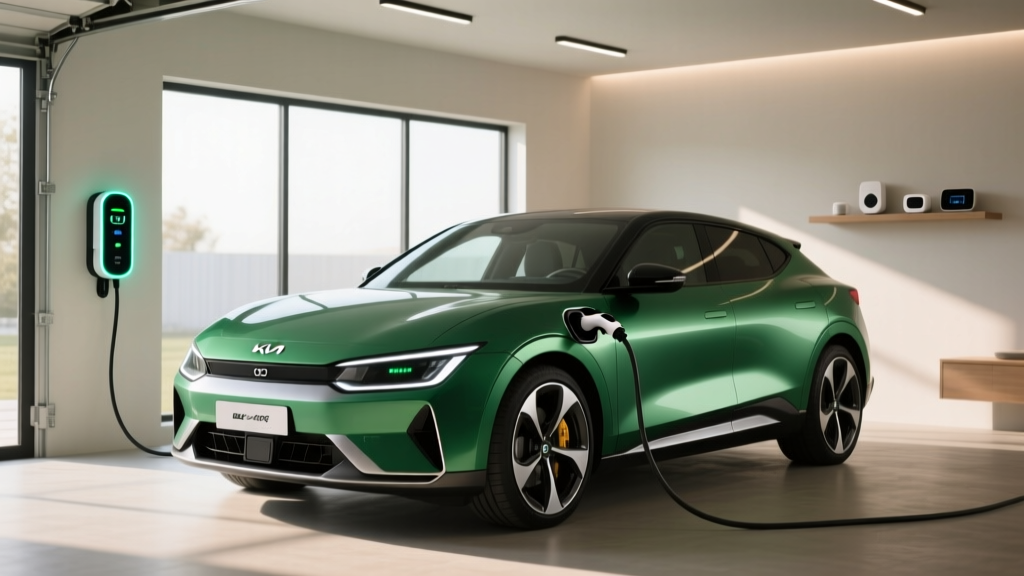
If you own or are shopping a Kia EV6, you already know its 800-volt architecture makes it one of the fastest-charging EVs on the road. But extracting the full benefit of that system — and preserving the Kia EV6 range you paid for — depends almost entirely on how you set up charging at home and which public networks you rely on. This guide walks through the exact electrical requirements, costs, and equipment you need to keep an EV6 charged efficiently in 2026.
2026 Kia EV6: Battery, Range, and Charging Specs at a Glance
Before sizing a charger, you need the EV6's hard numbers. The 2026 model year carries over the dual-battery strategy Kia introduced at launch, with updated EPA figures.
| Spec | Standard Range (RWD) | Long Range (RWD) | Long Range (AWD) | GT |
|---|---|---|---|---|
| Battery (usable) | 58.0 kWh (NMC) | 77.4 kWh (NMC) | 77.4 kWh (NMC) | 77.4 kWh (NMC) |
| EPA Range | 232 mi | 310 mi | 282 mi | 252 mi |
| Efficiency | 134 MPGe | 134 MPGe | 117 MPGe | 85 MPGe |
| Peak DC Charge Rate | 180 kW | 239 kW | 239 kW | 239 kW |
| 10–80% DC Time | ~22 min | ~18 min | ~18 min | ~18 min |
| Onboard AC Charger | 10.9 kW | 10.9 kW | 10.9 kW | 10.9 kW |
| Base MSRP | $42,900 | $47,500 | $51,500 | $61,900 |
| Battery Warranty | 10 years / 100,000 miles (≥70% capacity retention) | |||
Charging Levels Explained: kW, Miles per Hour, and Your EV6
The single most important EV literacy point: kW (kilowatts) measures power — how fast energy flows. kWh (kilowatt-hours) measures energy — how much your battery holds. A 77.4 kWh battery charged at 10.9 kW takes roughly 7 hours from empty. Here is what each level delivers for the EV6:
| Level | Voltage / Amps | Power (kW) | Miles of Range Added per Hour | EV6 10–80% Time (77.4 kWh) |
|---|---|---|---|---|
| Level 1 (120V outlet) | 120V / 12A | ~1.4 kW | ~4–5 mi/hr | ~44 hours |
| Level 2 (240V home) | 240V / 48A | ~11.5 kW | ~32–36 mi/hr | ~5.5 hours |
| Level 2 (240V, 40A circuit) | 240V / 40A | ~9.6 kW | ~27–30 mi/hr | ~6.5 hours |
| DC Fast (350 kW station) | 800V DC | Up to 239 kW | ~600+ mi/hr (peak) | ~18 minutes |
| DC Fast (150 kW station) | 400V+ DC | Up to 150 kW | ~400 mi/hr (peak) | ~25 minutes |
The EV6's 10.9 kW onboard AC charger is the bottleneck for home charging. Even if you install a 48-amp (11.5 kW) Level 2 station, the car caps intake at 10.9 kW. A 48A charger still makes sense — it future-proofs for your next EV and runs cooler at partial load.
Home Charger Installation: Electrical Requirements and Cost Breakdown
Most EV6 owners should install a hardwired Level 2 station on a dedicated 60-amp circuit (delivering 48A continuous to the car). Here is what that involves and what it costs.
Electrical Requirements
- Circuit: Dedicated 60A double-pole breaker, 240V
- Wire: 6 AWG copper (THHN in conduit or 6/2 NM-B for short indoor runs)
- Panel capacity: Your main panel must have 2 adjacent open slots and sufficient amperage headroom (typically a 200A panel for modern homes)
- GFCI: NEC 2023+ requires GFCI protection for 240V EV receptacles; hardwired units may be exempt in some jurisdictions
- Permit: Required in nearly all US jurisdictions; inspector will verify wire gauge, breaker sizing, and grounding
Installation Cost Breakdown
| Item | Simple Install (panel near garage) | Complex Install (long run / panel upgrade) |
|---|---|---|
| Level 2 Charger (equipment) | $400–$700 | $400–$700 |
| Electrician labor (2–4 hrs vs 6–10 hrs) | $400–$800 | $1,200–$2,500 |
| Wire, conduit, breaker, misc materials | $100–$300 | $300–$800 |
| Permit fee | $50–$200 | $50–$200 |
| Panel upgrade (100A → 200A) if needed | N/A | $1,500–$3,500 |
| Total Estimated Cost | $950–$2,000 | $3,450–$7,700 |
Panel upgrade reality check: Homes built before 1990 often have 100A or 150A panels that are already near capacity. Adding a 60A EV circuit may require a service upgrade to 200A. Get a licensed electrician to perform a load calculation before committing to equipment. Some utilities offer rebates of $250–$1,000 for panel upgrades tied to EV adoption.
Connector Compatibility: NACS, CCS1, and the 2026 EV6
The 2026 Kia EV6 sold in North America ships with the NACS (North American Charging Standard) port — the Tesla-style connector now adopted by most major automakers. This is a significant shift from the CCS1 port on 2022–2024 models.
| Connector | EV6 Model Year | Tesla Supercharger Access | Electrify America / EVgo / ChargePoint |
|---|---|---|---|
| NACS (native) | 2025–2026 EV6 | Direct plug — no adapter | Requires CCS1-to-NACS adapter (included with most new chargers or ~$200 aftermarket) |
| CCS1 (native) | 2022–2024 EV6 | Requires NACS-to-CCS1 adapter (~$200–$250) | Direct plug — no adapter |
| CHAdeMO | Not compatible | N/A | N/A — legacy standard, no adapter available for EV6 |
Adapter note: If you own a 2022–2024 EV6 with CCS1 and want Supercharger access, Kia and third-party suppliers offer NACS adapters rated for up to 250 kW DC. Verify the adapter is UL-listed and rated for your vehicle's peak charge rate. (Source: Kia.com EV6 specs)
Charging Cost: EV6 Cost per Mile vs Gasoline
The EV6 Long Range AWD consumes roughly 34 kWh per 100 miles (EPA combined). Your per-mile cost depends heavily on where and when you charge.
| Scenario | Rate ($/kWh) | Cost per 100 mi | Cost per Mile |
|---|---|---|---|
| Home, off-peak utility rate | $0.09 | $3.06 | $0.031 |
| Home, standard residential rate | $0.16 | $5.44 | $0.054 |
| Public Level 2 (ChargePoint, etc.) | $0.30 | $10.20 | $0.102 |
| DC Fast (Electrify America, EVgo) | $0.48 | $16.32 | $0.163 |
| Gasoline equivalent (25 MPG, $3.40/gal) | — | $13.60 | $0.136 |
Home charging at off-peak rates makes the EV6 roughly 4x cheaper per mile than a comparable gas crossover. Even DC fast charging is competitive with gasoline — but doing it daily erodes savings and accelerates battery wear. Plan to DC-fast-charge no more than 20–30% of your total charging for long-term battery health.
Best Level 2 Chargers for the Kia EV6 (2026 Picks)
These units pair well with the EV6's 10.9 kW onboard charger and NACS port.
ChargePoint Home Flex (NACS)
- Power Output: Up to 11.5 kW (48A, 240V)
- Connector: NACS native (CCS1 version also available)
- Cable Length: 23 ft
- Smart Features: Wi-Fi, app scheduling, utility demand-response, Alexa
- Price: ~$550
- Best For: Most EV6 owners; app ecosystem and utility integration
Wallbox Pulsar Plus (NACS)
- Power Output: Up to 11.5 kW (48A, 240V)
- Connector: NACS native
- Cable Length: 25 ft
- Smart Features: Wi-Fi + Bluetooth, load balancing, solar integration
- Price: ~$490
- Best For: Homes with solar panels; compact form factor
Tesla Wall Connector (NACS)
- Power Output: Up to 11.5 kW (48A, 240V)
- Connector: NACS native
- Cable Length: 24 ft
- Smart Features: Wi-Fi, OTA updates, power sharing (multiple units on one circuit)
- Price: ~$425
- Best For: Mixed Tesla + Kia households; lowest hardware cost at 48A
Emporia Vue + EV Charger
- Power Output: Up to 11.5 kW (48A, 240V)
- Connector: NACS or J1772
- Cable Length: 24 ft
- Smart Features: Whole-home energy monitoring, solar-aware scheduling, circuit-level tracking
- Price: ~$600 (charger) + $150 (Vue monitor)
- Best For: Data-driven owners wanting full home energy visibility
Safety, Code, and Installation Best Practices
EV charging draws sustained high current for hours — unlike a dryer or oven that cycles on and off. This makes proper installation non-negotiable.
- Dedicated circuit: Never share the EV circuit with other appliances. A 60A breaker serving only the charger prevents nuisance trips.
- Hardwired vs plug: Hardwired installations avoid the NEC GFCI requirement for 240V receptacles (which can cause false trips on some EVSEs). If you need portability, use a NEMA 14-50 receptacle with a GFCI breaker.
- Outdoor rating: If your charger is mounted outside or in an unsealed garage, confirm the unit is rated NEMA 4 (weatherproof). All picks above meet this standard.
- Thermal monitoring: Quality EVSEs like the ChargePoint and Wallbox include internal temperature sensors that throttle power if the unit overheats — critical for summer garage installs.
- Inspection: Always pull a permit and schedule inspection. Unpermitted EV charger installs can void home insurance claims and complicate future home sales.
Frequently Asked Questions
How much does it cost to install a home EV charger for the Kia EV6?
A straightforward Level 2 installation (short wire run, 200A panel with open slots) typically costs $950–$2,000 including equipment, labor, and permit. Homes needing a panel upgrade or long conduit runs should budget $3,500–$7,700. Always get a load calculation from a licensed electrician first.
How fast will each charging level add range to the EV6?
Level 1 (120V) adds roughly 4–5 miles per hour — adequate only for plug-in hybrids or emergency top-ups. Level 2 (240V, 48A) adds 32–36 miles per hour, fully replenishing the 77.4 kWh battery overnight. DC fast charging at a 350 kW station can add 200+ miles in 18 minutes, though the charge curve tapers significantly above 80% SoC.
Which connector does the 2026 Kia EV6 use?
The 2026 EV6 ships with a NACS (Tesla-style) charge port, giving direct access to Tesla Superchargers without an adapter. For Electrify America and other CCS1 networks, you will need a CCS1-to-NACS adapter. Model years 2022–2024 use CCS1 natively and need a NACS adapter for Supercharger access.
How much does charging the EV6 cost per mile compared to gas?
At a typical off-peak home rate of $0.09/kWh, the EV6 costs about $0.03 per mile. A comparable gas SUV at 25 MPG and $3.40/gallon costs $0.14 per mile — nearly 5x more. Even public DC fast charging at $0.48/kWh works out to $0.16/mile, roughly breaking even with gas.
What electrical upgrades might I need for a Level 2 charger?
The most common upgrade is a panel replacement from 100A to 200A service ($1,500–$3,500) if your existing panel lacks capacity for a 60A dedicated circuit. Older homes may also need a new meter base or utility service drop. A licensed electrician's load calculation will determine this before any work begins.
Does frequent DC fast charging hurt the EV6 battery?
Occasional DC fast charging has minimal impact. However, daily DC fast charging — especially at 239 kW peak rates — generates sustained heat that accelerates degradation over time. Kia's battery management system and 800V architecture handle heat well, but best practice is to rely on Level 2 for daily charging and reserve DC fast charging for road trips. The 10-year/100,000-mile warranty covers capacity loss below 70%.