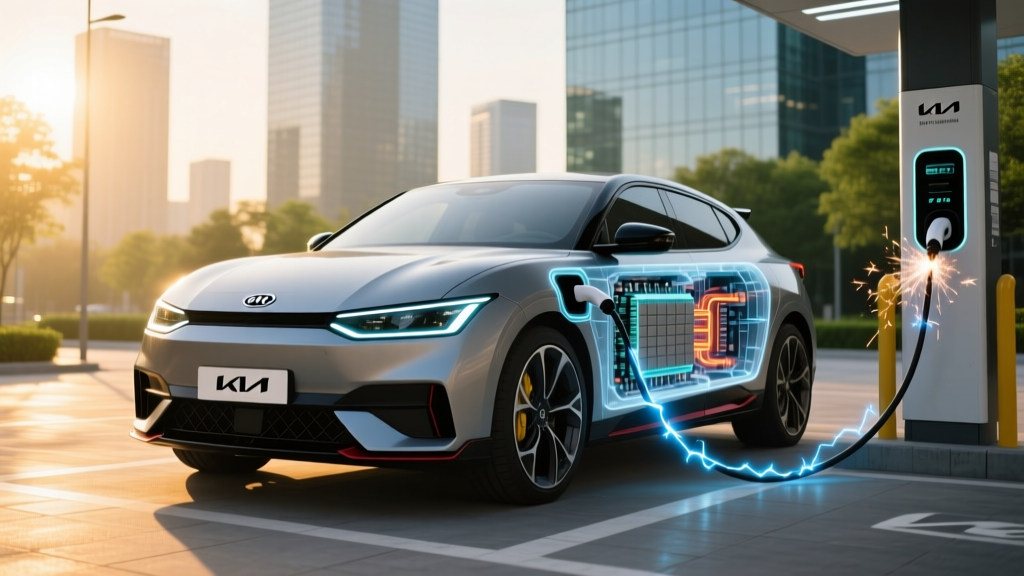
The Kia EV6 GT is an anomaly in the electric vehicle landscape: a 576-horsepower performance crossover that still delivers respectable efficiency. But buyers focused on the 0-60 mph time of 3.4 seconds often overlook the critical question: what is the real-world Kia EV6 GT range, and how do you keep it charged without spending a fortune? This guide covers the EV6 GT's 77.4 kWh battery, its 240 kW peak DC fast-charging capability, home Level 2 installation requirements, and exactly what you will pay per mile compared to a gas equivalent.
Kia EV6 GT Range: EPA Sticker vs Real-World Reality
The 2025–2026 Kia EV6 GT carries an EPA-estimated range of 206 miles on its 77.4 kWh (usable) NMC lithium-ion battery pack. That figure is lower than the EV6 Wind RWD's 310-mile EPA rating because the GT runs a dual-motor AWD powertrain, 21-inch wheels with stickier rubber, and a sport-tuned suspension that trades efficiency for grip.
EPA Combined: 206 miles
Highway (70 mph, moderate climate): ~175–190 miles
Cold Weather (below 32°F, heater on): ~140–160 miles
City/Regen-Heavy Driving: ~210–220 miles
The GT's dual motors and performance tires mean highway efficiency drops faster than lighter EV6 trims. Plan road trips around 150–160 mile segments in winter.
The EV6 GT's efficiency rating is approximately 79 MPGe combined, translating to roughly 42 kWh per 100 miles driven. In practical terms, that means highway driving at 75 mph will consume energy at a rate closer to 48–52 kWh/100mi, which is why real-world highway range falls short of the EPA sticker. The GT does include a heat pump as standard equipment, which mitigates cold-weather range loss compared to EVs without thermal management optimization.
Charging the EV6 GT: Level 1, Level 2, and DC Fast Charging Explained
Understanding charging speed requires separating two units that new EV owners frequently conflate: kW (kilowatts) measures power — the rate at which energy flows into your battery. kWh (kilowatt-hours) measures energy — the total capacity your battery stores. Think of kW as how fast water flows from a hose; kWh is the size of the bucket. The EV6 GT's bucket holds 77.4 kWh usable.
| Level | Power (kW) | Voltage / Amps | Miles of Range Per Hour | 0–100% Time (EV6 GT) |
|---|---|---|---|---|
| Level 1 (120V) | 1.0–1.4 kW | 120V / 12A | 2–3 miles | ~55–70 hours |
| Level 2 (240V) | 7.2–11.5 kW | 240V / 32–48A | 17–28 miles | ~7–11 hours |
| DC Fast (CCS/NACS) | 50–240 kW peak | 400–800V DC | 200–600+ miles (peak) | 10–80% in ~18 min |
The EV6 GT's onboard charger accepts up to 10.9 kW on Level 2 (AC), meaning a 48-amp, 240V home charger will add roughly 26 miles of range per hour of charging. On DC fast charging, the GT's 800V architecture enables a peak rate of 240 kW at compatible stations. In real-world testing on Electrify America 350 kW dispensers, the EV6 GT sustains roughly 200–230 kW from 10% to 55% SoC, then tapers progressively — hitting 80% in approximately 18 minutes under ideal thermal conditions. Above 80%, the charge curve drops sharply to protect the NMC cells, falling to under 50 kW by 90% SoC.
Home Level 2 Charger Installation: Requirements, Costs, and Panel Upgrades
To unlock the EV6 GT's full 10.9 kW Level 2 charging capability, you need a 240V circuit rated for at least 50 amps (which supports continuous 40A draw, or 48A for chargers that allow it). Here is what a typical installation involves:
Electrical Requirements:
- Dedicated 240V / 50-amp circuit (NEMA 14-50 outlet or hardwired connection)
- Minimum 100-amp electrical panel capacity available; 200-amp panel recommended
- 6 AWG copper wire for runs up to 50 feet; 4 AWG for longer runs
- GFCI breaker required by NEC 2020+ for EV charging circuits
| Component | Simple Install (Panel Nearby) | Complex Install (Long Run / Panel Upgrade) |
|---|---|---|
| Level 2 Charger (Equipment) | $400–$700 | $400–$700 |
| Electrician Labor | $300–$600 | $800–$2,000 |
| Permit & Inspection | $50–$150 | $100–$300 |
| Electrical Panel Upgrade (if needed) | $0 | $1,500–$3,500 |
| Conduit, Wire, Misc. | $50–$150 | $200–$500 |
| TOTAL | $800–$1,600 | $3,000–$7,000 |
The panel upgrade is the wildcard that catches many homeowners off guard. If your home has a 100-amp main panel that is already near capacity (common in homes built before 1990), adding a 50-amp EV circuit may require upgrading to a 200-amp panel. This adds $1,500–$3,500 to the project but is non-negotiable for safety and code compliance. A licensed electrician will perform a load calculation before recommending this.
Connector Compatibility: CCS1, NACS, and What the EV6 GT Uses
The 2025–2026 Kia EV6 GT sold in North America ships with a CCS1 (Combined Charging System) port. This means it uses the J1772 connector for Level 1/Level 2 AC charging and the CCS1 connector for DC fast charging. However, with the industry's ongoing shift toward the NACS (North American Charging Standard, originally Tesla's connector), Kia has announced that future model-year EV6 vehicles will transition to NACS. For current EV6 GT owners, here is what you need to know:
| Network / Connector | Compatible? | Adapter Needed? |
|---|---|---|
| Electrify America (CCS1) | Yes — native | No |
| EVgo (CCS1) | Yes — native | No |
| ChargePoint (CCS1 / J1772) | Yes — native | No |
| Tesla Supercharger (NACS) | Yes — with adapter | NACS-to-CCS1 adapter (~$200–$300) |
| Tesla Destination (J1772) | Yes — with adapter | Tesla-to-J1772 adapter (~$100–$150) |
Kia has offered a complimentary NACS adapter to qualifying EV6 owners for Supercharger access through select partnerships, but availability varies. Third-party adapters from brands like Lectron and A2Z also work, though always verify UL-listing or equivalent safety certification before purchasing. Using an uncertified adapter can void warranty coverage for charging-related issues.
Cost to Charge the EV6 GT: Home vs Public vs Gas Comparison
The EV6 GT's 77.4 kWh battery and ~42 kWh/100mi efficiency make it more expensive to charge than a lighter EV6 Wind, but still dramatically cheaper per mile than a comparable gas performance car. Here is the math:
| Scenario | Rate | Cost per 100 mi | Cost per Mile |
|---|---|---|---|
| Home (off-peak utility rate) | $0.10/kWh | $4.20 | $0.042 |
| Home (average US rate) | $0.16/kWh | $6.72 | $0.067 |
| Public Level 2 (ChargePoint/EVgo) | $0.25–$0.35/kWh | $10.50–$14.70 | $0.11–$0.15 |
| DC Fast (Electrify America) | $0.40–$0.55/kWh | $16.80–$23.10 | $0.17–$0.23 |
| Gas Equivalent (BMW X3 M, 21 MPG combined) | $3.50/gallon | $16.67 | $0.167 |
The takeaway is clear: home charging on an off-peak utility plan delivers the EV6 GT's fuel cost at roughly one-quarter the price of a gas performance SUV. Even DC fast charging at premium rates roughly matches the cost of gasoline per mile — and that is before considering the GT's lower maintenance costs (no oil changes, reduced brake wear from regenerative braking). The EV6 GT's Kia 10-year/100,000-mile powertrain warranty (which covers the battery) further reduces long-term ownership risk compared to a high-strung turbocharged gas engine.
Recommended Level 2 Chargers for the EV6 GT
To match the EV6 GT's 10.9 kW onboard charging limit, you need a Level 2 charger capable of delivering at least 48 amps (11.5 kW). Here are three proven options:
Power: Up to 11.5 kW (48A, adjustable down to 16A)
Connector: J1772 (CCS1 compatible)
Cable Length: 23 feet
Smart Features: Wi-Fi, app scheduling, utility integration, Alexa
Price: ~$550–$650
Best for: Flexible amperage adjustment if your panel has limited capacity.
Power: Up to 11.5 kW (48A)
Connector: J1772
Cable Length: 24 feet
Smart Features: Wi-Fi, energy monitoring, solar integration, load management
Price: ~$350–$450
Best for: Budget-conscious buyers who want smart features and energy tracking.
Power: Up to 10 kW (40A)
Connector: J1772
Cable Length: 24 feet
Smart Features: OCPP support, app control, extreme cold rating (-40°F)
Price: ~$450–$550
Best for: Cold-climate owners needing rugged, outdoor-rated durability.
All three chargers are UL-listed and NEMA 4-rated for outdoor installation. The ChargePoint Home Flex stands out for its adjustable amperage — if your electrician determines your panel can only support a 40-amp circuit, you can configure the Flex to 32A without buying a different unit. The Grizzl-E's slight power deficit (10 kW vs the GT's 10.9 kW max) means a full charge will take roughly 30–45 minutes longer overnight, which is negligible for daily use.
Safety and Electrical Code Considerations
EV charging draws sustained high current for hours — far longer than an oven or dryer cycle. This makes proper installation non-negotiable:
- Dedicated circuit: Your EV charger must have its own dedicated breaker. Sharing a circuit with other appliances creates a fire hazard.
- GFCI protection: NEC 2020 and later requires Ground Fault Circuit Interrupter protection on all EV charging circuits. This is typically handled by a GFCI breaker in the panel.
- Outdoor rating: If your charger is installed outdoors (garage exterior, driveway), the unit must be NEMA 4 or NEMA 4X rated for weather resistance. All three chargers recommended above meet this standard.
- Wire gauge: Undersized wire causes overheating. Your electrician will size wire based on circuit amperage and run length — do not attempt to save money by using thinner wire.
- Permit and inspection: Most jurisdictions require an electrical permit for EV charger installation. Skipping the permit risks insurance denial if a fire occurs and can complicate home resale.
Kia EV6 GT Range and Charging FAQ
How much does it cost to install a home EV charger for the Kia EV6 GT?
A straightforward installation with an adequate electrical panel costs $800–$1,600 total (charger + electrician + permit). If your home requires a panel upgrade from 100A to 200A, the total can reach $3,000–$7,000. Always get a load calculation from a licensed electrician before committing.
How fast will each charging level add range to the EV6 GT?
Level 1 (120V) adds 2–3 miles per hour — impractical for the GT's 77.4 kWh battery. Level 2 (240V, 48A) adds roughly 26 miles per hour, fully recharging overnight in about 8 hours. DC fast charging at a 240 kW-capable station adds up to 140 miles in 10 minutes under ideal conditions (10–80% in ~18 minutes).
Which connector does the Kia EV6 GT use, and can I charge at Tesla Superchargers?
The 2025–2026 EV6 GT uses a CCS1 connector natively. You can charge at Tesla Superchargers using a NACS-to-CCS1 adapter (approximately $200–$300 from third-party brands, or potentially complimentary through Kia's adapter program). Verify adapter safety certification before purchasing.
How much does charging the EV6 GT cost per mile compared to gas?
At home on an average US electricity rate of $0.16/kWh, the EV6 GT costs roughly $0.067 per mile. A comparable gas performance SUV (like a BMW X3 M at 21 MPG) costs about $0.167 per mile at $3.50/gallon. Home charging saves approximately 60% per mile; even DC fast charging roughly matches gas costs.
What electrical upgrades might I need for a Level 2 charger?
The most common upgrade is a panel capacity increase from 100 amps to 200 amps ($1,500–$3,500). Homes with older wiring may also need a new conduit run from the panel to the charger location. Your electrician will perform a load calculation per NEC Article 220 to determine if your existing panel can support a 50-amp dedicated circuit.
Does the EV6 GT's real-world range match the EPA estimate of 206 miles?
In mixed city/highway driving at moderate temperatures, expect 185–200 miles. Highway-only driving at 70+ mph reduces range to approximately 175–190 miles. In cold weather (below 32°F), range can drop to 140–160 miles despite the standard heat pump. City driving with heavy regenerative braking can exceed the EPA estimate, reaching 210–220 miles.