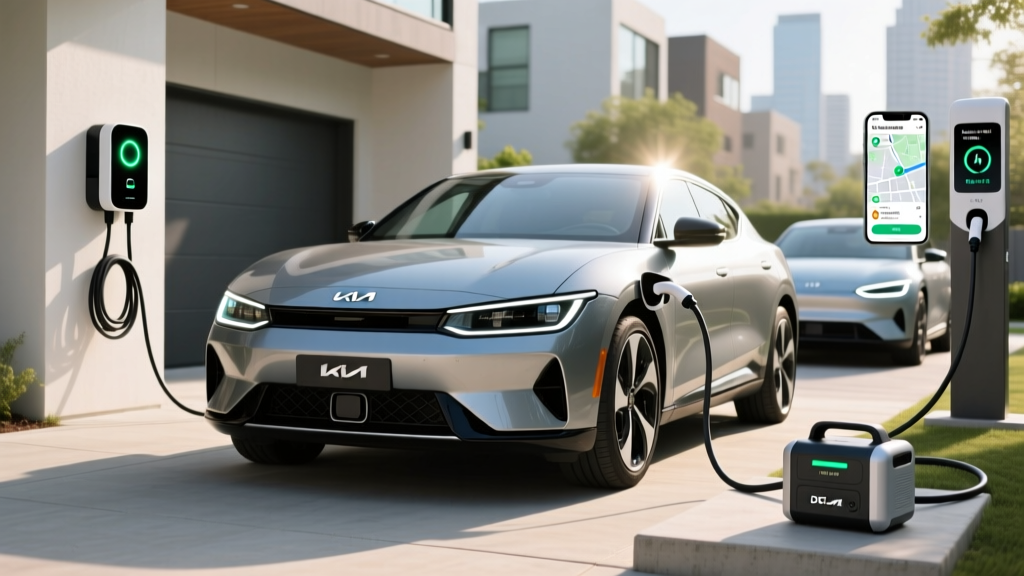
The Kia EV6 Charging System at a Glance
The Kia EV6 is built on the Hyundai Motor Group E-GMP platform with an 800-volt electrical architecture — one of only a handful of mainstream EVs (alongside the Porsche Taycan and Hyundai Ioniq 5) capable of ultra-fast DC charging. That architecture is the single biggest factor in choosing the right Kia EV6 charger setup, because it determines how quickly you can replenish the battery at home and on the road.
Before we get into equipment and installation, let's establish the hard numbers that matter for every EV6 owner:
- Battery capacity: 77.4 kWh usable (Standard Range: 58.0 kWh)
- Battery chemistry: NMC (nickel manganese cobalt)
- EPA range: up to 310 miles (Long Range RWD); expect ~250-270 mi highway, ~220-240 mi in freezing temps
- Peak DC fast charge rate: 240 kW (Long Range AWD) / 180 kW (some trims)
- 10-80% DC fast charge: ~18 minutes (under ideal conditions with preconditioning)
- Onboard AC charger: 10.9 kW (Level 2 maximum acceptance)
- Native connector: CCS1 (2025 and earlier); NACS native on select 2026+ models
The distinction between kW (kilowatts — the rate of power flow, like water pressure in a hose) and kWh (kilowatt-hours — the total energy stored, like gallons in a tank) is critical here. Your EV6 has a 77.4 kWh battery. A 10.9 kW Level 2 charger delivers 10.9 kWh of energy per hour. Simple division: 77.4 ÷ 10.9 ≈ 7.1 hours for a full 0-100% charge at Level 2.
Charging Levels Explained: How Fast Will Each Add Range?
Every Kia EV6 owner will use some combination of three charging levels. Here's what each delivers in real-world terms:
| Level | Power (kW) | Miles of Range / Hour | 10-80% Time (77.4 kWh) | Best Use Case |
|---|---|---|---|---|
| Level 1 (120V outlet) | 1.4 kW | ~4-5 mi/hr | ~30+ hours | Emergency / overnight top-up |
| Level 2 (240V home) | 10.9 kW (EV6 max) | ~32-36 mi/hr | ~5 hours | Daily home charging |
| DC Fast Charging | up to 240 kW | ~650+ mi/hr (peak) | ~18 min (10-80%) | Road trips |
Real-world charging curve reality check: That 240 kW peak only holds between roughly 10-55% state of charge. Above 80%, the charge rate tapers dramatically — often below 40 kW — to protect battery health. This is why manufacturers quote 10-80% times rather than 0-100%. Charging from 80-100% on a DC fast charger can take as long as the 10-80% session. Plan your road-trip stops accordingly: it's faster to charge to 80% and move on than to wait for a full battery.
Home Charger Installation: Electrical Requirements and Costs
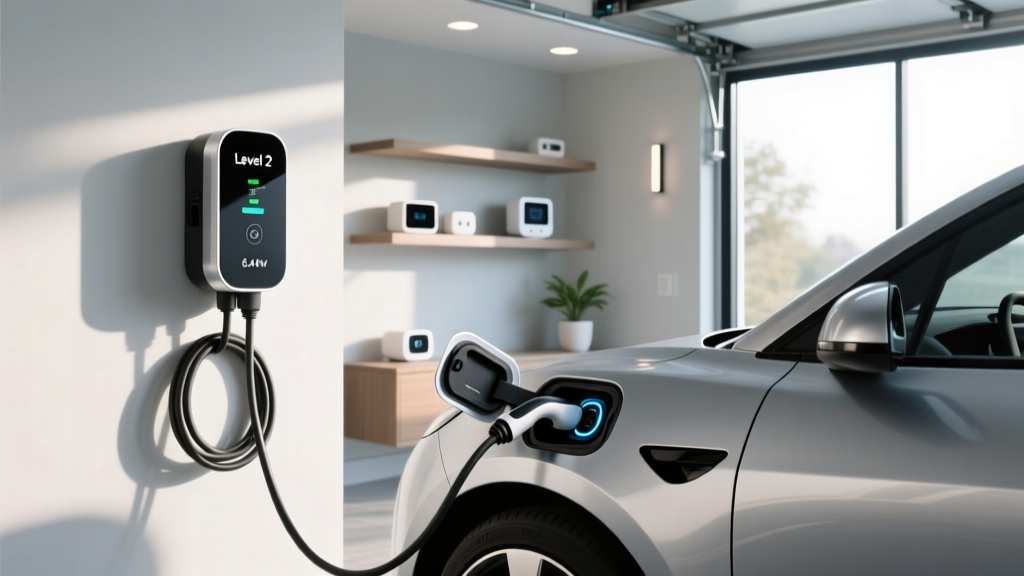
The most common and practical Kia EV6 charger setup is a Level 2 home station. The EV6's 10.9 kW onboard charger means you want a hardwired Level 2 unit capable of delivering at least 48 amps (11.5 kW) to fully utilize the car's acceptance rate. A 40-amp circuit will deliver about 9.6 kW — adequate for overnight charging but leaving ~10% of the EV6's capability on the table.
Electrical Requirements
- Voltage: 240V (same as a dryer or oven circuit)
- Amperage: 48A circuit (for full 11.5 kW) or 40A circuit (9.6 kW, slightly slower)
- Wire gauge: 6 AWG copper for 48A; 8 AWG for 40A (electrician will confirm)
- Panel capacity: Minimum 100A service; 200A preferred. A 48A EV charger draws continuous load — the NEC requires the circuit to be rated at 125% of continuous draw, meaning a 60A breaker.
- Dedicated circuit: Yes — the EV charger must have its own dedicated breaker, not shared with other appliances.
Do You Need a Panel Upgrade?
This is the question that determines whether your installation costs $800 or $4,000+. Homes built before 2000 often have 100A or 150A electrical panels. If your panel is already near capacity (running electric heat, an electric dryer, electric oven, and central AC), adding a 48A continuous load may exceed the panel's rating.
An electrician will perform a load calculation (NEC Article 220) to determine if your existing panel can handle the charger. If not, a panel upgrade to 200A typically costs $1,500-$3,000 before the charger circuit itself. Some homeowners opt for a smart load-management device (like the Emporia Smart Load Center or Span panel) that dynamically reduces charger draw when other appliances are running — this can avoid a panel upgrade entirely.
Installation Cost Breakdown
| Component | Simple Install (panel nearby) | Complex Install (long run / panel upgrade) |
|---|---|---|
| Level 2 charger (equipment) | $400 - $700 | $400 - $700 |
| Electrician labor (2-4 hrs simple / 6-10 hrs complex) | $300 - $800 | $900 - $2,000 |
| Permit & inspection | $50 - $200 | $100 - $350 |
| Panel upgrade (if needed) | N/A | $1,500 - $3,000 |
| Conduit, wire, mounting hardware | $50 - $150 | $200 - $600 |
| Total estimated cost | $800 - $1,850 | $3,100 - $6,650 |
Pro tip: The federal residential clean energy credit does not cover EV charger equipment for most taxpayers after 2022 (the old 30C alternative fuel vehicle refueling property credit expired for chargers in most areas). Check your state and utility — many offer $250-$1,000 rebates for Level 2 home charger installation. A licensed electrician should always pull a permit; unpermitted work can void home insurance claims and create a fire hazard.
Connector Compatibility: CCS1, NACS, and Adapter Options
The Kia EV6 shipped with a CCS1 (Combined Charging System) connector from its 2022 launch through the 2025 model year. For the 2026 model year, Kia has begun transitioning to the NACS (North American Charging Standard / Tesla connector) on new vehicles. Your connector determines where and how you can charge publicly — and whether you need an adapter.
| Model Year | Native Connector | Tesla Supercharger Access | Adapter Needed? |
|---|---|---|---|
| 2022-2025 EV6 | CCS1 | Yes (with NACS-to-CCS adapter) | NACS adapter for Superchargers; CCS native at Electrify America, EVgo, etc. |
| 2026+ EV6 | NACS (select trims) | Yes (native) | CCS adapter needed for older public DCFC stations |
Adapter reality check: Third-party NACS-to-CCS adapters (such as those from Lectron or A2Z) are available for $150-$250, but they add a connection point that can introduce resistance and heat at high charge rates. Kia and Hyundai have been slower than Ford and GM to officially approve specific adapters. Always verify that any adapter you purchase is rated for the EV6's 240 kW peak DC charge rate — an adapter rated only for 150 kW will bottleneck your charging speed. Check Kia's official guidance at kia.com before purchasing.
For Level 2 home charging, connector differences are less of an issue. All Level 2 chargers sold in the US use a J1772 connector (or a NACS connector on newer Tesla Wall Connectors). The EV6 accepts J1772 natively for AC charging regardless of model year. If you buy a Tesla Wall Connector (NACS plug), you'll need a NACS-to-J1772 adapter for a CCS-equipped EV6 — or simply choose a J1772-native charger to avoid the hassle.
Best Level 2 Chargers for the Kia EV6
Because the EV6 can accept up to 10.9 kW on Level 2, you want a charger that can deliver at least 48 amps to take full advantage. Here are top picks based on power output, build quality, smart features, and value:
ChargePoint Home Flex
- Power output: Up to 11.5 kW (48A) on 240V
- Connector: J1772 (NACS version available)
- Cable length: 23 feet
- Smart features: Wi-Fi, scheduling, energy tracking, Alexa integration
- Price: ~$550-$650
- Why for EV6: Full 48A output matches the EV6's 10.9 kW acceptance; UL-listed; adjustable amperage via DIP switches if your panel can't support 48A
Emporia Vue Smart EV Charger
- Power output: Up to 11.5 kW (48A)
- Connector: J1772
- Cable length: 24 feet
- Smart features: Wi-Fi, solar integration, real-time energy monitoring, load management
- Price: ~$400-$500
- Why for EV6: Best value at 48A; pairs with Emporia Vue energy monitor for whole-home load awareness; excellent app
Tesla Wall Connector (J1772 version)
- Power output: Up to 11.5 kW (48A)
- Connector: J1772 (NACS also available)
- Cable length: 24 feet
- Smart features: Wi-Fi, OTA updates, power sharing between two units
- Price: ~$475-$600
- Why for EV6: Sleek design, reliable hardware, power-sharing useful if you add a second EV; J1772 version plugs directly into the EV6
What about the Kia-branded charger? Kia offers a Level 2 home charger through its dealership network, typically a rebranded unit from a third-party manufacturer. It works fine but usually costs more ($600-$800) than equivalent ChargePoint or Emporia units without additional features. Unless bundled with your purchase or installation, third-party chargers generally offer better value.
Public DC Fast Charging: Networks, Costs, and the EV6 Advantage
The EV6's 800V architecture is its killer feature on road trips. While most EVs in its class peak at 150-175 kW on DC fast chargers, the EV6 can pull 240 kW — provided you're at a station that can deliver it. Here's how the major US networks stack up for EV6 owners:
- Electrify America: Most Hyperfast stations deliver 350 kW — more than enough. CCS1 native. Expect ~18-minute 10-80% sessions. Pricing: ~$0.43-$0.56/kWh (varies by state and membership tier).
- Tesla Supercharger (open to non-Tesla): V3 stalls deliver 250 kW; V4 stalls up to 350 kW. CCS-equipped EV6 needs a NACS adapter. Pricing: ~$0.28-$0.40/kWh (often the cheapest DCFC option).
- EVgo: Newer 350 kW stalls available in metro areas; older 50-150 kW stalls common. CCS1 native. Pricing: ~$0.39-$0.52/kWh.
- ChargePoint (DCFC): Mixed — some Express stations at 125-400 kW. Check the app before driving to a specific location.
Preconditioning matters. The EV6 will automatically precondition (warm or cool) its battery when you navigate to a DC fast charger using the built-in navigation. This is essential for achieving peak charge rates, especially in cold weather. A cold battery might only accept 80-100 kW even at a 350 kW station — doubling your charge time. Always use the car's nav to route to chargers, or manually trigger preconditioning via the Kia Connect app 15-20 minutes before arrival.
Charging Cost Per Mile: EV6 vs. Gasoline Crossover
One of the strongest arguments for the EV6 is operating cost. Let's compare real charging scenarios against a gasoline crossover like the Kia Sportage (28 MPG combined) at $3.40/gallon:
| Charging Scenario | Rate ($/kWh) | EV6 Cost/Mile | Gas Cost/Mile | Annual Savings (12,000 mi) |
|---|---|---|---|---|
| Home (off-peak utility rate) | $0.12 | $0.04 | $0.12 | $960 |
| Home (average US rate) | $0.17 | $0.055 | $0.12 | $780 |
| Public Level 2 | $0.25 | $0.08 | $0.12 | $480 |
| DC Fast Charging | $0.45 | $0.145 | $0.12 | -$300 (more expensive) |
The EV6 achieves approximately 3.5-3.7 miles per kWh (120-131 MPGe combined depending on trim and drivetrain). At home off-peak rates, you'll spend roughly $0.04 per mile — a third of what a gas crossover costs. The math flips on DC fast charging, where $0.45-$0.55/kWh makes the EV6 slightly more expensive per mile than gasoline. This is why home charging is the economic foundation of EV ownership.
Safety and Electrical Code Considerations
EV charging involves sustained high-current draw for hours at a time — this is fundamentally different from intermittent loads like a dryer or oven. Safety shortcuts here are dangerous and expensive.
- Dedicated circuit: The NEC requires EVSE (Electric Vehicle Supply Equipment) to be on a dedicated circuit. Do not share the circuit with any other outlet or appliance.
- GFCI protection: The 2020 NEC (Article 625.54) requires GFCI protection for receptacles used for EV charging. Hardwired installations may not require a GFCI breaker in all jurisdictions — your electrician will determine this based on local code adoption.
- Outdoor rating: If your charger is installed outdoors, it must be rated NEMA 4 (weatherproof). All chargers recommended above carry NEMA 4 ratings. The connector holster should keep the plug off the ground and protected from rain and snow.
- Hardwired vs. plug-in: A 48A charger on a 60A breaker should be hardwired (directly connected to junction box wiring). Plug-in installations using a NEMA 14-50 outlet are limited to 40A continuous (50A breaker) and introduce a failure point at the receptacle. Several EV owners have reported melted 14-50 outlets from sustained high-amperage draws — hardwired is safer and often required by local code for 48A+ circuits.
- Cable management: Use a retractable cable organizer or holster to prevent the charging cable from lying on the ground where it can be driven over, tripped on, or exposed to standing water.
Frequently Asked Questions
How much does it cost to install a home EV charger for the Kia EV6?
For a straightforward installation where your electrical panel has capacity and is near the garage, expect $800-$1,850 total (charger + electrician + permit). If you need a panel upgrade or a long conduit run from the panel to the garage, costs rise to $3,100-$6,650. Always get at least three quotes from licensed electricians and verify they pull a permit.
Can I charge the EV6 on a regular 120V outlet?
Yes, but slowly. Level 1 charging at 120V/12A delivers about 1.4 kW, adding roughly 4-5 miles of range per hour. A full charge from empty would take over 50 hours. Level 1 is fine for emergency use or for plug-in hybrids with small batteries, but it's impractical as a daily charging solution for the EV6's 77.4 kWh battery.
Do I need a NACS adapter for my CCS-equipped EV6?
If you want to use Tesla Superchargers (which now represent the largest fast-charging network in the US), yes — you'll need a NACS-to-CCS adapter for 2022-2025 model year EV6 vehicles. For Electrify America, EVgo, and other CCS-native networks, no adapter is needed. For 2026+ NACS-equipped EV6 models, you'll need a CCS adapter to use older public DCFC stations that haven't upgraded to NACS.
Will fast charging degrade my EV6 battery?
DC fast charging generates heat, and heat accelerates battery degradation — but the EV6's 800V system actually runs at lower current (amps) for a given power level compared to 400V systems, which reduces heat generation. Kia provides an 8-year/100,000-mile battery warranty covering capacity below 70%. Real-world data from early EV6 owners shows approximately 5-8% degradation after 60,000 miles, which is within normal expectations for NMC chemistry. To minimize degradation, avoid routinely charging to 100% and try to keep daily charging between 20-80%.
What electrical upgrades might I need for a home charger?
The most common upgrade is a panel replacement from 100A or 150A to 200A service ($1,500-$3,000). You may also need: a new 60A breaker ($30-$60), 6 AWG copper wiring ($2-$5/foot), conduit if the run is exposed or underground ($3-$8/foot), and a permit ($50-$350 depending on jurisdiction). In rare cases, your utility may need to upgrade the service drop to your home. An electrician's load calculation will reveal exactly what's needed before any work begins.