The Kia EV5 has generated substantial interest as a compact electric SUV slotting between the EV6 and the larger EV9 in Kia's lineup. For buyers evaluating this model, understanding its real-world range, charging behavior across Level 1, Level 2, and DC fast charging, and the true cost of setting up home charging infrastructure is essential before signing a purchase agreement.
This guide breaks down the Kia EV5's battery and charging specifications, maps those specs to the home and public charging equipment you'll actually use, and provides concrete installation cost data so you can budget accurately.
Kia EV5 Battery, Range, and Charging Specifications
The 2026 Kia EV5 is offered with multiple battery configurations depending on market and trim. North American specifications center on two primary battery packs:
- Standard Range: 58.3 kWh usable capacity (LFP chemistry, rear-wheel drive)
- Long Range: 81.0 kWh usable capacity (NMC chemistry, available in RWD and AWD)
EPA range estimates for the US-market EV5 are preliminary as of early 2026, but based on Kia's published WLTP figures and typical EPA conversion factors, we can project the following:
| Variant | Battery (kWh) | Est. EPA Range | Real-World Highway | Real-World Cold (30°F) |
|---|---|---|---|---|
| SR RWD | 58.3 (LFP) | ~220 mi | ~185–200 mi | ~155–170 mi |
| LR RWD | 81.0 (NMC) | ~290 mi | ~245–265 mi | ~200–220 mi |
| LR AWD | 81.0 (NMC) | ~270 mi | ~230–250 mi | ~190–210 mi |
Charging Levels Explained: kW, Speeds, and What They Mean for the EV5
A critical distinction every EV owner must internalize: kW (kilowatts) measures power — the rate at which energy flows into your battery. kWh (kilowatt-hours) measures energy — the total capacity stored in the battery. Think of kW as the width of a hose and kWh as the size of the bucket.
| Level | Voltage | Power (kW) | Miles Added/Hour | Best Use Case |
|---|---|---|---|---|
| Level 1 | 120V AC | 1.0–1.4 kW | 3–5 mi/hr | Overnight trickle, PHEVs, low-mileage drivers |
| Level 2 | 240V AC | 7.2–11.5 kW | 25–45 mi/hr | Home daily charging, workplace, destinations |
| DC Fast | 400–800V DC | 50–350 kW | 150–400+ mi/hr (peak) | Road trips, quick top-ups, commercial fleets |
How Fast Will Each Level Charge the Kia EV5?
The Kia EV5 supports up to 11 kW AC charging (Level 2) and, based on Kia's E-GMP platform architecture, up to approximately 150–175 kW DC fast charging for the Long Range variant. The Standard Range LFP pack will likely peak around 100–120 kW on DC.
| Charging Method | SR 58.3 kWh | LR 81.0 kWh |
|---|---|---|
| Level 1 (120V, 1.4 kW) | ~38 hours (0–100%) | ~53 hours (0–100%) |
| Level 2 (240V, 11 kW) | ~4.5 hours | ~6.5 hours |
| Level 2 (240V, 7.7 kW) | ~6 hours | ~9 hours |
| DC Fast (150 kW peak) | ~32 min | ~35 min |
| DC Fast (50 kW) | ~60 min | ~85 min |
Home Charger Installation: Electrical Requirements, Costs, and Upgrades
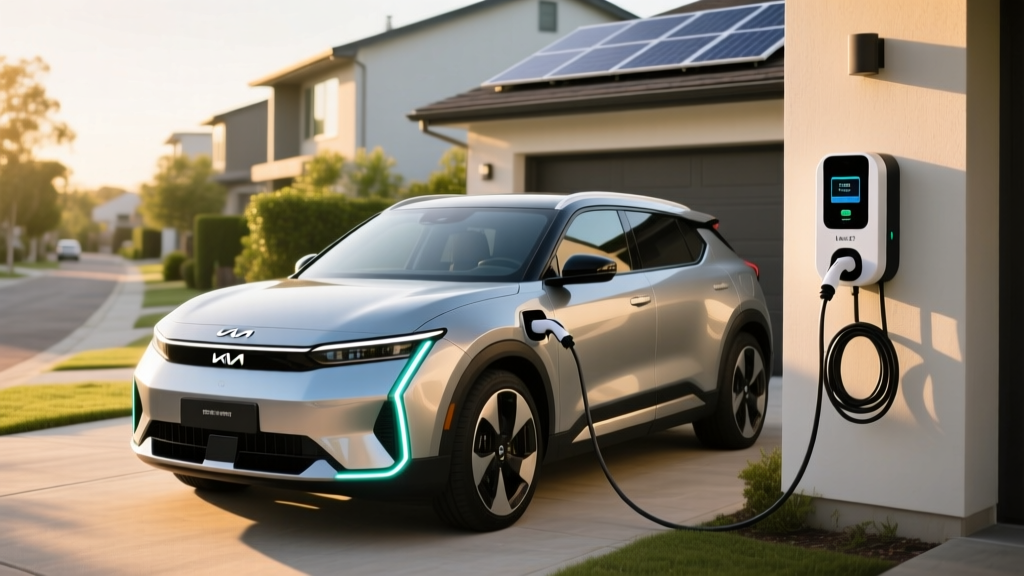
Installing a Level 2 home charger is the single most impactful upgrade for EV ownership. For the Kia EV5's 81 kWh Long Range battery, a properly sized Level 2 unit means waking up to a full charge every morning — even after depleting the pack to 20%.
Electrical Requirements
A Level 2 charger capable of delivering the EV5's full 11 kW AC rate requires a 240V, 50-amp dedicated circuit (which delivers up to 40 amps continuous to the vehicle, per NEC 80% rule). For a 7.7 kW unit, a 240V, 40-amp circuit (32 amps continuous) is sufficient.
Key considerations:
- Panel capacity: Most modern 200-amp panels can accommodate a 50-amp EV circuit. Older 100-amp panels often cannot and may require a panel upgrade ($1,500–$3,500).
- Dedicated circuit: NEC code requires the EV charger circuit be dedicated — it cannot share a breaker with other appliances.
- GFCI protection: 2023 NEC (and most 2026 local adoptions) requires GFCI protection for outdoor receptacles and some jurisdictions for hardwired EV chargers as well.
- Outdoor rating: If your charger mounts outside, both the unit and the wiring conduit must carry NEMA 4 (or NEMA 4X) weatherproof ratings.
How Much Does It Cost to Install a Home EV Charger?
| Component | Low Estimate | High Estimate | Notes |
|---|---|---|---|
| Level 2 Charger (Equipment) | $350 | $750 | 32A–48A smart chargers |
| Electrician Labor | $500 | $2,000 | Depends on run length, conduit, drywall work |
| Permit & Inspection | $50 | $300 | Varies by municipality |
| Electrical Panel Upgrade (if needed) | $1,500 | $3,500 | 100A → 200A service upgrade |
| Total (no panel upgrade) | $900 | $3,050 | Typical for modern homes |
| Total (with panel upgrade) | $2,400 | $6,550 | Older homes with 100A service |
The wide range in electrician labor reflects real variables: a garage install with the panel on the same wall may require only 10 feet of conduit, while running a circuit to a detached garage or the far side of a house can push labor above $2,000. Always get at least two quotes from licensed electricians who have EV charger installation experience.
Connector Compatibility: What Plug Does the Kia EV5 Use?
For the 2026 model year, Kia has transitioned its North American EV lineup to the NACS (North American Charging Standard) connector, also known as the Tesla-style plug. The EV5 ships from the factory with a NACS charge port, giving it native access to Tesla Superchargers (V3 and V4) as well as all NACS-equipped public chargers from Electrify America, EVgo, and other networks.
| Connector | Type | Used By | EV5 Compatible? |
|---|---|---|---|
| NACS (J3400) | AC + DC | Tesla, Kia (2025+), Ford, GM, Rivian, Hyundai | Native — factory equipped |
| CCS1 | DC | Older Kia/Hyundai, VW, BMW, most legacy chargers | With NACS-to-CCS adapter |
| CHAdeMO | DC | Nissan Leaf (legacy), some older public stations | Not compatible — network phasing out |
| J1772 | AC (L1/L2) | All non-Tesla EVs (pre-2025) | With NACS-to-J1772 adapter (usually included) |
Adapter note: Kia includes a NACS-to-J1772 adapter for Level 2 public charging at locations still equipped with J1772 cables. For legacy CCS1 DC fast chargers that haven't been retrofitted with NACS cables, Kia offers or authorizes a NACS-to-CCS1 adapter. Check with your dealer at delivery for included adapters.
Cost to Charge: EV5 vs Gas at Home and on the Road
Charging economics vary dramatically based on where and when you plug in. Here's a realistic breakdown using the EV5 Long Range (81 kWh battery) and a gasoline compact SUV averaging 28 MPG combined as a baseline.
| Scenario | Rate ($/kWh) | Full Charge Cost | Cost per Mile (est. 290 mi) |
|---|---|---|---|
| Home Off-Peak (utility time-of-use) | $0.08–$0.12 | $6.48–$9.72 | $0.022–$0.034 |
| Home Standard Rate | $0.14–$0.18 | $11.34–$14.58 | $0.039–$0.050 |
| Public Level 2 (workplace/destination) | $0.20–$0.35 | $16.20–$28.35 | $0.056–$0.098 |
| DC Fast Charging (Electrify America, etc.) | $0.35–$0.55 | $28.35–$44.55 | $0.098–$0.154 |
| Gasoline SUV (28 MPG, $3.40/gal) | — | — | $0.121 |
For owners who charge primarily at home on off-peak rates, the EV5 costs roughly $0.03 per mile — about one-quarter the per-mile fuel cost of a comparable gas SUV. Even at DC fast charging rates on road trips, costs are competitive with gasoline. The savings compound: at 12,000 miles per year, home-charging the EV5 saves approximately $1,050–$1,200 annually compared to the gas baseline.
Refer to the EPA's EV fuel economy data for official efficiency ratings as they're published for the US-market EV5.
Recommended Home Charging Equipment for the Kia EV5
To take full advantage of the EV5's 11 kW onboard charger, you need a Level 2 unit that delivers at least 48 amps (11.5 kW at 240V). Here are proven options with the specifications that matter:
ChargePoint Home Flex
- Power: Up to 11.5 kW (48A, configurable down to 16A)
- Connector: NACS (native), J1772 available
- Cable Length: 23 feet
- Smart Features: Wi-Fi, app scheduling, energy tracking, Alexa
- Price: ~$550–$650
- Best For: Flexible amperage for older panels
Tesla Universal Wall Connector
- Power: Up to 11.5 kW (48A)
- Connector: NACS with integrated J1772 adapter
- Cable Length: 24 feet
- Smart Features: Wi-Fi, OTA updates, power sharing (multiple units)
- Price: ~$450–$500
- Best For: NACS-native vehicles like the EV5, best value
Emporia Level 2 EV Charger
- Power: Up to 11.5 kW (48A)
- Connector: J1772 (NACS adapter needed) or NACS version
- Cable Length: 24 feet
- Smart Features: Wi-Fi, solar integration, energy monitoring
- Price: ~$350–$400
- Best For: Budget-conscious, solar-home owners
Grizzl-E Smart
- Power: Up to 10 kW (40A)
- Connector: J1772 or NACS
- Cable Length: 24 feet
- Smart Features: OCPP, app control, extreme-temp rated
- Price: ~$450–$550
- Best For: Cold-climate durability, Canadian-built
For the Kia EV5 specifically, the Tesla Universal Wall Connector offers the best combination of native NACS compatibility, 48-amp output matching the EV5's 11 kW onboard charger, and competitive pricing. The ChargePoint Home Flex is the strongest alternative if your electrician recommends a lower amperage circuit due to panel constraints — its configurability from 16A to 48A provides flexibility no other unit matches.
Safety, Electrical Code, and Permit Requirements
EV charger installation is not a DIY project. Improper wiring carries fire risk and will void both your charger warranty and potentially your homeowner's insurance coverage.
- Dedicated breaker: The charger must be on its own dedicated circuit — no sharing with HVAC, dryer, or other loads.
- Wire gauge: A 50-amp circuit requires 6 AWG copper wire (THHN in conduit or NM-B depending on jurisdiction). A 40-amp circuit requires 8 AWG.
- GFCI protection: Required for all outdoor installations per NEC 2023 §625.54. Some jurisdictions also require it for indoor garage installations.
- Hardwired vs. plug-in: Hardwired installations (no receptacle) are generally preferred for 48A+ circuits because NEMA 14-50 receptacles are rated for intermittent, not continuous, high-load use. If using a 14-50 receptacle, specify an industrial-grade unit rated for continuous duty.
- Permit and inspection: Nearly all US jurisdictions require an electrical permit and post-installation inspection for EV charger circuits. Skipping this step risks code violations discovered during a future home sale.
- Utility notification: Some utilities require notification before adding a significant new load. Check whether your utility offers EV-specific time-of-use rates — these can cut charging costs by 40–60% compared to standard residential rates.
Frequently Asked Questions
How much does it cost to install a home EV charger for the Kia EV5?
Expect $900–$3,050 for a typical installation in a home with a modern 200-amp electrical panel. This includes the Level 2 charger ($350–$750), electrician labor ($500–$2,000), and permit fees ($50–$300). Homes with older 100-amp panels may need a service upgrade adding $1,500–$3,500 to the total.
How fast will each charging level add range to the EV5?
Level 1 (120V) adds approximately 3–5 miles of range per hour — adequate only for very low daily mileage. Level 2 (240V, 48A) adds roughly 37–42 miles per hour, fully recharging the 81 kWh Long Range battery overnight in about 6.5 hours. DC fast charging at 150 kW adds roughly 150+ miles in 15 minutes during the peak portion of the charge curve (10–50% SoC).
Which connector and charger is compatible with the 2026 Kia EV5?
The 2026 EV5 uses the NACS (J3400) connector natively for both AC and DC charging. This gives direct access to Tesla Superchargers and all NACS-equipped public networks. For legacy CCS1 stations, a NACS-to-CCS adapter is needed. For J1772 Level 2 public chargers, a NACS-to-J1772 adapter (typically included with the vehicle) is required.
How much does charging the EV5 cost per mile vs. gas?
Home charging at off-peak utility rates costs approximately $0.02–$0.03 per mile. Standard home rates push this to $0.04–$0.05 per mile. DC fast charging on road trips costs $0.10–$0.15 per mile. A comparable gasoline SUV at 28 MPG and $3.40/gallon costs about $0.12 per mile. Home charging delivers 60–75% per-mile savings.
What electrical upgrades might I need for a Level 2 charger?
If your home has a 200-amp electrical panel with available capacity, you likely need only a new 50-amp breaker and a wiring run to your garage or parking spot. If you have a 100-amp panel, or if your panel is near capacity, a service upgrade to 200 amps will be required — typically $1,500–$3,500 including the new panel, labor, and utility coordination. A load calculation performed by your electrician will determine this before any work begins.
Is the Kia EV5 eligible for the federal EV tax credit?
Eligibility for the IRS §30D clean vehicle credit depends on multiple factors: the vehicle's MSRP must not exceed $80,000 (SUVs), the buyer's adjusted gross income must fall below $150,000 (single) or $300,000 (joint), and the battery must meet critical mineral and component sourcing requirements that tighten annually. The credit amount (up to $7,500) depends on how many sourcing thresholds are met. Additionally, the credit can now be transferred to the dealer at point of sale as an immediate price reduction. Verify current eligibility on the IRS website and with your tax professional before purchasing.
Should I charge the EV5 to 100% every night?
For the Standard Range model with an LFP battery, regular 100% charging is acceptable and even recommended periodically for cell balancing. For the Long Range model with an NMC battery, daily charging to 80–90% maximizes long-term battery health. Reserve 100% charges for road trips or days when you need maximum range. The EV5's infotainment system allows you to set a custom charge limit.
For the latest Kia EV5 specifications as they're finalized for the US market, refer to Kia's official US site and the EPA's fueleconomy.gov EV database.