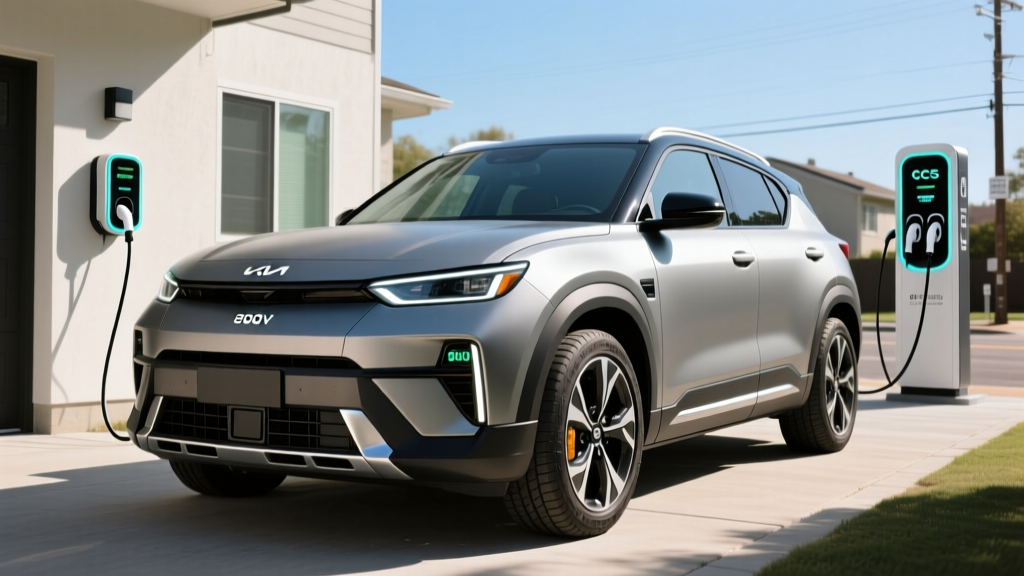
The Kia EV5 facelift adds rugged styling and 800V charging — a combination that transforms the compact electric SUV from a practical commuter into a road-trip-capable machine with cladding to match. But 800-volt architecture isn't just a marketing bullet point. It fundamentally changes how fast you can charge on the road, what equipment you need at home, and how much you'll spend on electricity versus gasoline. This guide breaks down everything EV5 buyers (and any 800V EV shopper) need to know about charging infrastructure, costs, and equipment in 2026.
Understanding Charging Levels: How Fast Will Each Add Range?
Before diving into the EV5's specific needs, you need to understand the three charging tiers available to every EV owner. The critical distinction: kW (kilowatts) measures power — the rate of energy flow — while kWh (kilowatt-hours) measures energy — the total amount stored in the battery. Think of kW as how wide the pipe is, and kWh as how full the tank gets.
| Level | Voltage / Power | Miles of Range Added Per Hour | Best For |
|---|---|---|---|
| Level 1 | 120V / 1.4–1.9 kW | 3–5 miles/hour | Overnight top-ups, PHEVs, emergency use |
| Level 2 | 240V / 7.2–19.2 kW | 20–60 miles/hour | Daily home charging, workplace, shopping centers |
| DC Fast Charge | 400V–800V / 50–350 kW | 150–1,000+ miles/hour (peak) | Road trips, highway corridors, rapid top-ups |
For the Kia EV5 with its estimated 75–84 kWh usable battery capacity, a full Level 2 charge from empty takes roughly 8–11 hours depending on your charger's amperage. On a 350 kW DC fast charger leveraging the 800V architecture, Kia targets a 10–80% charge in approximately 18 minutes — roughly the time it takes to grab food and use the restroom on a road trip.
Home Charger Installation: Electrical Requirements, Costs, and Panel Upgrades
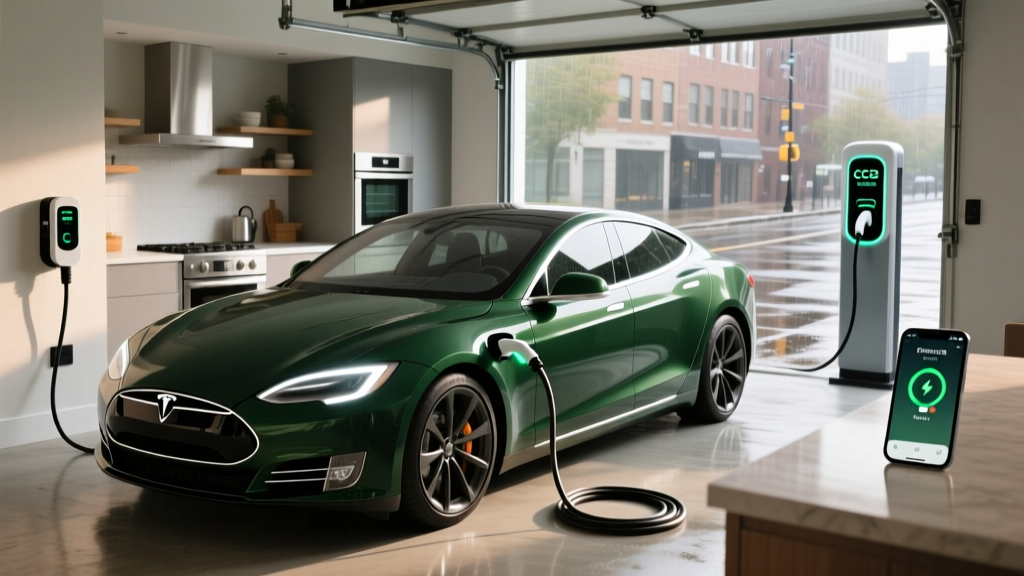
The 800V architecture in the EV5 facelift doesn't change home charging — your house delivers 240V AC to the car's onboard charger, which converts it to DC for the battery. What matters at home is your Level 2 circuit amperage and the EVSE (Electric Vehicle Supply Equipment) you choose.
Electrical Requirements for the Kia EV5
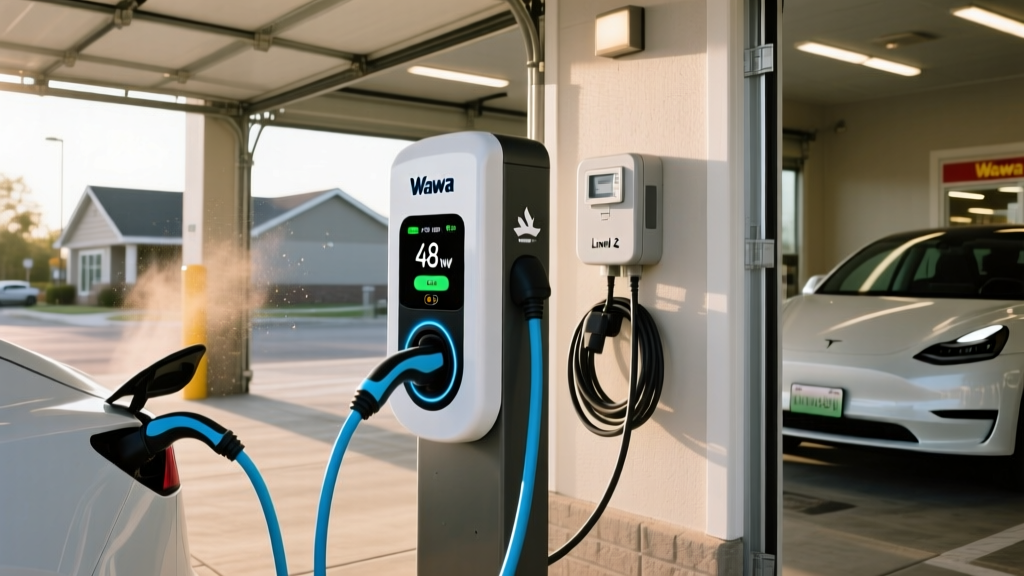
The EV5's onboard charger is expected to accept up to 11 kW on Level 2 (48 amps on a 60-amp dedicated circuit). To get maximum home charging speed, you need:
- 240V dedicated circuit with a 60-amp breaker (for a 48A continuous draw)
- NEMA 14-50 outlet (if using a plug-in charger) or hardwired connection
- Minimum 4-gauge copper wire (2-gauge recommended for longer runs or future-proofing)
- GFCI protection — required by NEC 2020 and later for EV receptacles
- Outdoor-rated equipment (NEMA 4 or NEMA 4X) if your charger is installed outside
How Much Does It Cost to Install a Home EV Charger?
Installation costs vary enormously depending on your electrical panel's capacity, the distance from panel to charger location, and local permit fees. Here's a realistic breakdown based on 2026 national averages:
| Component | Simple Install (Panel Adjacent) | Complex Install (Long Run / Panel Upgrade) |
|---|---|---|
| EVSE Equipment (Level 2 charger) | $400–$700 | $500–$800 |
| Electrician labor (2–4 hours simple, 6–12 complex) | $300–$800 | $1,200–$3,000 |
| Permit and inspection | $50–$200 | $100–$350 |
| Electrical panel upgrade (100A → 200A) | Not needed | $1,500–$4,000 |
| Total Estimated Cost | $750–$1,700 | $3,300–$8,150 |
Connector Compatibility: NACS, CCS, and the 2026 Landscape
As of the 2026 model year, Kia has transitioned its North American EV lineup to the NACS (North American Charging Standard) connector, originally developed by Tesla. The EV5 facelift is expected to ship with a native NACS port, granting direct access to Tesla's Supercharger network — now the largest and most reliable DC fast-charging network in the U.S. with over 25,000 stalls.
| Connector | Network Access | Max Power (DC) | EV5 Compatibility |
|---|---|---|---|
| NACS | Tesla Supercharger, Electrify America (select), EVgo, Rivian Adventure Network | Up to 350 kW | Native (expected) |
| CCS1 | Electrify America, EVgo, ChargePoint, most non-Tesla networks | Up to 350 kW | Via NACS-to-CCS adapter (often included) |
| CHAdeMO | Legacy stations (declining rapidly) | Up to 100 kW | Not supported |
For Level 2 home and public AC charging, all connectors use the J1772 standard or NACS (which carries J1772 signaling). Your home Level 2 charger will work regardless of whether you choose a NACS-terminated or J1772-terminated EVSE — adapters are inexpensive and widely available.
Charging Cost Per Mile: EV5 vs. Gasoline Equivalent
One of the strongest ownership arguments for the EV5 is fuel cost savings, but the actual number depends heavily on where and when you charge. Here's a realistic cost comparison assuming the EV5 achieves approximately 3.2 miles per kWh (roughly 108 MPGe combined, per preliminary estimates):
| Scenario | Rate ($/kWh) | Cost Per Mile | Annual Cost (12,000 mi) |
|---|---|---|---|
| Home off-peak (utility time-of-use rate) | $0.09–$0.14 | $0.03–$0.04 | $360–$480 |
| Home standard rate (national avg.) | $0.16–$0.18 | $0.05–$0.06 | $600–$720 |
| Public Level 2 (workplace, shopping) | $0.20–$0.35 | $0.06–$0.11 | $720–$1,320 |
| DC Fast Charge (road trips) | $0.35–$0.55 | $0.11–$0.17 | $1,320–$2,040 |
| Gasoline equivalent (27 MPG avg, $3.40/gal) | — | $0.13 | $1,560 |
The takeaway: If you charge primarily at home on off-peak rates, the EV5 costs roughly 70–75% less per mile than a comparable gasoline SUV. Even mixing in 30% DC fast charging on road trips, most owners will see a 40–50% fuel cost reduction. According to fueleconomy.gov, electricity costs vary significantly by state — check your utility's EV-specific time-of-use rate plans, which can cut charging costs by half compared to standard residential rates.
800V DC Fast Charging: Real-World Charge Times and Curve Behavior
The EV5's 800-volt architecture is the headline feature for road-trippers, but understanding the charge curve is essential for realistic trip planning. No EV sustains peak charging power from 0–100%. Here's what actually happens:
- 10–30% SoC: The EV5 can accept near-peak power (~250–270 kW on a 350 kW charger), adding roughly 3–4 miles of range per minute.
- 30–60% SoC: Power gradually tapers to ~200–230 kW as battery temperature and voltage rise.
- 60–80% SoC: Further taper to ~150–180 kW. The 10–80% session completes in approximately 18–22 minutes under ideal conditions.
- Above 80% SoC: Charging slows dramatically to protect battery health — expect 30–40+ minutes to go from 80–100%. This is why road-trip strategy focuses on 10–80% cycles.
Cold weather significantly impacts charging speed. In sub-freezing conditions (below 32°F), expect 10–80% charge times to extend to 25–35 minutes even with preconditioning, and range to drop by 20–30% from the EPA estimate. This is a physics reality for all lithium-ion batteries, not a defect.
Recommended Home Charging Equipment for the Kia EV5
Based on the EV5's expected 11 kW onboard charger and NACS connector, here are three Level 2 EVSE options optimized for 2026 Kia EV owners:
Emporia Vue EV Charger
- Power Output: 48A / 11.5 kW (240V)
- Connector: NACS native or J1772
- Cable Length: 24 feet
- Smart Features: Wi-Fi, energy monitoring, solar integration, scheduling via app
- Price: ~$400–$450
- Best For: Budget-conscious owners who want smart scheduling and energy tracking
ChargePoint Home Flex
- Power Output: Configurable 16–50A / up to 12 kW (240V)
- Connector: NACS or J1772 (swappable)
- Cable Length: 23 feet
- Smart Features: Wi-Fi, Alexa integration, flexible amperage to match your circuit
- Price: ~$550–$650
- Best For: Homes with 40A or 50A circuits (adjustable amperage prevents overdraw)
Tesla Wall Connector (Universal)
- Power Output: 48A / 11.5 kW (240V)
- Connector: NACS with integrated J1772 adapter
- Cable Length: 24 feet
- Smart Features: Wi-Fi, OTA updates, power sharing between two units, Tesla app integration
- Price: ~$600–$650
- Best For: Multi-EV households (power sharing) and Tesla Supercharger ecosystem users
All three chargers are NEMA 4 rated for indoor/outdoor use and support hardwired or NEMA 14-50 plug installation. For the EV5's 11 kW onboard charger, a 48A/60A circuit delivers the fastest possible home charge — roughly 32–35 miles of range per hour of charging.
Safety, Code Compliance, and Permitting
EV charger installation is governed by the National Electrical Code (NEC) and your local authority having jurisdiction (AHJ). Key 2026 requirements include:
- Dedicated circuit: Your EVSE must have its own breaker — no sharing with other appliances.
- GFCI protection: Required for all 240V receptacles used for EV charging (NEC 625.54). Hardwired installations may be exempt in some jurisdictions.
- Permit and inspection: Nearly all jurisdictions require an electrical permit for new 240V circuits. Permits typically cost $50–$200 and trigger a safety inspection.
- Outdoor rating: Any charger or outlet exposed to weather must carry a NEMA 4 (splash-resistant) or NEMA 4X (corrosion-resistant) rating with an in-use cover for receptacles.
- Wire gauge: A 60A circuit requires minimum 4 AWG copper (THHN in conduit) or 3 AWG for NM-B cable. Longer runs (over 100 feet) may need upsized wire to limit voltage drop below 3%.
Skipping permits to save money is a false economy — unpermitted work can void homeowner's insurance claims, fail a home inspection during sale, and create fire risk. According to NHTSA, proper electrical installation is the single most important safety factor in home EV ownership.
Kia EV5 Facelift: Quick Specs and Charging Summary
| Specification | Kia EV5 (2026 Facelift, Preliminary) |
|---|---|
| Battery Capacity (usable) | ~75–84 kWh (NMC chemistry expected) |
| EPA Range (est.) | 270–310 miles (real-world highway: ~230–270 mi) |
| Architecture | 800V E-GMP platform |
| Peak DC Fast Charge Rate | ~250–270 kW (on 350 kW station) |
| 10–80% DC Fast Charge Time | ~18–22 minutes (ideal conditions) |
| Level 2 Onboard Charger | 11 kW (48A) |
| Connector (North America) | NACS (expected) |
| Battery/Powertrain Warranty | 10 years / 100,000 miles (Kia standard) |
| Est. Base MSRP | $38,000–$42,000 (subject to final announcement) |
Frequently Asked Questions
How much does it cost to install a home EV charger for the Kia EV5?
A straightforward Level 2 installation near your electrical panel typically costs $750–$1,700 including equipment, electrician labor, and permits. If your home needs a panel upgrade from 100A to 200A, or the charger location is far from the panel, costs can range from $3,300 to $8,150. Always get a load calculation from a licensed electrician before committing.
How fast will each charging level add range to the EV5?
Level 1 (120V) adds roughly 3–5 miles per hour — adequate only for PHEVs or emergency top-ups. Level 2 (240V/48A) adds approximately 32–35 miles per hour, fully recharging the EV5 overnight. DC fast charging at a 350 kW station can add 150–200+ miles in a 15–20 minute session, thanks to the 800V architecture sustaining high power longer than 400V competitors.
Which connector and charger is compatible with the Kia EV5 facelift?
The 2026 EV5 is expected to use a native NACS connector, giving direct access to Tesla Superchargers and growing NACS-equipped public networks. For CCS-only stations, a NACS-to-CCS adapter (typically included or ~$150–$200 aftermarket) is needed. Any NACS or J1772 Level 2 charger works for home charging.
How much does charging the EV5 cost per mile compared to gas?
Charging at home on off-peak electricity ($0.09–$0.14/kWh) costs approximately $0.03–$0.04 per mile — about 70–75% less than a 27 MPG gasoline SUV at $3.40/gallon ($0.13/mile). Even exclusive DC fast charging at $0.45/kWh ($0.14/mile) remains competitive with gasoline, though home charging delivers the strongest savings.
What electrical upgrades might I need before installing an EV charger?
The most common upgrade is a panel replacement from 100 amps to 200 amps ($1,500–$4,000), required when your existing panel can't accommodate a new 60-amp circuit. Older homes may also need wiring updates, a new grounding rod, or service lateral replacement. A licensed electrician's load calculation will determine exactly what's needed before any equipment purchase.