The 2026 Kia EV4 sedan enters the compact electric segment with a targeted EPA range of up to 290 miles (Long Range RWD) and a starting MSRP near $35,000. But range is only half the ownership equation — how you charge at home and in public determines your daily experience, monthly budget, and road-trip viability. This guide breaks down the Kia EV4's charging profile, home installation costs, connector requirements, and real-world electricity expenses so you can plan a complete setup before delivery day.
Kia EV4 Range and Battery: What You're Working With
The 2026 Kia EV4 is offered in Standard Range and Long Range configurations. Based on Kia's preliminary specifications, the Long Range RWD model targets approximately 290 miles of EPA-estimated range from an estimated 71.2 kWh usable battery pack (NMC chemistry). The Standard Range variant targets roughly 230 miles from a smaller pack. These are EPA estimates; real-world results vary based on driving style, temperature, and terrain.
EPA Estimate: ~290 miles
Highway (70-80 mph, moderate temps): ~245-265 miles
Cold Weather (below 30°F, cabin heat): ~200-230 miles
City/Stop-and-Go (regen-heavy): ~275-295 miles
Expect 15-20% range loss on sustained highway driving and 20-30% in deep cold. Preconditioning the battery before fast charging helps recover some efficiency.
| Attribute | Standard Range | Long Range RWD |
|---|---|---|
| EPA Range (est.) | ~230 mi | ~290 mi |
| Battery (usable, est.) | ~58 kWh | ~71.2 kWh |
| Chemistry | NMC | NMC |
| Peak DC Charge Rate | ~150 kW | ~170 kW |
| 10-80% DC Fast Charge | ~25 min | ~27 min |
| Level 2 Onboard Charger | 10.9 kW | 10.9 kW |
| Connector | NACS (native) | NACS (native) |
| Base MSRP (est.) | ~$35,000 | ~$39,000 |
| Battery Warranty | 10 yr / 100,000 mi | 10 yr / 100,000 mi |
Note: Specs are preliminary and based on Kia's announced figures. Final EPA certification and pricing may vary at launch. Source: Kia America.
Charging Levels Explained: How Fast Does Each Add Range?
Understanding EV charging requires distinguishing between kW (kilowatts), which measures power — the rate of energy delivery — and kWh (kilowatt-hours), which measures energy — the total capacity of the battery. Think of kW as the width of a hose and kWh as the size of the bucket. A wider hose (higher kW) fills the bucket faster, but the bucket size stays the same.
| Level | Power Output | Miles Added/Hour (EV4 est.) | Best For |
|---|---|---|---|
| Level 1 (120V) | 1.0-1.4 kW | 3-5 mi/hr | Overnight trickle, emergencies |
| Level 2 (240V) | 3.3-19.2 kW | 12-70 mi/hr | Daily home/work charging |
| DC Fast Charging | 50-350 kW | 150-400+ mi/hr (peak) | Road trips, quick top-ups |
For the Kia EV4 Long Range with its 10.9 kW onboard charger, a 48-amp Level 2 home station delivering 11.5 kW will add roughly 38-42 miles of range per hour. A full 10-100% charge at home takes approximately 7-8 hours — ideal for overnight replenishment. On a DC fast charger, the EV4 peaks at approximately 170 kW (Long Range), though sustained rates taper significantly above 80% state of charge. Expect a 10-80% session in roughly 27 minutes under optimal thermal conditions.
Home Charger Installation: Electrical Requirements and Costs
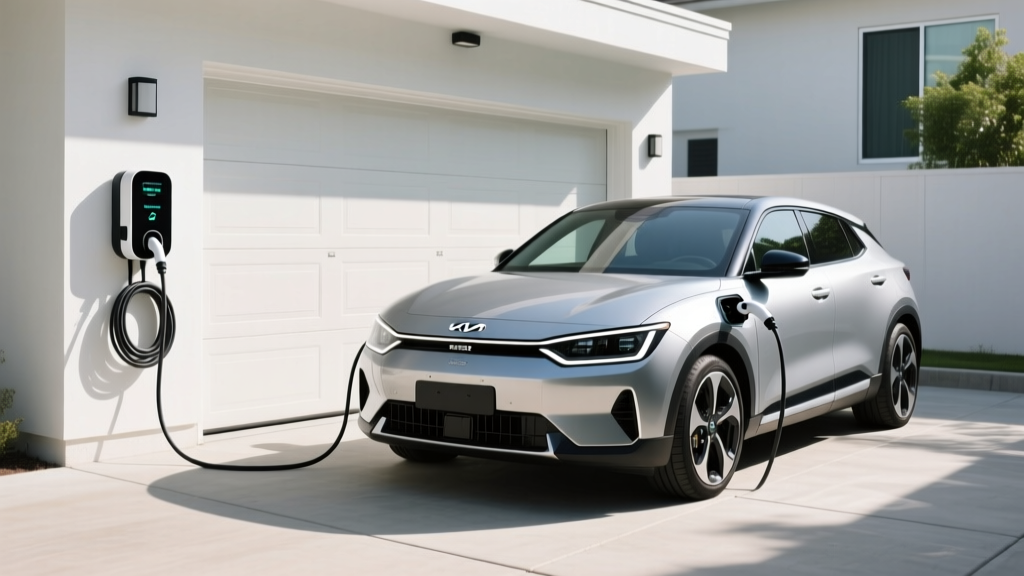
Installing a dedicated Level 2 home charger is the single most impactful upgrade for EV ownership. For the Kia EV4's 10.9 kW onboard charger, you'll want a 240V circuit with at least a 48-amp charger (requiring a 60-amp dedicated breaker, per National Electrical Code's 80% continuous-load rule).
Electrical Requirements for Kia EV4 Home Charging
- Voltage: 240V (split-phase residential)
- Recommended Circuit: 60-amp dedicated breaker
- Charger Amperage: 48 amps continuous (delivers ~11.5 kW)
- Wire Gauge: 6 AWG copper (typical for 60A circuit)
- Outlet Option: NEMA 14-60 (if using plug-in charger) or hardwired (preferred for 48A+ units)
Panel Upgrade Considerations
Many older homes have 100-amp or 150-amp electrical panels that may not have capacity for a new 60-amp circuit. A licensed electrician will perform a load calculation per NEC Article 220 to determine if your panel can handle the additional draw. If an upgrade to 200-amp service is needed, expect a significant added cost.
| Component | Simple Install (panel nearby) | Complex Install (long run/panel upgrade) |
|---|---|---|
| Level 2 Charger (48A, hardwired) | $500-$750 | $500-$750 |
| Electrician Labor (2-4 hrs simple; 6-10+ hrs complex) | $500-$1,200 | $1,500-$3,500 |
| Electrical Permit | $50-$200 | $100-$350 |
| Panel Upgrade (if needed) | N/A | $1,500-$4,000 |
| Conduit/Wire (long runs) | $50-$150 | $300-$1,000 |
| Estimated Total | $1,100-$2,300 | $3,900-$9,600 |
For homes with a modern 200-amp panel and a garage adjacent to the electrical service, a straightforward hardwired install typically lands between $1,200 and $2,000 all-in. Homes needing a panel upgrade, long conduit runs through finished walls, or trenching to a detached garage can see costs exceed $5,000. Always get at least three quotes from licensed electricians and verify they hold appropriate local licensing and insurance.
Connector Compatibility: NACS, CCS1, and Adapters
The 2026 Kia EV4 comes equipped with a native NACS (North American Charging Standard) port — the Tesla-origin connector now adopted by most major automakers. This is a significant practical advantage: the EV4 can plug directly into Tesla Superchargers (now open to non-Tesla EVs via the NACS standard) and the growing network of NACS-equipped public chargers without an adapter.
| Network/Charger Type | Connector | EV4 Compatibility |
|---|---|---|
| Tesla Supercharger (NACS stalls) | NACS | ✅ Native — no adapter |
| Electrify America (new NACS stalls) | NACS | ✅ Native |
| Electrify America (legacy CCS1 stalls) | CCS1 | ⚠️ Requires NACS-to-CCS adapter |
| EVgo / ChargePoint (CCS1 stalls) | CCS1 | ⚠️ Requires NACS-to-CCS adapter |
| Home Level 2 (J1772 wall chargers) | J1772 | ⚠️ Requires J1772-to-NACS adapter |
| Home Level 2 (NACS wall chargers) | NACS | ✅ Native |
| CHAdeMO (Nissan Leaf legacy) | CHAdeMO | ❌ Not compatible |
Adapter recommendation: Keep a NACS-to-CCS1 adapter ($150-$250 from reputable brands like Lectron or A2Z) in the EV4's frunk or cargo area for use at older public DC fast chargers that haven't yet added NACS cables. For home charging, if you already own a J1772 Level 2 charger from a previous EV, a J1772-to-NACS adapter (~$100-$150) will work, though a native NACS home charger is the cleaner long-term solution.
Recommended Home Chargers for the Kia EV4
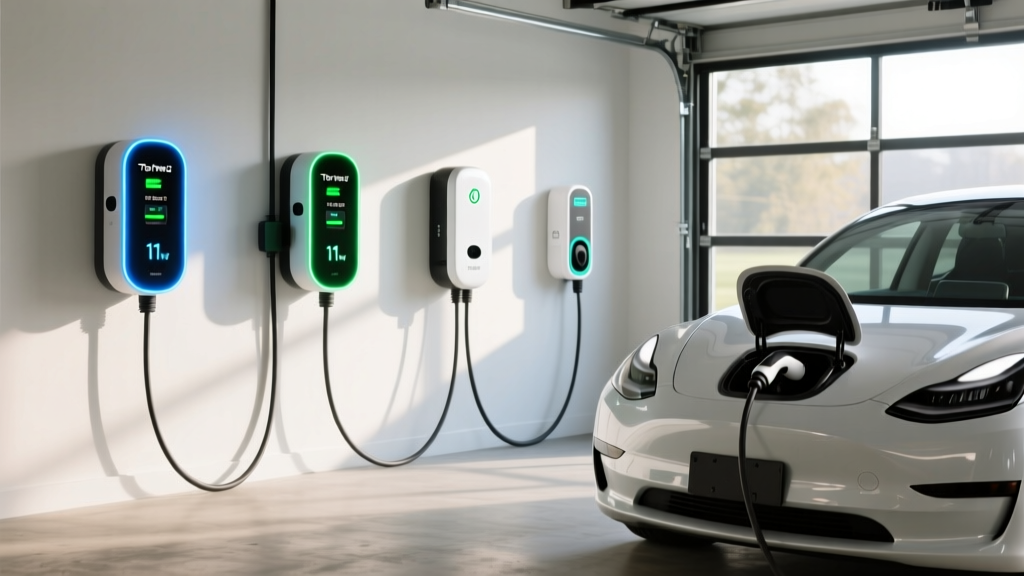
With the EV4's 10.9 kW onboard charger, you'll want a home station that can deliver at least 48 amps (11.5 kW) to maximize charging speed. Here are top picks for 2026:
Tesla Wall Connector (NACS)
- Power Output: Up to 11.5 kW (48A on 60A circuit)
- Connector: Native NACS
- Cable Length: 24 ft
- Smart Features: Wi-Fi, OTA updates, power sharing, access control
- Price: ~$475
- Why for EV4: Native NACS means no adapter; proven reliability; 24-ft cable reaches most garage positions
ChargePoint Home Flex (NACS version)
- Power Output: Up to 12 kW (50A on 60A circuit, configurable)
- Connector: NACS (2025+ models)
- Cable Length: 23 ft
- Smart Features: App scheduling, energy tracking, Alexa integration
- Price: ~$550-$600
- Why for EV4: Flexible amperage settings let you match your circuit; strong app for tracking kWh and cost
Emporia Vue Level 2 Charger
- Power Output: Up to 11.5 kW (48A)
- Connector: NACS or J1772 (choose at purchase)
- Cable Length: 24 ft
- Smart Features: Energy monitoring, solar integration, scheduled charging
- Price: ~$400-$450
- Why for EV4: Budget-friendly with excellent energy monitoring; solar-aware scheduling for homes with PV panels
Cost to Charge: EV4 Electricity vs. Gasoline Per Mile
One of the strongest ownership arguments for the EV4 is fuel cost. At an estimated efficiency of 3.5-4.0 miles per kWh (roughly 100-115 MPGe combined), the EV4's per-mile energy cost undercuts even the most efficient gas compact sedans.
| Scenario | Rate ($/kWh) | Cost for 290 mi (full) | Cost Per Mile |
|---|---|---|---|
| Home Off-Peak (utility TOU rate) | $0.08-$0.12 | $5.70-$8.55 | $0.02-$0.03 |
| Home Standard Rate (national avg.) | $0.16-$0.18 | $11.40-$12.85 | $0.04-$0.04 |
| Public Level 2 (ChargePoint, etc.) | $0.25-$0.40 | $17.85-$28.55 | $0.06-$0.10 |
| DC Fast Charging (EA, EVgo, etc.) | $0.35-$0.55 | $25.00-$39.30 | $0.09-$0.14 |
| Gas Sedan (33 MPG, $3.40/gal) | N/A | $29.90 | $0.10 |
Bottom line: Home-charging the EV4 on an off-peak utility rate costs roughly $0.02-$0.03 per mile — about one-quarter to one-third the cost of a comparable gas sedan. Even at public DC fast-charging rates, the EV4 is cost-competitive with gasoline. Over 15,000 annual miles, home charging saves approximately $1,000-$1,500 per year compared to a 33-MPG gas compact at $3.40/gallon.
Safety, Electrical Code, and Permit Considerations
EV charging installations must comply with the National Electrical Code (NEC) and local building codes. Key requirements to verify with your electrician:
- Dedicated Circuit: Your Level 2 charger must be on its own dedicated breaker — no sharing with other appliances or outlets.
- GFCI Protection: NEC 2020 and later requires GFCI (Ground Fault Circuit Interrupter) protection for EV charging outlets in garages. Hardwired chargers may be exempt in some jurisdictions — confirm locally.
- Outdoor Rating: If installing outside, the charger must carry a NEMA 4 (weatherproof) or equivalent rating. All chargers listed above meet outdoor installation standards.
- Permit Required: Virtually all jurisdictions require an electrical permit for a new 240V circuit. Permit fees typically range from $50-$350 depending on locality. Unpermitted work can void homeowner's insurance coverage.
- Inspection: After installation, a local inspector will verify code compliance before the circuit is energized. Factor 1-3 weeks for inspection scheduling.
Federal Tax Credit and Incentive Context
Under the IRS §30D Clean Vehicle Credit, the Kia EV4 may qualify for up to $7,500 in federal tax credits — subject to MSRP caps ($55,000 for sedans), buyer income limits ($150,000 single / $300,000 joint AGI), and battery critical-mineral and component sourcing requirements. As of 2026, the point-of-sale transfer option allows eligible buyers to apply the credit as an immediate price reduction at the dealership rather than waiting for tax filing. Eligibility changes as sourcing rules tighten — verify current status at fueleconomy.gov before purchasing.
Additionally, the §25E Energy Efficient Home Improvement Credit covers 30% of home EV charger equipment and installation costs, up to $1,000 — helping offset the install expense. This credit applies through 2032 and is claimed on your federal tax return.
Frequently Asked Questions
How much does it cost to install a home EV charger for the Kia EV4?
A straightforward Level 2 installation (60-amp circuit, short wire run, modern panel) typically costs $1,200-$2,300 including the charger, electrician labor, and permit. Homes requiring a panel upgrade, long conduit runs, or trenching to a detached garage can see costs of $4,000-$9,600. The §25E federal tax credit covers 30% of equipment and installation, up to $1,000.
How fast will each charging level add range to the EV4?
Level 1 (120V standard outlet) adds approximately 3-5 miles per hour — adequate only for overnight trickle or emergencies. Level 2 (240V, 48A home charger) adds roughly 38-42 miles per hour, fully replenishing the Long Range battery in about 7-8 hours. DC fast charging at peak rate (~170 kW) can add over 200 miles in approximately 20 minutes, though the charge curve tapers significantly above 80%.
Which connector does the Kia EV4 use?
The 2026 Kia EV4 uses a native NACS (North American Charging Standard) connector. This provides direct access to Tesla Superchargers and new NACS-equipped public stations. For older CCS1 public chargers, a NACS-to-CCS1 adapter (~$150-$250) is needed. For J1772 home chargers, a J1772-to-NACS adapter works but a native NACS home charger is preferred.
How much does charging the EV4 cost per mile compared to gas?
Home charging on an off-peak utility rate costs roughly $0.02-$0.03 per mile. On a standard residential rate, expect $0.04 per mile. A comparable 33-MPG gas sedan at $3.40/gallon costs about $0.10 per mile. Over 15,000 miles annually, home charging the EV4 saves approximately $1,000-$1,500 versus gasoline.
What electrical upgrades might I need for home charging?
If your home has a 200-amp panel with available capacity, you likely need only a new 60-amp breaker and wire run. Homes with 100-amp or 150-amp panels may require a panel upgrade ($1,500-$4,000) to accommodate a 48-amp continuous charger load. Your electrician will perform an NEC Article 220 load calculation to determine available capacity. Older wiring, aluminum conductors, or panels with known issues (Federal Pacific, Zinsco) may also need replacement.
Can I use a standard 120V outlet to charge the EV4?
Yes, using the included Level 1 mobile charger, but at only 1.0-1.4 kW you'll gain 3-5 miles per hour. A full charge of the Long Range battery would take 50+ hours — impractical for daily use but sufficient for occasional top-ups or emergencies. For regular ownership, a Level 2 installation is strongly recommended.
Always consult a licensed electrician for final installation specifications and your local building department for permit requirements. Federal tax credit eligibility is subject to change — verify current rules at irs.gov and consult a tax professional for personal eligibility.