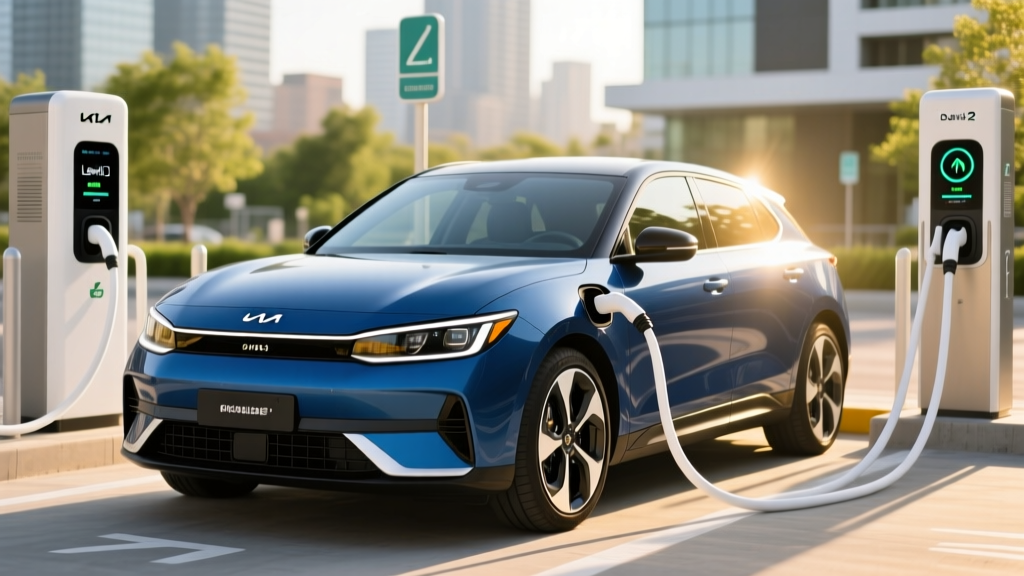
When evaluating the Kia electric range across the current lineup — from the compact Niro EV to the flagship EV9 three-row SUV — the EPA sticker is only half the story. What truly determines how far you can go, how quickly you can recharge, and how much it costs per mile depends entirely on your charging strategy. This guide breaks down the exact charging hardware, speeds, electrical requirements, and real-world costs for owning a Kia EV in 2026.
Current Kia EV Lineup: Range, Battery & Charging Specs
Before selecting a charger, you need to know what you're filling. Kia's 2026 electric lineup spans three architectures and two battery chemistries. The EV6 and EV9 ride on the E-GMP platform with 800V-capable battery systems, enabling some of the fastest DC charging in the segment. The Niro EV uses a 400V architecture with more modest charge rates.
| Model | Battery (usable kWh) | Chemistry | EPA Range (mi) | Real-World Range* | Max DC Charge (kW) | 10–80% DC Time | Level 2 Rate (kW) |
|---|---|---|---|---|---|---|---|
| Niro EV Wind | 64.8 | NMC | 239 | ~195–215 | 85 | ~43 min | 11 |
| EV6 Light RWD | 58.0 | NMC | 232 | ~190–210 | 180 | ~18 min | 10.9 |
| EV6 GT-Line AWD | 77.4 | NMC | 282 | ~235–255 | 240 | ~18 min | 10.9 |
| EV9 Light RWD | 76.1 | NMC | 230 | ~190–210 | 170 | ~24 min | 10.9 |
| EV9 GT-Line AWD | 100.0 | NMC | 270 | ~225–245 | 210 | ~24 min | 10.9 |
Charging Levels Explained: How Fast Will Each Level Add Range?
Understanding the difference between kW (power — the rate of energy delivery) and kWh (energy — the battery's total capacity) is essential. Think of kW as how wide the hose is, and kWh as the size of the bucket. A higher kW charger fills the bucket faster, but the battery's acceptance rate limits the maximum flow.
| Level | Voltage / Amps | Max Power (kW) | Miles Added per Hour | Best Use Case |
|---|---|---|---|---|
| Level 1 (120V) | 120V / 12A | 1.4 kW | 3–5 mi/hr | Overnight top-off, PHEV, emergency |
| Level 2 (240V) | 240V / 32–48A | 7.7–11.5 kW | 22–40 mi/hr | Daily home charging |
| DC Fast (CCS/NACS) | 400–800V DC | 85–240 kW | 150–650 mi/hr | Road trips, rapid top-up |
For the EV6 GT-Line with its 77.4 kWh battery, a 48A Level 2 charger delivering 11.5 kW will replenish a full battery in roughly 7 hours. That same battery on DC fast charging (peaking at 240 kW) can go from 10–80% in approximately 18 minutes — though the charge curve tapers significantly above 80%, so charging to 100% on DC is rarely time-efficient.
Home Charger Installation: Electrical Requirements & Costs
How much does it cost to install a home EV charger? The answer depends on your electrical panel's capacity, the distance from the panel to the charger location, and local permit fees. Here's a realistic breakdown for a 240V/48A Level 2 installation — the sweet spot for Kia's E-GMP vehicles.
| Component | Typical Range | Notes |
|---|---|---|
| Level 2 Charger (hardware) | $400–$750 | 40A–48A Wi-Fi-enabled units |
| Electrician labor | $500–$1,500 | Depends on run length, conduit, drywall work |
| Electrical permit | $50–$200 | Varies by municipality |
| Panel upgrade (if needed) | $1,500–$3,500 | Required if panel is 100A or near capacity |
| Total (no panel upgrade) | $950–$2,450 | Most homes with 200A service |
| Total (with panel upgrade) | $2,450–$5,950 | Older homes with 100A panels |
What Electrical Upgrades Might I Need?
A 48A charger requires a dedicated 60A circuit (NEC code mandates chargers draw no more than 80% of the circuit rating — so 48A continuous load needs a 60A breaker). Your electrical panel must have two open slots and sufficient remaining capacity. Homes with 200A service typically handle this without issue. Homes with 100A panels — common in pre-1990 construction — often require an upgrade to 200A, which is the single largest cost variable in any EV charger installation.
A licensed electrician will perform a load calculation per NEC Article 220 to determine if your panel can support the added draw. Do not skip this step. Some utilities offer rebates of $200–$500 for panel upgrades tied to EV adoption — check with your local provider.
Which Connector Is Compatible With My Kia EV?
Kia's connector strategy shifted significantly starting with the 2025 model year. Here's what you need to know for each model:
| Model | Built-in Port | DC Fast Network Access | Adapter Needed? |
|---|---|---|---|
| EV6 (2025+) | NACS (native) | Tesla Supercharger + CCS networks | CCS adapter for older Electrify America stations |
| EV9 (2025+) | NACS (native) | Tesla Supercharger + CCS networks | CCS adapter for legacy CCS stations |
| Niro EV (all years) | CCS1 | Electrify America, EVgo, ChargePoint | NACS-to-CCS adapter for Tesla Superchargers |
| EV6 (2022–2024) | CCS1 | Electrify America, EVgo, ChargePoint | NACS-to-CCS adapter for Tesla Superchargers |
The transition to NACS on newer EV6 and EV9 models means direct access to the Tesla Supercharger network — over 25,000 stalls in North America — without an adapter. For older CCS-equipped Kias, Kia and third-party manufacturers offer NACS-to-CCS adapters (typically $150–$250) that unlock Supercharger access. Verify adapter compatibility with your specific model year before purchasing.
Cost to Charge: Home vs. Public vs. Gas Comparison
How much does charging cost per mile vs gas? This is where EV ownership economics become clear — but only if you charge primarily at home. Public DC fast charging narrows the gap considerably.
| Scenario | Rate | Cost per kWh | Cost per Mile (EV6) |
|---|---|---|---|
| Home — off-peak utility rate | $0.12/kWh | $0.12 | $0.037 |
| Home — standard rate | $0.18/kWh | $0.18 | $0.056 |
| Public Level 2 (ChargePoint, etc.) | $0.30/kWh | $0.30 | $0.093 |
| DC Fast (Electrify America) | $0.48/kWh | $0.48 | $0.149 |
| Gas SUV (25 MPG, $3.40/gal) | — | — | $0.136 |
At a national average electricity rate of ~$0.16/kWh and the EV6's efficiency of roughly 3.1 miles/kWh (108 MPGe combined per fueleconomy.gov), home charging costs about $0.05 per mile. That's less than half the cost of a comparable gas SUV. However, exclusive reliance on DC fast charging at $0.48/kWh actually exceeds the gas cost per mile — a critical factor for apartment dwellers without home charging access.
The EV9, with its lower efficiency of ~2.5 mi/kWh due to weight and aerodynamics, will cost roughly 20–25% more per mile across all scenarios.
Recommended Level 2 Chargers for Kia EVs
Not all Level 2 chargers are equal. For Kia's E-GMP platform (EV6/EV9), you want a charger capable of at least 40A to take advantage of the vehicle's 10.9 kW onboard charger. Here are three proven options:
Emporia Vue Smart Charger
- Power: 48A / 11.5 kW (240V)
- Connector: NACS (J3400) — CCS adapter included
- Cable: 24 ft
- Smart features: Wi-Fi, energy monitoring, solar integration, scheduling
- Price: ~$499
- Best for: Budget-conscious buyers wanting full smart features
ChargePoint Home Flex
- Power: Up to 50A / 12 kW (240V, adjustable)
- Connector: NACS or CCS1 (configurable)
- Cable: 23 ft
- Smart features: Wi-Fi, app scheduling, Alexa, load sharing
- Price: ~$649
- Best for: Reliable brand with strong app ecosystem
Tesla Wall Connector
- Power: 48A / 11.5 kW (240V)
- Connector: NACS native
- Cable: 24 ft
- Smart features: Wi-Fi, power sharing with 2nd unit, OTA updates
- Price: ~$450
- Best for: NACS-equipped Kia EV6/EV9 owners wanting simple reliability
For Niro EV owners with a CCS1 port, choose the ChargePoint Home Flex in CCS configuration or use a NACS-to-CCS adapter with the Tesla Wall Connector. Always confirm your vehicle's port type before ordering.
Safety, Code & Installation Best Practices
EV charging involves sustained high-current draw — often 8+ hours at full amperage. This is not the same as running a dryer for 45 minutes. Key safety requirements:
- Dedicated circuit: Your charger must be on its own breaker — no sharing with other appliances.
- Breaker sizing: 40A charger → 50A breaker; 48A charger → 60A breaker (NEC 80% rule).
- GFCI protection: NEC 2023+ requires GFCI breakers for outdoor receptacles. Hardwired installations avoid this requirement and are generally preferred for reliability.
- Outdoor rating: If installing outside, ensure the unit carries a NEMA 4 or NEMA 4X rating for weather resistance.
- Wire gauge: 6 AWG copper for 48A circuits; 4 AWG for 60A+ circuits. Your electrician will size accordingly.
- Permit & inspection: Most jurisdictions require an electrical permit and post-installation inspection. Skipping this can void homeowner's insurance coverage for electrical fires.
Hardwired installations (no plug) eliminate the NEMA 14-50 receptacle as a failure point and allow full 48A draw. Plug-in setups using a 14-50 outlet are limited to 40A continuous and introduce a connection that can overheat if the receptacle quality is poor — use only industrial-grade Hubbell or Bryant 14-50 receptacles, never residential-grade units from big-box stores.
Frequently Asked Questions
Can I charge my Kia EV6 or EV9 on a standard 120V outlet?
Yes, but slowly. Level 1 charging at 120V/12A delivers roughly 1.4 kW, adding about 3–5 miles of range per hour. For an EV6 with a 77.4 kWh battery, a full charge from empty would take approximately 55 hours. Level 1 is practical only for overnight top-offs of 30–40 miles or for PHEV owners with smaller batteries.
Does DC fast charging degrade my Kia's battery faster?
Occasional DC fast charging has minimal impact. Kia's battery management system actively manages cell temperature and limits charge rates to protect longevity. However, exclusive reliance on DC fast charging — particularly in hot climates — can accelerate degradation by 1–3% over 100,000 miles compared to Level 2 charging. Kia's battery warranty covers 10 years/100,000 miles with a capacity retention threshold of 70% per Kia's warranty terms.
How do I precondition my Kia EV for faster DC charging?
Both the EV6 and EV9 offer battery preconditioning. When you enter a DC fast charger as your navigation destination, the thermal management system warms or cools the battery to its optimal charging temperature (roughly 25–35°C). This is critical in cold weather — without preconditioning, a cold battery may accept only 40–60 kW even at a 240 kW stall. Always navigate to your charger rather than just driving there.
Do I qualify for a tax credit on my home charger installation?
The federal Alternative Fuel Vehicle Refueling Property Credit (§30C) covers 30% of home charger hardware and installation costs, up to $1,000. However, eligibility is restricted to census tracts classified as low-income or non-urban. Check your eligibility using the IRS tool at irs.gov. Many utilities also offer separate rebates of $200–$500 for Level 2 installations.
Is the Kia EV9's range enough for road trips?
The EV9 GT-Line AWD's EPA-estimated 270 miles drops to roughly 225–245 miles in real-world highway driving. On a 500-mile trip, plan for two DC fast-charging stops. At a 210 kW-capable stall, each 10–80% session takes approximately 24 minutes — comparable to a rest stop with food and a restroom break. The EV9's NACS port on 2025+ models provides access to the Tesla Supercharger network, significantly improving route flexibility.