What Is a Kempower Charging Station?
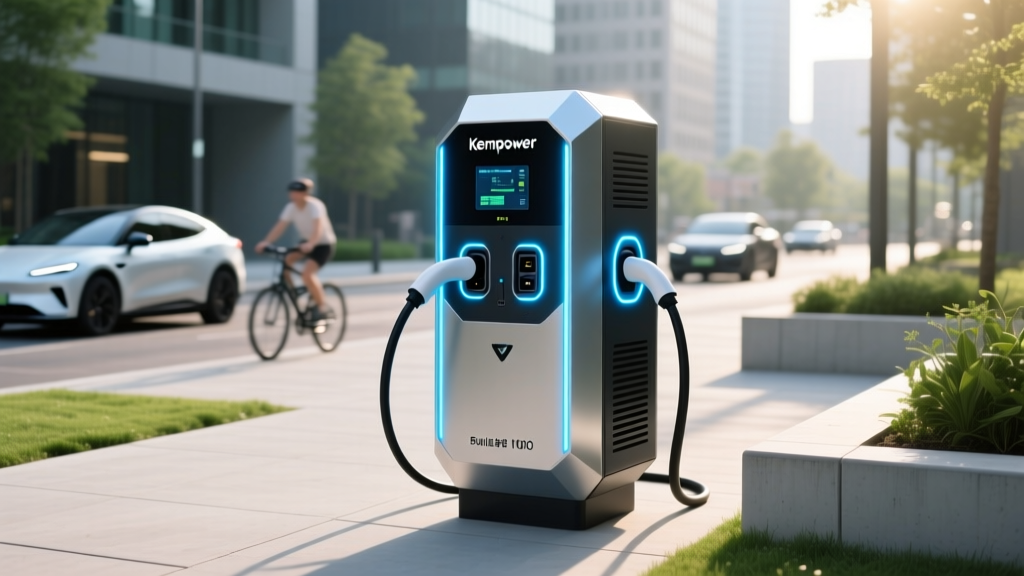
Kempower is a Finnish DC fast-charging manufacturer that has carved out a distinct niche in the EV charging infrastructure market with its modular Satellite charging system. Unlike conventional all-in-one DC fast chargers that cram power electronics and the connector cable into a single bulky pedestal, Kempower splits the architecture into two components: a centralized Power Cabinet (which houses the rectifiers and power electronics) and one or more compact Satellite charging posts connected by underground DC cabling.
This split design matters for real-world charging. The Satellite post is roughly the size of a standard bollard — about 19 inches wide — making it dramatically easier to install in tight urban spaces, gas station forecourts, and fleet depots where a traditional 350 kW CCS pedestal simply won't fit. The power cabinet can be placed up to 200 meters away, often behind a building or in a utility area.
As of 2025–2026, Kempower's product lineup includes the S-Unit Satellite (up to 600 kW total from a single C-Series cabinet), the T-Series Satellite (a compact single-post unit for lower-power deployments), and the Movable Charger (a portable DC unit for events and temporary sites). The system supports dynamic power sharing — meaning the cabinet distributes available kW across multiple satellites based on each vehicle's actual demand, rather than locking each connector to a fixed allocation.
Kempower Charging Speeds: DC Fast, Level 2, and Level 1 Compared
Kempower's core product is DC fast charging (Level 3). To understand where it fits, here is how all three EV charging levels compare in real-world speed. Note that miles added per hour varies by vehicle efficiency — the figures below assume an average efficiency of 3.0 miles per kWh (typical for a mid-size crossover like the Hyundai Ioniq 5 or Tesla Model Y).
| Charging Level | Power Output | Miles Added/Hour | Typical Use Case |
|---|---|---|---|
| Level 1 (120V AC) | 1.4–1.9 kW | 3–5 mi/hr | Overnight top-up; emergency backup |
| Level 2 (240V AC) | 7.2–19.2 kW | 20–60 mi/hr | Home, workplace, destination charging |
| DC Fast (Kempower Satellite) | 25–600 kW | 150–1,200+ mi/hr (peak) | Highway corridors, fleet depots, urban hubs |
Kempower's Satellite system can deliver anywhere from 25 kW (a single power module allocated to one vehicle) up to 600 kW (all modules routed to a single vehicle with an 800V architecture, such as the Hyundai Ioniq 5 N or Porsche Macan Electric). Most current EVs max out between 150–350 kW on the vehicle side, so the full 600 kW is primarily future-proofing for next-generation battery platforms.
Real-World 10–80% Charge Times on Kempower Hardware
Here's what actual charging sessions look like on Kempower equipment for common EV battery sizes. These times assume the vehicle's peak charge rate is supported and the battery is preconditioned to optimal temperature:
- 60 kWh battery (e.g., Chevrolet Equinox EV): ~18–22 minutes at 150 kW sustained average
- 77 kWh battery (e.g., Tesla Model Y Long Range): ~20–25 minutes at 250 kW peak, ~170 kW average
- 84 kWh battery (e.g., Kia EV6 GT-Line): ~18 minutes at 239 kW peak (800V architecture)
- 100 kWh battery (e.g., GMC Sierra EV): ~28–35 minutes at 200 kW average
Charge curve reality check: No EV sustains its peak kW rate from 10% to 80%. A vehicle rated for 250 kW peak may only hold that rate between roughly 10–30% state of charge, then taper to 150 kW, then drop further above 60%. Kempower's dynamic power sharing helps by reallocating unused power modules to other vehicles as one vehicle's demand tapers — improving throughput across the whole station.
Connector Compatibility: NACS, CCS, and CHAdeMO on Kempower
Kempower Satellites are connector-agnostic at the hardware level — the posts can be configured with CCS1, NACS (Tesla's North American Charging Standard), or CHAdeMO connectors depending on the market and operator's requirements. In North America, the industry has decisively shifted toward NACS as the standard, and Kempower has responded by offering NACS-native Satellite posts alongside CCS1 configurations.
| Connector | Max Power | EVs Using It (2026) | Adapter Needed? |
|---|---|---|---|
| NACS (North American Charging Standard) | Up to ~900 kW (theoretical) | Tesla (all), Ford, GM, Rivian, Volvo, Polestar, Hyundai/Kia (2025+), most new EVs | CCS-to-NACS adapter for older CCS vehicles at NACS-only posts |
| CCS1 (Combined Charging System) | Up to 350 kW | Legacy EVs (pre-2025 Hyundai/Kia, VW ID.4 early models, BMW iX) | NACS-to-CCS adapter for CCS vehicles at NACS posts; becoming less common |
| CHAdeMO | Up to 100 kW (typical) | Nissan Leaf (legacy), Mitsubishi Outlander PHEV (legacy) | No adapter available to NACS/CCS; CHAdeMO is being phased out in North America |
For EV drivers, the practical takeaway is that Kempower-equipped sites increasingly feature NACS connectors as the default in North America. If you drive a CCS1-equipped vehicle from the 2022–2024 model years, carry a Tesla-approved CCS adapter or a third-party equivalent to ensure access. According to the U.S. Department of Energy's Alternative Fuels Data Center, NACS has become the dominant connector standard for new DC fast-charging deployments.
Where You'll Find Kempower Charging Stations
Kempower doesn't operate its own public charging network the way Tesla operates Superchargers or Electrify America operates its stations. Instead, Kempower is a hardware supplier — it sells charging equipment to site operators, fleet managers, fuel retailers, and charging networks. You'll find Kempower Satellites deployed by operators such as:
- Electrify America — selected next-gen metro sites
- Shell Recharge — European and select U.S. fuel station conversions
- Independent CPOs (charge point operators) building urban charging hubs
- Fleet depots — delivery, transit, and rental car operators
- European networks — Kempower's home market (Finland, Nordics, Germany) has dense deployment
To locate Kempower-equipped stations, use apps like PlugShare or A Better Routeplanner (ABRP) and look for Kempower listed under the station's hardware provider. The compact Satellite posts are visually distinctive — slim, dark gray or black posts with a small touchscreen, quite unlike the large rectangular cabinets of ABB or ChargePoint stations.
Charging Cost: Kempower DC Fast Charging vs. Home vs. Gas
The cost to charge at a Kempower-equipped station depends entirely on the site operator, not on Kempower itself. Kempower hardware supports flexible pricing models including per-kWh billing (the most transparent and increasingly mandated by state weights-and-measures laws), per-minute billing, and idle fees.
Here's how typical charging costs break down across scenarios for a vehicle averaging 3.0 miles per kWh:
| Charging Scenario | Price per kWh | Cost per Mile | Cost for 300-mi Trip |
|---|---|---|---|
| Home charging (off-peak utility rate) | $0.08–$0.14 | $0.03–$0.05 | $8–$14 |
| Home charging (standard residential rate) | $0.15–$0.22 | $0.05–$0.07 | $15–$22 |
| Public DC fast (Kempower site, typical) | $0.35–$0.55 | $0.12–$0.18 | $35–$55 |
| Gasoline (25 MPG combined, $3.50/gal) | — | $0.14 | $42 |
The bottom line: Home charging on off-peak rates is dramatically cheaper than any public DC fast charging or gasoline. Public DC fast charging at Kempower sites is roughly cost-competitive with gasoline on a per-mile basis — the advantage is speed and convenience on road trips, not cost savings. If you can charge at home 80%+ of the time, your blended cost per mile will be well below gas.
Home Charging Setup: What You Actually Need (and What It Costs)
Kempower's Satellite system is commercial/industrial DC fast-charging hardware — it is not designed for residential installation. For home charging, you need a Level 2 AC charger connected to a dedicated 240V circuit. Here is what a proper home EV charging installation involves and what it costs.
Electrical Requirements for Home Level 2 Charging
- Voltage: 240V (same as a dryer or oven circuit)
- Amperage: 40A circuit for a 32A continuous charger (NEC requires circuits rated at 125% of continuous load); 60A circuit for a 48A charger
- Wire gauge: 6 AWG copper for 40A; 4 AWG for 60A (varies by run length and local code)
- Dedicated circuit: The EV charger must have its own breaker — no shared circuits
- GFCI protection: Required by NEC 2020+ for outdoor receptacles; hardwired installations may have different requirements depending on jurisdiction
- Outdoor rating: NEMA 4 or NEMA 4X rated enclosure if the charger is mounted outdoors
Home Charger Installation Cost Breakdown
| Component | Low End | High End | Notes |
|---|---|---|---|
| Level 2 charger (hardware) | $300 | $700 | 40A–48A smart charger; hardwired or NEMA 14-50 plug |
| Electrician labor (standard install) | $400 | $1,200 | Short run from panel to garage; longer runs cost more |
| Permit and inspection | $50 | $250 | Required in most jurisdictions; varies by municipality |
| Electrical panel upgrade (if needed) | $1,500 | $4,000+ | Needed if panel is at capacity (common in pre-2000 homes with 100A service) |
| TOTAL (no panel upgrade) | $750 | $2,150 | Most homes with 200A service and short wire runs |
| TOTAL (with panel upgrade) | $2,250 | $6,150+ | Older homes or homes with heavy existing loads |
Panel upgrade reality: Homes built before 2000 often have 100A or 150A electrical service. Adding a 40A or 60A EV circuit to a panel that is already near capacity (running HVAC, electric dryer, electric oven, etc.) may require a service upgrade to 200A. This is the single biggest variable in home charger installation cost. Always have a licensed electrician perform a load calculation before quoting the job.
Recommended Home Level 2 Chargers
While Kempower serves the commercial DC fast-charging market, here are proven Level 2 home chargers that pair well with vehicles you'd otherwise charge at Kempower public stations:
Emporia Vue Level 2 Charger
- Power: 48A / 11.5 kW (hardwired, 60A circuit)
- Connector: NACS (native), CCS adapter available
- Cable length: 24 ft
- Smart features: Wi-Fi, app scheduling, solar integration, energy monitoring
- Price: ~$400
ChargePoint Home Flex
- Power: Up to 50A / 12 kW (adjustable, NEMA 14-50 or hardwired)
- Connector: NACS (2025+ models), J1772 (older)
- Cable length: 23 ft
- Smart features: Wi-Fi, Alexa, app scheduling, charge tracking
- Price: ~$550
Tesla Wall Connector
- Power: 48A / 11.5 kW (hardwired, 60A circuit)
- Connector: NACS (native), J1772 adapter included
- Cable length: 24 ft
- Smart features: Wi-Fi, OTA updates, power sharing between multiple units
- Price: ~$475
Grizzl-E Smart
- Power: 40A / 9.6 kW (NEMA 14-50 plug, 50A circuit)
- Connector: J1772 (NACS adapter for newer EVs)
- Cable length: 24 ft
- Smart features: OCPP-compatible, app control, extreme cold rated (-40°F)
- Price: ~$450
Kempower's Dynamic Power Sharing: Why It Matters for Drivers
The technical feature that most distinguishes Kempower from competitors like ABB Terra or ChargePoint Express is dynamic power sharing across multiple Satellite posts from a single Power Cabinet. Here's how it works in practice:
Imagine a Kempower C-Series Power Cabinet rated at 400 kW, connected to four Satellite posts. When four vehicles plug in simultaneously, each might initially receive 100 kW. But as Vehicle A's battery passes 60% state of charge and its demand tapers to 50 kW, the system automatically reallocates those freed-up 50 kW to Vehicle B, which is still at 20% and can absorb the full rate. This means:
- Faster average sessions for all vehicles, not just the first to arrive
- Higher station utilization for the operator (less wasted capacity)
- More consistent charge speeds regardless of how many vehicles are plugged in
For the driver, this means you're less likely to experience the frustrating "split charger" scenario where arriving at a station with another vehicle plugged in cuts your charge rate in half — a common complaint at older CCS deployments with static power splitting.
Safety, Codes, and Compliance for DC Fast Charging Infrastructure
While home charging safety was covered above, Kempower-class DC fast-charging installations are governed by a different set of commercial and industrial codes:
- NEC Article 625: Governs all EV charging system equipment in the United States
- UL 2202 / UL 2594: Safety standards for EV charging system equipment (DC and AC respectively)
- National Institute of Standards and Technology (NIST) Handbook 44: Weights and measures requirements for kWh metering accuracy in commercial billing — Kempower hardware is NIST-compliant for per-kWh billing
- ADA compliance: Charging stations must meet accessibility requirements for cable reach, screen height, and pathway clearance
- Local fire codes: May require specific setback distances, fire suppression, or bollard protection for DC fast-charging equipment
Kempower's Satellite posts carry IP54 outdoor ratings (protection against dust ingress and water spray), IK10 impact resistance (vandal-resistant housing), and operate in ambient temperatures from -35°C to +50°C (-31°F to 122°F). For fleet operators in northern climates, the cold-weather rating is a meaningful advantage over equipment that derates or faults below freezing.
For authoritative guidance on EV charging infrastructure codes, the National Highway Traffic Safety Administration (NHTSA) and your state's electrical board provide jurisdiction-specific requirements.
Frequently Asked Questions
How much does it cost to install a home EV charger?
A standard Level 2 home charger installation costs between $750 and $2,150 (equipment, electrician labor, and permit) for homes with a 200A electrical panel and a short wire run. If your home needs a panel upgrade from 100A to 200A service, expect to add $1,500–$4,000+, bringing the total to $2,250–$6,150. Always get a load calculation from a licensed electrician first.
How fast will each charging level add range?
Level 1 (120V) adds 3–5 miles per hour. Level 2 (240V) adds 20–60 miles per hour depending on amperage and vehicle efficiency. Kempower DC fast chargers add 150–1,200+ miles per hour at peak rates, meaning a typical 10–80% session takes 18–35 minutes for most current EVs.
Which connector/charger is compatible with my EV?
If your EV is a 2025+ model from Tesla, Ford, GM, Rivian, Hyundai, Kia, Volvo, or Polestar, it almost certainly has a NACS port. Older EVs (2022–2024) from Hyundai, Kia, VW, and BMW typically have CCS1. Kempower stations can be configured with either connector. Carry an adapter if your vehicle's connector doesn't match the station. CHAdeMO is limited to the Nissan Leaf and is being phased out.
How much does charging cost per mile vs gas?
Home charging at off-peak rates costs roughly $0.03–$0.05 per mile — about one-third to one-quarter the cost of gasoline at $0.14 per mile (25 MPG, $3.50/gal). Public DC fast charging at Kempower sites typically costs $0.12–$0.18 per mile, which is roughly comparable to gasoline. The economics strongly favor home charging for daily use.
What electrical upgrades might I need for a home charger?
The most common upgrade is a panel capacity increase from 100A to 200A service, needed in older homes where the existing panel is near capacity. You may also need a new breaker slot, upgraded service wire from the utility, or a sub-panel if the main panel is far from the charging location. A licensed electrician's load calculation will determine exactly what's needed.
Can I install a Kempower Satellite charger at home?
No. Kempower Satellite systems are commercial-grade DC fast chargers requiring 480V three-phase power input, utility-grade transformers, and commercial permitting. They are designed for fleet depots, retail sites, and highway charging stations — not residential use. For home charging, a Level 2 AC charger on a 240V circuit is the correct solution.
Does Kempower operate its own charging network?
No. Kempower is a hardware manufacturer, not a network operator. You'll find Kempower equipment deployed by various charging networks (Electrify America, Shell Recharge, independent operators). Use PlugShare or A Better Routeplanner to locate Kempower-equipped sites near your routes.