2021 Jeep Wrangler 4xe Charging Basics: Battery, Connector, and What You Need
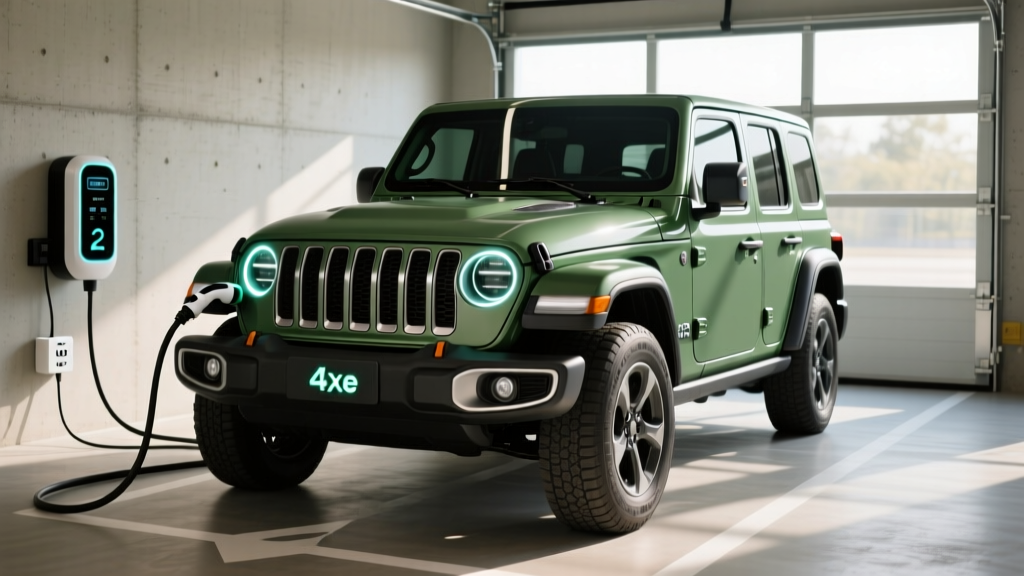
The 2021 Jeep Wrangler 4xe pairs a 2.0L turbocharged engine with a 17 kWh lithium-ion battery pack (approximately 14.7 kWh usable), delivering an EPA-estimated 22 miles of electric-only range and 49 MPGe combined. Whether you bought one new or picked one up on the used market, understanding exactly how long it takes to charge — and what home setup gets you the fastest, most cost-effective top-ups — is essential to getting real value from the powertrain.
The 4xe uses a SAE J1772 connector for Level 1 and Level 2 AC charging. This is the standard connector for virtually all non-Tesla plug-in vehicles sold in North America. The onboard charger is rated at 7.2 kW maximum, which means even if you plug into a 48-amp (11.5 kW) Level 2 station, the 4xe will only ever accept 7.2 kW. This is a critical detail when selecting home charging equipment — you don't need to overspend on a high-amperage unit to get maximum speed.
Charging Levels Explained: Speeds, kW, and What Each Delivers
Before we get into exact charging times, let's establish the three charging tiers. The distinction between kW (kilowatts) and kWh (kilowatt-hours) is the single most important concept in EV ownership: kW measures the rate of power delivery (like water pressure from a hose), while kWh measures total energy stored (like gallons in a bucket). A 7.2 kW charger delivers energy at 7.2 kilowatts; your battery stores up to 17 kWh total.
| Level | Voltage / Amperage | Power (kW) | Miles of Range Added per Hour | Full Charge Time (0–100%) |
|---|---|---|---|---|
| Level 1 (Standard Outlet) | 120V / 12A | ~1.4 kW | ~3–4 miles/hr | ~12–14 hours |
| Level 2 (Home / Public AC) | 240V / 32A (onboard limit) | 7.2 kW (max) | ~14–16 miles/hr | ~2–2.5 hours |
| DC Fast Charging | N/A | Not supported | N/A | N/A |
Key takeaway: The Wrangler 4xe does not support DC fast charging. There is no CCS or CHAdeMO port — only the J1772 inlet. All charging is AC-based, which means your fastest option is a Level 2 connection at 7.2 kW. For a PHEV with a relatively small battery, this is sufficient and normal.
2021 Jeep Wrangler 4xe Level 2 Charging Time: The Exact Numbers
With the onboard charger capped at 7.2 kW, here is what you can expect from a properly configured Level 2 setup:
- 0% to 100% (full charge): Approximately 2 hours to 2 hours 30 minutes
- 20% to 80% (typical daily use): Approximately 1 hour 15 minutes to 1 hour 30 minutes
- Depleted to full after a day of hybrid driving: Typically 1.5 to 2 hours, depending on how much battery was consumed
These times assume a dedicated 240V/32A circuit delivering the full 7.2 kW. If your Level 2 station is on a lower-amperage circuit — say a 24A circuit delivering 5.76 kW — your 0–100% time stretches to approximately 3 hours. Always match the circuit to the charger's rated output.
For context, the EPA's fueleconomy.gov listing confirms the 4xe's 49 MPGe combined and 22-mile EV range, which aligns with the charging math above. A full 14.7 kWh charge at 7.2 kW takes roughly 2 hours and 3 minutes in ideal conditions, plus a brief taper near 100% as the battery management system balances cells.
Home Level 2 Charger Installation: Electrical Requirements, Costs, and Panel Considerations
Installing a Level 2 charger at home is the single best upgrade for any 4xe owner. Here is exactly what the job entails.
Electrical Requirements
To deliver the 4xe's maximum 7.2 kW, you need a 240V circuit rated at 40 amps. This follows the National Electrical Code (NEC) 80% continuous-load rule: a 40-amp breaker supports 32 amps of continuous draw, which at 240V equals 7.68 kW — more than enough headroom for the 4xe's 7.2 kW ceiling. If you install a charger capable of higher output (say, 48 amps), you would need a 60-amp breaker and appropriate wire gauge, but the 4xe will still only pull 7.2 kW.
Panel Upgrade Possibilities
Older homes — particularly those built before 1990 — may have 100-amp electrical panels that lack the spare capacity for a new 40-amp circuit. Signs you might need a panel upgrade:
- Your panel is 100A or less and already near capacity (electric range, dryer, A/C, water heater)
- You have a Federal Pacific or Zinsco panel (known safety hazards, often flagged by inspectors)
- The run from the panel to the garage exceeds 100 feet (requires thicker, more expensive wire)
A panel upgrade from 100A to 200A typically costs $1,500 to $3,500 depending on your utility's requirements and local labor rates. This is the hidden cost that catches many new PHEV/EV buyers off guard.
Installation Cost Breakdown
| Component | Low End | High End | Notes |
|---|---|---|---|
| Level 2 Charger (Hardware) | $300 | $700 | 32A–40A units; smart Wi-Fi models cost more |
| Electrician Labor | $400 | $1,200 | Depends on run length, wall type, conduit needs |
| Electrical Permit | $50 | $250 | Varies by municipality; some waive for EV circuits |
| Panel Upgrade (if needed) | $1,500 | $3,500 | 100A to 200A; not always required |
| Total (No Panel Upgrade) | $750 | $2,150 | Most common scenario for modern homes |
| Total (With Panel Upgrade) | $2,250 | $5,650 | Older homes or high-load panels |
Always hire a licensed electrician and pull a permit. Unpermitted electrical work can void homeowners insurance and create fire risk. The NEC requires a dedicated circuit for EV charging — you cannot share the circuit with other large appliances.
Connector Compatibility and Adapter Needs for the 4xe
The 2021 Wrangler 4xe uses the SAE J1772 connector for all AC charging. This is straightforward: virtually every public Level 2 station in the United States provides a J1772 plug. No adapter is needed for public Level 2 charging.
| Connector | Type | Compatible with 4xe? | Notes |
|---|---|---|---|
| SAE J1772 | AC (Level 1 & 2) | Yes — native | Standard for all public Level 2 stations |
| NACS (Tesla) | AC/DC | No (no adapter needed) | 4xe does not use DC fast charging; NACS AC adapters exist but offer no benefit |
| CCS1 (Combo) | DC Fast | No | 4xe has no DC fast charge port |
| CHAdeMO | DC Fast | No | Legacy DC standard; 4xe cannot use it |
Practical note: If you also own a Tesla or plan to buy a NACS-equipped vehicle in the future, you can install a NACS (Tesla Wall Connector) at home and use a Tesla-to-J1772 adapter for the 4xe. The adapter costs approximately $200–$250 and works flawlessly for AC charging. However, for 4xe-only households, a native J1772 charger is simpler and less expensive.
Recommended Level 2 Chargers for the Wrangler 4xe
Since the 4xe tops out at 7.2 kW (32 amps at 240V), you don't need a 48-amp or 80-amp charger. However, buying a 40-amp or 48-amp unit gives you future-proofing if your next vehicle has a larger battery and a faster onboard charger. Here are three proven options:
Emporia Level 2 EV Charger
- Power Output: 48A / 11.5 kW max (4xe will draw 7.2 kW)
- Connector: J1772
- Cable Length: 24 feet
- Smart Features: Wi-Fi, app scheduling, energy monitoring, solar integration
- Price: ~$350–$400
- Best For: Budget-conscious buyers who want smart features and energy tracking
ChargePoint Home Flex
- Power Output: Configurable 16A–50A / up to 12 kW (set to 40A for the 4xe)
- Connector: J1772
- Cable Length: 23 feet
- Smart Features: Wi-Fi, app-based scheduling, Alexa integration, flexible amperage settings
- Price: ~$550–$650
- Best For: Owners who want adjustable amperage to match their circuit exactly
Grizzl-E Smart
- Power Output: 40A / 9.6 kW max
- Connector: J1772
- Cable Length: 24 feet
- Smart Features: Wi-Fi, OCPP compatibility, outdoor-rated (NEMA 4), extreme cold tested to -40°F
- Price: ~$450–$550
- Best For: Outdoor installs, cold-climate owners, and garage-less setups
All three chargers are UL-listed (a critical safety certification — do not buy non-UL chargers from overseas marketplaces) and will deliver the full 7.2 kW the 4xe can accept. For a 40-amp circuit, set the ChargePoint Home Flex to 40A and the Grizzl-E to its default 40A output. The Emporia unit can be hardwired on a 60-amp breaker at full 48A or configured lower via DIP switches.
Charging Cost: Home vs. Public vs. Gas — What the 4xe Actually Costs Per Mile
The 4xe's 14.7 kWh usable battery is small enough that charging costs are minimal — especially at home. Here is how the math breaks down across different scenarios:
| Scenario | $/kWh or $/Gallon | Cost for Full Charge / Tank | Cost per Mile (EV Mode) | Cost per Mile (Gas Mode) |
|---|---|---|---|---|
| Home (Off-Peak Rate) | $0.12/kWh | $1.76 | $0.08/mi | $0.22/mi (at $3.50/gal, 20 MPG) |
| Home (Average Rate) | $0.16/kWh | $2.35 | $0.11/mi | $0.22/mi |
| Public Level 2 | $0.30/kWh | $4.41 | $0.20/mi | $0.22/mi |
| Gasoline Only (Combined) | $3.50/gal | $75.25 (21.5 gal tank) | N/A | $0.18/mi (at 20 MPG combined) |
At home on off-peak rates, driving the 4xe in electric mode costs roughly $0.08 per mile — less than half the cost of gasoline. Over a year of 12,000 miles, if you charge nightly and drive within the 22-mile EV range on weekdays, you could save $800–$1,200 in fuel costs compared to gas-only operation. However, the 4xe's relatively short EV range means highway-heavy drivers will spend most of their miles in hybrid mode, where the 20 MPG combined gas rating means savings narrow considerably.
To check current electricity rates in your area, the U.S. Energy Information Administration (EIA) maintains state-by-state rate data.
Safety, Code, and Best Practices for Home Charging
Proper installation protects your home, your vehicle, and your insurance coverage. Here are the non-negotiable safety requirements:
- Dedicated circuit: The NEC requires EV chargers to have their own dedicated circuit — never share with a dryer, oven, or workshop equipment.
- GFCI protection: The 2020 NEC update (adopted by most states by 2026) requires GFCI protection for outdoor receptacles and many indoor garage installations. Hardwired chargers often bypass this requirement, which is one reason electricians prefer hardwiring.
- Outdoor rating: If your charger is installed outside or in an unsealed garage, it must carry a NEMA 4 or NEMA 4X rating (protection against rain, ice, and dust). The Grizzl-E and Emporia both carry this rating.
- Wire gauge: A 40-amp circuit requires minimum 8 AWG copper wire; a 60-amp circuit requires 6 AWG. Your electrician will size this based on run length and local code.
- Cable management: Use a wall-mounted holster or retractable reel to keep the charging cable off the garage floor. Tripping over a 24-foot cable is a real hazard.
Frequently Asked Questions
Can I charge the 2021 Jeep Wrangler 4xe on a regular 120V outlet?
Yes. The 4xe comes with a Level 1 charging cord that plugs into a standard 120V household outlet. However, at approximately 1.4 kW, a full charge takes 12–14 hours. This works for overnight top-ups if you only depleted 5–10 miles of range, but for daily full charges, Level 2 is strongly recommended.
Does the Wrangler 4xe support DC fast charging?
No. The 2021 Wrangler 4xe does not have a DC fast-charge port (CCS or CHAdeMO). The vehicle can only accept AC power through its J1772 inlet, with a maximum rate of 7.2 kW on Level 2. This is typical for PHEVs with smaller batteries.
Will a 48-amp charger charge my 4xe faster than a 32-amp charger?
No. The 4xe's onboard charger is limited to 7.2 kW (32 amps at 240V). A 48-amp charger can deliver up to 11.5 kW, but the 4xe will only draw 7.2 kW. The charging time will be identical. The advantage of a higher-amp charger is future-proofing for your next EV.
How much does it cost to install a Level 2 charger for the 4xe at home?
Expect $750–$2,150 for a standard installation (charger + electrician + permit) if your electrical panel has spare capacity. If you need a panel upgrade from 100A to 200A, add $1,500–$3,500. Always get 2–3 quotes from licensed electricians.
Is the 2021 Wrangler 4xe eligible for any tax credits?
The original $7,500 federal tax credit (§30D) for new 4xe purchases has been subject to evolving IRS rules around battery sourcing, income caps, and MSRP limits. For used 4xe purchases, the used clean vehicle credit (up to $4,000 or 30% of sale price, whichever is lower) may apply if the sale price is $25,000 or less, your income falls below IRS thresholds ($75,000 single / $150,000 married filing jointly), and the vehicle is purchased from a licensed dealer. Consult a tax professional for your specific eligibility.
How fast does public Level 2 charging add range to the 4xe?
Public Level 2 stations typically deliver 6.6–7.2 kW, which adds approximately 14–16 miles of EV range per hour to the 4xe. Since the total EV range is only 22 miles, a 90-minute stop at a public Level 2 station will fully recharge the battery in most cases.
Should I charge to 100% every night?
The 4xe uses an NMC (nickel manganese cobalt) lithium-ion battery. For NMC chemistry, daily charging to 80–90% is generally better for long-term battery health than consistently charging to 100%. However, given the small 22-mile EV range, many owners charge to 100% daily to maximize usable electric miles — this is a reasonable trade-off, and Jeep's battery management system includes a top-buffer to protect against overcharge stress. The Wrangler 4xe's high-voltage battery warranty covers 8 years or 100,000 miles with a capacity retention threshold.