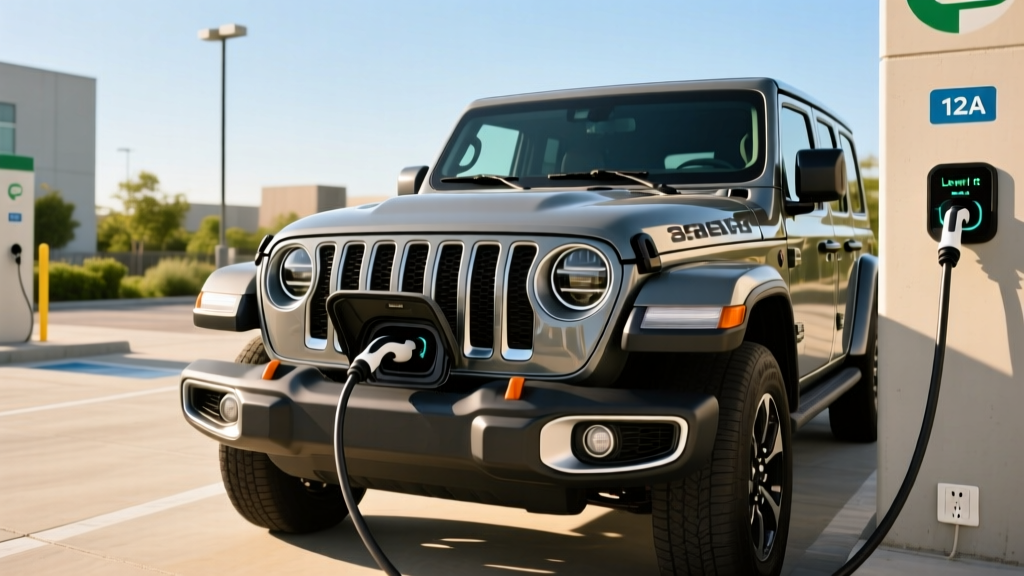
If you own or are considering a used 2021 Jeep Wrangler 4xe, you've probably searched for its Level 1 charging time at 12 amps and found conflicting numbers. The Wrangler 4xe packs a 17 kWh battery (about 15 kWh usable) and comes with a portable Level 1 cordset that draws 12A from a standard 120V household outlet. That yields roughly 1.4 kW of charging power — enough to fully replenish the battery in approximately 12 to 13 hours from empty.
For a plug-in hybrid with just 22 miles of EPA-rated electric range, that long charge time might seem frustrating. But understanding why it takes that long — and what your faster options are — is the key to getting the most out of the 4xe powertrain. This guide covers the real-world Level 1 charging experience, Level 2 upgrade paths, home electrical requirements, installation costs, and the economics of charging a PHEV versus filling its gas tank.
Understanding Level 1 Charging for the Wrangler 4xe
Level 1 charging uses a standard 120V AC household outlet. The 2021 Wrangler 4xe's included portable charging cord draws 12 amps, which translates to:
120V × 12A = 1,440 watts (1.44 kW)
After accounting for charging inefficiency (heat loss, battery management overhead), expect roughly 1.2 to 1.3 kW of actual energy reaching the battery per hour. With approximately 15 kWh of usable capacity, the math works out to:
15 kWh ÷ 1.3 kW ≈ 11.5 to 12.5 hours for a full charge
Level 1 Miles Added Per Hour
At the EPA-rated efficiency of roughly 49 MPGe (combined), each kWh provides about 3.5 miles of electric driving. At 1.3 kW delivery, you gain approximately 4 to 5 miles of electric range per hour of Level 1 charging.
| Level | Voltage / Amperage | Power (kW) | Miles of Range Added Per Hour | Full Charge Time (4xe ~15 kWh usable) |
|---|---|---|---|---|
| Level 1 (12A) | 120V / 12A | ~1.4 kW | ~4–5 miles | ~12–13 hours |
| Level 1 (16A)* | 120V / 16A | ~1.9 kW | ~6–7 miles | ~8–9 hours |
| Level 2 (32A) | 240V / 32A | ~7.7 kW | ~25–30 miles | ~2–2.5 hours |
| Level 2 (40A) | 240V / 40A | ~9.6 kW | ~30–35 miles | ~1.5–2 hours |
*The Wrangler 4xe's onboard charger is capped at 7.2 kW for Level 2 AC. Level 1 at 16A requires a dedicated 20A circuit and a cordset rated for that amperage — the stock cord is 12A only.
Level 2 Charging: The Practical Upgrade for 4xe Owners
While Level 1 works for overnight top-ups when the battery isn't fully depleted, most Wrangler 4xe owners find that a Level 2 home charger transforms the ownership experience. The 4xe has a 7.2 kW onboard charger, meaning it can accept up to 7.2 kW from a 240V Level 2 source.
At 7.2 kW, the 15 kWh usable battery charges in approximately 2 to 2.5 hours. That means you can plug in when you get home from work and have a full battery before bedtime — or top up during the day while working from home.
Why Level 2 Matters for a PHEV
With only 22 miles of electric range (per fueleconomy.gov), the 4xe rewards frequent charging. If you charge once daily, you might use 10–15 kWh and cover most short commutes on electricity. But if you skip a day and deplete the battery, you'll need that full 12+ hour Level 1 cycle to recover. Level 2 eliminates that penalty and makes daily electric driving sustainable.
The math is compelling: a PHEV owner who charges daily on Level 2 can cover 6,000–8,000 electric miles per year (assuming 20-mile daily commutes), displacing roughly 200–270 gallons of gasoline. At $3.50/gallon, that's $700–$950 in annual fuel savings.
Home Charger Installation: Requirements, Costs & Panel Upgrades
Installing a Level 2 charger at home is the single biggest upgrade a PHEV or EV owner can make. Here's what's involved for a 240V circuit to support the Wrangler 4xe's 7.2 kW maximum.
Electrical Requirements
To deliver 7.2 kW to the 4xe, you need:
- Voltage: 240V (standard dryer/oven circuit voltage)
- Amperage: 32A minimum (32A × 240V = 7.68 kW, matching the 4xe's 7.2 kW onboard charger with slight overhead)
- Circuit breaker: 40A (NEC code requires the breaker to be rated at 125% of continuous load: 32A × 1.25 = 40A)
- Wire gauge: 8 AWG copper (for runs up to ~50 feet); 6 AWG for longer runs
- Dedicated circuit: The charger must have its own breaker — it cannot share with other appliances
Do You Need a Panel Upgrade?
This is the most common hidden cost. Most homes built after the 1990s have a 200A main electrical panel, which typically has enough spare capacity for a 40A EV circuit. However, if your home has a 100A panel (common in older construction) or if your panel is already near capacity (running electric heat, a hot tub, double ovens), you may need a panel upgrade.
A panel upgrade from 100A to 200A typically costs $1,500–$3,000 depending on local labor rates and the complexity of the job. Some utility companies offer rebates that offset this cost.
Installation Cost Breakdown
| Component | Low-End Estimate | High-End Estimate | Notes |
|---|---|---|---|
| Level 2 Charger (hardware) | $250 | $650 | 32A–40A J1772 smart charger |
| Electrician labor | $300 | $1,200 | Depends on run length, wall type, conduit |
| Electrical materials (wire, conduit, breaker) | $75 | $300 | 8 AWG copper, 40A breaker, PVC conduit |
| Permit & inspection | $50 | $200 | Required by most jurisdictions |
| Panel upgrade (if needed) | $1,500 | $3,000 | Only if existing panel lacks capacity |
| Total (no panel upgrade) | $675 | $2,350 | Most homes: $800–$1,500 |
| Total (with panel upgrade) | $2,175 | $5,350 | Older homes with 100A service |
Connector Compatibility: What Fits the Wrangler 4xe?
The 2021 Jeep Wrangler 4xe uses the SAE J1772 connector for all AC charging (Level 1 and Level 2). This is the universal standard for non-Tesla electrified vehicles in North America. You will not use NACS, CCS1, or CHAdeMO connectors for home charging — those apply only to DC fast charging, which the 4xe does not support.
| Connector Type | Use Case | 4xe Compatible? | Adapter Needed? |
|---|---|---|---|
| SAE J1772 | Level 1 & Level 2 AC charging (home, public AC) | ✅ Yes — native port | No |
| NACS (Tesla) | Tesla Superchargers & Tesla Wall Connector | ❌ Not applicable | N/A — 4xe has no DC fast charge |
| CCS1 | DC fast charging (Electrify America, EVgo) | ❌ Not applicable | N/A — PHEV, no DC port |
| CHAdeMO | Legacy DC fast (Nissan Leaf) | ❌ Not applicable | N/A |
| NEMA 14-50 (outlet) | 240V receptacle for portable Level 2 cords | ✅ With compatible cordset | J1772-equipped mobile charger |
For home Level 2 charging, purchase any J1772-equipped charger rated at 32A or 40A. The 4xe will draw only what its 7.2 kW onboard charger allows, so a 40A charger is fine — the vehicle self-limits.
Level 2 Equipment Recommendations for the 4xe
Since the Wrangler 4xe maxes out at 7.2 kW (32A at 240V), you don't need the most powerful charger on the market. A quality 32A–40A J1772 unit with smart features is ideal. Here are three proven options:
Emporia Vue Level 2 Smart Charger
- Power output: 40A / 9.6 kW max (4xe will use 7.2 kW)
- Connector: J1772
- Cable length: 24 feet
- Smart features: Wi-Fi, app scheduling, energy monitoring, load management
- Price: ~$350–$400
- Best for: Budget-conscious owners who want app control and energy tracking
ChargePoint Home Flex
- Power output: Configurable 16A–50A (set to 32A or 40A for 4xe)
- Connector: J1772
- Cable length: 23 feet
- Smart features: Wi-Fi, Alexa integration, scheduled charging, ChargePoint network
- Price: ~$550–$650
- Best for: Owners who want a premium, network-connected charger with flexible amperage
Grizzl-E Smart
- Power output: 40A / 9.6 kW max
- Connector: J1772
- Cable length: 24 feet
- Smart features: Wi-Fi, OCPP support, adjustable amperage via DIP switches
- Price: ~$450–$500
- Best for: Outdoor/garage installs in harsh climates — built in Canada, rated to -40°F
Cost to Charge: Electricity vs. Gasoline Per Mile
The Wrangler 4xe's value proposition depends on how often you drive on electricity. Here's a realistic cost comparison:
| Scenario | Energy Source | Rate | Cost Per Mile |
|---|---|---|---|
| Home Level 2 (off-peak) | Electricity | $0.10/kWh | $0.03/mile |
| Home Level 2 (average US rate) | Electricity | $0.16/kWh | $0.05/mile |
| Public Level 2 (network fee) | Electricity | $0.30/kWh | $0.09/mile |
| Gasoline (4xe gas-only mode, 20 MPG) | Gasoline | $3.50/gallon | $0.18/mile |
| Gasoline (gas-only, 20 MPG at $4.00/gal) | Gasoline | $4.00/gallon | $0.20/mile |
At the US average residential rate of ~$0.16/kWh, charging the 4xe's full 15 kWh usable battery costs approximately $2.40 — for 22 miles of electric driving. That's roughly 3.5 to 6 times cheaper per mile than running the 4xe on gasoline alone, which returns about 20 MPG combined in gas-only mode per EPA data.
Over a year of daily charging and a 20-mile commute, you'd spend about $175 on electricity versus $630–$720 on gasoline for the same distance. That's a savings of $450–$550 annually — enough to pay off a Level 2 charger installation within 1–3 years.
Safety, Code & Best Practices for Home Charging
Whether you're plugging into a standard outlet for Level 1 or installing a hardwired Level 2 unit, electrical safety is non-negotiable. Here's what the National Electrical Code (NEC) and common-sense practice require:
Level 1 Safety (120V Outlet)
- Use a dedicated outlet: Don't plug the charger into an extension cord, power strip, or outlet shared with high-draw appliances (space heaters, microwaves)
- Check outlet condition: Older or worn outlets can overheat under sustained 12A draw. If the plug feels warm after an hour of charging, replace the outlet with a commercial-grade 15A or 20A receptacle
- GFCI protection: NEC 2020 and later require GFCI protection for 120V outlets in garages. Ensure your garage outlet is GFCI-protected
- Outdoor rating: If charging outdoors, the outlet must be in a weatherproof "in-use" cover rated for wet locations
Level 2 Safety (240V Circuit)
- Dedicated circuit: The 40A breaker must serve only the EV charger — no shared loads
- Hardwired vs. plug-in: Hardwired installations (no plug) eliminate one failure point and may not require GFCI breakers in some jurisdictions. Plug-in units using a NEMA 14-50 outlet need a GFCI breaker per NEC 2020+, which adds $50–$100 to the breaker cost
- Permit and inspection: Most municipalities require an electrical permit for new 240V circuits. The inspection ensures proper wire gauge, breaker sizing, and grounding — don't skip this step
- Outdoor installation: Choose a charger rated NEMA 4 or IP65 for outdoor use. The Grizzl-E and ChargePoint Home Flex both carry outdoor ratings
Frequently Asked Questions
How long does it really take to charge a 2021 Jeep Wrangler 4xe on Level 1 at 12A?
Approximately 12 to 13 hours from a fully depleted battery to 100%. In practice, most owners plug in with 30–50% remaining, requiring 6–9 hours — easily achievable overnight. The 12A draw rate yields about 1.4 kW, adding roughly 4–5 miles of electric range per hour.
Can I speed up Level 1 charging on the Wrangler 4xe?
Not with the stock cordset, which is limited to 12A. Some aftermarket Level 1 cordsets can draw 16A from a 120V/20A circuit, reducing charge time to 8–9 hours. However, this requires a dedicated 20A outlet (NEMA 5-20) and provides only marginal improvement. A Level 2 upgrade is far more impactful.
Does the Wrangler 4xe support DC fast charging?
No. The 4xe is a plug-in hybrid with AC-only charging capability via its J1772 port. Its 17 kWh battery is small enough that DC fast charging would add cost and weight without significant benefit. Level 2 at 7.2 kW fills the battery in about 2 hours, which is practical for daily use.
How much does it cost to install a home EV charger?
For a Level 2 (240V/40A) installation without a panel upgrade, expect $675–$2,350, with most homeowners paying $800–$1,500. If your home needs a panel upgrade from 100A to 200A, add $1,500–$3,000. Always get 2–3 quotes from licensed electricians and confirm the estimate includes permit and inspection fees.
Is the 4xe's 22-mile electric range worth charging every day?
Absolutely — if your daily driving is under 22 miles, daily charging means you'll rarely use gasoline for commutes. At $0.05/mile (home electricity) versus $0.18/mile (gasoline), the savings compound quickly. Over 5 years of daily charging, you could save $2,500–$3,500 in fuel costs while reducing engine wear. Per the IRS §30D guidelines, the original purchaser may have qualified for up to $7,500 in federal tax credits, though used-vehicle buyers should check current eligibility rules.
Which Level 2 charger should I buy for the Wrangler 4xe?
Any J1772 charger rated at 32A or 40A will work. Top picks include the Emporia Vue (~$350–$400), ChargePoint Home Flex (~$550–$650), and Grizzl-E Smart (~$450–$500). Since the 4xe's onboard charger caps at 7.2 kW (32A), you don't need a 48A or 80A unit — but buying a 40A charger gives you headroom for a future full-electric vehicle.
What electrical upgrades might I need for Level 2 charging?
The most common upgrade is a new 40A/240V circuit with 8 AWG wire. If your electrical panel lacks spare breaker slots or total capacity (common in homes with 100A service), a panel upgrade to 200A may be necessary. Your electrician will perform a load calculation to determine this. Utility rebates and the federal alternative fuel vehicle refueling property credit (up to $1,000 for home charger installation, subject to income and location limits) can offset some costs.