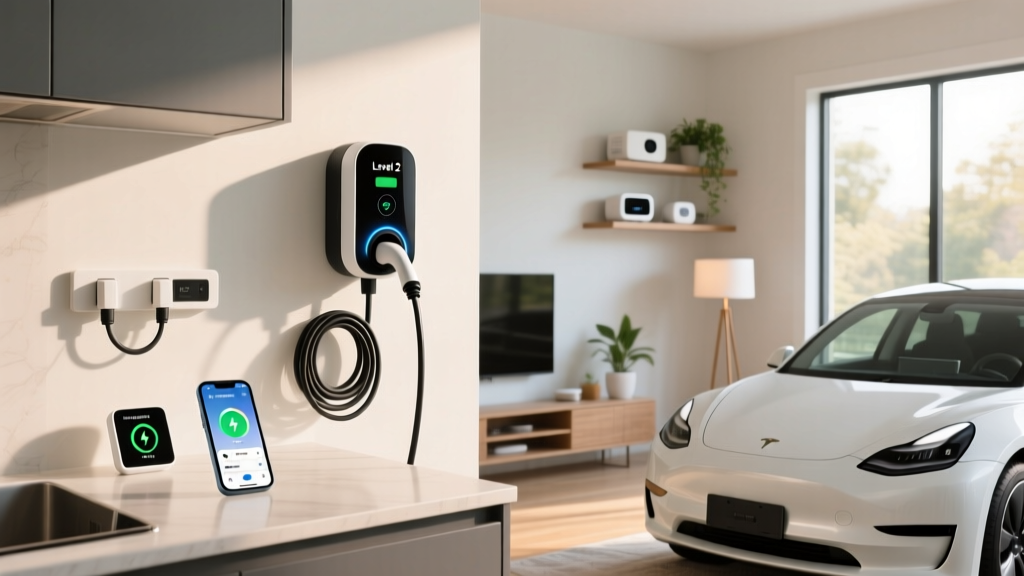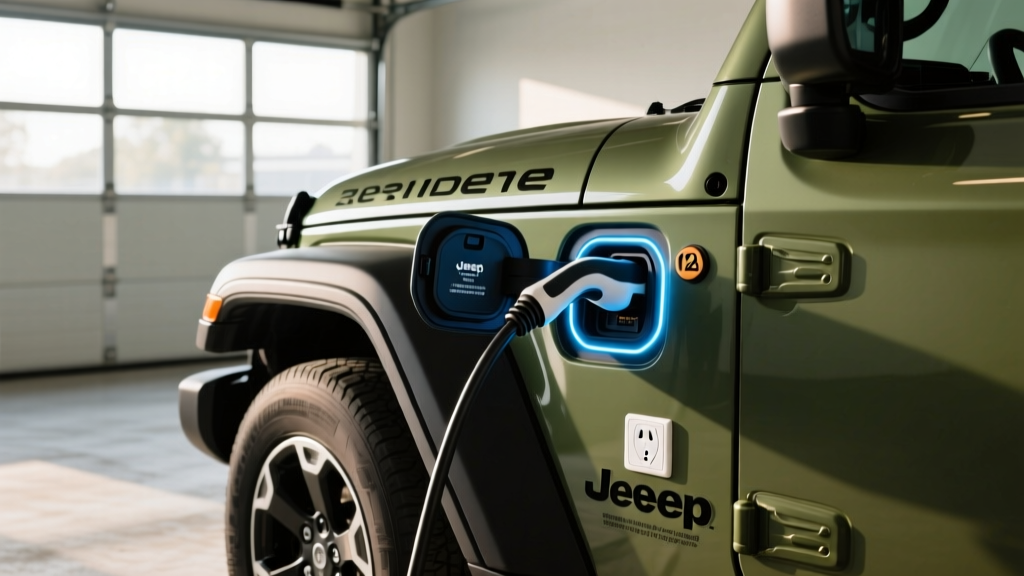
The 2021 Jeep Wrangler 4xe pairs a 2.0L turbo engine with a 17 kWh battery (14.4 kWh usable) and a J1772 charge port. If you are plugging into a standard 120V wall outlet at 12 amps, here is the number that matters: Level 1 charging at 12A delivers roughly 1.4 kW, adding about 3 to 4 miles of electric range per hour. A full 0-to-100% charge on Level 1 takes approximately 10 to 12 hours for the 4xe's usable pack.
That is workable for overnight top-ups if your daily electric commute is under 20 miles. But if you want faster turnarounds, a Level 2 home charger cuts that to roughly 2.5 hours. Below is the complete charging picture for the Wrangler 4xe — home installation, public networks, cost math, and equipment picks.
Wrangler 4xe Battery and Charging Specifications
| Specification | Value |
|---|---|
| Total Battery Capacity | 17 kWh (NMC chemistry) |
| Usable Battery Capacity | ~14.4 kWh |
| EPA Electric-Only Range | 21 miles (fueleconomy.gov) |
| EPA MPGe (Electric + Gas) | 49 MPGe combined |
| Gas-Only MPG (Charge-Depleted) | 20 MPG combined |
| Onboard Charger (AC) | 3.3 kW (single-phase) |
| Charge Port Connector | J1772 (AC) — no DC fast charging |
| Level 1 Time (120V / 12A) | ~10–12 hours (0–100%) |
| Level 2 Time (240V / 16A) | ~2.5–3 hours (0–100%) |
| Battery Warranty | 8 years / 100,000 miles (60% capacity retention) |
| Combined System Output | 375 HP / 470 lb-ft torque |
| 0–60 mph | ~6.0 seconds |
Charging Levels Explained: Speed, Power, and What to Expect
A common point of confusion is the difference between kW (kilowatts — the rate of power delivery, like water pressure from a hose) and kWh (kilowatt-hours — the total energy stored, like the size of the bucket). The Wrangler 4xe's usable bucket is 14.4 kWh. The hose size determines how fast you fill it.
| Level | Voltage / Amperage | Power (kW) | Miles of Range Added Per Hour | Best For |
|---|---|---|---|---|
| Level 1 | 120V / 12A | ~1.4 kW | 3–4 mi/hr (PHEV) / 3–5 mi/hr (BEV) | Overnight PHEV top-ups, no install |
| Level 1 | 120V / 16A (max circuit) | ~1.8 kW | 4–5 mi/hr | Slightly faster, needs dedicated circuit |
| Level 2 | 240V / 16A | ~3.3 kW | 10–14 mi/hr (PHEV) | Full 4xe charge in ~2.5 hours |
| Level 2 | 240V / 32A | ~7.7 kW | 25–30 mi/hr (BEV) | BEV overnight; overkill for 4xe's 3.3 kW onboard limit |
| Level 2 | 240V / 48A | ~11.5 kW | 35–44 mi/hr (BEV) | Large-battery BEVs (F-150 Lightning, Rivian) |
| DC Fast | 400V+ / variable | 50–350 kW | 150–1,000+ mi/hr | Road trips (BEV only — 4xe does NOT support DCFC) |
Level 1 Charging at 12A: The Detailed Math
When you plug the 4xe's included Level 1 cord into a standard 120V household outlet at 12 amps:
- Power delivered: 120V × 12A = 1,440 watts = 1.44 kW
- Energy added in 10 hours: 1.44 kW × 10 hrs = 14.4 kWh — essentially a full usable charge
- Real-world time to full: 10–12 hours accounting for charging losses (~10–15% heat/conversion losses)
- Range added overnight (8 hours): ~11.5 kWh, or roughly 17–19 electric miles — enough to cover the EPA-rated 21-mile range
This is why many 4xe owners never bother with a Level 2 install. If you plug in when you get home at 7 PM and unplug at 7 AM, you have a full battery every morning. Level 1 at 12A is the pragmatic default for PHEVs with small batteries.
When Level 1 Falls Short
Level 1 becomes a problem if you need multiple full charges in a single day (e.g., a midday top-up between errands) or if you share the outlet with other loads. A 120V/12A draw is near the continuous-load limit of a standard 15A household circuit. If that circuit also powers lights, a TV, or a refrigerator, you risk tripping the breaker.
Level 2 Home Charger Installation: Costs and Electrical Requirements
Upgrading to a 240V Level 2 station means faster top-ups and more scheduling flexibility. Here is what that involves for the Wrangler 4xe.
Electrical Requirements for the 4xe
Because the 4xe's onboard charger caps at 3.3 kW, a 240V / 20A dedicated circuit (delivering up to 4.8 kW, more than enough) is the sweet spot. You do not need a 40A or 50A circuit, which saves on wire gauge and breaker cost.
- Minimum circuit: 240V / 20A (NEMA 6-20 or hardwired)
- Ideal circuit: 240V / 30A (NEMA 14-30 or 6-30) — future-proofs for a BEV upgrade
- Wire gauge: 12 AWG (20A) or 10 AWG (30A) copper
- Breaker: Double-pole, correctly sized to NEC 80% continuous-load rule
Home Installation Cost Breakdown
| Component | Low End | High End | Notes |
|---|---|---|---|
| Level 2 EVSE Equipment (16A–32A) | $250 | $650 | Brands: Emporia, ChargePoint, Wallbox |
| Electrician Labor (2–6 hours) | $300 | $900 | Varies by region and run length |
| Electrical Permit | $50 | $200 | Required in most jurisdictions |
| Panel Upgrade (if needed) | $1,500 | $3,500 | 100A→200A service; older homes only |
| Conduit / Wire / Misc. Materials | $100 | $400 | Longer runs from panel = higher cost |
| Total (no panel upgrade) | $700 | $2,150 | Most homes with 200A service |
| Total (with panel upgrade) | $2,200 | $5,650 | Homes with 100A or maxed-out panels |
Federal Tax Credit for Home Charging (§30C)
The IRS §30C Alternative Fuel Vehicle Refueling Property Credit covers up to 30% of home charger equipment and installation costs, capped at $1,000. This credit is subject to income limits and must be installed at your primary residence in a qualifying census tract. Consult a tax professional for eligibility — rules are current for the 2026 tax year and subject to legislative change.
Connector Compatibility: What Plugs Into the Wrangler 4xe?
The 2021 Wrangler 4xe uses the J1772 connector for all AC charging. It does not have a DC fast-charge port. Here is how that maps to the broader connector landscape:
| Connector | Type | Compatible Vehicles | 4xe Compatible? |
|---|---|---|---|
| J1772 | AC (Level 1 & 2) | All non-Tesla EVs/PHEVs (Jeep, Ford, Hyundai, BMW, etc.) | ✅ Yes — native port |
| NACS (Tesla) | AC + DC | Tesla (all), Ford, GM, Rivian, Volvo (2025+), others adopting through 2026 | ❌ No — adapter available (Tesla→J1772) for Level 2 only |
| CCS1 | DC Fast | Most non-Tesla BEVs (VW, Hyundai, BMW, etc.) | ❌ Not applicable (4xe has no DCFC) |
| CHAdeMO | DC Fast | Nissan LEAF, Mitsubishi (legacy — being phased out) | ❌ Not applicable |
Adapter note: If you have access to a Tesla Wall Connector (NACS), you can purchase a Tesla-to-J1772 adapter (~$150–$250 from brands like Lectron or TeslaTap) to use it with the 4xe. This only works for AC charging — Tesla Superchargers (DC) will not charge the 4xe regardless of adapter.
Cost to Charge: Home vs. Public vs. Gas
The 4xe's small battery makes charging cost straightforward. Here is the math across common scenarios, using the 14.4 kWh usable capacity:
| Scenario | Rate ($/kWh) | Full Charge Cost | Cost Per Electric Mile (21 mi EPA) |
|---|---|---|---|
| Home Level 1 (national avg. residential) | $0.16 | $2.30 | $0.11 |
| Home Level 2 (off-peak TOU rate) | $0.09 | $1.30 | $0.06 |
| Home Level 2 (peak TOU rate) | $0.28 | $4.03 | $0.19 |
| Public Level 2 (ChargePoint, EVgo, etc.) | $0.25–$0.49 | $3.60–$7.06 | $0.17–$0.34 |
| Gas-only driving (20 MPG, $3.40/gal) | — | $3.40/gallon | $0.17 |
The takeaway: Charging at home on an off-peak rate is dramatically cheaper than gas — roughly $0.06 per electric mile versus $0.17 per gas mile. That is a 65% savings per mile driven on electricity. However, public Level 2 charging can cost as much or more than gas for the 4xe, so home charging is where the economics work.
For context, if you drive 12,000 miles per year and manage 5,000 of those on electricity (charged at home off-peak), you save approximately $550 per year in fuel costs versus running the 4xe purely on gas. The savings are modest compared to a full BEV because the 4xe's electric range is limited.
Recommended Level 2 Chargers for the Wrangler 4xe
Since the 4xe caps at 3.3 kW, you do not need a high-amperage charger. A 16A or 24A unit is perfectly matched. Here are three options scaled to different budgets:
Budget Pick: Emporia Vue Level 2 EV Charger
- Power Output: Up to 48A (adjustable down to 16A for 4xe)
- Connector: J1772 (native fit for Wrangler 4xe)
- Cable Length: 24 feet
- Smart Features: Wi-Fi, app scheduling, energy monitoring, solar integration
- Price: ~$350–$400
- Why for 4xe: Affordable, adjustable amperage means you can set it to 16A on a 20A circuit. App-based scheduling lets you target off-peak TOU rates.
Best Overall: ChargePoint Home Flex
- Power Output: Up to 50A (adjustable via DIP switches to 16A–50A)
- Connector: J1772
- Cable Length: 23 feet
- Smart Features: Wi-Fi, ChargePoint app scheduling, Alexa integration, detailed session history
- Price: ~$550–$650
- Why for 4xe: Rock-solid reliability, excellent app, adjustable to 16A or 24A. NEMA 14-50 plug option means portable install — take it when you move.
Premium / Future-Proof: Wallbox Pulsar Plus
- Power Output: Up to 48A (11.5 kW at 240V)
- Connector: J1772
- Cable Length: 25 feet
- Smart Features: Wi-Fi + Bluetooth, load balancing, Power Sharing (daisy-chain two units), myWallbox app
- Price: ~$580–$680
- Why for 4xe: Compact form factor, excellent load-balancing if your panel is tight. Overkill for the 4xe today, but ready for a future BEV purchase without rewiring.
Safety, Code, and Installation Best Practices
EV charging is a continuous load (defined by the NEC as running 3 hours or more). This triggers specific electrical code requirements:
- Dedicated circuit: Your Level 2 EVSE must be on its own circuit — not shared with other outlets or appliances.
- 80% rule (NEC 210.20): A 20A circuit can only deliver 16A continuous. A 30A circuit delivers 24A continuous. Your EVSE must be set to 80% of the breaker rating.
- GFCI protection: NEC 2020 and later requires GFCI protection for all 120V/15A and 20A receptacles used for EV charging in garages. Most quality EVSEs have built-in ground-fault protection, but your local inspector may still require a GFCI breaker.
- Outdoor rating: If your charge point is outside, the EVSE must carry a NEMA 4 or IP65 weather rating. All three units recommended above are outdoor-rated.
- Permit and inspection: Most municipalities require a permit for new 240V circuits. The inspection ensures your wire gauge, breaker, and grounding meet code. Budget $50–$200 for the permit; skipping it risks insurance and resale issues.
- Hardwired vs. plug-in: Hardwired units avoid the NEC GFCI breaker requirement (the EVSE provides its own protection) and are generally preferred for permanent installs. Plug-in (NEMA 14-50) units offer portability but may require a GFCI breaker, adding $50–$100 to the install.
Frequently Asked Questions
How much does it cost to install a home EV charger for the Wrangler 4xe?
Expect $700–$2,150 for a Level 2 install in a home with adequate panel capacity (equipment + electrician + permit). If your home needs a 100A-to-200A panel upgrade, add $1,500–$3,500. Since the 4xe only needs a 20A/240V circuit, your electrician's labor and wire costs are on the lower end of these ranges.
How fast will each charging level add range to the 4xe?
Level 1 at 120V/12A adds roughly 3–4 miles of electric range per hour. Level 2 at 240V/16A adds roughly 10–14 miles per hour. The 4xe has no DC fast charging capability. Total electric range is only 21 EPA miles, so Level 1 overnight is usually sufficient.
Which connector and charger is compatible with the Wrangler 4xe?
The 4xe uses the J1772 connector for AC Level 1 and Level 2 charging. Any J1772-equipped home charger or public Level 2 station is compatible. Tesla Wall Connectors require a Tesla-to-J1772 adapter. CCS1, CHAdeMO, and NACS DC connectors are not applicable — the 4xe does not support DC fast charging.
How much does charging the 4xe cost per mile versus gas?
At a $0.09/kWh off-peak home rate, electric driving costs about $0.06 per mile. Gas-only driving at 20 MPG and $3.40/gallon costs about $0.17 per mile. Home charging saves roughly 65% per mile. Public Level 2 rates ($0.25–$0.49/kWh) narrow or eliminate that advantage.
What electrical upgrades might I need for a Level 2 charger?
Most homes with 200A service and available breaker slots need no panel upgrade — just a new 240V circuit. Homes with 100A service, maxed-out panels, or panels with known safety issues (Federal Pacific, Zinsco) will need a full panel upgrade ($1,500–$3,500). A licensed electrician's load calculation is the definitive answer.
Can I use the included Level 1 cord indefinitely without installing a Level 2 charger?
Yes. For the Wrangler 4xe's 14.4 kWh usable battery, Level 1 at 12A fully recharges the pack in 10–12 hours. If you plug in nightly and drive fewer than 21 electric miles per day, Level 1 is entirely adequate. Many 4xe owners never install a Level 2 station.
Does the 2021 Wrangler 4xe qualify for any EV tax credits?
The 4xe originally qualified for the federal §30D credit, but eligibility depends on current-year battery sourcing and critical mineral requirements per IRS guidelines. For new purchases, the 4xe's credit status should be verified on the IRS qualified vehicles list, as sourcing rules have tightened since 2023. For used 4xe purchases, the §25E used EV credit (up to $4,000, subject to income and price caps) may apply. Always confirm with a tax professional.