What Connector Does the 2021 Jeep Wrangler 4xe Use?
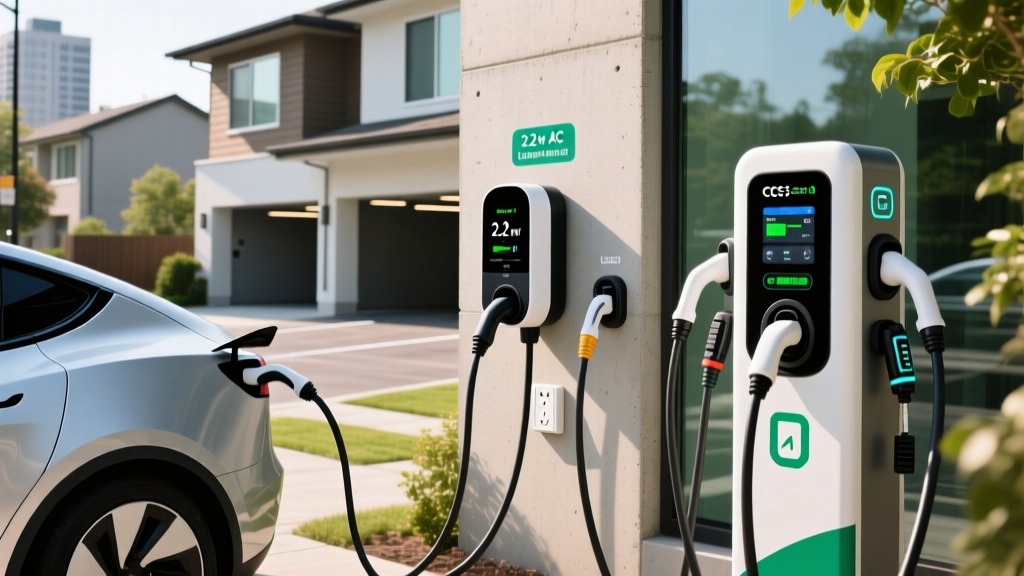
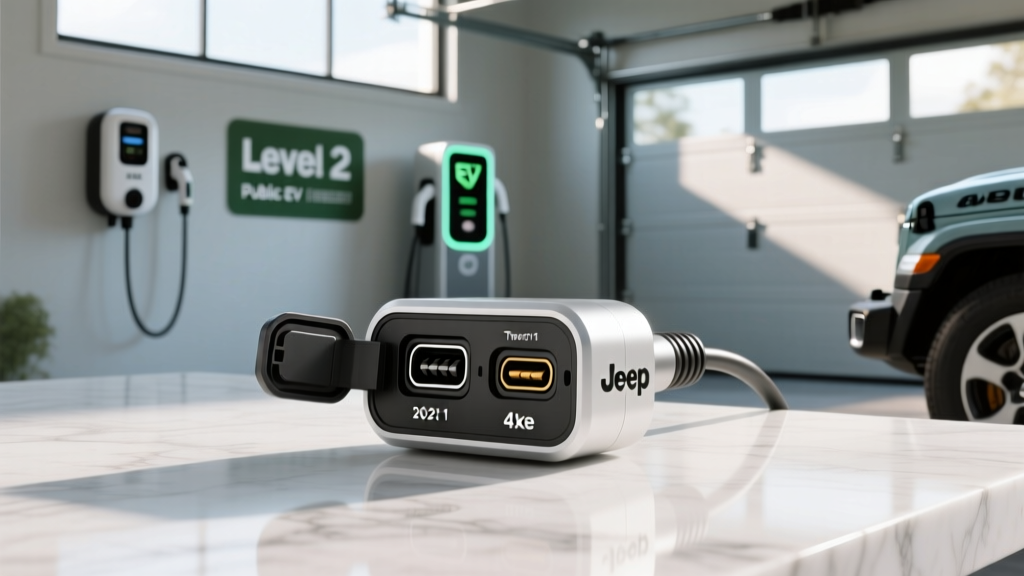
The 2021 Jeep Wrangler 4xe uses a J1772 connector for Level 1 and Level 2 AC charging, and a CCS1 (Combined Charging System) connector for DC fast charging. The J1772 inlet is located on the driver-side front fender, behind a locking flap. The CCS1 connector adds two large DC pins below the standard J1772 five-pin layout, enabling high-speed public charging.
For 2021 Wrangler 4xe owners — whether you bought new or picked one up on the used market — understanding your connector type is the first step to setting up efficient home charging and navigating public networks. This guide covers exactly what hardware you need, what it costs, and how fast you can expect to charge.
- Level 1 (120V AC): J1772 connector — included portable cordset
- Level 2 (240V AC): J1772 connector — requires purchased or installed station
- DC Fast Charging: CCS1 connector — available at Electrify America, EVgo, and most non-Tesla networks
- Tesla Supercharger (NACS): Not natively compatible; requires a third-party CCS-to-NACS adapter (limited availability for PHEVs)
Understanding Charging Levels: Speeds and Range Added
Before we get into equipment, let's clarify the distinction that trips up many new EV and PHEV owners: kW (kilowatts) measures power — the rate at which electricity flows into your battery. kWh (kilowatt-hours) measures energy — the total capacity stored. Your Wrangler 4xe has a 17.3 kWh battery pack (approximately 14.0 kWh usable), so charging speed in kW determines how quickly that pack refills.
| Charging Level | Voltage | Power (kW) | Miles of Electric Range/Hour | 0–100% Time (17.3 kWh) |
|---|---|---|---|---|
| Level 1 (120V household) | 120V | 1.4 kW | ~4–5 miles/hr | ~12–14 hours |
| Level 2 (240V home/public) | 240V | 3.3–7.2 kW | ~10–21 miles/hr | ~2.5–5.5 hours |
| DC Fast Charge (CCS1) | 400V+ | Up to ~50 kW peak | ~80–100 miles/hr (equiv.) | 10–80% in ~25 min |
Real-world note: The Wrangler 4xe's onboard charger maxes out at approximately 7.2 kW on Level 2. Even if you plug into a 48-amp station capable of 11.5 kW, the Jeep will only accept what its onboard charger can handle. This means any quality 32-amp Level 2 station (7.7 kW output) is a perfect match — you don't need to overspend on a 48- or 80-amp unit for this vehicle.
The EPA rates the 2021 Wrangler 4xe at 22 miles of all-electric range and 49 MPGe combined (source: fueleconomy.gov). In real-world driving — especially with highway speeds, aggressive acceleration, or cold weather below 40°F — expect closer to 15–18 miles of usable electric range before the gas engine kicks in.
Home Charger Installation: Electrical Requirements and Costs
Most Wrangler 4xe owners will want a dedicated Level 2 home charger. The included Level 1 cordset works for overnight top-ups, but filling the full 17.3 kWh battery at 1.4 kW takes over 12 hours — Level 2 cuts that to roughly 2.5 hours on a 32-amp circuit.
Electrical Specifications Needed
For a standard 32-amp, 7.7 kW Level 2 charger (ideal for the 4xe's 7.2 kW onboard limit), your electrician will need to install:
- Dedicated 240V circuit with a 40-amp breaker (NEC requires circuits to be rated at 125% of continuous load — 32A continuous draw requires a 40A breaker)
- NEMA 14-50 outlet (if using a plug-in charger) or direct hardwire connection
- 6 AWG copper wire for runs up to 50 feet; thicker gauge for longer runs
- GFCI protection — required by NEC 2020 and later for EV charging outlets in garages
What Electrical Upgrades Might I Need?
Many homes built before 2000 have 100-amp electrical panels. If your panel is already near capacity (running electric oven, dryer, HVAC, and water heater), adding a 40-amp EV circuit may push you over the limit. Signs you might need a panel upgrade:
- Your panel is 100 amps or less with few open breaker slots
- You already have multiple 240V appliances running simultaneously
- Your electrician's load calculation shows less than 20% spare capacity
- You have a Federal Pacific or Zinsco panel (known safety issues, often flagged at inspection)
A panel upgrade from 100A to 200A typically costs $1,500–$3,000 on top of the charger installation. This is the single biggest variable in home charging cost — get a load calculation done before committing to equipment.
| Cost Component | Low Estimate | High Estimate | Notes |
|---|---|---|---|
| Level 2 charger hardware (32–40A) | $250 | $650 | J1772 plug-in or hardwire |
| Electrician labor (standard install) | $400 | $1,200 | Depends on wire run length, wall type |
| Permit and inspection | $50 | $250 | Varies by municipality |
| Panel upgrade (if needed) | $1,500 | $3,000 | 100A→200A; not always required |
| Total (no panel upgrade) | $700 | $2,100 | Most common scenario |
| Total (with panel upgrade) | $2,200 | $5,100 | Older homes or heavy-load panels |
Federal incentive note: The §30D tax credit applies to the vehicle, not the charger. However, the Residential Clean Energy Credit (IRC §25D) previously covered 30% of home charger equipment and installation up to $1,000. Check current-year IRS guidance for active status, as this credit has undergone legislative changes.
Connector Compatibility Across Charging Networks
Knowing which public networks work with your Wrangler 4xe's CCS1/J1772 inlet saves time and frustration on road trips. Here's a compatibility breakdown:
| Network | Connector Available | Wrangler 4xe Compatible? | Notes |
|---|---|---|---|
| Electrify America | CCS1, CHAdeMO | ✅ Yes (CCS1) | Best DC fast option for 4xe |
| EVgo | CCS1, CHAdeMO | ✅ Yes (CCS1) | Widely available in metro areas |
| ChargePoint | J1772 (L2), CCS1 (DC) | ✅ Yes (both) | Largest L2 network; good for destination charging |
| Tesla Supercharger | NACS | ❌ No (adapter required) | Tesla opening some stalls with Magic Dock CCS1 adapter |
| Tesla Destination (L2) | NACS or J1772 | ⚠️ J1772 locations only | Many hotels offer J1772; confirm before arrival |
For Wrangler 4xe owners who frequently travel in areas dominated by Tesla Superchargers, the reality is that CCS1 infrastructure from Electrify America and EVgo is your best bet for DC fast charging. The 4xe's relatively small battery means most daily driving can be handled on electric alone with nightly home charging, reducing reliance on public DC fast chargers.
Recommended Level 2 Chargers for the Wrangler 4xe
Since the 4xe's onboard charger caps at 7.2 kW, a 32-amp station (7.7 kW output) is the sweet spot. Going higher won't charge faster but doesn't hurt — it just costs more. Here are three proven options with J1772 connectors:
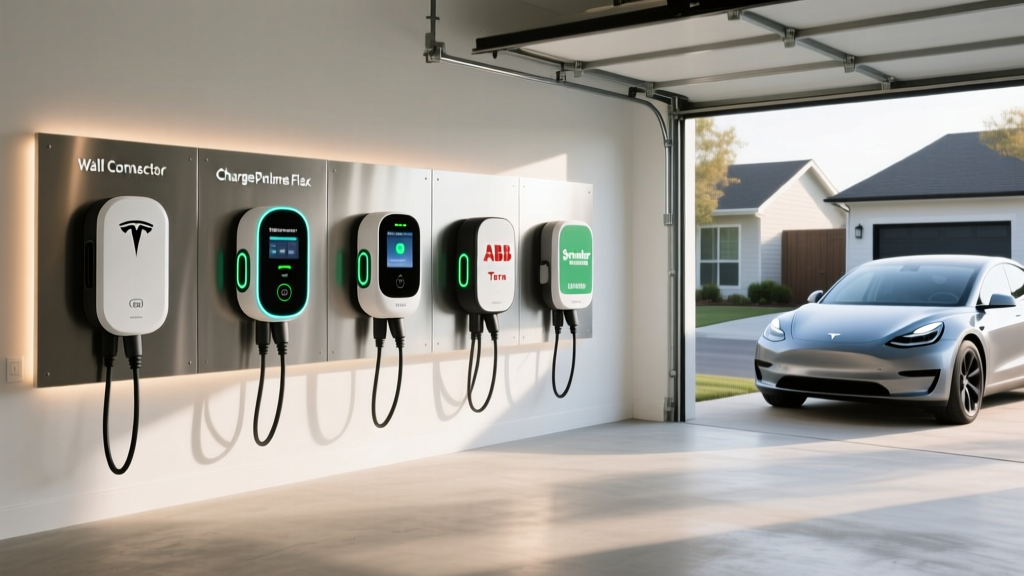
Best Overall: ChargePoint Home Flex
- Power output: Up to 12 kW (50A) — adjustable down to 32A via DIP switch
- Connector: J1772 (25-foot cable)
- Smart features: Wi-Fi, app scheduling, energy tracking, Alexa integration
- Connection: NEMA 14-50 plug or hardwire
- Price: ~$550 (often on sale for ~$450)
- Why it works: Adjustable amperage lets you match your circuit exactly. UL-listed, outdoor-rated.
Best Value: Emporia Level 2 EV Charger
- Power output: Up to 11.5 kW (48A) — configurable in app
- Connector: J1772 (24-foot cable)
- Smart features: Wi-Fi, app-based amperage adjustment, energy monitoring, solar integration
- Connection: NEMA 14-50 plug or hardwire
- Price: ~$350–$400
- Why it works: Budget-friendly with full smart features. App lets you dial down to 32A to match the 4xe and your circuit.
Rugged Pick: Grizzl-E Smart
- Power output: Up to 10 kW (40A)
- Connector: J1772 (24-foot cable)
- Smart features: Wi-Fi, OCPP-compatible, app scheduling
- Connection: NEMA 14-50 plug or hardwire
- Price: ~$450
- Why it works: Built in Canada, IP67-rated for extreme weather — ideal if your Wrangler lives outdoors or in an unheated garage. 3-year warranty.
Charging Cost: Per-Mile Comparison vs. Gas
One of the Wrangler 4xe's strongest arguments is the ability to run short commutes on electricity. Here's what charging actually costs compared to the gas-only Wrangler:
| Scenario | Rate / Cost | Cost for Full 17.3 kWh Charge | Cost Per Electric Mile (22 mi) |
|---|---|---|---|
| Home charging (off-peak utility rate) | $0.10/kWh | $1.73 | $0.079/mi |
| Home charging (average US rate) | $0.16/kWh | $2.77 | $0.126/mi |
| Public Level 2 (ChargePoint, etc.) | $0.25–$0.39/kWh | $4.33–$6.75 | $0.197–$0.307/mi |
| DC fast charge (Electrify America) | $0.36–$0.48/kWh | $6.23–$8.30 | $0.283–$0.377/mi |
Gas comparison baseline: The 2021 Wrangler 4xe with the 2.0L turbo gets 20 MPG combined on gas alone (fueleconomy.gov). At $3.50/gallon, that's $0.175 per mile. Home Level 2 charging at average rates ($0.126/mi) saves roughly $0.05 per mile over gas — or about $500 per year if you drive 10,000 miles annually on electric power. Public DC fast charging, however, can actually cost more per mile than gas.
The takeaway: The 4xe's economics work best when you charge at home overnight and use the electric range for daily commutes under 20 miles. If you rely primarily on public charging, the cost advantage over gas shrinks considerably.
Safety and Code Considerations for Home Installation
Level 2 EV charging draws significant continuous current — similar to running an electric dryer for hours at a time. Proper installation is non-negotiable for safety and insurance coverage.
Key Code Requirements
- Dedicated circuit: Your EV charger must have its own breaker — it cannot share a circuit with other appliances.
- GFCI protection: NEC 2020+ requires ground-fault circuit interrupter protection for all EV charging outlets. Many modern chargers have built-in GFCI; confirm with your electrician to avoid nuisance tripping from double-GFCI setups.
- Outdoor rating: If your charger is installed outside or in an open carport, the unit must carry an IP65 or higher ingress protection rating. All three chargers recommended above meet this standard.
- Permit required: Nearly all jurisdictions require an electrical permit for new 240V circuits. Skipping the permit risks voiding homeowner's insurance coverage for any electrical fire originating from the unpermitted work.
- Wire gauge: 6 AWG copper for 40A circuits up to 50 feet. For longer runs, your electrician may specify 4 AWG to minimize voltage drop.
Charging the 4xe Safely: Battery Care Tips
The Wrangler 4xe uses an NMC (nickel-manganese-cobalt) lithium-ion battery pack. To maximize longevity:
- Avoid routinely charging to 100% and leaving the vehicle sitting for days — the battery management system includes a buffer, but sustained high SoC accelerates degradation.
- Use scheduled charging in your Level 2 station's app to finish charging just before your morning departure rather than hours before.
- In extreme cold (below 20°F), plug in whenever possible — the battery thermal management system uses grid power to maintain temperature, preserving range and battery health.
- The 4xe's battery carries a 8-year/100,000-mile warranty covering capacity loss below a specified threshold (typically 60–70% of original capacity, per Stellantis warranty documentation).
Frequently Asked Questions
How much does it cost to install a home EV charger for my Wrangler 4xe?
A standard Level 2 home charger installation (32-amp, NEMA 14-50 outlet, no panel upgrade) typically costs $700–$2,100 total, including equipment ($250–$650), electrician labor ($400–$1,200), and permits ($50–$250). If your home needs an electrical panel upgrade from 100A to 200A, add $1,500–$3,000 to that total.
How fast will each charging level add range to the 4xe?
Level 1 (120V) adds roughly 4–5 miles of electric range per hour. Level 2 (240V, 32A) adds approximately 15–20 miles per hour and can fully recharge the 17.3 kWh battery in about 2.5 hours. DC fast charging via CCS1 can take the battery from 10–80% in roughly 25 minutes at a 50 kW station.
Can I use a Tesla Supercharger with my 2021 Wrangler 4xe?
Not directly. The Wrangler 4xe uses a CCS1/J1772 connector, while Tesla Superchargers use the NACS (North American Charging Standard) connector. Some Tesla Supercharger locations now feature a "Magic Dock" with a built-in CCS1 adapter — you can check availability in the Tesla app under "Charge Your Non-Tesla." Third-party CCS-to-NACS adapters exist but are primarily designed for BEVs and may not be fully validated for PHEV applications.
How much does charging cost per mile vs. gas in the Wrangler 4xe?
Charging at home at the US average electricity rate ($0.16/kWh) costs about $0.13 per electric mile. Driving on gas at 20 MPG combined and $3.50/gallon costs about $0.18 per mile. Home charging saves roughly 28% per mile. However, public DC fast charging at $0.40+/kWh can exceed the cost of gas per mile.
Do I need a 48-amp charger for my Wrangler 4xe?
No. The 4xe's onboard charger accepts a maximum of 7.2 kW (approximately 30 amps at 240V). A 32-amp charger (7.7 kW output) is the practical ceiling — the vehicle will only draw what it can accept. A 48-amp charger works fine but provides no speed advantage for this specific vehicle. It may be worth the extra cost only if you plan to purchase a future EV with a higher onboard charge rate.
What happens if I charge my 4xe in extreme cold?
Lithium-ion batteries charge more slowly in cold temperatures, and the battery management system will limit charge rate to protect the cells. Expect Level 2 charging to take 30–50% longer when ambient temperatures are below freezing. The vehicle's thermal management system will warm the battery using grid power when plugged in — this is why plugging in during cold weather is recommended even if the battery is mostly full.