Understanding Jeep Wagoneer EV Range: EPA Estimates vs Real-World Reality
The 2026 Jeep Wagoneer S, Jeep's first fully electric SUV built on the STLA Large platform, carries an 100 kWh usable battery pack (NMC chemistry) and an EPA-estimated range of approximately 300 miles for the Launch Edition trim. However, as with any large, heavy electric SUV, real-world results vary significantly based on conditions.
- EPA Sticker: ~300 miles (combined city/highway)
- Real-World Highway (70 mph, moderate temps): ~240–265 miles
- Cold Weather (below 32°F, highway): ~195–230 miles
- City/Stop-and-Go with Regen: ~280–310 miles
The Wagoneer S's 5,000+ lb curb weight and boxy SUV aerodynamics penalize highway efficiency more than sleeker sedans. Cold weather further reduces range due to battery thermal management demands and cabin heating load. Always plan road trips around ~230 miles of usable range to maintain a safety buffer.
With a battery this large, your charging strategy—both at home and on the road—becomes the single most important ownership decision you'll make. Let's break down every level, cost, and connector you need to know.
Charging Levels Explained: How Fast Will Each Level Add Range?
Before we get into speeds, a critical distinction: kW (kilowatts) measures power—the rate at which energy flows into your battery. kWh (kilowatt-hours) measures energy—the total capacity of your battery. Think of kW as the width of a hose and kWh as the size of the bucket. A 100 kWh battery charged at 10 kW takes roughly 10 hours; at 100 kW, roughly 1 hour (in ideal conditions, before charge-curve taper).
| Level | Voltage | Power (kW) | Miles of Range Added/Hour | Best For |
|---|---|---|---|---|
| Level 1 | 120V AC | 1.0–1.4 kW | 3–5 miles/hr | Overnight top-off, PHEVs, emergencies |
| Level 2 | 240V AC | 7.2–19.2 kW | 22–60 miles/hr | Daily home charging, workplace |
| DC Fast Charge | 400–800V DC | 50–350 kW | 150–700+ miles/hr (peak) | Road trips, highway corridors |
For the Wagoneer S with its ~100 kWh battery, Level 1 charging is impractical as a primary strategy—plugging into a standard 120V outlet would take over 80 hours for a full charge. Level 2 home charging is the backbone of daily ownership. DC fast charging is your road-trip lifeline.
DC Fast Charging Times for the Wagoneer S
The Wagoneer S supports up to approximately 175 kW peak DC fast charging on a 400V architecture. Real-world charge times depend on the station's output, battery temperature, and state of charge:
- 10–80% at a 150+ kW charger: ~28–33 minutes
- 10–80% at a 50 kW charger: ~85–100 minutes
- 10–80% at a 350 kW charger: ~28–33 minutes (vehicle caps at ~175 kW peak)
Charge-curve reality check: Peak kW is never sustained across the entire session. The Wagoneer S will pull maximum power between roughly 10–50% SoC, then taper significantly above 80%. This is why most EV drivers charge to 80% on road trips—going from 80% to 100% can take as long as the 10–80% session itself.
Home Charger Installation: Electrical Requirements, Costs & Panel Upgrades
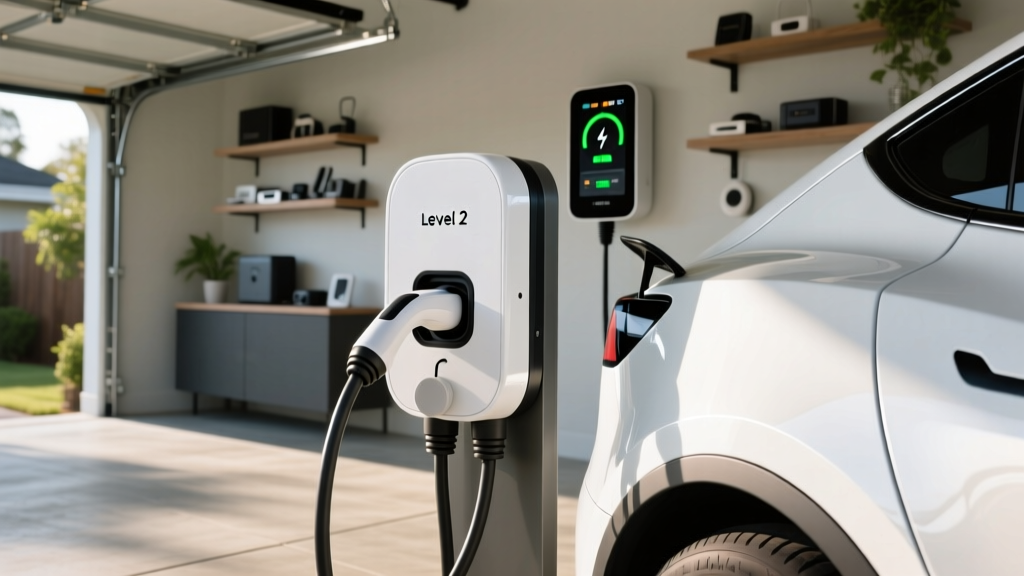
Installing a Level 2 home charger is the single best investment for Wagoneer S ownership. Here's what's actually involved.
Electrical Requirements
For optimal Level 2 charging of a 100 kWh battery, you'll want:
- Circuit: Dedicated 60-amp breaker (for a 48-amp continuous charger) or 50-amp breaker (for a 40-amp continuous charger)
- Voltage: 240V (standard for EV Level 2, same as a dryer or oven circuit)
- Wire gauge: 6 AWG copper (60A circuit) or 8 AWG copper (50A circuit)
- Outlet vs hardwired: NEMA 14-50 outlet offers portability; hardwired is preferred for 48A+ chargers and may be required by local code for circuits above 50A
Do You Need a Panel Upgrade?
This is the question that catches many homeowners off guard. Your electrical panel has a total capacity—typically 100A, 150A, or 200A in residential homes. Adding a 60A EV circuit to an already loaded 100A panel may exceed capacity, requiring a panel upgrade to 200A. Signs you may need an upgrade:
- Your panel is 100A and already has high-draw appliances (electric oven, dryer, HVAC)
- No available breaker slots
- Your home has an older fuse box rather than a breaker panel
- A licensed electrician's load calculation shows insufficient headroom
A panel upgrade adds $1,500–$4,000 to your project. Always get a professional load calculation before assuming you're fine.
Installation Cost Breakdown
| Component | Cost Range | Notes |
|---|---|---|
| Level 2 Charger (Equipment) | $350–$750 | Smart Wi-Fi chargers cost more |
| Electrician Labor | $500–$2,000 | Depends on run length, conduit, panel proximity |
| Permit & Inspection | $50–$250 | Required in most jurisdictions |
| Electrical Panel Upgrade (if needed) | $1,500–$4,000 | 100A to 200A upgrade |
| Total (No Panel Upgrade) | $900–$3,000 | Most homes with 200A panels |
| Total (With Panel Upgrade) | $2,400–$7,000 | Older homes with 100A service |
Some utilities and states offer rebates of $250–$1,000 for home charger installation. Check with your local utility and AFDC for current programs in your area. The federal Residential Clean Energy Credit (as of 2026) may also cover a portion of charger hardware costs—consult a tax professional for eligibility.
Connector Compatibility: NACS, CCS, and the Wagoneer S
The connector landscape has shifted dramatically. The Jeep Wagoneer S launches with the NACS (North American Charging Standard) port—the Tesla-derived connector now adopted by Stellantis and most major automakers. This is a significant advantage for public charging access.
| Connector | Vehicles Using It | Public Network Access | Adapter Needed for Wagoneer S? |
|---|---|---|---|
| NACS (Tesla) | Tesla (all), Ford, GM, Rivian, Jeep/Stellantis, Hyundai, BMW, others | Tesla Superchargers, Electrify America (new stations), EVgo | No — native port |
| CCS1 | Older VW ID.4, older BMW iX, legacy models | Electrify America, EVgo, ChargePoint | Yes — NACS-to-CCS adapter (~$200–$350) |
| CHAdeMO | Nissan LEAF (legacy, discontinued) | Limited and declining | Rarely needed; adapters scarce |
With a native NACS port, the Wagoneer S gains direct access to the Tesla Supercharger network—over 25,000 stalls in North America as of 2026—without any adapter. This is currently the most reliable and widespread DC fast-charging network. For older CCS-only stations still in operation, a NACS-to-CCS adapter from an authorized manufacturer covers you.
Cost to Charge: Home vs Public vs Gas Comparison
The Wagoneer S's efficiency is estimated at roughly 2.8–3.2 kWh/mile (approximately 85–95 MPGe combined), typical for a large, heavy electric SUV. Let's translate that into real dollars.
| Scenario | Rate | Cost per Full Charge (100 kWh) | Cost per Mile |
|---|---|---|---|
| Home — Off-Peak Utility Rate | $0.08–$0.12/kWh | $8–$12 | $0.025–$0.04 |
| Home — Standard Residential Rate | $0.13–$0.18/kWh | $13–$18 | $0.04–$0.06 |
| Public Level 2 (ChargePoint, etc.) | $0.25–$0.49/kWh | $25–$49 | $0.08–$0.16 |
| DC Fast Charging (Electrify America, Tesla) | $0.30–$0.55/kWh | $30–$55 | $0.10–$0.18 |
| Gas Equivalent (22 MPG combined, $3.50/gal) | — | $16 per gallon-equivalent | $0.16 |
The bottom line: Charging at home on off-peak rates saves roughly 75–85% per mile compared to a gas-powered Wagoneer getting 17–20 MPG combined. Even at DC fast-charging prices, you're roughly at parity with or slightly below gasoline. However, if you rely exclusively on expensive public DC fast chargers, your savings shrink dramatically. Home charging is where the economics work best.
For a driver covering 12,000 miles/year:
- Home charging (off-peak): ~$360–$480/year
- Mixed home + public: ~$600–$1,200/year
- Gas Wagoneer (17 MPG combined, $3.50/gal): ~$2,470/year
Best Home Chargers for the Jeep Wagoneer S: Equipment Picks
With a ~100 kWh battery, you want a charger that can deliver enough power to fully replenish overnight. Here are top recommendations, all with NACS connectors (or available with NACS):
ChargePoint Home Flex (NACS)
- Power Output: Up to 12 kW (50A) / 9.6 kW (40A) configurable
- Connector: NACS (native, 2025+ models)
- Cable Length: 23 feet
- Smart Features: Wi-Fi, app scheduling, utility integration, Alexa
- Price: ~$550–$650
- Why It Works: Configurable amperage lets you match your circuit. Excellent app and reliability track record.
Tesla Wall Connector (NACS)
- Power Output: Up to 11.5 kW (48A)
- Connector: NACS (native)
- Cable Length: 24 feet
- Smart Features: Wi-Fi, OTA updates, power sharing (multiple units), load management
- Price: ~$420–$475
- Why It Works: Best value for a smart NACS charger. Power-sharing feature is excellent for homes with two EVs on one circuit.
Emporia Level 2 EV Charger
- Power Output: Up to 11.5 kW (48A)
- Connector: NACS (available)
- Cable Length: 24 feet
- Smart Features: Wi-Fi, energy monitoring, solar integration, time-of-use scheduling
- Price: ~$350–$400
- Why It Works: Budget-friendly smart charger with excellent energy monitoring. Ideal if you have solar panels.
Grizzl-E Smart (NACS)
- Power Output: Up to 10 kW (40A)
- Connector: NACS
- Cable Length: 24 feet
- Smart Features: Wi-Fi, app control, OCPP compatibility
- Price: ~$400–$500
- Why It Works: Built in Canada, rated for extreme cold (-40°F). Best choice for cold-climate owners.
For the Wagoneer S's 100 kWh battery, a 48A/11.5 kW charger will add roughly 35–40 miles of range per hour and fully charge from empty in about 9–10 hours. A 40A/9.6 kW unit takes about 11 hours—still sufficient for overnight charging if you start with 20% remaining.
Safety, Code & Installation Best Practices
EV charging involves sustained high-current draw over many hours—unlike most household appliances. Cutting corners here is a fire risk. Follow these non-negotiable guidelines:
- Dedicated circuit: Your Level 2 charger must be on its own dedicated breaker. Never share a circuit with other high-draw appliances.
- GFCI protection: The 2023 NEC (National Electrical Code) requires GFCI protection for EV charging outlets in garages and outdoors. Hardwired installations may have different requirements—your electrician will know local code.
- Outdoor rating: If your charger is installed outside, ensure the unit carries a NEMA 4 or IP65 rating for weather resistance. All recommended chargers above meet this standard.
- Permit and inspection: Most jurisdictions require an electrical permit and post-installation inspection for EV charger circuits. This protects your home insurance coverage and ensures code compliance.
- Continuous load derating: NEC requires that continuous loads (anything running 3+ hours, which includes EV charging) use only 80% of a breaker's rated capacity. A 50A breaker supports a 40A continuous charger; a 60A breaker supports 48A.
- Wire sizing: Undersized wire causes voltage drop and heat. Always follow your electrician's wire-gauge specification for the run length.
Charging the Wagoneer S on Road Trips: Planning & Network Tips
With an EPA range of ~300 miles and real-world highway range closer to 240–265 miles, road-trip planning matters. Here's how to optimize:
- Precondition the battery: When you set a DC fast charger as your navigation destination, the Wagoneer S will precondition its battery to optimal temperature for faster charging. This can shave 5–10 minutes off your stop.
- Target 10–80% charges: The charge curve tapers sharply above 80%. Plan shorter, more frequent stops charging to 80% rather than one long stop to 100%.
- Use Tesla Superchargers: With native NACS, the Wagoneer S accesses the most reliable DC fast-charging network. Supercharger stalls are well-maintained with high uptime rates above 95%.
- Plan for 200-mile legs: In cold weather or mountain driving, plan to stop every ~200 miles. This keeps you in the fast-charging sweet spot and maintains a safety buffer.
- Apps to use: PlugShare, A Better Routeplanner (ABRP), and the built-in Jeep navigation system all support route planning with charging stops.
Frequently Asked Questions
How much does it cost to install a home EV charger for the Jeep Wagoneer S?
Expect $900–$3,000 for a standard installation with a 200A panel and short wire run. If your home needs a panel upgrade from 100A to 200A, total costs can reach $2,400–$7,000. Always get a licensed electrician's load calculation first.
How fast will each charging level add range to the Wagoneer S?
Level 1 (120V) adds 3–5 miles per hour—essentially unusable for a 100 kWh battery. Level 2 (240V, 48A) adds roughly 35–40 miles per hour. DC fast charging at 150+ kW can add 150+ miles in 15–20 minutes during the peak portion of the charge curve.
Which connector does the Jeep Wagoneer S use?
The 2026 Wagoneer S uses the NACS (North American Charging Standard) connector natively. This gives direct access to Tesla Superchargers and an expanding network of NACS-equipped public chargers without adapters. For legacy CCS1 stations, a NACS-to-CCS adapter is available.
How much does charging the Wagoneer S cost per mile vs a gas Wagoneer?
At home off-peak rates ($0.10/kWh), charging costs roughly $0.03–$0.04 per mile. A gas Wagoneer at 17 MPG combined and $3.50/gallon costs about $0.21 per mile. That's a savings of roughly $1,800–$2,100 per year for a driver covering 12,000 miles annually.
What electrical upgrades might I need for a home charger?
The most common upgrade is a panel increase from 100A to 200A service ($1,500–$4,000). You may also need additional breaker slots, a new sub-panel, or upgraded service wiring from the utility. A licensed electrician's load calculation will determine exactly what's required for your home.
Does the Wagoneer S qualify for the federal EV tax credit?
Federal §30D tax credit eligibility depends on MSRP caps (under $80,000 for SUVs), buyer income limits ($300K joint / $150K single), and battery critical-mineral and component sourcing requirements. As of 2026, point-of-sale transfer is available, letting you apply the credit as a down payment reduction at the dealer. Consult a tax professional and verify current-year rules at IRS.gov, as sourcing requirements phase in progressively.
Sources: fueleconomy.gov (EPA range and efficiency data), IRS.gov (§30D clean vehicle credit rules), AFDC (charging infrastructure and incentive data).