Jeep Recon Range & Charging: What You Need Before You Plug In
The all-electric Jeep Recon slots into the brand's lineup as a rugged, trail-rated SUV built on Stellantis' STLA Large platform. With an expected battery pack hovering around 100 kWh (usable) and an EPA-estimated range target of roughly 300+ miles, the Recon promises legitimate daily-driver usability alongside off-road capability. But range is only half the ownership equation — how fast you can replenish that battery, what it costs to install a home charger, and how much you'll spend per mile versus a gas Wrangler determine whether the Recon makes financial sense.
This guide breaks down every charging variable for the Jeep Recon: Level 1, Level 2, and DC fast charging speeds, home electrical requirements, connector compatibility (the Recon launches with a NACS charge port for the 2026 model year), equipment picks, and real cost-per-mile math.
Charging Levels Explained: kW, Speeds & Miles Per Hour
The single most important distinction in EV charging is kW (kilowatts), which measures power — how fast energy flows into the battery — versus kWh (kilowatt-hours), which measures energy capacity, the size of the battery itself. Think of kW as the width of the hose and kWh as the size of the tank. A wider hose (higher kW) fills the tank faster.
| Charging Level | Voltage | Max Power (kW) | Miles of Range Added Per Hour | Typical Use Case |
|---|---|---|---|---|
| Level 1 (120V) | 120V AC | 1.2–1.9 kW | 3–5 miles/hr | Emergency / overnight trickle |
| Level 2 (240V) | 240V AC | 7.2–19.2 kW | 20–60 miles/hr | Home daily charging, workplace |
| DC Fast Charging | 400–800V DC | 50–350 kW | 150–350+ miles/hr (peak) | Road trips, quick top-ups |
For a ~100 kWh battery like the Recon's, Level 1 is impractical as a primary strategy — it would take well over 50 hours for a full charge. Level 2 at home is the sweet spot: a 48-amp (11.5 kW) station can replenish the Recon from 20% to 80% in roughly 5–6 hours, perfect for overnight charging. DC fast charging is reserved for road trips and rapid top-ups.
Jeep Recon DC Fast Charging: Peak Speed & Curve Reality
The Recon is expected to support DC fast charging at up to approximately 150–175 kW on compatible stations. On the STLA Large platform, Stellantis has engineered for 800-volt architecture compatibility, though initial Recon models may operate on a 400V system, which caps peak charge rates below competitors like the Hyundai Ioniq 5 or Kia EV6.
Here's the critical nuance that spec sheets obscure: peak kW is not sustained kW. A charger rated at 150 kW will only deliver that rate at a low state of charge (SoC), typically between 10–40%. As the battery fills, the battery management system (BMS) tapers the charge rate to protect cell health. A realistic 10–80% session for the Recon at a 150+ kW station should take approximately 28–35 minutes.
Above 80% SoC, charging slows dramatically — often to under 40 kW. This is why road-trip strategy focuses on the 10–80% window. Charging from 80% to 100% can take as long as the 10–80% session itself.
Home Charger Installation: Electrical Requirements & Costs
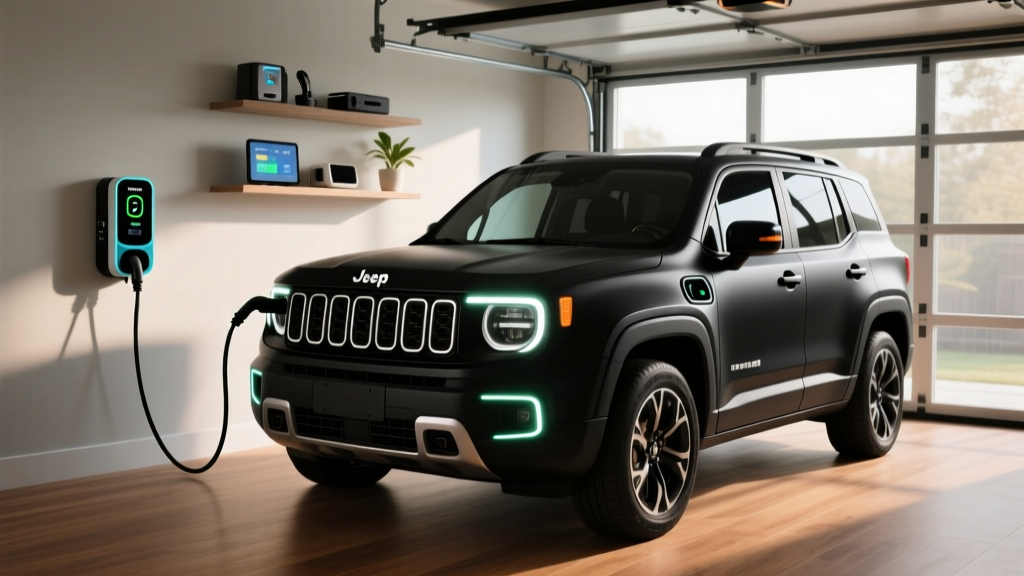
Installing a Level 2 home charger for the Jeep Recon requires a dedicated 240-volt circuit, typically 40A to 60A depending on the charger's amperage. Most EV owners opt for a 48-amp charger on a 60-amp breaker (the National Electrical Code requires the breaker to be rated 125% of the continuous load).
What Your Electrician Will Evaluate
- Electrical panel capacity: A 200-amp panel is standard in newer homes and usually sufficient. Older homes with 100-amp panels may need a service upgrade ($1,500–$3,500+) to accommodate a 60-amp EV circuit alongside existing loads.
- Wire gauge: 6 AWG copper for 48A circuits; 4 AWG for 60A circuits. Longer wire runs (garage far from the panel) increase material costs.
- Permit requirements: Most jurisdictions require an electrical permit ($50–$200) and a post-installation inspection.
- GFCI protection: The 2020 NEC and later require GFCI protection for EV charging circuits in garages. Some chargers have built-in GFCI; otherwise, a GFCI breaker is needed.
- Outdoor rating: If the Recon charges in a driveway or carport, the charger must carry a NEMA 4 (weatherproof) rating.
| Cost Component | Low Estimate | High Estimate | Notes |
|---|---|---|---|
| Level 2 Charger (Equipment) | $400 | $750 | 48A smart charger, NACS connector |
| Electrician Labor | $500 | $1,500 | Depends on panel proximity, wall type, conduit run |
| Electrical Permit | $50 | $200 | Varies by municipality |
| Panel Upgrade (if needed) | $1,500 | $3,500 | 100A → 200A service upgrade; not always required |
| Total (no panel upgrade) | $950 | $2,450 | Most common scenario for newer homes |
| Total (with panel upgrade) | $2,450 | $5,950 | Older homes with 100A service |
The IRS Residential Clean Energy Credit (§25D) covers 30% of home EV charger equipment and installation costs, up to $1,000, for equipment placed in service. This credit is available through 2032. Consult a tax professional to confirm eligibility based on your specific situation and tax liability.
Connector Compatibility: NACS, CCS & What the Recon Uses
The 2026 Jeep Recon is equipped with a NACS (North American Charging Standard) charge port, aligning with Stellantis' decision to adopt the Tesla-originated connector across its EV lineup. This is a significant advantage: NACS provides native access to Tesla's Supercharger network — the largest and most reliable DC fast-charging network in the U.S. — without an adapter.
| Connector Type | Networks Supported | Recon Compatibility |
|---|---|---|
| NACS (Tesla) | Tesla Supercharger, Electrify America (new stations), EVgo, many others | Native — no adapter needed |
| CCS1 | Electrify America (legacy), EVgo (legacy), ChargePoint DC | Requires NACS-to-CCS adapter (available from Tesla and third parties, ~$150–$250) |
| CHAdeMO | Limited legacy stations, mostly discontinued | Not recommended; adapter availability is scarce |
For home Level 2 charging, any NACS-equipped wall connector will plug directly into the Recon. If you already own a J1772 Level 2 charger from a previous EV, a J1772-to-NACS adapter (typically $100–$150) allows you to keep using it.
Cost to Charge: Per-Mile Math vs. Gas
Whether the Recon saves you money at the "pump" depends entirely on where and when you charge. Here's a realistic breakdown using an estimated Recon efficiency of approximately 2.8–3.2 kWh per mile (roughly 85–95 MPGe combined, typical for a body-on-frame-style electric SUV with all-terrain tires).
| Charging Scenario | Avg $/kWh | Cost Per Mile (Recon est.) | Equivalent Gas MPG at $3.50/gal |
|---|---|---|---|
| Home Off-Peak (utility time-of-use rate) | $0.09–$0.13 | $0.027–$0.039 | 90–130 MPG |
| Home Standard Rate (national avg.) | $0.16–$0.18 | $0.048–$0.058 | 60–73 MPG |
| Public Level 2 (ChargePoint, etc.) | $0.25–$0.40 | $0.075–$0.12 | 29–47 MPG |
| DC Fast Charging (Electrify America, EVgo) | $0.35–$0.55 | $0.105–$0.176 | 20–33 MPG |
| Tesla Supercharger (avg. 2026) | $0.28–$0.40 | $0.084–$0.12 | 29–42 MPG |
For comparison, a 2026 Jeep Wrangler 4xe (PHEV) achieves roughly 49 MPGe on electric and 20 MPG combined on gas. A gas-only Wrangler averages 19–22 MPG combined, translating to roughly $0.16–$0.18 per mile at $3.50/gallon. The Recon charged at home off-peak cuts fuel cost by 75–80% versus the gas Wrangler. Even DC fast charging on road trips is roughly cost-neutral with gas, though it varies by network and time of day.
Recommended Home Chargers for the Jeep Recon
Every charger below ships with a NACS connector (native for the Recon), supports at least 48 amps, and includes Wi-Fi-connected smart features for scheduling off-peak charging sessions.
ChargePoint Home Flex (NACS)
- Power Output: Up to 12 kW (50A) on a 60A circuit; adjustable down to 16A
- Cable Length: 23 feet
- Smart Features: Wi-Fi, ChargePoint app scheduling, Alexa integration, energy reports
- Price: ~$550–$650
- Best For: Flexible amperage adjustment for older panels; excellent app ecosystem
Tesla Wall Connector (NACS)
- Power Output: Up to 11.5 kW (48A) on a 60A circuit
- Cable Length: 24 feet
- Smart Features: Wi-Fi, Tesla app, over-the-air firmware updates, load sharing (two units on one circuit)
- Price: ~$425–$475
- Best For: Best value in NACS-native chargers; clean design; proven reliability
Emporia Vue Level 2 Charger (NACS)
- Power Output: Up to 11.5 kW (48A) on a 60A circuit
- Cable Length: 24 feet
- Smart Features: Wi-Fi, Emporia app with real-time energy monitoring, solar integration, scheduling
- Price: ~$400–$500
- Best For: Homeowners with solar panels; granular energy tracking; budget-conscious buyers
For a ~100 kWh Recon battery, a 48A charger delivers roughly 11.5 kW, adding about 35–40 miles of range per hour. An overnight session (10 hours) can add 350+ miles — more than a full charge. If your electrical panel is constrained, the ChargePoint Home Flex's adjustable amperage lets you dial down to 32A or 40A without replacing hardware.
Jeep Recon Charging Time Examples
Based on the Recon's estimated ~100 kWh usable battery and typical charging efficiencies:
| Scenario | Charger / Rate | Session (10–80% SoC) | Approx. Time |
|---|---|---|---|
| Home Level 2, 48A (11.5 kW) | ~70 kWh added | Overnight | ~6–7 hours |
| Home Level 2, 32A (7.7 kW) | ~70 kWh added | Overnight | ~9–10 hours |
| DC Fast, 150 kW station | ~70 kWh added | Road trip stop | ~28–35 minutes |
| DC Fast, 350 kW station | ~70 kWh added | Road trip stop | ~25–32 minutes (Recon likely caps below 350 kW) |
| Level 1, 120V (1.4 kW) | ~70 kWh added | Emergency only | ~50+ hours |
The Recon's charging speed on 350 kW stations will be bottlenecked by its onboard charge acceptance rate. If the Recon peaks at ~150–175 kW, plugging into a 350 kW stall won't meaningfully reduce charge time versus a 150 kW stall. This is worth knowing on road trips — don't go out of your way for the highest-powered station if a 150 kW unit is more convenient.
Safety, Code & Installation Best Practices
Beyond the electrical panel assessment, several safety and code considerations apply to every home EV charger installation:
- Dedicated circuit: The EV charger must have its own dedicated breaker — never share a circuit with other high-draw appliances (dryers, HVAC).
- NEMA 4 rating: Required for outdoor installations. All three chargers recommended above carry outdoor ratings.
- GFCI protection: Required by NEC 2020+ for garage receptacles. Hardwired installations (recommended over plug-in for reliability) may not require an external GFCI breaker if the charger includes internal ground-fault protection.
- Cable management: Wall-mount a cable holster or use a retractable reel to prevent tripping hazards and cable damage.
- Load management: If your panel is near capacity, consider a smart panel monitor (like the Emporia Vue or Sense) that dynamically reduces charger amperage when other household loads spike.
Always hire a licensed electrician and pull a permit. Unpermitted work can void homeowner's insurance claims and create fire risk. The National Electrical Code (NEC) governs EV charger installation requirements, and local amendments may add further restrictions.
Frequently Asked Questions
How much does it cost to install a home EV charger for the Jeep Recon?
Expect $950–$2,450 for a standard installation (equipment + electrician + permit) if your electrical panel has sufficient capacity. If you need a 100A-to-200A panel upgrade, total costs can reach $2,450–$5,950. The IRS §25D credit covers 30% of equipment and installation, up to $1,000.
How fast will each charging level add range to the Recon?
Level 1 (120V) adds roughly 3–5 miles per hour. Level 2 (240V, 48A) adds approximately 35–40 miles per hour. DC fast charging at 150 kW can add 150+ miles in approximately 15–20 minutes at low state of charge, though the rate tapers significantly above 60% SoC.
Which connector does the Jeep Recon use?
The 2026 Jeep Recon uses the NACS (North American Charging Standard) connector, providing native access to Tesla Superchargers and a growing number of third-party networks. A NACS-to-CCS adapter (~$150–$250) is available for legacy CCS stations.
How much does charging the Recon cost per mile vs. a gas Wrangler?
At home off-peak rates ($0.10/kWh), the Recon costs approximately $0.03 per mile — about 80% cheaper than a gas Wrangler at $3.50/gallon (~$0.17/mile). Public DC fast charging narrows the gap to roughly cost-neutral depending on network pricing.
What electrical upgrades might I need for a home charger?
Homes with 200-amp electrical panels typically need no upgrade for a 48A Level 2 charger. Homes with 100-amp panels or those with high existing loads (electric heat, hot tubs, EV + dryer running simultaneously) may need a panel upgrade to 200A or a smart load-management device. Your electrician will perform a load calculation to determine this.
Is the Jeep Recon's EPA range accurate in real-world driving?
EPA range estimates assume mixed city/highway driving at moderate temperatures. In sustained highway driving at 75 mph, expect roughly 85–90% of the EPA sticker. In cold weather (below 30°F), range can drop 15–25% due to battery resistance and cabin heating. Preconditioning the battery while plugged in mitigates cold-weather losses.
Does the Jeep Recon qualify for the federal EV tax credit?
Federal EV tax credit eligibility under IRS §30D depends on MSRP caps ($80,000 for SUVs), buyer income limits ($300K joint / $150K single AGI), battery component and critical minerals sourcing requirements, and final assembly in North America. The Recon is assembled in North America, but exact credit eligibility depends on the specific model year's battery sourcing compliance. The credit can be transferred to the dealer as a point-of-sale rebate. Verify current eligibility on the IRS website or with a tax professional before purchase.
Sources: EPA fueleconomy.gov, IRS §30D Clean Vehicle Credits, Stellantis STLA Large platform specifications.